Push Day Warm-Up
This warm-up prepares the chest, shoulders, triceps, and upper back for pressing work such as the bench press, overhead press, and dips. It uses a brief raise phase, dynamic mobility, targeted activation, and lift-specific ramp-up sets. Total time is 8-12 minutes.
Por qué funciona este calentamiento
A short general warm-up raises muscle temperature and heart rate, which improves readiness for subsequent work. Dynamic mobility is then used to increase shoulder and thoracic movement without the performance reductions sometimes seen with longer static stretching before strength and power tasks. [2] [3]
Activation and ramp-up sets improve coordination in the pressing pattern and increase task-specific preparedness before heavier sets. Warm-ups that combine general activity, dynamic movement, and specific rehearsal are consistently supported for performance preparation, and may also contribute to injury risk reduction when applied appropriately. [1]
La rutina
Light cardio
Use a low-intensity cyclical option such as brisk walking, easy rowing, or light bike work. Raise body temperature and breathing rate without creating fatigue.
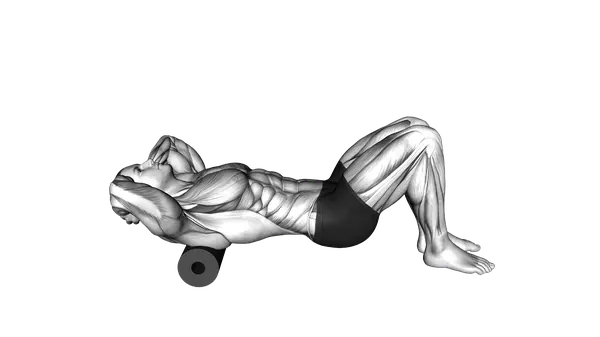
Upper-back tissue prep
Roll slowly through the upper back, pausing briefly on stiff areas. Keep the movement controlled and avoid excessive extension through the lower back.
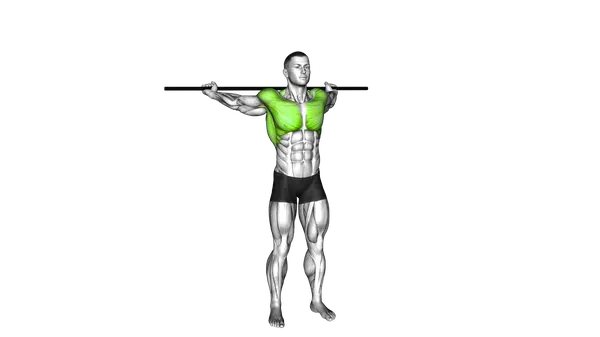
Shoulder pass-throughs
Use a pain-free grip width and move the arms from front to overhead and behind with control. This opens the shoulders and prepares overhead range for pressing.
Chest opening
Move into a gentle chest-opening position and keep the ribcage stacked rather than flared. Use a mild stretch only; this step is for mobility, not aggressive lengthening.
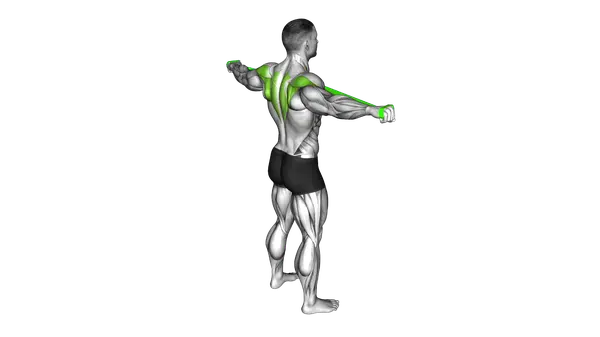
Upper-back and rear-delt activation
Pull the band apart with straight or softly bent elbows and keep the shoulders level. Focus on controlled scapular movement to improve shoulder positioning before pressing.
Core and shoulder stability
Hold a stable plank and alternate taps without shifting the hips. This reinforces trunk stiffness and single-arm shoulder support for pressing mechanics.
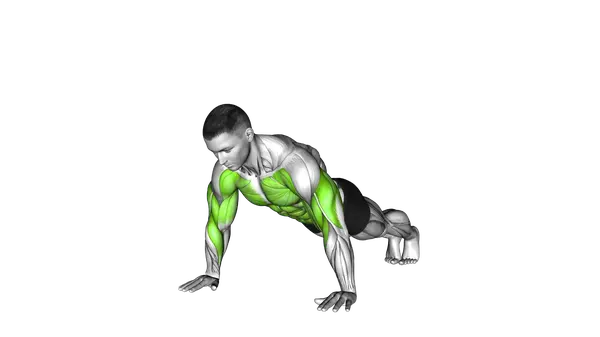
Light press pattern rehearsal
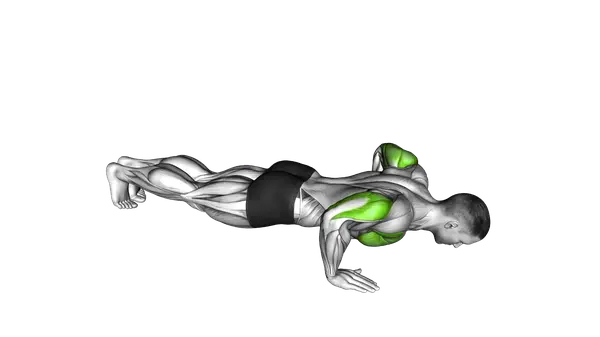
Use a controlled tempo and stop well short of fatigue. This activates the chest, front delts, and triceps in the same general pattern used in push-day training.
Ramp-up sets of the first main lift
Perform 2-4 progressively heavier sets of your first press with low reps, such as 5, 3, and 2. Increase load gradually while keeping all sets submaximal.
If time is limited, keep the raise phase, one shoulder mobility drill, one activation drill, and ramp-up sets. If you have a history of shoulder irritation, reduce range on mobility drills and emphasize pain-free band work and conservative ramp-up progression.
Hecho para progresar
Cada sesión empieza con el calentamiento adecuado
La app de GrabGains planifica tu sesión completa — calentamiento incluido — según los músculos que entrenas ese día.
Preguntas frecuentes
Should this warm-up change for bench press versus overhead press?
The structure can stay the same, but the emphasis can shift slightly. For overhead press, keep pvc-pass-through as a priority and use more gradual ramp-up sets; for bench press, keep chest opening and push-up patterning as the main focus.
Is static stretching appropriate before push day?
Brief, low-intensity stretching can be included if a specific area is restricted, but the main mobility work should stay dynamic. Longer or more aggressive static stretching immediately before strength work can reduce force output in some settings, so it should not replace dynamic preparation. [2] [3]
How hard should the activation work feel?
Activation work should feel light to moderate and should not create local fatigue. The goal is improved movement quality, joint control, and rehearsal of the pressing pattern before heavier loading.
Referencias cientificas
Kłobuchowski W, Skorulski M, Ornowski K et al. · Sports (Basel, Switzerland) (2026)
[2] A review of the acute effects of static and dynamic stretching on performance.
Behm DG, Chaouachi A · European journal of applied physiology (2011)
Opplert J, Babault N · Sports medicine (Auckland, N.Z.) (2018)
Las fuentes son publicaciones academicas revisadas por pares de PubMed.