Comparativa de ejercicios
Dumbbell Fly vs Cable Fly: Where Each Loads the Chest
The dumbbell fly and cable fly are chest isolation exercises with the same arm path that load the pecs at different points of the range. Gravity makes the dumbbell fly hardest at the bottom, where the chest is stretched, and nearly unloaded at the top. The middle cable chest fly, with the pulleys set at about shoulder height, keeps tension on the chest through most of the arc, including the point where the hands meet.
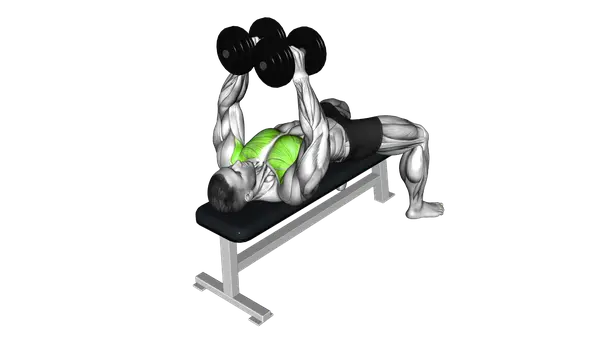
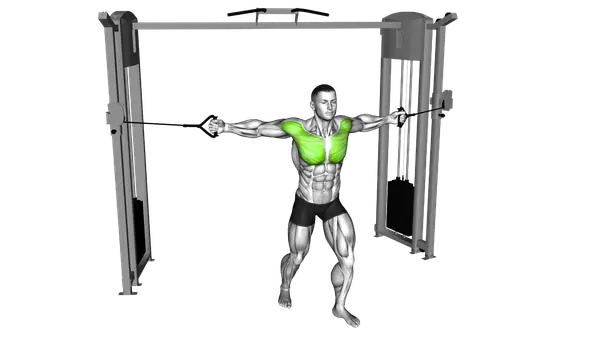
Dumbbell Fly vs Middle Cable Chest Fly
De un vistazo
| Característica | Dumbbell Fly | Middle Cable Chest Fly |
|---|---|---|
| Músculos principales | Pectorales | Pectorales |
| Músculos secundarios | Deltoides anteriores | Deltoides anteriores |
| Equipamiento | Mancuerna | Cable |
| Dificultad | Intermedio | Intermedio |
| Tipo | Aislamiento | Aislamiento |
| Tipo de fuerza | Push | Push |
01
Setup and movement path
The Dumbbell Fly is performed lying on a flat bench with the dumbbells held above the chest and a slight, fixed bend in the elbows. The arms open in a wide arc until the upper arms are about level with the torso, then return along the same path. The bench supports the upper back and keeps the shoulder blades set throughout.
The Middle Cable Chest Fly is performed standing between two cable columns with the pulleys at roughly shoulder height. From a staggered stance, the handles are brought together in front of the chest in the same horizontal arc. Because the lifter is standing, the trunk and legs brace against the pull of the cables, and the distance from the pulleys determines how far the arms travel back at the start.
02
Resistance profile: stretch versus constant tension
With dumbbells, resistance always acts straight down. The load on the shoulder is greatest when the arms are out to the sides and the chest is fully stretched, and it drops toward zero as the dumbbells rise over the shoulders. An EMG study found that pectoralis major and anterior deltoid activation in the dumbbell fly was similar to the barbell and dumbbell bench press, but the muscles were active for a significantly smaller proportion of the lift [1].
A cable pulls toward the pulley rather than toward the floor. With the pulleys at shoulder height, the cables continue to pull the arms apart as the hands come together, so tension remains on the chest at the end of the movement. The cable fly is therefore harder in the shortened, fully contracted position, where the dumbbell fly provides little resistance.
03
Muscle activation and joint loading
Flies are accessory movements rather than replacements for pressing. A more recent study in resistance-trained men using six-repetition-maximum loads found clearer differences: the barbell bench press produced higher pectoralis major, anterior deltoid and triceps activation than the dumbbell fly, while the biceps were more active in the fly [2]. The higher biceps activity reflects the elbow being held at a fixed angle against a long lever arm.
Cable flies change how the shoulder is loaded. A motion-capture study found that cable pulley chest exercises, including the cable cross-over, produced larger maximum shoulder joint moments than flat and incline bench pressing, and the cross-over showed joint angles and loading that fluctuated more through each repetition [3]. The authors advised careful stabilization of the joints during cable cross-overs, which favors moderate loads and strict technique.
04
Stretch, range of motion and hypertrophy
The main argument for the dumbbell fly is its loading at long muscle lengths. In a 2025 trial with trained lifters, lengthened partial repetitions produced similar upper-arm growth to full-range repetitions, and the authors concluded that lifters seeking muscle size should emphasize the stretched position [4]. The dumbbell fly places its highest load in exactly that position.
The evidence is not one-sided. A 2025 meta-analysis found that training at longer and shorter mean muscle lengths produced similar hypertrophy overall [5]. The cable fly loads the chest across a wider portion of the range, including the shortened position, and both loading patterns are reasonable for chest growth when sets are taken close to failure.
05
Loading, safety and equipment
The dumbbell fly is difficult to load heavily. Getting heavy dumbbells into position takes effort, and failing a repetition at the bottom leaves the shoulders in their most stretched position under load. Dumbbell flies are therefore usually performed with moderate weights and stopped a repetition or two short of failure.
The cable fly is easier to take close to failure, because a failed repetition simply returns the arms to the start position and the load is spread more evenly across the range. The weight stack also allows small load changes. Many cable stations use pulley ratios that change the effective resistance, so stack numbers are not comparable to dumbbell weights or between machines. The dumbbell fly requires only a bench and a pair of dumbbells, which makes it the practical option for home training.
La conclusión
Choose the Dumbbell Fly when the goal is to load the chest hardest in the stretched position, or when only dumbbells and a bench are available. Choose the Middle Cable Chest Fly when the goal is tension through the full arc, easier load adjustments and safer sets close to failure. Neither replaces a pressing movement, since the barbell bench press produces higher pectoralis major activation than the dumbbell fly [2]. A practical arrangement is to press first, then use one fly variation for moderate to high repetitions, rotating between the two across training blocks.
¿Cuál es tu objetivo de fitness?
Elige uno y la app construye tu programa en torno a él, a tu equipamiento y a los días que puedes entrenar.
Conviene saber
Preguntas frecuentes
Neither has been shown to be clearly superior for hypertrophy. The dumbbell fly loads the chest most in the stretched position, while the cable fly maintains tension into the fully contracted position. Both build the chest when performed through a full range and taken close to failure.
Set the pulleys at about shoulder height so the cables run roughly horizontally to the hands, which aligns the resistance with the middle of the chest. Higher pulleys create a high-to-low fly and lower pulleys a low-to-high fly, which are commonly used to emphasize the lower and upper chest fibers respectively.
Lower the dumbbells until the upper arms are about level with the torso or slightly below, keeping a fixed bend in the elbows. Going deeper increases the stretch and the load on the front of the shoulder, so depth should stop where the shoulders remain comfortable.
Referencias científicas
-
[1]
Electromyographic activity of the pectoralis major and anterior deltoid muscles during three upper-body lifts.
Welsch EA, Bird M, Mayhew JL · Journal of strength and conditioning research (2005)
-
[2]
A Comparison of Muscle Activation between Barbell Bench Press and Dumbbell Flyes in Resistance-Trained Males.
Solstad TE, Andersen V, Shaw M et al. · Journal of sports science & medicine (2020)
-
[3]
Chest Exercises: Movement and Loading of Shoulder, Elbow and Wrist Joints.
Schütz P, Zimmer P, Zeidler F et al. · Sports (Basel, Switzerland) (2022)
-
[4]
Lengthened partial repetitions elicit similar muscular adaptations as full range of motion repetitions during resistance training in trained individuals.
Wolf M, Androulakis Korakakis P, Piñero A et al. · PeerJ (2025)
-
[5]
Does Muscle Length Influence Regional Hypertrophy? A Systematic Review and Meta-Analysis.
Varovic D, Wolf M, Schoenfeld BJ et al. · International journal of sports medicine (2025)
Las fuentes son publicaciones académicas revisadas por pares de PubMed.