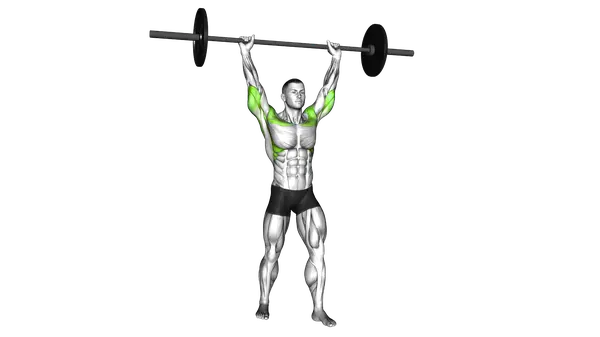
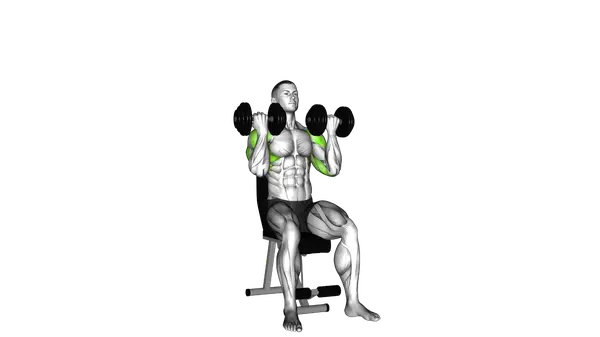
Comparativa de ejercicios
Standing vs Seated Dumbbell Shoulder Press: Which to Choose
The standing and seated dumbbell shoulder press share the same pressing motion, but a back-supported bench changes both the load and the core demand. Standing requires the legs, hips and trunk to stabilize the body, while sitting lets the shoulders and triceps handle heavier dumbbells. Research shows a clear trade-off between deltoid and core activity on one side and pressing strength on the other.
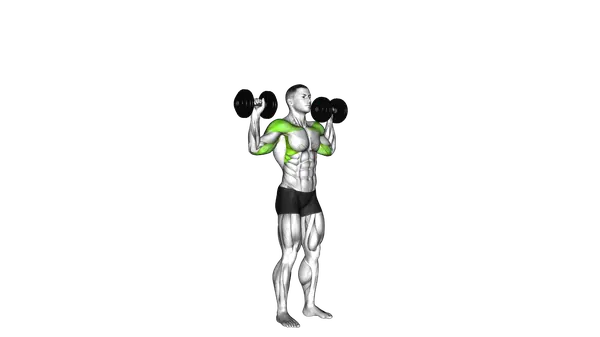
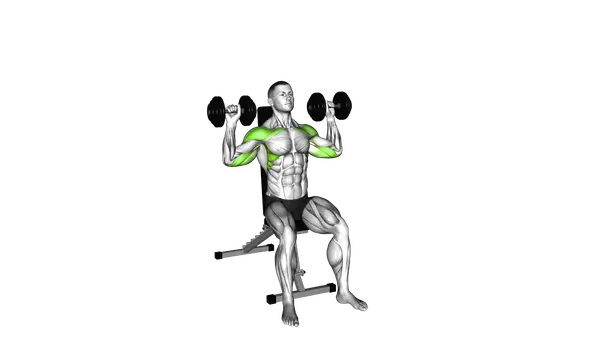
Standing Dumbbell Shoulder Press vs Seated Dumbbell Shoulder Press
De un vistazo
| Característica | Standing Dumbbell Shoulder Press | Seated Dumbbell Shoulder Press |
|---|---|---|
| Músculos principales | Deltoides anteriores, Deltoides laterales | Deltoides anteriores, Deltoides laterales |
| Músculos secundarios | Tríceps | Tríceps |
| Equipamiento | Mancuerna | Mancuerna |
| Dificultad | Intermedio | Intermedio |
| Tipo | Compuesto | Compuesto |
| Tipo de fuerza | Push | Push |
01
Setup and stability demands
In the standing dumbbell shoulder press, the lifter stands with the feet about hip-width apart, braces the trunk and glutes, and presses two dumbbells from shoulder height to lockout. Nothing supports the torso, so the trunk and hips must keep the lower back from arching as the weights move overhead.
In the seated dumbbell shoulder press, an upright bench supports the back and the hips are fixed on the seat. This removes most of the balance requirement and prevents leg drive. In both versions each arm controls its own dumbbell, so the shoulders still stabilize the load independently.
02
Pressing strength: the seated press allows more weight
Back support increases the load that can be pressed. In a study of healthy men, the one-repetition maximum (1RM) in the standing dumbbell press was about 10% lower than in the seated dumbbell press [1]. Of the four variations tested, which also included standing and seated barbell presses, the standing dumbbell press had the lowest 1RM [1].
The gap reflects the stability requirement rather than weaker shoulders. Standing, part of the effort goes into controlling the trunk and balancing two free weights, which caps the load the deltoids can move. For progressive overload with heavier dumbbells, the seated press is the easier version to load.
03
Deltoid activity: standing works the shoulders harder per rep
At the same relative load of 80% of 1RM, the standing dumbbell press produced higher deltoid activity than the seated version. Medial deltoid activity was about 15% lower when seated and posterior deltoid activity about 24% lower, while anterior deltoid activity showed a non-significant trend of about 8% lower [1].
Biceps brachii activity was also about 23% lower in the seated press [1]. The less stable standing position recruits more muscle to control the dumbbells, even though the load is lighter.
04
Core demand
Standing turns the shoulder press into a trunk-stability exercise as well. In bilateral dumbbell presses at 80% of 1RM, rectus abdominis activity was about 81% lower and external oblique activity about 58% lower seated than standing, while erector spinae activity did not differ between the two positions [2].
Pressing one dumbbell at a time raised external oblique activity in both positions [2]. An uneven load pulls the trunk sideways, and the obliques work to keep it upright. For lifters who want the shoulder press to also train the abdominals and obliques, the standing single-arm press provides the largest core demand.
05
Lower back and overhead mobility
The standing press places more demand on lumbar position. Limited shoulder flexion mobility is often compensated by arching the lower back as the dumbbells approach lockout, and this tendency increases with fatigue late in a set. Bracing the abdominals and squeezing the glutes reduces the compensation.
An upright back support limits how far the torso can lean back, although an excessive arch is still possible if the hips slide forward on the seat. For lifters with lower-back discomfort under load or limited overhead mobility, the seated version is usually the more tolerable starting point.
06
Muscle growth and strength
Higher EMG amplitude indicates greater muscle excitation during a set, but EMG comparisons alone cannot establish which exercise produces more strength or hypertrophy over time [3]. The higher deltoid activity of the standing press and the heavier loads of the seated press therefore do not translate into a clear winner for shoulder growth.
A meta-analysis found similar hypertrophy with low- and high-load training when sets were taken to muscular failure, while gains in 1RM favored heavier loads [4]. Both positions build the deltoids when sets end close to failure. The seated press allows the heavier loads that favor maximal strength, while the standing press is more specific to unsupported overhead pressing.
La conclusión
Choose the seated dumbbell shoulder press when the priority is shoulder size and strength with the heaviest possible dumbbells, when lower-back discomfort limits standing work, or when core fatigue would otherwise end sets early. Choose the standing dumbbell shoulder press when the goal includes trunk stability, overhead strength in an unsupported position, or higher deltoid activity per rep with lighter weights. A practical approach is to press seated for heavier, lower-rep work and standing for moderate loads. Both versions build the front and side delts and the triceps.
¿Cuál es tu objetivo de fitness?
Elige uno y la app construye tu programa en torno a él, a tu equipamiento y a los días que puedes entrenar.
Conviene saber
Preguntas frecuentes
The bench stabilizes the torso and hips, so less effort goes into balance and bracing and more into pressing. In a study of healthy men, the standing dumbbell press 1RM was about 10% lower than the seated version.
Yes. Standing presses produce markedly higher rectus abdominis and oblique activity than seated presses, because the trunk must stabilize the body without back support. Pressing one arm at a time increases oblique activity further.
Neither position has been shown to produce more shoulder growth. The seated press allows heavier dumbbells, while the standing press produces higher deltoid activity at the same relative load, and both build the delts effectively when sets are taken close to failure.
Referencias científicas
-
[1]
Effects of body position and loading modality on muscle activity and strength in shoulder presses.
Saeterbakken AH, Fimland MS · Journal of strength and conditioning research (2013)
-
[2]
Muscle activity of the core during bilateral, unilateral, seated and standing resistance exercise.
Saeterbakken AH, Fimland MS · European journal of applied physiology (2012)
-
[3]
Interpreting Signal Amplitudes in Surface Electromyography Studies in Sport and Rehabilitation Sciences.
Vigotsky AD, Halperin I, Lehman GJ et al. · Frontiers in physiology (2017)
-
[4]
Strength and Hypertrophy Adaptations Between Low- vs. High-Load Resistance Training: A Systematic Review and Meta-analysis.
Schoenfeld BJ, Grgic J, Ogborn D et al. · Journal of strength and conditioning research (2017)
Las fuentes son publicaciones académicas revisadas por pares de PubMed.