Progressive overload training your ultimate guide to building muscle
Unlock your true potential with progressive overload training by understanding how small, structured increases in training stress lead to real, measurable progress over time. Instead of repeating the same workouts and hoping for better results, this guide explains how progressive overload actually works, why it is essential for muscle and strength development, and how to apply it correctly in your weekly routine.
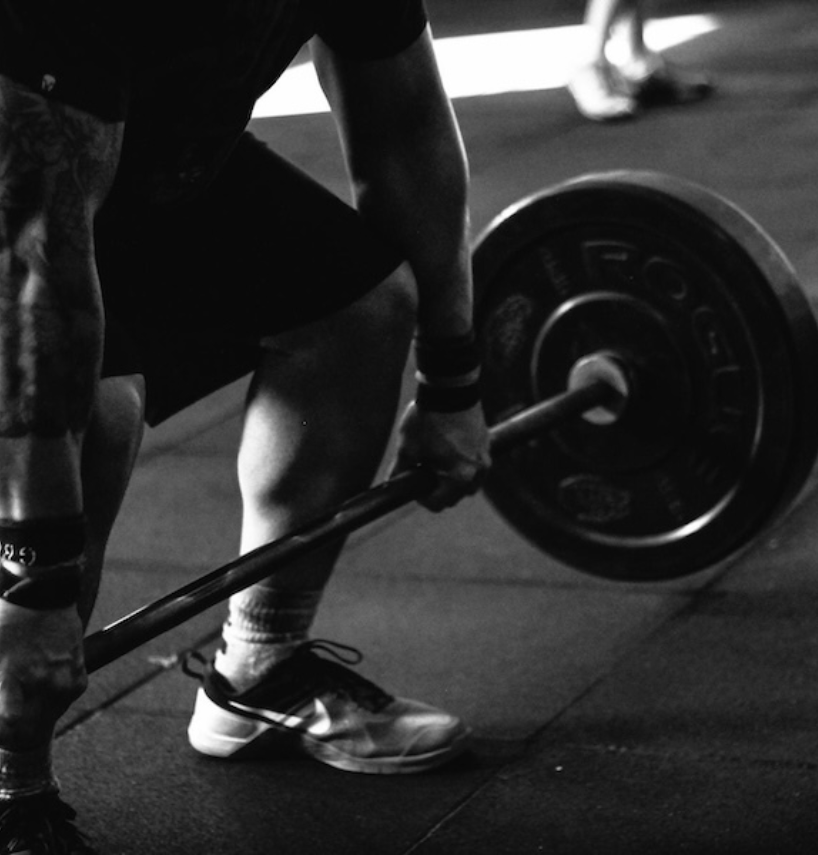
Progressive overload is the single most important rule in the gym. It's the simple, powerful idea that to get stronger and build muscle, you have to consistently make your workouts a little bit harder over time. If you don't gradually increase the demand on your body, it has no reason to change. Without this challenge, your progress will eventually grind to a halt.
What is progressive overload and why is it essential for growth?
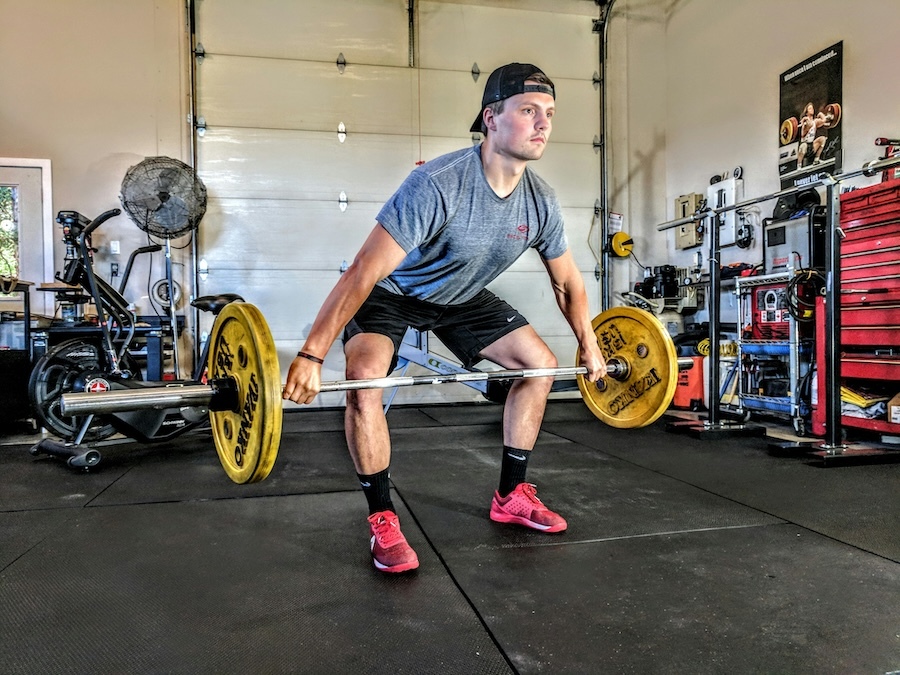
Think of your body like a construction crew. The first time you lift a heavy weight, it’s like a surprisingly large order comes in. The crew struggles a bit but gets the job done. To prepare for the next one, they hire more workers (build more muscle) and upgrade their tools (strengthen neural connections).
Progressive overload is the art of sending in a slightly bigger order each time.
Built for progress
Take the guesswork out of training
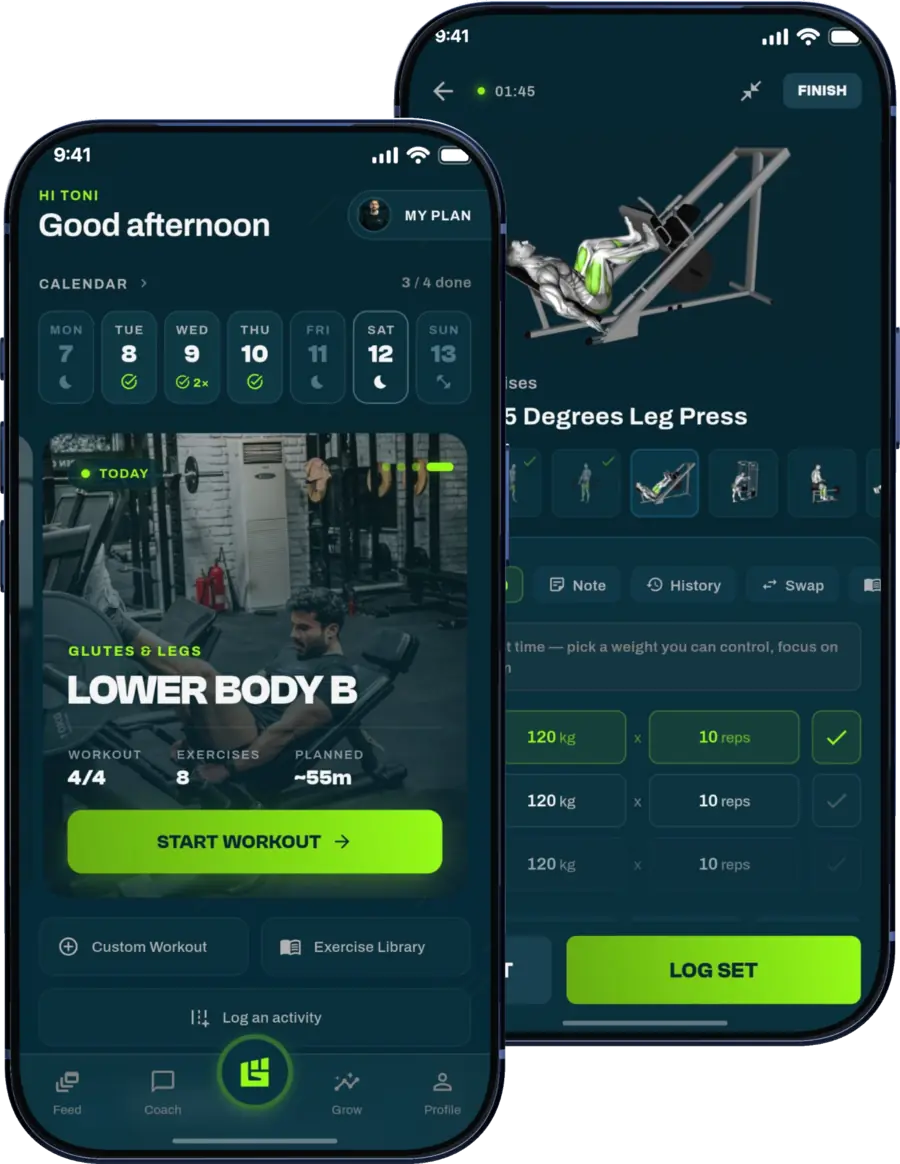
Get a personalized workout plan built around your goal, equipment and schedule. Train smarter, track every rep and keep moving forward, one workout at a time.






But if you keep sending the same small order week after week, the crew gets comfortable. They become incredibly efficient at that one task, stop expanding, and growth flatlines. This is a plateau, and it’s the number one reason people stop seeing results.
The foundation of all training progress
This isn't just a modern fitness buzzword; the principle has its roots in rehabilitation science. It was pioneered by an Army physician named Thomas L. DeLorme during World War II, who was looking for a better way to help injured soldiers regain their strength.
His method was simple: have soldiers perform sets at their 10-repetition maximum and slowly increase the weight. The results were so effective that the concept became a cornerstone of physical therapy and strength training. You can dig into the history by reading the original published research on DeLorme's work.
At its core, progressive overload is the language your muscles understand. It sends a clear signal that they need to adapt to a new demand. That adaptation leads to more than just bigger muscles; it drives:
- Increased Strength: Your nervous system gets better at recruiting muscle fibers, letting you move heavier loads.
- Enhanced Endurance: Your muscles learn to resist fatigue, so you can do more work for longer.
- Stronger Bones and Connective Tissues: The stress from training signals your bones, tendons, and ligaments to become denser and more resilient.
The human body is an adaptation machine. It will only change in response to a demand it isn't used to. Progressive overload is simply the structured application of that demand.
Five core methods of progressive overload
So, how do you actually put this into practice? It’s not just about piling more plates on the bar. There are several ways to turn up the dial and keep your body adapting. Understanding these methods gives you a versatile toolkit to make sure you never get stuck.
Here's a quick look at the five main techniques you can use. We'll dive much deeper into each one in the sections ahead.
| Method | Description | Best For |
|---|---|---|
| Increase Load | Gradually adding more weight or resistance to an exercise. | Building maximal strength and muscle density. |
| Increase Volume | Performing more repetitions or sets with the same weight. | Promoting muscle hypertrophy (size) and endurance. |
| Increase Frequency | Training a specific muscle group or movement more often per week. | Breaking through plateaus and accelerating skill acquisition. |
| Decrease Rest | Reducing the rest time between sets to increase workout density. | Improving metabolic conditioning and muscular endurance. |
| Improve Technique | Enhancing form, range of motion, or tempo for better muscle activation. | Building a strong foundation and making exercises more effective. |
Each method provides a different kind of stimulus. The key to long-term progress is learning how to use the right tool for the right job, ensuring your body never fully adapts to your training.
The science behind how your muscles adapt and grow
To really get the most out of progressive overload, it helps to know what’s actually happening inside your body. Think of every single workout as a signal you’re sending your muscles. When you challenge them, you’re telling them they need to get stronger, and their response is a complex biological process that turns all that effort into real, measurable growth.
This process is more than just "tearing" muscle fibers: it’s a sophisticated symphony of signals, repairs, and upgrades. Lifting a weight that’s heavier than what your muscles are used to creates a powerful stimulus. That stimulus kicks off a chain reaction that ultimately builds bigger, stronger, and more resilient muscle tissue.
The three drivers of muscle growth
Scientists generally agree that three main things drive muscle hypertrophy (the technical term for muscle growth). A smart training plan will hit all three to maximize results, and understanding them shows why just adding more weight isn’t the only path forward.
- Mechanical Tension: This is the force your muscle generates when it’s stretched under load, like when you’re lowering a heavy dumbbell during a bicep curl. This tension is, by far, the most important driver of muscle growth. It directly signals your muscle cells to kickstart the repair and growth process.
- Muscle Damage: This refers to the microscopic tears that happen in muscle fibers during a tough workout. While it might sound bad, this localized damage is a completely normal part of training. It triggers an inflammatory response that helps clear out old cellular debris and brings in nutrients to rebuild the fibers bigger and stronger than they were before.
- Metabolic Stress: Ever feel that intense "pump" or burning sensation during a high-rep set? That’s metabolic stress. It’s the build-up of byproducts like lactate and hydrogen ions inside your muscle cells. This chemical change signals the release of muscle-building hormones and causes the cells to swell, adding another layer to the growth stimulus.
The real art of progressive overload is applying just enough stress to trigger adaptation without causing so much damage that you can’t recover. It’s a calculated push to convince your body it needs to be better prepared for the next challenge.
Your body’s two-phase adaptation
When you start a progressive overload program, your body adapts in two clear phases. The first gains often feel fast and almost magical, but what's really happening is your nervous system getting a tune-up.
First, your nervous system gets much more efficient. It learns how to recruit more of your existing muscle fibers and make them fire together in a more coordinated way. This is why beginners often see their strength shoot up by 20-30% in the first four to six weeks, long before any significant muscle growth has occurred.
Only after this initial neurological upgrade does serious hypertrophy kick in. With continued overload, your body ramps up myofibrillar protein synthesis—the actual process of building new muscle proteins—by as much as 50-100% after a tough workout. This is where you start to see noticeable increases in muscle size. Research has shown that tracking your volume load (sets x reps x weight) is one of the best ways to predict these muscular gains. You can dig into the research on how training volume drives these changes to learn more.
This two-step process shows why consistency is king. Those early strength gains build the foundation you need to lift heavier later on, creating the mechanical tension required for long-term muscle growth. Each workout truly builds on the last, creating a powerful cycle of stimulus, recovery, and adaptation.
Your toolbox of progressive overload techniques
Knowing the science is one thing, but putting it to work is where the real changes happen. Progressive overload isn't a single, rigid rule—it's a whole toolbox of techniques you can use to keep your body guessing.
Learning how to use each one gives you multiple ways to challenge your muscles. This variety is what keeps you from hitting plateaus and lets you adapt your training to any situation, whether you're in a fully-equipped gym or just working with what you've got at home.
The idea is simple: to make your muscles grow, you have to consistently give them a reason to. You need to introduce a new stimulus they aren't used to handling. The cycle below shows exactly what we’re trying to kickstart with these techniques.
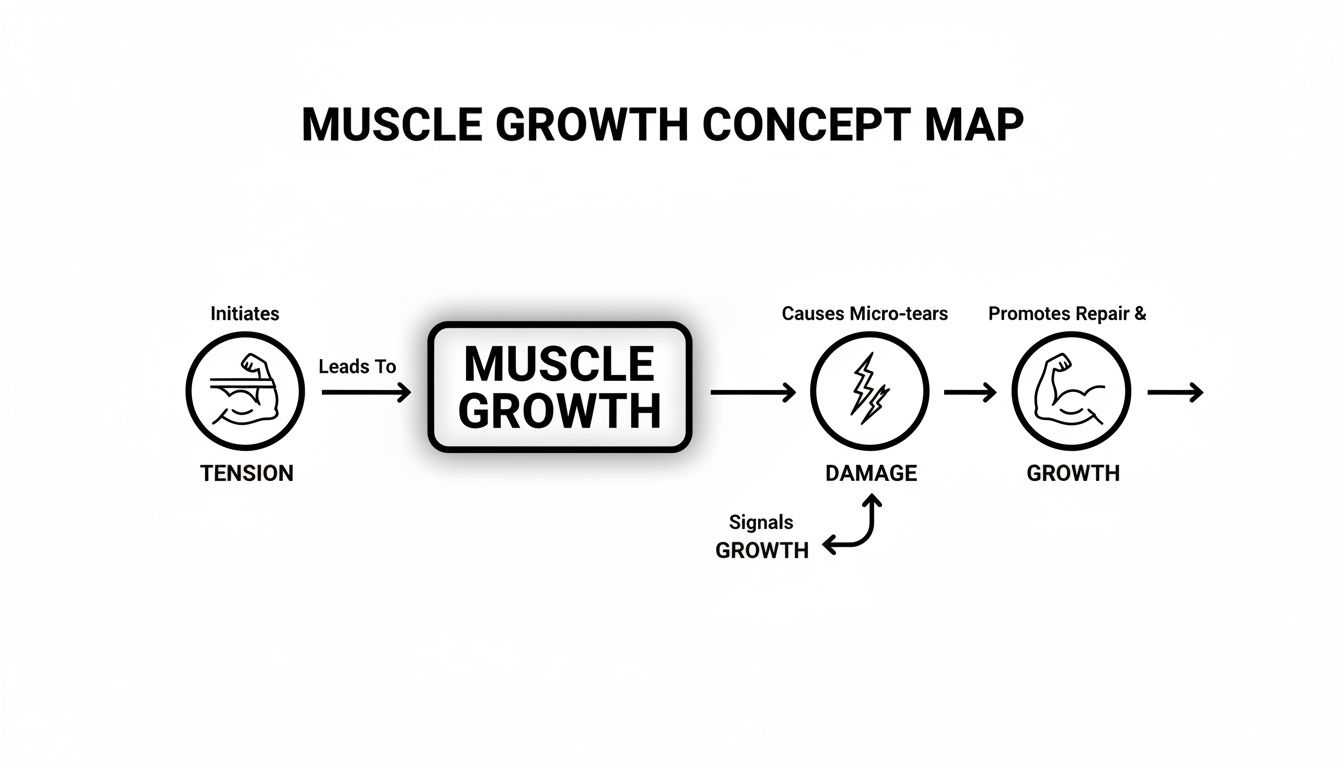
It all starts with tension. That tension creates tiny micro-tears in the muscle fibers, which signals your body to get to work repairing and rebuilding them—only this time, stronger and bigger to handle that stress in the future.
Let’s break down the best ways to apply that tension.
Increase the load
This is the classic, most straightforward way to do it. Just add more weight. More resistance. More load. When you increase the mechanical tension on the muscle, you’re sending the most direct signal possible to get stronger.
Let's say you bench pressed 135 pounds for 3 sets of 8 reps this week and it felt solid. Next time, your goal is simple: try for 140 pounds for the same sets and reps. It’s clean, measurable, and effective.
But here’s the catch: you have to increase the load without wrecking your form. Piling on weight your body can't handle with good technique—also known as ego lifting—is a fast pass to injury, not progress. A smart rule of thumb is to only add weight once you can hit all your target reps with clean, confident form.
Increase the volume
Volume is the total amount of work you do, usually calculated as sets x reps x weight. Bumping up your volume is a killer way to drive muscle growth (hypertrophy) and boost muscular endurance, even if the weight on the bar stays the same.
You can increase volume in a couple of different ways:
- Add More Reps: If you squatted for 3 sets of 8 last week, aim for 3 sets of 9 or 10 this week with the same weight.
- Add More Sets: If your plan calls for 3 sets, try doing 4 sets next time. This is a great way to get more total work in without having to grind out every single set to failure.
This method is perfect for times when you don't have heavier weights available or when your main goal is building muscle size over raw, one-rep-max strength.
A popular and effective guideline for progressing is the "2-for-2 rule." When you can successfully complete two more reps than your target in the final set of an exercise for two consecutive workouts, it's time to increase the weight.
Increase the training frequency
Another powerful tool in your toolbox is frequency. This is all about how often you train a specific muscle group or practice a certain lift within a week.
For example, if you're currently hitting legs just once a week, you could progress by splitting that session into two shorter, less grueling workouts spread across the week. This gives your muscles more frequent signals to grow and can be a game-changer for breaking through stubborn plateaus.
This technique is also great for nailing down the technique on complex lifts like squats and deadlifts, since it gives you more chances to practice the movement pattern. It lets you get in more high-quality work over the week without completely frying yourself in one marathon session.
Improve your training density and technique
Not all progress is measured on a calculator. Sometimes, the best way to overload your muscles is to make your workouts more efficient or simply get better at each and every rep.
- Decrease Rest Time: This is a great way to increase your workout density. If you usually rest for 90 seconds between sets, try cutting that down to 75 or 60 seconds. Your muscles get less time to recover, forcing them to adapt to a whole new kind of metabolic stress.
- Improve Form and Range of Motion: Doing an exercise with a bigger range of motion is an instant upgrade. Think squatting deeper or using a slower, more controlled tempo on the way down. This forces your muscles to work harder through every inch of the movement, making the same weight feel much heavier.
Focusing on these qualitative improvements builds a rock-solid foundation. In fact, improving your technique often allows you to lift more weight safely down the line, creating a positive feedback loop that fuels long-term gains.
Building your own progressive overload plan
Knowing the different ways to apply progressive overload is one thing, but a great principle needs a great plan. This is where we stop talking theory and start mapping out a clear path forward—one that removes the guesswork and ensures every workout builds on the last.
The secret is to match your progression style to your goal. Are you training for pure strength, muscle size (hypertrophy), or muscular endurance? Each of these goals responds best to a different mix of variables, like reps, sets, and rest times.
Tailoring your plan to your fitness goal
Let's take a foundational exercise—the barbell back squat—and see how you could structure a 4-week plan for three completely different outcomes. These templates show how tiny weekly adjustments can drive wildly different results.
Keep in mind, these numbers are just examples. Your starting weight should feel challenging but still allow you to complete every single rep with crisp, clean form. A great way to find your starting point is by using a one rep max calculator to estimate your strength levels.
Template 1: Strength focus
Here, the only thing that matters is moving more weight. This plan is built around low reps and high intensity (heavy weight), with long rest periods to make sure you can generate maximum force in every set.
- Week 1: 4 sets of 5 reps @ 185 lbs (Rest: 3 minutes)
- Week 2: 4 sets of 5 reps @ 190 lbs (Rest: 3 minutes)
- Week 3: 4 sets of 5 reps @ 195 lbs (Rest: 3 minutes)
- Week 4: 4 sets of 5 reps @ 200 lbs (Rest: 3 minutes)
Notice the only thing that changes is the load. We're keeping the volume the same but nudging the weight up each week to force those strength adaptations.
Template 2: Hypertrophy (muscle size) focus
To build muscle, we need to increase the total work done (volume) while staying in that sweet spot of moderate reps. The rest periods are shorter to crank up the metabolic stress, which is a key ingredient for muscle growth.
- Week 1: 3 sets of 8 reps @ 155 lbs (Rest: 90 seconds)
- Week 2: 3 sets of 10 reps @ 155 lbs (Rest: 90 seconds)
- Week 3: 3 sets of 12 reps @ 155 lbs (Rest: 90 seconds)
- Week 4: 4 sets of 8 reps @ 160 lbs (Rest: 90 seconds)
In this plan, we first add reps week-to-week. Once we hit our target, we add another set and a little more weight, then start the cycle over.
Template 3: Endurance focus
When you want to improve muscular endurance, the game is all about doing more work in less time. This means higher reps and much shorter rest periods to really challenge your muscles' ability to fight off fatigue.
- Week 1: 3 sets of 15 reps @ 115 lbs (Rest: 60 seconds)
- Week 2: 3 sets of 15 reps @ 115 lbs (Rest: 45 seconds)
- Week 3: 3 sets of 18 reps @ 115 lbs (Rest: 45 seconds)
- Week 4: 4 sets of 15 reps @ 115 lbs (Rest: 45 seconds)
Progress here is driven by shrinking the rest time first, then bumping up the reps, and finally adding another set to increase the total workload.
Applying progressive overload beyond the weight room
The rules of progressive overload aren't just for lifting weights—they're universal. The same principles work just as well for boosting your cardio and functional strength. The core idea never changes: you have to gradually increase the demand to force your body to adapt.
This concept is well-proven across different fitness disciplines. For instance, runners who methodically increased their weekly mileage by no more than 10% saw their VO2 max—a key marker of aerobic fitness—climb by 15-20% over 12 weeks. In functional fitness, a technique known as Progressive Movement Training (PMT) has shown incredible results by overloading range of motion. One study found PMT led to an 11% improvement in vertical jump height, compared to a tiny 1.4% gain from traditional training.
Progressive overload is not an exercise-specific tactic; it's a fundamental law of adaptation. Whether you're lifting a barbell, running a trail, or holding a yoga pose, the body will only improve if you ask it to do slightly more than it did before.
How to track progress and avoid common mistakes

There's an old saying: you can't manage what you don't measure. When it comes to progressive overload, this couldn't be more true. Without a record of what you did last time, you’re just guessing. And guesswork is the fastest way to stall out.
Think of a detailed training log as the engine that drives your progress. It turns your effort into hard data, letting you make smart decisions about your next workout. It doesn't need to be fancy—a simple notebook or a good fitness app is all you need.
What to record in your training log
To make your log useful, you need to capture the details that matter. This data paints the full picture of your performance, showing you exactly where you can push for more.
- Exercise: The specific movement you performed.
- Weight Used: The load you lifted for each set.
- Sets and Reps: How many sets you did and the reps you hit in each one.
- Rest Periods: The time you took between sets, which directly impacts your workout density.
- RPE (Rate of Perceived Exertion): On a scale of 1-10, how tough did that set feel? This adds crucial context to your numbers.
When you track these variables, you create a clear roadmap. If you squatted 185 lbs for 3 sets of 8 last week with an RPE of 7, your goal for this week is obvious: maybe aim for 9 reps, or try 190 lbs. That’s how you make data-driven progress.
Avoiding common progressive overload pitfalls
Knowing the theory is one thing, but applying it consistently is where the real challenge lies. It's easy to fall into common traps that can kill your progress or even lead to injury.
The single biggest mistake is ego lifting. This is when you prioritize piling on more weight over maintaining solid form. A sloppy, partial rep with a heavier weight is far less effective—and much more dangerous—than a clean, full-range-of-motion rep with a lighter one. Bad form doesn't just cheat your muscles out of the stimulus they need; it puts a ton of stress on your joints.
Think of your training in terms of a slow cooker, not a pressure cooker. The goal is steady, sustainable progress over months and years, not risky gains that could sideline you for weeks.
Another common pitfall is trying to progress too quickly. Your muscles, tendons, and ligaments all adapt at different speeds. Pushing for more weight or volume every single session can easily outpace your body's ability to recover, leading to nagging pains, burnout, and a higher risk of injury. A good rule of thumb is to increase your main lifts by no more than 5-10% each week, and only when your form feels solid.
Here are a few practical ways to stay on track:
- Film Your Lifts: Your phone is an incredible coaching tool. Record your main lifts from the side to get an honest look at your technique. You might be surprised by what you see.
- Listen to Your Body: Some days you’ll feel like a superhero, and other days you won’t. Don't be afraid to stick with the same weight or even take a small step back if you're feeling beat up. Recovery is just as important as the training itself.
- Prioritize Sleep and Nutrition: You can’t out-train a bad recovery plan. Getting enough sleep and eating enough protein are non-negotiable if you’re serious about making real gains.
Automate your success with intelligent training
Manually tracking every rep, set, and pound you lift works, but let's be honest—it takes a ton of attention and careful planning. What if you had a personal trainer in your pocket, one that crunches the numbers for you and makes sure you’re always pushing just the right amount? That's where smart training apps come in, making progressive overload feel almost effortless.
These platforms take the guesswork out of your training. Instead of wondering whether it's time to add weight or go for an extra rep, the system analyzes your workout data and makes the call for you. This keeps you in that sweet spot for growth without ever feeling lost or overwhelmed.
How smart technology powers your progress
Think of an intelligent training app like a GPS for your fitness journey. You plug in your destination—building raw strength, adding muscle size, or boosting your endurance—and it maps out the most efficient route. If you hit a detour, like a tough workout or a missed session, it instantly recalculates to get you back on track.
This all works because the system logs every detail of your performance. It knows when a set felt easy and when you had to grind out that last rep. Based on that data, it automatically adjusts the plan for your next session.
- Adaptive Routines: The platform builds workouts that are actually designed for your specific goals. A strength plan will prioritize adding weight to the bar, while a hypertrophy plan will smartly adjust your volume and reps to maximize muscle growth.
- Data-Driven Decisions: Let's say you hit your rep target on the bench press for two workouts in a row. The system will see that and automatically suggest bumping the weight up by 5 lbs for your next session. It's the core principle of progressive overload, completely automated.
- Form and Technique Guidance: Many platforms, like GrabGains, come with huge exercise libraries. You get clear video demos and step-by-step instructions for every movement, making sure you’re performing each lift safely and effectively to get the most out of every single rep.
An intelligent training platform doesn’t just record your workouts; it learns from them. It turns your past performance into a predictive model for your future success, making progressive overload a built-in feature of your training.
From manual logging to motivating analytics
One of the biggest wins of automating your training is the shift from tedious logging to inspiring feedback. Instead of staring at rows of numbers in a notebook, your hard work gets transformed into clean, visual progress charts.
Seeing your progress in a graph is incredibly motivating. Watching your squat numbers climb over the weeks or seeing your total workout volume increase is tangible proof that your consistency is paying off. It reinforces good habits and gives you that extra push you need to get through the tough workouts. By letting technology handle the planning and tracking, you can pour all your mental energy into what really matters: showing up and putting in the work.
Frequently asked questions about progressive overload training
Even with a great plan, questions always come up. That’s a good thing. Progressive overload is a journey of learning and tweaking as you go. Here are some straightforward answers to the questions I hear the most.
How often should I increase the weight or reps?
There’s a great rule of thumb for this called the "2-for-2 rule." If you can hit two more reps than your goal on your last set of an exercise, for two workouts in a row, it's a solid signal that you're ready for more weight.
When you're just starting out, you might feel like you can add weight almost every time you walk into the gym. That’s normal. For lifters with more experience under their belt, progress might come weekly or even every couple of weeks. The key is to be consistent and listen to your body: never add weight if it means your form starts to fall apart.
Can I use progressive overload with only bodyweight exercises?
Absolutely. Progressive overload is a principle, not a piece of equipment. When adding plates isn't an option, you just get creative and find other ways to make the exercise harder.
You’ve got a few solid options:
- Increase Reps: The simplest way. Just do more.
- Add Sets: If you normally do three sets of push-ups, try for four.
- Decrease Rest Time: Less rest between sets makes the workout denser and forces your muscles to work harder with less recovery.
- Use Harder Variations: Once standard push-ups feel too easy, move to decline push-ups or archer push-ups. The challenge ramps up fast.
What should I do when I hit a training plateau?
First off, don't panic. Plateaus are a normal, even expected, part of training. It just means your body has successfully adapted to what you've been throwing at it. Before you change your entire workout, check the fundamentals: are you getting enough quality sleep? Are you eating enough protein to actually rebuild muscle?
If recovery is on point, it’s time to change the stimulus. If you've only been adding weight, switch your focus for a few weeks to adding reps or total volume. Sometimes, the best thing you can do is schedule a "deload" week—intentionally pulling back on the intensity to let your body fully recover. You’ll often come back stronger.
Hitting a plateau doesn't mean you've failed; it means your body has successfully adapted. It's simply a signal that it's time for a new type of challenge.
Is it possible to progress too quickly?
Yes, and it's one of the easiest traps to fall into. Chasing bigger numbers too fast almost always leads to sloppy form. When your technique breaks down, you’re not only making the exercise less effective, but you're also opening the door to injury.
Real, lasting progress is steady and deliberate. Perfect form will always be more valuable than a new personal record set with bad technique. Remember, it's the consistent, small steps forward that build massive long-term results.
Stop guessing and start progressing. GrabGains uses AI to analyze your performance and automatically adjust your workouts, ensuring you’re always applying the right amount of progressive overload. Let us handle the planning so you can focus on getting stronger. Pre-register today for the app and be the first to experience your pocket personal trainer.
Get inspired and motivated