Optimized for Growth
Workout routines
20 free workout routines, sorted into 8 categories by goal. Every plan lists its level, how many days per week it needs, how long one session takes and what equipment you need, so you can pick on the two things that actually decide whether a plan works: the days you can commit and the equipment you can reach.

Dumbbell Shred (5x/week) routine
This 5-day dumbbell-only routine is designed for people who want to get lean, strong, and defined without needing access to a full gym. Whether you're training from home or prefer…
Beginner & full body
| Routine | Level | Days per week | Session | Equipment | Goal |
|---|---|---|---|---|---|
 Time-Saver Express (3x/week) routine
|
Beginner | 3 | 30 min | Full gym | General fitness |
 Beginner Full Body (3x/week) routine
|
Beginner | 3 | 45 min | Full gym | General fitness |
What to know about Beginner & full body
A full-body routine is the best starting point for anyone new to strength training. Training three days per week with a rest day in between means every muscle group gets trained three times weekly, which is more total stimulus than a beginner gets from any split. Sessions run 30 to 45 minutes and use the five movement patterns that appear in every later plan: squat, hinge, push, pull and carry. The main advantage is repetition. Practising the same lifts three times a week builds technique far faster than meeting each exercise once a week, and technique is what allows load to increase safely. Stay on a full-body plan until you can add weight or reps for six to twelve weeks without form breaking down, then move to an upper/lower or push-pull split. Two sessions per week still works if three is not realistic; the loss compared to three is smaller than the loss from a plan you abandon.
Muscle gain splits
| Routine | Level | Days per week | Session | Equipment | Goal |
|---|---|---|---|---|---|
 Chest & Back Builder (2x/week) routine
|
Beginner | 2 | 50 min | Full gym | Muscle gain |
 Upper Lower Split (4x/week) routine
|
Intermediate | 4 | 60 min | Full gym | Muscle gain |
 Bodybuilding Split (5x/week)
|
Advanced | 5 | 70 min | Full gym | Muscle gain |
 PPL + Abs Add-On (6x/week) routine
|
Advanced | 6 | 65 min | Full gym | Muscle gain |
 Push Pull Legs (6x/week) routine
|
Advanced | 6 | 60 min | Full gym | Muscle gain |
What to know about Muscle gain splits
Splits divide the body across training days so each session covers less ground and can carry more volume per muscle group. The routines here run from two to six days per week. A 2-day chest and back plan suits a limited schedule; upper/lower on four days hits every muscle group twice weekly, which research consistently puts at or near the optimum for hypertrophy; push pull legs on six days trains each muscle twice with the most volume per session. More days is not automatically better. A six-day split only outperforms a four-day one if sleep, protein intake and recovery can support it, which is why the 5x and 6x plans are marked advanced. Sessions run 50 to 70 minutes and assume access to a full gym. Weekly volume is the figure to track: roughly ten to twenty hard sets per muscle group per week covers most trainees, spread across whichever split fits the schedule. The split itself is a scheduling decision, not a growth mechanism.
Built for progress
Not sure which routine fits you?
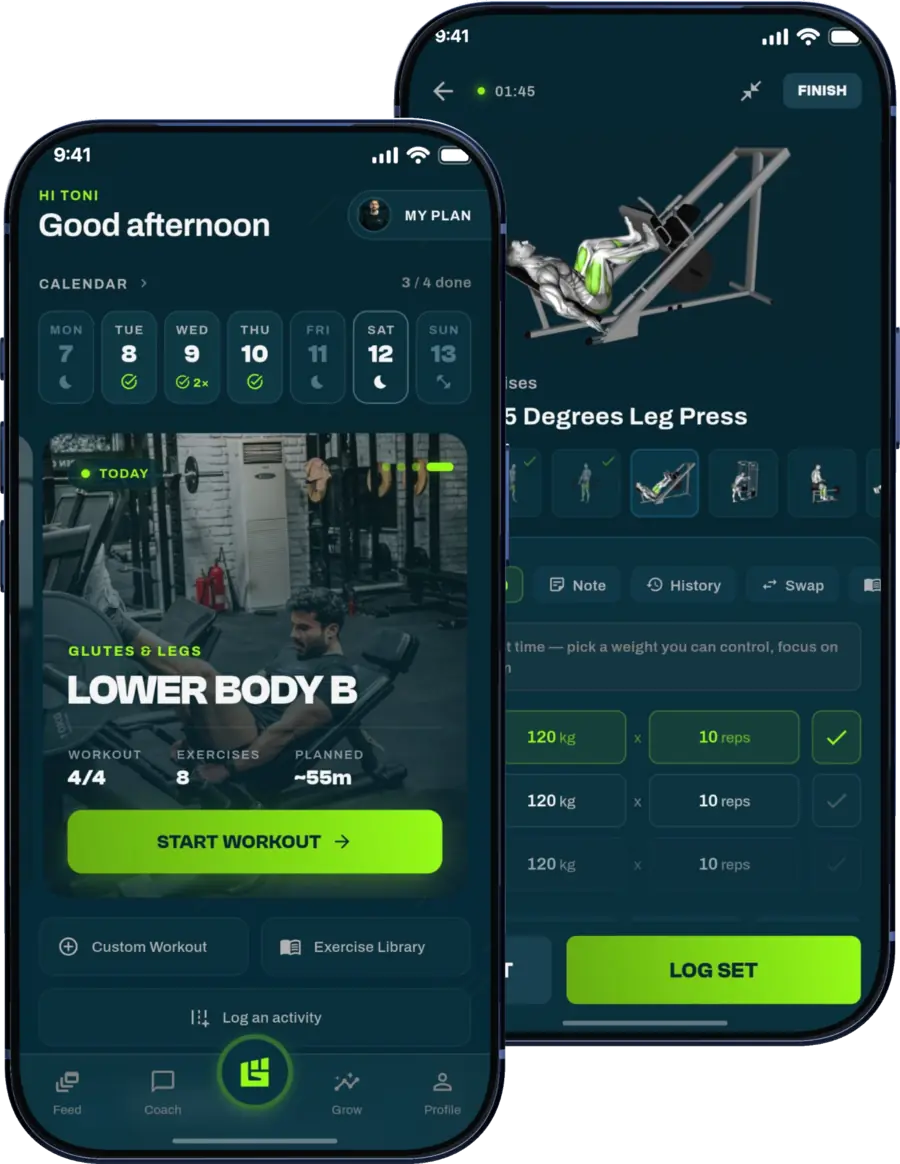
The GrabGains app builds a plan around your goal, equipment and schedule, then tracks every set you log.






Strength
| Routine | Level | Days per week | Session | Equipment | Goal |
|---|---|---|---|---|---|
 Strength Focus (3x/week) routine
|
Intermediate | 3 | 60 min | Barbell & rack | Strength |
 Barbell Only Split (4x/week)
|
Intermediate | 4 | 60 min | Barbell & rack | Strength |
What to know about Strength
Strength routines prioritise load over volume: fewer reps per set, longer rest periods, and a small number of barbell lifts trained frequently. The plans here need a barbell and a rack, run three or four days per week and take about 60 minutes per session. Progress is measured in weight added to the bar rather than in sets completed. Programming centres on the squat, deadlift, bench press and overhead press, trained in the two-to-six rep range with three to five minutes of rest between heavy sets. That rest is not optional; it is what allows the next set to be performed at a load high enough to drive adaptation. Accessory work fills gaps in the main lifts rather than adding volume for its own sake. Both plans suit intermediate lifters who already own the movement patterns. Expect progress in kilograms per month rather than per week once the first year is behind you.
Fat loss & conditioning
| Routine | Level | Days per week | Session | Equipment | Goal |
|---|---|---|---|---|---|
 Endurance + Conditioning (4x/week) routine
|
Intermediate | 4 | 45 min | Full gym | Endurance |
 Fat, Burn & Lean (4x/week) routine
|
Intermediate | 4 | 45 min | Full gym | Fat loss |
What to know about Fat loss & conditioning
Fat loss is decided by energy balance, not by the workout, which is why these routines are built to preserve muscle while a calorie deficit does the work. Training four days per week for about 45 minutes, they keep resistance work as the base and add conditioning rather than replacing lifting with cardio. Keeping the weights heavy matters more than burning calories in the session. Muscle retained during a deficit is what keeps metabolic rate and strength from dropping, and resistance training is the signal that tells the body to keep it. Conditioning is added at the end of sessions or on separate days to raise total energy expenditure without cutting into recovery from the lifting. Both plans assume a full gym and suit intermediate trainees. Weight loss of roughly 0.5 to 1 percent of bodyweight per week is the range that limits muscle loss; faster than that and strength usually falls with it. Protein intake matters more here than in any other training block.
Home & dumbbell only
| Routine | Level | Days per week | Session | Equipment | Goal |
|---|---|---|---|---|---|
 Full Body Dumbbell Routine (3x/week) routine
|
Beginner | 3 | 45 min | Dumbbells only | Muscle gain |
 Home Workout (4x/week) routine
|
Beginner | 4 | 35 min | Bodyweight | General fitness |
 Dumbbell Shred (5x/week) routine
|
Intermediate | 5 | 40 min | Dumbbells only | Fat loss |
What to know about Home & dumbbell only
You can build muscle at home with a pair of dumbbells or nothing at all, provided the sets are taken close to failure. These routines need no rack, no machines and 35 to 45 minutes per session, running three to five days per week. Limited load is compensated for with higher reps, slower tempo, single-leg and single-arm variations, and shorter rest periods. The practical ceiling arrives later than most people expect. Bodyweight and dumbbell training drives strength and size gains for months in untrained and lightly trained lifters, and progress stalls not because the load is too light but because the sets stop being hard. Adding one rep per set each week, or slowing the lowering phase to three seconds, extends a dumbbell plan well past the point where it looks limited. A single pair of adjustable dumbbells covers more of the useful load range than a fixed set, which is usually the better first purchase.
Glutes & core
| Routine | Level | Days per week | Session | Equipment | Goal |
|---|---|---|---|---|---|
 Core Destroyer (3x/week) routine
|
Intermediate | 3 | 25 min | Bodyweight | Glutes & core |
 Booty Builder Routine (3x/week) routine
|
Intermediate | 3 | 45 min | Full gym | Glutes & core |
 Glutes & Core Focus (3x/week) routine
|
Beginner | 3 | 40 min | Full gym | Glutes & core |
What to know about Glutes & core
Glute and core routines target a specific area three days per week, which makes them a supplement to a full programme rather than a replacement for one. Sessions run 25 to 45 minutes. Glute work centres on hip extension under load — hip thrusts, Romanian deadlifts, split squats — trained in the eight-to-fifteen rep range where the muscle responds best. Core work is trained for tension rather than repetition: planks, dead bugs, carries and anti-rotation work build the bracing strength that transfers to squats and deadlifts, while high-rep crunches mostly build endurance in a muscle that is rarely the limiting factor. A dedicated core session of 25 minutes three times weekly is enough for most trainees, and the plans here can run alongside any of the muscle gain splits. Direct glute work is also the most common gap in otherwise complete programmes, because squats alone load the quadriceps more heavily than the hips through a full range.
Athletic performance
| Routine | Level | Days per week | Session | Equipment | Goal |
|---|---|---|---|---|---|
 Hyrox/Crossfit Performance (5x/week) routine
|
Advanced | 5 | 60 min | Full gym | Athletic performance |
 Athlete Builder (5x/week) routine
|
Advanced | 5 | 60 min | Full gym | Athletic performance |
What to know about Athletic performance
Athletic routines train qualities that a hypertrophy plan does not: rate of force development, repeat-effort capacity and work under fatigue. Both plans run five days per week for about 60 minutes and assume a full gym. Sessions are ordered by neural demand — sprints, jumps and Olympic lift variations come first while the nervous system is fresh, then heavy strength work, then conditioning. Reversing that order compromises the highest-value work. The Hyrox and CrossFit plan additionally trains sustained mixed-modal output, where strength and conditioning are expressed at the same time under load. These are advanced plans. They assume a strength base already exists, because power development scales with the maximum force available to develop it, and they demand recovery capacity that beginners do not yet have. Quality over quantity applies literally here: a jump or sprint performed at 90 percent of best output trains a different quality than the same movement performed tired, and only the first one develops power.
Mobility & recovery
| Routine | Level | Days per week | Session | Equipment | Goal |
|---|---|---|---|---|---|
 Mobility & Recovery (3x/week) routine
|
All levels | 3 | 30 min | Mat only | Mobility |
What to know about Mobility & recovery
Mobility work maintains usable range of motion around the joints you load in training, and it is trained rather than stretched into place. Three sessions per week of about 30 minutes is enough to hold and slowly extend range. The distinction that matters: passive stretching lengthens tissue temporarily, while loaded end-range work teaches the nervous system to produce force in that new position, which is what makes it stick. Recovery sessions serve a second purpose. Light movement between hard training days increases blood flow without adding meaningful fatigue, which reduces soreness and keeps joints comfortable. This routine suits any level and is designed to run alongside a strength or hypertrophy plan on rest days rather than to replace training. Hips, ankles, shoulders and thoracic spine are the four areas worth checking first, since restriction in any of them shows up directly as compensation in squats, presses or deadlifts.
How to choose a workout routine
Start from the days you can always train
Pick a routine by the number of days you can train in a bad week, not a good one. A three-day plan completed every week beats a five-day plan completed two weeks out of four, because adaptation follows the total training you actually accumulate over months. Training frequency is the single attribute most people get wrong when choosing a plan, and it is the one that determines whether the plan survives contact with work, travel and illness. If you are unsure, choose the lower number. Adding a fourth day to a three-day plan you are already completing is straightforward; cutting a six-day split down after missing sessions usually means abandoning it and starting over. Missing a session on a three-day plan costs a third of that week; on a six-day plan the schedule usually collapses rather than absorbing it.
Match the plan to the equipment you can actually reach
Equipment decides which routines are usable, so filter on it before anything else. A barbell strength plan needs a rack and plates and cannot be approximated with dumbbells, because the whole point is loading a lift heavily enough to work in the two-to-six rep range. The reverse is not true: dumbbell and bodyweight plans do work, and they work for longer than most people assume, as long as sets are taken close to failure. A home routine with two dumbbells will build muscle for months. What it will not do is develop a maximal squat or deadlift, so if strength in the barbell lifts is the goal, gym access is a requirement rather than a preference. Check the equipment column before the level column: a plan you cannot physically perform is not a beginner-friendly plan, whatever its level says.
Commit to one goal per training block
Pick one goal and hold it for the length of a training block. Muscle gain, maximal strength, fat loss and conditioning ask for different rep ranges, different rest periods and different amounts of total work, and pursuing two at once means doing neither well enough to drive change. This does not mean the others disappear. A fat loss block still lifts heavy to preserve muscle, and a strength block still includes conditioning. It means one goal sets the structure of the programme and the rest are maintained rather than developed. Six to twelve weeks per goal is the useful range: long enough for measurable adaptation, short enough that a second priority is not neglected for a full year. Cutting and bulking simultaneously is the most common version of this mistake, and it is why body recomposition works reliably only in beginners and in returning lifters.
Change routines on stalled progress, not on boredom
Switch plans when progress stops, not when the plan gets repetitive. If you can still add a rep or a small increase in weight to your main lifts, the routine is working, and replacing it discards the adaptation you have accumulated. Two to three weeks of no progress on the main lifts, with sleep and nutrition accounted for, is the signal to change something. Often the change needed is smaller than a new programme: a deload week, more sleep, or reducing volume on a lift that has stopped responding. Novelty feels productive and rarely is. The lifters who make the most progress over years are usually running unremarkable plans for long stretches and adding weight to them. Keep a log of the main lifts. Without written numbers, stalled progress and a bad week are indistinguishable, and most plan-hopping comes from mistaking one for the other.
Build Your Own Routine
Create custom workout routines from our exercise database. Track your sets, reps, and progress!
Frequently asked questions about workout routines
Two days per week is the minimum that builds muscle, three suits most people, and four is where upper/lower splits become effective. Beyond four days the returns depend entirely on recovery. Choose the number of days you can sustain for months rather than the highest number you can manage for two weeks.
A full-body routine three days per week, with a rest day between sessions. It trains every muscle group three times weekly and gives repeated practice on the squat, hinge, push, pull and carry patterns. Technique improves fastest with frequent repetition, and technique is what allows load to increase safely.
Any split works if each muscle group is trained about twice per week and recovery is adequate. Common structures are full body, upper/lower, push/pull, and push pull legs. Avoid placing heavy pressing days back to back, or a heavy pulling day directly after deadlifts.
Between 25 and 70 minutes, depending on how many days per week the plan runs. Higher-frequency splits use shorter sessions because each day covers less of the body. Sessions longer than roughly 75 minutes rarely add stimulus in proportion to the extra time and fatigue.
Yes. Three full-body sessions per week train each muscle group three times, which exceeds the twice-weekly frequency associated with optimal hypertrophy in the research. Total weekly volume and progressive overload determine growth far more than the number of training days.
Yes, provided sets are taken close to failure. Limited load is offset with higher reps, slower lowering phases, single-limb variations and shorter rest. Dumbbell plans drive muscle growth for months. What they cannot develop is a maximal barbell squat or deadlift, which needs a rack and heavy plates.
Six to twelve weeks, or as long as you are still adding reps or weight to the main lifts. Change the plan after two to three weeks of stalled progress, with sleep and nutrition accounted for. Switching because a routine feels repetitive discards adaptation you have already built.
Yes, and lift first if both are in one session. Doing conditioning before resistance work reduces the load you can handle on the lifts, while the reverse costs little. If the two can be separated by several hours or placed on different days, that is better for both.
Four to eight, depending on session length and how much of the body the day covers. Full-body sessions use five or six compound lifts; a split covering one or two muscle groups can use more isolation work. Sets per muscle group matter more than the number of different exercises.
Yes. A programme's results come from appropriate volume, progressive overload and consistency, none of which require payment. What paid coaching adds is individual adjustment and accountability. Every routine on this page is free to read and follow without an account.