Your ultimate workout routine for muscle growth
Stop guessing in the gym and start training with purpose. This complete guide to workout routines for muscle growth gives you everything you need to build real size, from the science-backed principles that drive hypertrophy to ready-to-use training plans for every experience level. Whether you're a beginner or a seasoned lifter, it's time to train smarter and finally see the results you've been chasing.


If you've ever felt lost in the gym, you're not alone. But building an effective routine for muscle growth isn't about memorizing complicated theories or spending endless hours lifting.
It boils down to a few core principles that drive hypertrophy—the scientific term for muscle growth. Getting these right is the difference between spinning your wheels and seeing real, measurable results from your hard work.
Built for progress
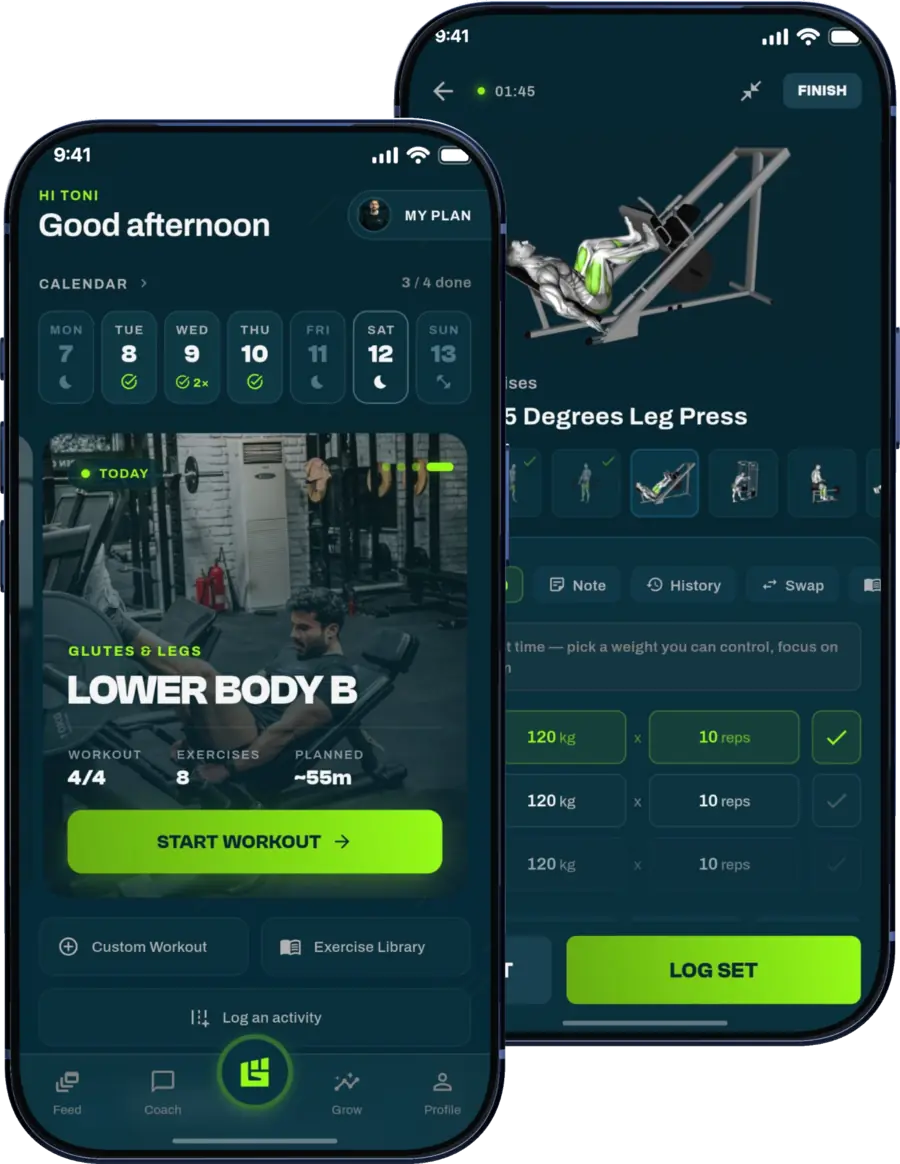
Take the guesswork out of training
Get a personalized workout plan built around your goal, equipment and schedule. Train smarter, track every rep and keep moving forward, one workout at a time.






This isn't about just showing up and doing random exercises. It’s about having a clear, actionable plan. A well-designed routine provides the structure you need to apply the fundamentals of muscle building consistently, and that consistency is everything.
What really drives muscle growth
At its heart, a successful workout routine is all about creating the right stimulus. Your muscles simply won't grow unless you give them a compelling reason to. This is where the non-negotiable pillars come into play.
- Progressive overload: This is the absolute foundation. You must continually increase the demands on your muscles over time. That means lifting heavier weights, doing more reps, or adding more sets. Your body adapts, so you have to keep giving it a new challenge.
- Sufficient volume: Volume is the total amount of work you do, often calculated as sets x reps x weight. You need to perform enough total work to signal your muscles that they need to get bigger and stronger to handle the load.
- Appropriate intensity: Intensity is all about how heavy you're lifting, usually measured as a percentage of your one-rep max. For hypertrophy, you want to be in a challenging rep range—typically 6-12 reps—where the last couple of reps are a real grind.
- Optimal frequency: This is simply how often you train each muscle group. Research and real-world results show that hitting each muscle group 2-3 times per week is the sweet spot for maximizing growth.
A common misconception is that you need to live in the gym to build muscle. The truth is, consistency with a smart plan is far more powerful than sporadic, marathon sessions.
Why a structured routine is non-negotiable
A lot of people fail to see results for one simple reason: they don't have a plan. They show up, do whatever exercises feel right that day, and hope for the best. A structured workout routine for muscle growth completely removes the guesswork.
It ensures you’re hitting all the necessary components for progress, every single week.
It’s easy to feel like you’re not doing enough, especially when CDC data shows that over 75% of U.S. adults don't meet the recommended guidelines for muscle-strengthening activities. But you don't need to overdo it.
In fact, one study found that just 30 minutes of lifting twice a week, hitting all major muscle groups, led to significant muscle gains over eight weeks. You can read more about these muscle growth statistics on forgedbythegym.com. This just goes to show that an efficient, well-structured routine is the key.
To help you put this all together, here’s a quick breakdown of what to focus on based on your experience level.
Core components of a muscle growth workout
| Component | Beginner Focus | Intermediate/Advanced Focus |
|---|---|---|
| Progressive Overload | Master form first, then add weight or reps weekly. | Use periodization (planned cycles of intensity/volume) and advanced techniques like drop sets. |
| Volume | Start with 10-12 total sets per muscle group per week. | Increase volume to 15-20+ sets per muscle group per week, managing fatigue carefully. |
| Intensity | Lift in the 8-12 rep range, leaving 2-3 reps "in the tank" to avoid burnout. | Lift closer to failure (0-2 reps in reserve) and incorporate heavier sets in the 5-8 rep range. |
| Frequency | Train each muscle group 2 times per week using a full-body or upper/lower split. | Train muscles 2-3 times per week with a more specialized split (e.g., Push/Pull/Legs). |
| Exercise Selection | Stick to compound movements (squats, presses, rows) to build a solid foundation. | Add isolation exercises to target specific muscle groups and bring up lagging parts. |
This table gives you a clear starting point. As you gain experience, you'll naturally shift your focus from simply learning the movements to strategically manipulating these variables for continued growth.
Understanding the science of how muscles grow
To build a workout that actually works, it helps to know what's happening under the hood when you lift weights. You don't need a PhD in biology, but understanding the basics lets you make smarter choices in the gym. Think of it as learning the rules of the game before you try to win.
The whole process is called hypertrophy, which is just the scientific term for growing your muscle cells. Your workouts are the signal that tells your body it needs to build bigger, stronger muscles to handle what you throw at it next. You can get into the nitty-gritty with our complete guide to hypertrophy.
The three drivers of muscle growth
Muscle growth isn't a one-trick pony. It’s the result of three things working together, and a solid workout routine should hit all of them.
- Mechanical tension: This is the force your muscles experience when you lift challenging weights. It's the most important driver, period. Imagine stretching a rubber band—that tension signals to the muscle fibers that they need to get stronger.
- Muscle damage: When you finish a tough workout and feel sore the next day, you're feeling the effects of tiny micro-tears in your muscle fibers. This isn't a bad thing. It kicks off a repair process where your body builds the fibers back bigger and more resilient than before.
- Metabolic stress: Ever feel that "burn" or get a massive "pump" during a high-rep set? That's metabolic stress. It's the buildup of byproducts like lactate inside the muscle cells, which also sends a powerful signal to grow.
Lifting progressively heavier weights through a full range of motion creates a ton of mechanical tension. This is the absolute cornerstone of any successful muscle-building plan.
Progressive overload is your golden rule
If you only remember one thing from this section, make it progressive overload. Your body is smart and lazy; it won't waste energy building muscle it doesn't think it needs. To force it to grow, you must consistently demand more from it.
And no, that doesn't just mean piling more plates on the bar, though that's a great way to do it.
Here are a few ways you can apply progressive overload:
- Increase the weight: The classic approach. Lifting heavier for the same number of reps.
- Increase the reps: Doing more reps with the same weight.
- Increase the sets: Adding another set to an exercise.
- Decrease rest time: Cutting your rest between sets makes the workout more demanding.
- Improve your form: Better technique often puts more direct tension on the target muscle.
Without this constant push for "more," your body will adapt, and your progress will grind to a halt. A good workout plan always has progression built right in.
The critical role of volume and frequency
Beyond just lifting heavy, two other variables are key: how much you lift in total (volume) and how often you train (frequency). Training volume is simply your sets x reps x weight. While there's a clear link between volume and muscle growth, piling on "junk volume" isn't the answer.
Finding the right frequency is just as important. Hitting a muscle just once a week usually isn't enough to maximize its growth. Spreading your work out over multiple sessions gives your muscles more chances to get that all-important growth signal.
A 2019 study really drove this point home, finding that workout frequency was the single most important factor for strength gains in women. The group that trained 3 times per week for 15 weeks packed on an average of 1.5kg of muscle and boosted their strength by a whopping 25%. Other research backs this up, showing that doing 10 or more sets per muscle group each week can lead to up to 10% more growth compared to doing fewer than five sets. You can check out the UNSW Sydney study findings for more details. The takeaway is clear: a smart plan that hits your muscles multiple times a week is far more effective.
Choosing the right exercises and workout splits
Alright, you get the science. Now let's turn that theory into a real-world plan. The exercises you pick and how you organize your week are the true building blocks of a great routine. This isn't about just listing random exercises; it's about choosing the right tools for the job and arranging them in a way that actually fits your life.
A smart plan prioritizes movements that give you the most bang for your buck and fits them into a schedule you can actually follow.
Compound movements are your foundation
If you were building a house, you’d start with a strong foundation, not the window trim. It's the exact same logic for building muscle. Compound exercises are your foundation.
These are the big, multi-joint movements that recruit a ton of muscle all at once. Think squats, deadlifts, bench presses, and overhead presses. Because they engage so much muscle mass, they let you lift heavier weight, which creates more of that all-important mechanical tension we just talked about.
- Squats: Work your quads, glutes, hamstrings, and core.
- Deadlifts: Engage your entire back, glutes, hamstrings, and grip.
- Bench press: Targets your chest, shoulders, and triceps.
- Overhead press: Builds strong shoulders, triceps, and upper back stability.
Basing your routine around these "big lifts" is hands-down the most efficient way to stimulate overall muscle growth and build functional strength that carries over into everything else you do.
Your primary focus, especially when you're starting out, should be getting progressively stronger on a handful of key compound lifts. This alone will drive more muscle growth than any fancy machine or complicated routine ever could.
Adding isolation exercises strategically
Once that foundation is set, you can start adding the details. Isolation exercises are single-joint movements that hit a specific muscle, like bicep curls, tricep extensions, or leg curls.
These are fantastic for bringing up lagging body parts, adding some extra targeted volume, and chasing that satisfying "pump" from metabolic stress. They're the finishing touches, not the main event. For instance, after a few heavy sets of bench presses, you might add dumbbell flyes to put extra focus directly on your chest.
Finding the right workout split
A "workout split" is just a fancy term for how you organize your training days to hit all your major muscle groups throughout the week. The best split is always the one you can stick to consistently. There’s no magic bullet here; it all comes down to your schedule, experience, and how well you recover.
Here are the three most popular and effective splits for building muscle.
- Full body: You train all major muscle groups in each session. This is an excellent choice for beginners or anyone training three or fewer days per week, as it maximizes how often you stimulate each muscle.
- Upper/lower: You split your workouts into upper-body days and lower-body days. This is perfect for intermediate lifters who can hit the gym four times a week, as it allows for more volume per muscle group than a full-body plan.
- Push/pull/legs (PPL): You group muscles by their function. "Push" day hits the chest, shoulders, and triceps. "Pull" day works the back and biceps. "Legs" day is, well, legs. This is a great split for those who can train five or six days a week.
Let’s quickly break down how these splits stack up to help you make the right choice for your routine.
Comparing popular workout splits for muscle growth
Choosing the right training split is a crucial first step. The table below compares the most common options to help you find the best fit based on your schedule, experience, and goals.
| Workout Split | Best For | Training Frequency | Pros | Cons |
|---|---|---|---|---|
| Full Body | Beginners or those training 2-3 days/week. | Each muscle is hit 2-3 times per week. | High frequency for muscle growth stimulus; great for learning movements; very time-efficient. | Sessions can be long and fatiguing; less volume per muscle group in a single workout. |
| Upper/Lower | Intermediates or anyone training 4 days/week. | Each muscle is hit 2 times per week. | Excellent balance of frequency and volume; allows for more focus on specific muscle groups per session. | Requires at least four training days to be effective; less recovery between sessions for related muscles. |
| Push/Pull/Legs | Intermediates/Advanced lifters training 5-6 days/week. | Each muscle is hit 2 times per week (on a 6-day cycle). | Allows for maximum volume and focus on each muscle group; less systemic fatigue per workout. | Requires a high time commitment; missing a day can throw off the entire week's schedule. |
Ultimately, be honest with yourself. A beginner jumping into a six-day PPL split is a recipe for burnout, just as an advanced lifter might find a two-day full-body routine isn't quite enough stimulus. A plan that looks perfect on paper is useless if you can't actually follow it in the real world.
Sample workout routines you can start today
Theory is great, but the real gains happen when you start lifting. Now that we’ve covered how to pick the right exercises and workout splits, let's put it all together into a few solid, ready-to-go plans. These aren't just random lists of exercises; they're structured routines built for one thing: muscle growth.
Each plan lays out the exact exercises, sets, reps, and rest periods you need. Just find the one that fits your experience and schedule, and you’re good to go.
Picking the right split can feel like a huge commitment, but it's simpler than you think. This flowchart breaks it down based on how many days you can realistically get to the gym each week.
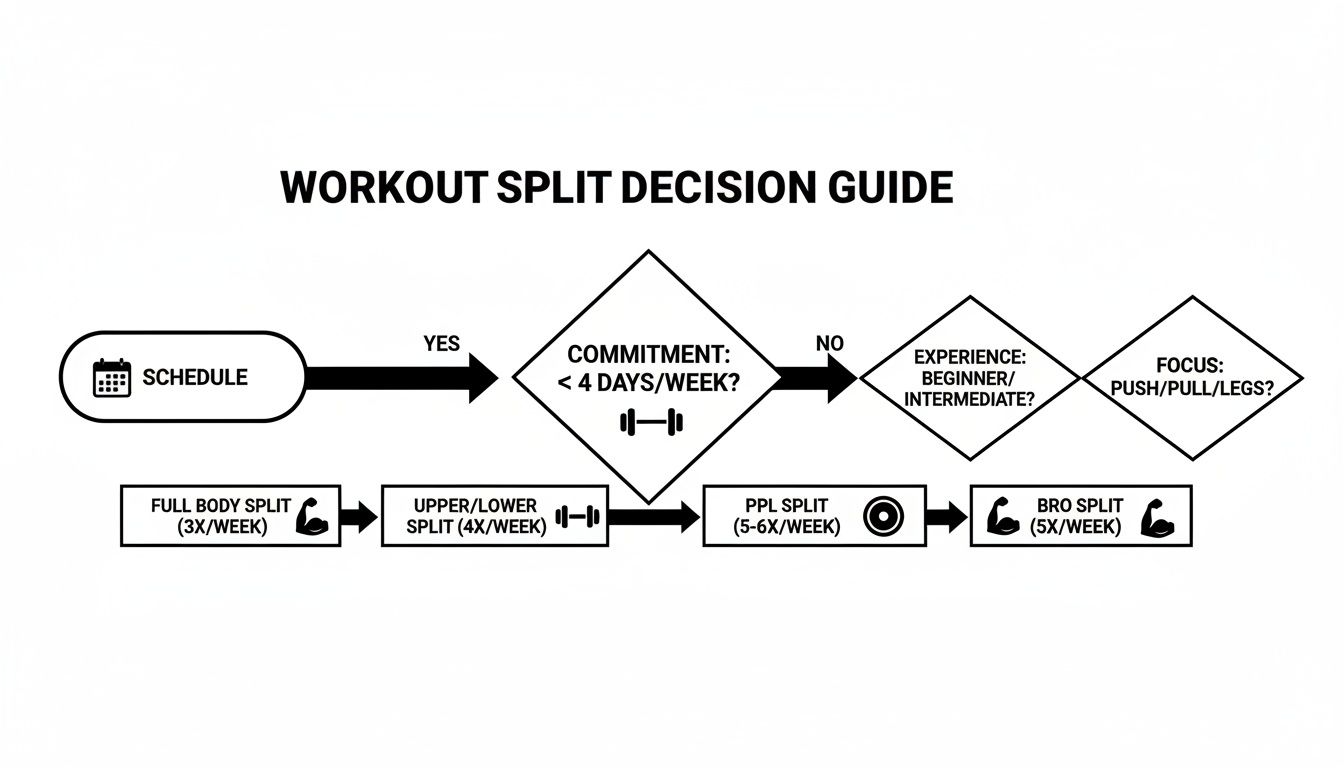
The main takeaway? Your schedule is king. If you can train less than four days a week, a full-body or upper/lower split is your most efficient option. More training days open the door to more specialized splits.
The beginner 3-day full-body routine
If you're new to the gym or can only train three times a week, a full-body routine is your best friend. This approach hits every major muscle group in each session, which maximizes how often you trigger the signal for growth. The goal here is simple: master the big compound lifts and build a rock-solid foundation of strength.
Do this routine on non-consecutive days (like Monday, Wednesday, and Friday) to give your body time to recover.
- Squats: 3 sets of 8-12 reps
- Bench press: 3 sets of 8-12 reps
- Barbell rows: 3 sets of 8-12 reps
- Overhead press: 3 sets of 10-15 reps
- Lat pulldowns: 3 sets of 10-15 reps
- Plank: 3 sets, hold for 30-60 seconds
Rest for 60-90 seconds between sets. Pick a weight where the last couple of reps in each set feel tough, but your form stays perfect.
The intermediate 4-day upper/lower split
Once you’ve got 6-12 months of consistent training under your belt, an upper/lower split is a fantastic way to step things up. By giving your upper and lower body their own dedicated sessions, you can fit in more exercises and volume for each muscle group, creating a bigger stimulus for growth.
A common way to schedule this is two days on, one day off, then two more days on (e.g., Monday, Tuesday, Thursday, Friday).
Day 1: Upper body strength
- Bench press: 3 sets of 6-8 reps
- Bent-over rows: 3 sets of 6-8 reps
- Incline dumbbell press: 3 sets of 8-12 reps
- Seated cable rows: 3 sets of 8-12 reps
- Lateral raises: 3 sets of 12-15 reps
- Tricep pushdowns: 3 sets of 12-15 reps
Day 2: Lower body strength
- Barbell squats: 3 sets of 6-8 reps
- Romanian deadlifts: 3 sets of 8-12 reps
- Leg press: 3 sets of 10-15 reps
- Leg curls: 3 sets of 12-15 reps
- Calf raises: 4 sets of 15-20 reps
Rest for 90-120 seconds on your main lifts (like squats and bench) and 60 seconds on the smaller accessory movements. The other two training days would typically focus on hypertrophy with slightly higher rep ranges.
Remember, the best workout routine for muscle growth is the one you actually stick with. Don't try to cram a five-day split into a three-day schedule; pick the plan that fits your life.
The time-crunched 2-day routine
What if you're slammed with work and life? You can still make incredible progress with just two gym days a week. The secret is to be brutally efficient. We're talking about focusing only on the big, compound movements that deliver the most bang for your buck.
This goes against the "more is better" mentality, but the research on low-frequency training is surprisingly strong. A multi-year study of nearly 15,000 people found that a once-a-week strength program made participants 30% stronger after one year and 50% stronger by year seven. It’s proof that consistency, even when it’s not frequent, is what drives long-term results. You can dig into these ultra-minimalist workout research findings on outsideonline.com.
Here’s a simple but killer two-day full-body plan:
- Workout A: Squats, Bench press, Barbell rows, Face pulls
- Workout B: Deadlifts, Overhead press, Pull-ups (or Lat pulldowns), Leg press
For each exercise, aim for 3-4 sets in the 6-10 rep range. This minimalist setup ensures you’re hitting every major muscle with enough intensity to grow, without spending your life in the gym.
Fueling your body for optimal muscle growth
All that hard work in the gym? It's only half the story. A tough workout is the stimulus for muscle growth, but the actual repair and rebuilding happens when you’re resting and refueling.
Think of it like this: your workout is the demolition crew, and your nutrition and sleep are the builders that construct something bigger and stronger in its place.

Without the right building materials, progress will grind to a halt, no matter how hard you train. Let's break down the essentials without getting bogged down in complicated science.
Your nutritional building blocks
To build new muscle, your body needs two things: energy and raw materials. These come from the three macronutrients—protein, carbohydrates, and fats. Getting the balance right is what fuels your workouts and repairs the damage afterward.
For muscle growth, you need to be in a slight calorie surplus. That just means eating a bit more than your body burns each day. This provides the extra energy required to build new muscle tissue.
Muscles don't grow in the gym; they grow on rest days. But they only grow if you feed them a steady supply of protein, the raw material for repair and rebuilding.
Just as critical is your protein intake. Protein provides the amino acids needed to patch up the micro-tears in your muscles caused by lifting.
- Protein target: A solid goal is 0.8 grams of protein per pound of body weight (or 1.6 grams per kilogram). So, a 180-pound person should aim for around 144 grams daily.
- Consistency is key: Your body needs this protein every day, not just on lifting days. The muscle repair process is always running, peaking in the 24-48 hours after a workout.
The underrated role of sleep and recovery
You can have the perfect workout plan and a flawless diet, but if you skimp on sleep, you're shooting yourself in the foot. Sleep is when your body does most of the heavy lifting for repair and hormone regulation.
During deep sleep, your body releases human growth hormone (HGH), a major player in muscle growth. Lack of quality sleep blunts this process and raises cortisol, a stress hormone that can actually break down muscle tissue. Aim for 7-9 hours of quality sleep every night. It’s non-negotiable.
Active recovery and staying hydrated
Recovery isn’t just about sitting on the couch. Active recovery on your off days can make a surprisingly big difference.
- Light activity: Gentle movement like walking, stretching, or foam rolling gets blood flowing to your muscles. This helps deliver nutrients and flush out waste products, which can reduce soreness and speed up recovery.
- Hydration: Water is involved in pretty much every bodily function, including nutrient transport. Being even slightly dehydrated can tank your performance and slow down recovery, so keep a water bottle handy all day.
Finally, while supplements aren't magic, some can give you a small edge. Creatine monohydrate is one of the most well-researched supplements out there, proven to help with strength and muscle mass. Adding 3-5 grams daily is a simple way to support your hard work.
These small habits outside the gym are what turn all that effort into real, visible results.
How to track progress and break through plateaus
A great workout plan isn't set in stone—it's a living document that grows with you. To keep making gains for the long haul, you have to track your performance and know when to make smart adjustments. This means looking beyond just the number on the scale.
The easiest way to see what's working is with a workout log. This isn't about complex spreadsheets. Just jot down the exercises you did, the weight you used, and the sets and reps you hit. This simple log is your proof that progressive overload is happening. Seeing those numbers slowly tick up over weeks and months is the clearest sign you’re on the right track.
When your progress grinds to a halt
Sooner or later, everyone hits a plateau. It’s that frustrating point where you stop getting stronger or seeing changes, even though you feel like you're doing everything right. It’s a completely normal part of training, but pushing past it requires a strategic change, not just more brute force.
You'll know you've hit a wall when you notice a few common signs:
- Stagnant lifts: You’ve been stuck at the same weight and reps on your main lifts for several weeks.
- Persistent fatigue: You feel run down all the time, and your motivation to get to the gym is tanking.
- Increased soreness: You’re feeling more beat up than usual after workouts, which is a big hint that you’re not recovering enough.
Smart strategies to keep growing
When you hit that wall, your first instinct might be to just train harder. But often, the smarter move is to do the opposite.
This is where a planned deload week comes in. By cutting your training volume and intensity by about 50%, you give your body a real chance to recover and repair. It might feel counterintuitive to back off, but this break is often the exact thing you need to come back stronger the following week.
Another killer strategy is to introduce exercise variations. If your bench press has stalled for a month, don't just keep banging your head against the wall. Swap it out for something like an incline dumbbell press or a close-grip bench press for a few weeks. That small shift in stimulus can be all it takes to break the stalemate and get you growing again.
Common questions on building muscle
Let’s tackle some of the most common questions that come up when you’re trying to build muscle. Getting these answers straight will give you the confidence to stick with your plan.
How long does it take to see muscle growth?
This is the big one, and it’s all about setting realistic expectations. You'll probably feel stronger within just a few weeks. That’s mostly your brain getting more efficient at activating your muscles (neural adaptations).
But for visible changes in muscle size? You’re typically looking at 8-12 weeks of consistent training and proper nutrition. Your genetics and how long you’ve been training also play a huge part in how quickly you'll see results.
Should I train to failure on every set?
Training to failure is a tool, not a rule. While it has its place for stimulating growth, using it on every single set is a fast track to burnout and potential injury.
A much smarter approach is to use it sparingly. Pushing the very last set of a smaller exercise, like bicep curls, to failure can be a great way to add intensity.
For your big compound lifts like squats and presses, leaving 1-2 reps in the tank is far more sustainable. You’ll still provide a powerful stimulus for growth without accumulating excessive fatigue.
Can I build muscle with just bodyweight exercises?
Absolutely, especially if you're new to training. Push-ups, pull-ups, and squats are fantastic for building a solid foundation of strength.
The main challenge with only using bodyweight is making exercises progressively harder over time. While it’s a great option for training at home, adding external weight is the most straightforward and reliable path to long-term muscle gain.
Ready to stop guessing and start growing? GrabGains builds your perfect, AI-powered workout plan that adapts as you get stronger, ensuring you're always making progress. Pre-register today for the app and be the first to experience your pocket personal trainer.
Get inspired and motivated