How to build muscle fast: a practical, evidence-based guide
Building muscle fast requires more than just showing up to the gym, it demands a strategic approach backed by real science. Learn how to build muscle fast with our evidence-based guide covering the three pillars that actually drive results: progressive overload training, optimal nutrition, and smart recovery.


If you want to build muscle fast, you have to nail the fundamentals. It’s not about finding a secret workout or a miracle supplement—it's about consistently applying three core principles: training with progressive overload, eating in a calorie surplus with enough protein, and prioritizing recovery.
Master these, and you'll see rapid, sustainable results. Forget the fluff.
Your blueprint for rapid muscle growth
Let's cut through the noise. Gaining muscle isn't complicated, but it does require a plan. This guide gives you a direct, science-backed roadmap to building the physique you want, eliminating the guesswork so you can focus on the work that actually matters.
Built for progress
Take the guesswork out of training
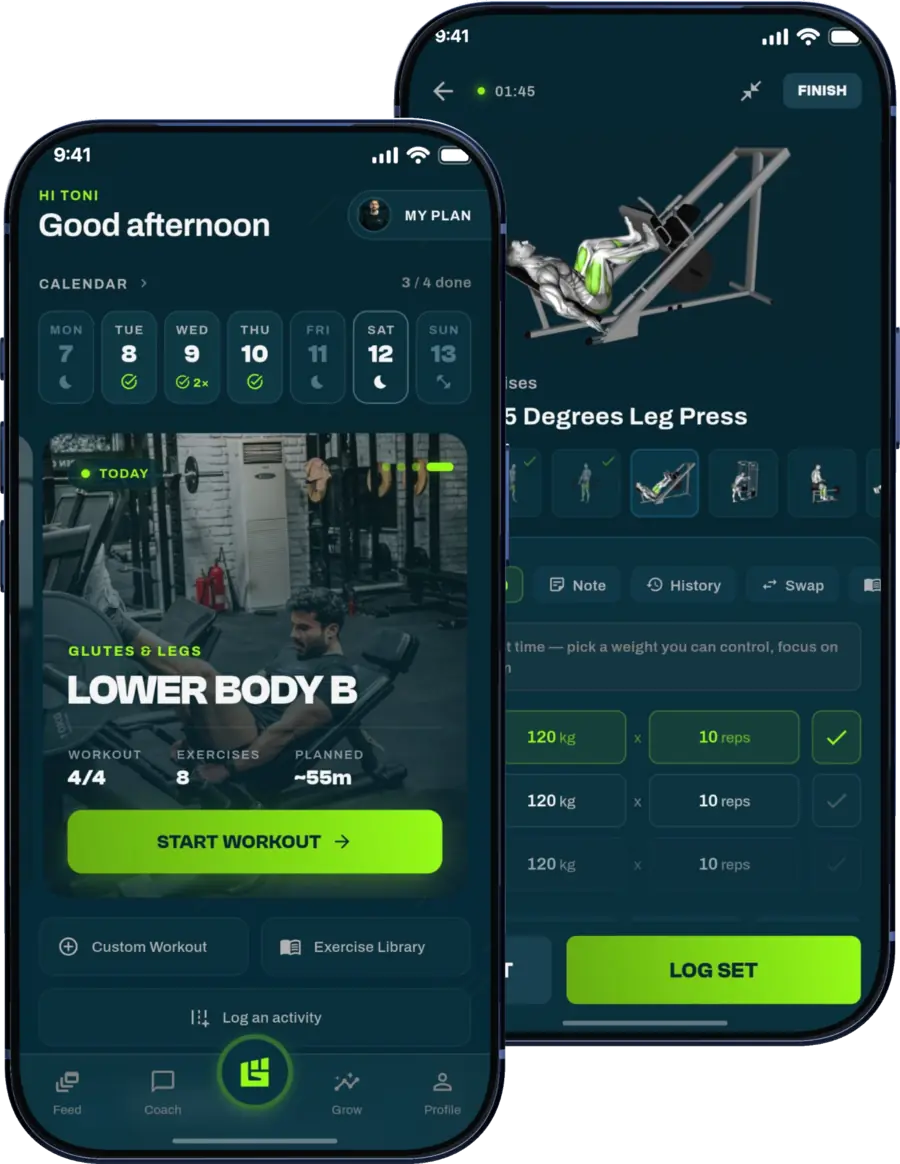
Get a personalized workout plan built around your goal, equipment and schedule. Train smarter, track every rep and keep moving forward, one workout at a time.






Think of this as your foundational checklist. It's designed to ensure every ounce of effort you put into your training and nutrition translates directly into visible muscle. Whether you're just starting out or trying to smash through a frustrating plateau, these pillars are universal.
The non-negotiables for building muscle
To truly understand how to build muscle fast, you need to internalize three key concepts. These aren't just suggestions; they are the absolute requirements for stimulating hypertrophy (the scientific term for muscle growth).
- Progressive Overload: This is the cornerstone of all muscle growth. You must continually challenge your muscles by increasing the demand placed on them over time. That could mean lifting heavier weight, squeezing out more reps with the same weight, or adding another set. Without a constant increase in challenge, your muscles have no reason to adapt and grow.
- Strategic Calorie Surplus & High Protein: You can't build a house without bricks, and you can't build muscle without a surplus of energy and protein. Your body needs extra calories to fuel the repair and growth process. A modest surplus of 250-500 calories above your daily maintenance is the sweet spot for lean gains. On top of that, you need the raw materials. Aiming for 0.7 to 1.0 grams of protein per pound of bodyweight provides the building blocks your muscles need to rebuild bigger and stronger.
- Intelligent Recovery: Growth doesn't happen in the gym; it happens when you rest. During recovery, your body repairs the microscopic tears in your muscle fibers created during training. Prioritizing 7-9 hours of quality sleep per night is non-negotiable. This is when your body releases growth hormone and protein synthesis kicks into high gear.
By focusing your energy on these three pillars, you create a powerful system for growth. If you neglect any one of them, your progress will stall. Master them, and you'll be on the fast track to hitting your goals.
To make it even clearer, here’s a quick rundown of these core principles and what they mean for your training.
Core principles for rapid muscle growth
| Principle | What It Means for You | Why It's Critical for Gains |
|---|---|---|
| Progressive Overload | Consistently make your workouts harder over time by adding weight, reps, or sets. | It forces your muscles to adapt and grow stronger to handle the increased stress. No challenge, no change. |
| Calorie & Protein Intake | Eat slightly more calories than you burn (250-500 extra) and get enough protein (0.7-1.0g/lb). | Calories provide the energy for muscle repair, while protein provides the literal building blocks for new tissue. |
| Recovery & Sleep | Prioritize 7-9 hours of quality sleep and allow your muscles time to rest between sessions. | Muscle growth happens during rest, not during training. Sleep is when key hormones are released. |
This framework isn't just theory; it's the practical application of exercise science that elite athletes and bodybuilders use every single day. By adopting this blueprint, you are setting yourself up for success from day one.
Training smarter for maximum hypertrophy
To build muscle, you need to train smarter, not just harder. While lifting heavy is part of the equation, the real magic happens when you understand what actually triggers growth. This lets you structure your workouts with purpose, ensuring every session in the gym moves you closer to your goal instead of just leaving you sore.
At its core, muscle hypertrophy is your body's response to three specific types of stress. You don’t need a biology degree to get it, but knowing what they are helps clarify why certain training methods work so well.
- Mechanical Tension: This is the force your muscles generate when contracting against a heavy weight, like during a big bench press. It's the most critical driver of muscle growth.
- Metabolic Stress: Ever feel that intense "pump" or burning sensation during a high-rep set of bicep curls? That's metabolic stress, caused by the buildup of byproducts like lactate in the muscle.
- Muscle Damage: This refers to the microscopic tears in muscle fibers that occur during intense exercise. Your body responds by repairing them and rebuilding them bigger and stronger than before.
These three factors work together to signal your body that it’s time to adapt by building more muscle tissue. The trick is to apply these stressors systematically.
The power of progressive overload
Progressive overload is the single most important training principle for building muscle, and it's surprisingly simple. It means you must continually increase the demands you place on your muscles over time. If you lift the same weights for the same reps every week, your body will adapt and have no reason to grow any further.
Think of it like this: if you bench press 135 pounds for 8 reps this week, your mission for next week is to beat that performance. This forces your body into a constant state of adaptation.
You can apply progressive overload in a few different ways:
- Increase the Weight: The most obvious method. Go from 135 lbs to 140 lbs for the same reps.
- Increase the Reps: Stick with 135 lbs but aim for 9 or 10 reps.
- Increase the Sets: Do an additional set with the same weight and reps.
- Improve Your Form: Slowing down the eccentric (lowering) phase of a lift increases time under tension and stimulates more growth.
The rule is simple: always strive to do a little more than you did last time. This consistent, incremental improvement is the engine of long-term muscle gain. Don't chase massive jumps in weight at the expense of good form; focus on small, sustainable progress.
Finding your intensity sweet spot
While progressive overload tells you what to do over time, training intensity dictates how effective each individual workout is. Intensity isn’t just about grunting and throwing weights around; it's about lifting something challenging enough to trigger a growth response. A lot of people go wrong here, either lifting too light to make a difference or too heavy to get quality reps in.
For maximum efficiency, research points to a clear sweet spot. A mathematical model developed by University of Cambridge researchers found that while muscle growth can happen with loads as light as 30% of your one-rep max, the optimal range is around 70%. This level of intensity powerfully stimulates the mechanosensitive signaling pathways that tell your muscles it's time to grow. You can dig deeper into how loading intensity impacts muscle adaptation in their research.
So what does that mean in the gym? It translates to choosing a weight you can lift for roughly 8-12 repetitions before hitting muscular failure—the point where you can't complete another rep with good form. This range serves up the perfect blend of mechanical tension and metabolic stress.
Your last one or two reps in a set should be a real struggle, but not impossible. That’s how you know you’re in the right zone for growth.
Actionable workout plans for every fitness level
Knowing the principles of muscle growth is one thing, but putting them into practice is what actually builds muscle. Theory is great, but it’s consistent, smart training that gets you results. This is where we shift from the "what" to the "how," laying out gym-ready workout splits for different experience levels. The goal is simple: walk into the gym with a plan that works.
These templates aren't just random lists of exercises. They’re designed to maximize hypertrophy by centering on big compound movements, the right amount of volume, and an effective training frequency. No matter where you are on your journey, there’s a clear path forward.
The beginner full-body routine
If you’re new to lifting, your first job is to build a solid base and get comfortable with the main movement patterns. A full-body routine is the most efficient way to do this. You'll hit every major muscle group multiple times a week, which speeds up both learning and those initial "newbie gains."
Do this workout three times a week on non-consecutive days—like Monday, Wednesday, and Friday—to give your body enough time to recover.
- Barbell Squats: 3 sets of 8-10 reps
- Dumbbell Bench Press: 3 sets of 8-10 reps
- Lat Pulldowns: 3 sets of 10-12 reps
- Dumbbell Rows: 3 sets of 10-12 reps per arm
- Overhead Press: 3 sets of 8-10 reps
- Plank: 3 sets, hold for 30-60 seconds
Your main focus here is form. It's much better to use a lighter weight with perfect technique than to ego-lift with sloppy mechanics. Every week, the goal is simple: try to add a little more weight to the bar or squeeze out one more rep per set.
The intermediate push-pull-legs split
Once you've been training consistently for at least six months and your progress has started to level off, it’s time to dial up the volume and intensity. The Push-Pull-Legs (PPL) split is a classic for a reason: it’s incredibly effective for intermediate lifters. It lets you give each muscle group more focused attention while still training everything roughly twice a week.
You can run this as a six-day split (PPL, Rest, PPL) or adapt it for four days (e.g., Push, Pull, Rest, Legs, Push).
- Push Day (Chest, Shoulders, Triceps): Bench Press, Incline Dumbbell Press, Overhead Press, Lateral Raises, Tricep Pushdowns.
- Pull Day (Back, Biceps): Deadlifts or Barbell Rows, Pull-Ups, Lat Pulldowns, Dumbbell Curls, Hammer Curls.
- Leg Day (Quads, Hamstrings, Glutes, Calves): Barbell Squats, Romanian Deadlifts, Leg Press, Leg Curls, Calf Raises.
For most of these, shoot for 3-4 sets of 8-12 reps. The PPL split works so well because it groups muscles that work together naturally, paving the way for intense sessions that really drive growth.
The importance of training frequency
How often you train a muscle is a huge piece of the puzzle. Hitting each muscle just once a week is a common approach, but research suggests it’s not the fastest way to grow. Training a muscle group two or more times per week—known as higher-frequency training—consistently delivers better results.
This decision tree helps visualize how to balance intensity and frequency based on your goals and recovery.
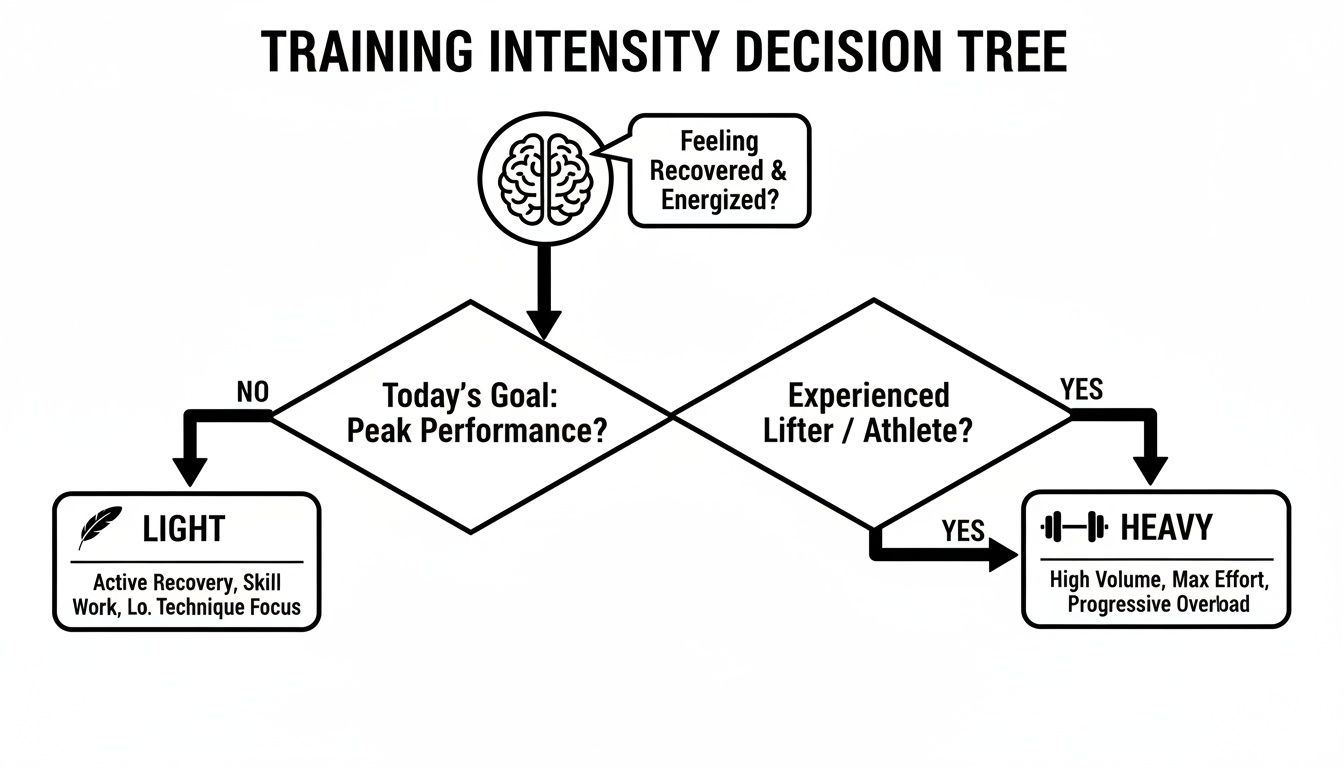
The evidence is clear: spreading your total weekly work over more sessions sends more frequent growth signals to your muscles.
One major analysis found that higher-frequency training led to muscle growth that was about 38% faster than lower-frequency plans. When total weekly volume was lower, the difference was even bigger, with higher-frequency groups growing nearly 77% faster. For a deeper dive, check out the full research on training frequency and muscle growth.
The takeaway is clear: if you want to build muscle fast, structure your workout split to train each muscle group at least twice per week. This aligns perfectly with both the beginner full-body routine and the intermediate PPL split.
The advanced body-part split
For the seasoned lifter with years under their belt, a body-part split (or "bro split") can be a great tool for bringing up stubborn muscle groups and chiseling in detail. This style dedicates an entire workout to just one or two muscles, which lets you hammer them with maximum volume and intensity.
This is a demanding approach that requires excellent recovery capacity and is really only suited for those who can hit the gym 5-6 days a week.
- Day 1: Chest
- Day 2: Back
- Day 3: Shoulders
- Day 4: Legs
- Day 5: Arms (Biceps & Triceps)
- Day 6: Rest or Active Recovery
The trick to making this split work for hypertrophy is making sure each muscle still gets hit more than once a week, either directly or indirectly. For instance, your chest day will also work your front delts and triceps, and back day is going to light up your biceps. This built-in overlap provides the secondary stimulation needed to keep those growth signals firing all week long.
Fueling your body for optimal muscle gain
You can't out-train a bad diet. It doesn't matter how perfect your training plan is; if your nutrition isn't dialed in, your efforts in the gym will stall out.
Think of it like this: your body is a construction site. Workouts are the labor, but food provides the raw materials—the bricks, mortar, and energy—to actually build new muscle. Many people get this backward. They grind in the gym but neglect the fuel, and then wonder why they’re stuck in a plateau.
Let's break down the nutritional blueprint that will work just as hard as you do.
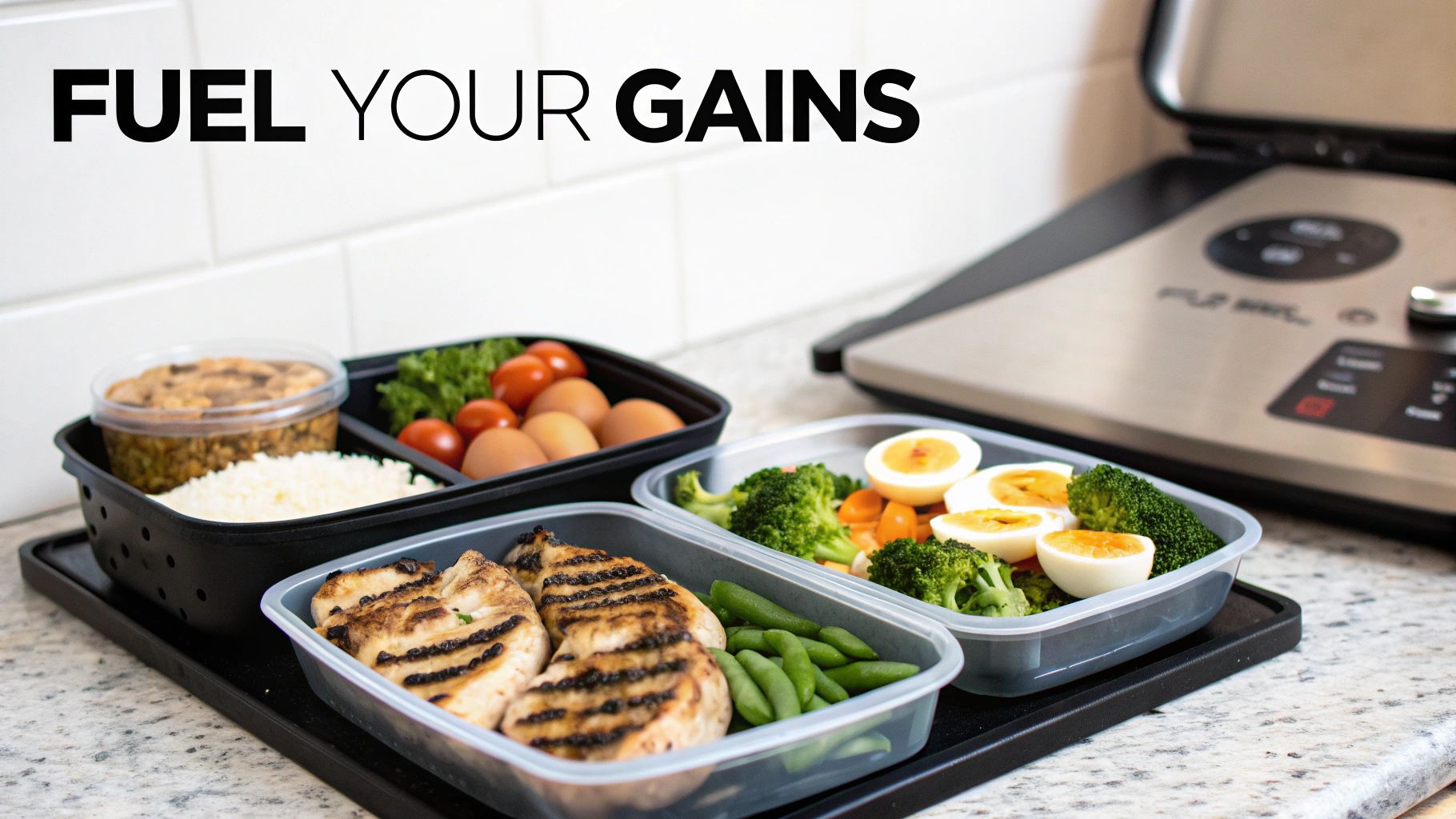
The critical role of a calorie surplus
The first rule of building muscle is simple energy balance. To build new tissue, your body needs more energy (calories) than it burns. This is known as a caloric surplus. Without it, your body just doesn't have the resources to kickstart muscle protein synthesis, the process that builds new muscle.
But "more" doesn't mean "a lot more." A classic mistake is the "see-food" diet, where you eat everything in sight. This approach just packs on unnecessary body fat alongside any muscle you might gain. The goal is a modest, controlled surplus that maximizes lean gains.
A good starting point is an extra 250 to 500 calories above your daily maintenance level. This gives your body just enough fuel to build muscle efficiently without spilling over into significant fat storage. If you’re not sure where to start, you can use our macro calculator for muscle growth to get a personalized estimate.
Protein: the building blocks of muscle
If calories are the energy for the construction site, protein provides the actual bricks. Your muscles are made of protein. After a tough workout, your body is screaming for amino acids (the components of protein) to repair the damage and rebuild your muscle fibers bigger and stronger than before.
Skimping on protein is the fastest way to kill your progress. The science-backed recommendation for optimal muscle growth is to consume 0.7 to 1.0 grams of protein per pound of your target body weight each day. So, for a 180-pound person, that’s roughly 126 to 180 grams of protein daily.
Your body is in a constant state of flux, breaking down old proteins and building new ones. Resistance training puts this process into overdrive. Eating enough protein ensures that muscle-building (synthesis) stays ahead of muscle breakdown, leading to net muscle gain.
To hit that daily target, make sure you’re getting high-quality protein in every meal.
- Lean Meats: Chicken breast, turkey, and lean cuts of beef are staples for a reason.
- Fish: Salmon, tuna, and tilapia are packed with protein and healthy omega-3 fatty acids.
- Dairy and Eggs: You can't go wrong with Greek yogurt, cottage cheese, milk, and whole eggs.
- Plant-Based Sources: Lentils, chickpeas, tofu, tempeh, and quinoa are all fantastic options for plant-based lifters.
- Protein Supplements: A whey or casein protein shake can be a lifesaver for hitting your goals, especially right after a workout.
Smart carb and fat intake
Protein gets all the hype, but carbs and fats play critical supporting roles. They aren't the enemy; they’re essential tools when you use them correctly.
Carbohydrates are your body's preferred fuel source. They get stored in your muscles as glycogen, which is what powers you through those high-intensity workouts. Timing your carb intake around your training sessions ensures you have the energy to lift heavy and push hard—the very stimulus needed to trigger growth.
Fats are also vital. They play a key role in producing muscle-building hormones, including testosterone. Focus on getting healthy fats from sources like avocados, nuts, seeds, and olive oil to support your hormonal health and overall well-being.
Why recovery is your secret weapon for growth
Intense training is where you break your muscles down, but the real growth happens when you step away from the gym. Recovery isn't just a passive waiting period; it’s an active and critical phase where your body repairs damaged tissue and rebuilds it bigger and stronger.
Treating rest as a non-negotiable part of your plan is one of the biggest secrets to building muscle fast. Too many lifters fall into the "more is better" trap, leading to overtraining, burnout, and stalled progress. Smart recovery, on the other hand, ensures every grueling workout actually translates into visible results.
The anabolic power of sleep
Sleep is, without a doubt, the most powerful recovery tool you have. It’s during these crucial hours that your body shifts into peak repair mode, flooding your system with anabolic hormones like human growth hormone (HGH) that are essential for growth.
At the same time, levels of cortisol—a catabolic (muscle-wasting) stress hormone—drop. Skimping on sleep flips this hormonal switch, cranking up cortisol while tanking HGH. It's like trying to build a house while a demolition crew is working on the other side.
Prioritizing 7-9 hours of quality sleep per night is non-negotiable. This is when the majority of muscle protein synthesis and hormonal regulation occurs, turning your effort in the gym into actual tissue growth.
Improving your sleep for better gains
Knowing you need more sleep and actually getting it are two different things. If you struggle to get high-quality rest, a few simple adjustments can make a huge difference.
- Establish a Routine: Go to bed and wake up around the same time every day, even on weekends. This helps regulate your body's internal clock, or circadian rhythm.
- Optimize Your Environment: Make your bedroom a sanctuary for sleep. Keep it dark, cool, and quiet.
- Limit Blue Light Exposure: The blue light from phones, tablets, and computers can disrupt melatonin production. Power down screens at least an hour before bed.
These small habits create a powerful feedback loop, improving your sleep quality and accelerating your recovery and growth.
Strategic rest days and deloads
Your muscles aren't the only thing that needs a break—your central nervous system (CNS) does, too. The CNS is responsible for activating your muscles and generating force. Constant heavy lifting without a break can lead to CNS fatigue, which shows up as a drop in strength, motivation, and overall performance.
Rest days are mandatory. They allow your CNS to recover, your muscle glycogen stores to replenish, and your body to complete the repair process.
It's also a good idea to plan a deload week every 4-8 weeks. During a deload, you significantly reduce your training volume and intensity. This gives your body a chance to fully recover, heal nagging aches, and come back even stronger. Think of it as one step back to take two giant leaps forward.
Active recovery techniques
Rest days don't always have to mean sitting on the couch. Active recovery involves light physical activity that helps increase blood flow to your muscles without causing further stress. This enhanced circulation can help flush out metabolic waste and deliver fresh nutrients, which can cut down on muscle soreness.
A few effective active recovery methods include:
- Foam Rolling: Can help release muscle tightness and improve flexibility.
- Stretching: Gentle static stretching can alleviate soreness and maintain mobility.
- Light Cardio: A brisk walk or a slow bike ride gets the blood moving without taxing your system.
Working these techniques in on your off days can help you feel better and get your body ready for the next tough training session.
Tracking progress and staying consistent
You can have the most dialed-in diet and a perfect training plan, but they mean nothing without the one thing that actually builds muscle: consistency.
This is where the real work happens, long after the initial buzz of starting a new program wears off. It’s the daily choice to show up, do the work, and trust the process. That’s what separates the people who build serious muscle from those who stay stuck spinning their wheels.
The journey is never a straight line. Some days you’ll feel unstoppable in the gym. Other days, you’d rather do anything else. The secret is managing this ebb and flow by tracking what you do, listening to your body, and staying on track even when life tries to knock you off course.
Why you absolutely must track your workouts
If you’re not tracking, you’re guessing. It’s that simple.
For progressive overload to work, you have to know what you did last time so you can beat it this time. Trying to remember the exact weights, sets, and reps you hit last week for every single exercise is a recipe for stalled progress.
A workout log—whether it's a notebook or an app—is your personal feedback loop. It turns vague effort into hard data you can use to make smart training decisions.
- It’s Objective Proof: Your log shows you exactly when you're getting stronger (e.g., squatting five more pounds than last month) and when you’ve hit a wall.
- It Informs Your Next Move: Bench press stuck at the same weight for three weeks? The data makes it obvious it's time to change something—maybe your rep scheme, an accessory lift, or your recovery.
- It’s a Motivation Machine: Looking back at where you started is a powerful reminder of how far you’ve come. That’s pure gold on days when you feel like you're getting nowhere.
Think of tracking as the blueprint for your physique. Every workout is a brick, and your log shows you exactly where to place the next one for the strongest possible structure. Without it, you're just stacking bricks randomly and hoping for the best.
Listening to your body and sidestepping plateaus
Your body sends you signals all the time. Learning to read them is a skill that separates good lifters from great ones.
Sure, pushing through discomfort is part of building muscle, but ignoring genuine pain or deep fatigue is a fast track to injury and burnout. You have to pay attention to how you feel.
Are you constantly sore? Is your sleep quality tanking? Has your motivation to train fallen off a cliff? These are all warning signs that you might be overreaching and need to pull back. A planned deload week, as we covered earlier, can be the perfect reset button.
This approach is critical for long-term consistency, yet most people struggle with it. Globally, participation in muscle-strengthening activities is shockingly low. In the U.S., only 24.2% of adults met the guidelines for both aerobic and muscle-strengthening activities in 2020. With nearly half of all fitness goal-setters focused on building muscle, there's a huge gap between what people want and what they do. This is often due to a lack of guidance and a simple way to track progress. You can learn more about how personalized fitness platforms can improve adherence and help close this gap.
The key numbers to watch for muscle growth
To make sure you're actually moving forward, you need to focus on a few key metrics. These numbers give you a clear, unbiased look at your progress.
- Your Training Log: This is your #1 indicator. Are your main lifts getting stronger over time? Are you consistently adding reps or weight? This is the most direct proof that progressive overload is working.
- Body Measurements: Every month, grab a tape measure and track key spots like your chest, arms, waist, and thighs. The scale lies, but the tape measure tells the real story about where you're gaining size.
- Progress Photos: Snap photos from the front, side, and back every 4-6 weeks in the same spot with the same lighting. Visual changes happen so slowly you often miss them day-to-day, but the photos will show you the undeniable proof of your hard work.
- How Your Clothes Fit: Are your shirts getting tighter in the shoulders and arms? This is one of the most satisfying real-world signs that you're building muscle.
By keeping an eye on these metrics, you build a complete picture of your progress. This data-driven approach keeps you honest, motivated, and focused on the actions that get real, measurable results.
Stop guessing and start growing. GrabGains takes the guesswork out of your training by creating personalized workout plans that adapt with you. With smart tracking, an extensive exercise library, and AI-driven insights, you’ll have everything you need to stay consistent and maximize your results. Pre-register today for the app and be the first to experience your pocket personal trainer.
Get inspired and motivated