What is Functional Strength Training: Learn Real-World Power & Endurance
Discover what functional strength training is and how it translates to real-world mobility, power, and everyday performance by focusing on movement patterns instead of isolated muscles. Rather than training only for gym-specific output, functional strength work builds coordinated, full-body strength that carries over to daily activities, sports, and injury resilience.
What is Functional Strength Training: Learn Real-World Power & Endurance
Functional strength training isn’t about building beach muscles or hitting a new one-rep max just for the sake of it. It’s about building practical power—strength you can actually use in your day-to-day life. The whole point is to train your body to handle real-world activities efficiently and safely, from hoisting a heavy suitcase into an overhead bin to chasing your kids around the park without feeling gassed.
What is functional strength training really about?
Let's cut through the fitness jargon. Functional strength training is all about preparing your body for the physical demands you face every single day. Think of it as building a versatile, all-purpose toolkit rather than a single, specialized tool. It's less about isolating one muscle with a machine and more about teaching entire muscle groups to fire together in harmony.
Instead of obsessing over aesthetics, this approach prioritizes movement quality and overall capability. The end goal is simple: make life outside the gym feel easier, lower your risk of injury, and build a body that’s resilient and ready for whatever you throw at it.
Built for progress
Take the guesswork out of training
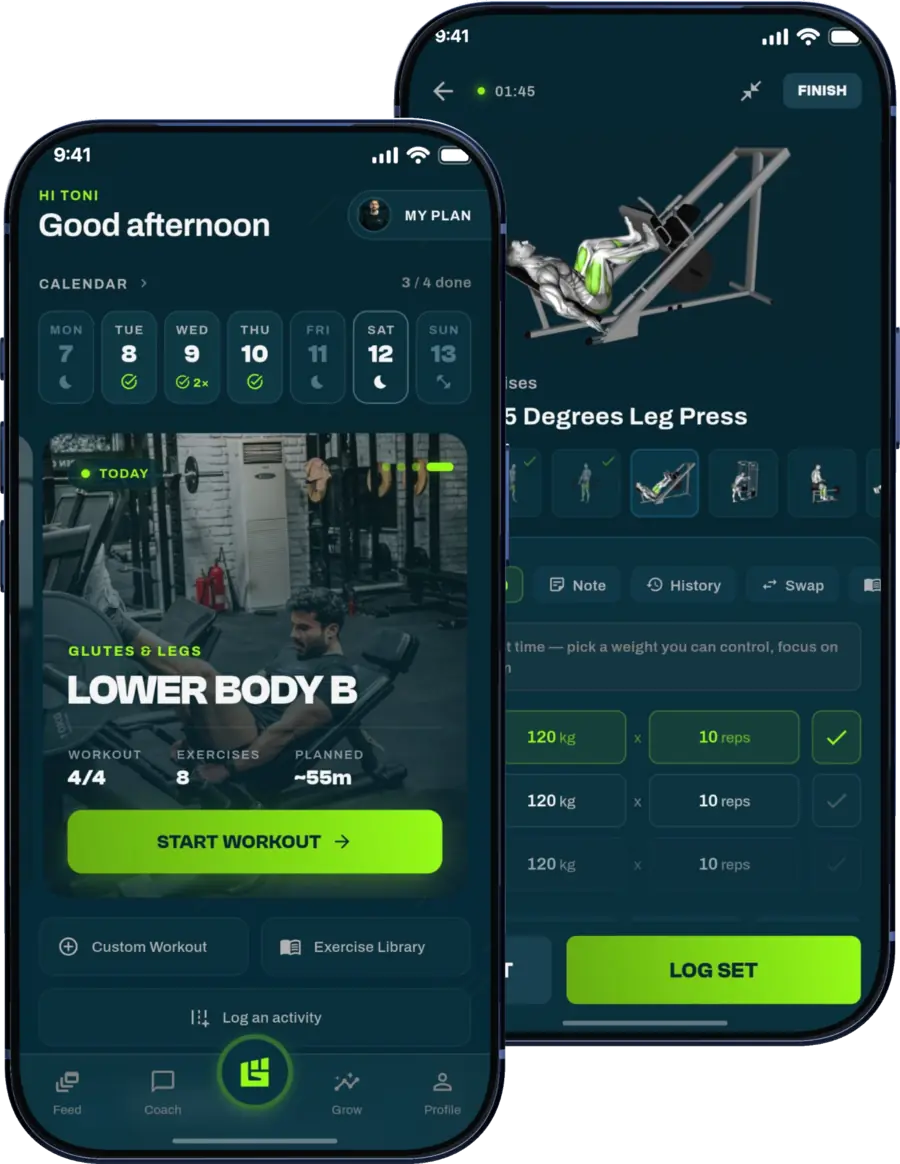
Get a personalized workout plan built around your goal, equipment and schedule. Train smarter, track every rep and keep moving forward, one workout at a time.







The philosophy behind the movement
The idea behind functional training is refreshingly simple: your workouts should directly improve your life. It's designed to bridge the gap between what you do in the gym and how you move in the real world by focusing on exercises that mimic natural human movements.
These are almost always compound exercises, meaning they get multiple joints and muscle groups working at the same time. This integrated approach builds strength that actually translates to practical tasks, like picking up a heavy box or pushing a stalled car.
The core philosophy is to train for life, not just for the gym. It's about developing the strength, stability, and mobility needed to perform everyday activities with confidence and ease.
This style of training isn’t some new fad, but its popularity has exploded for a good reason. According to the American College of Sports Medicine's (ACSM) annual survey, it has consistently ranked in the top 20 global fitness trends every year since 2007. This staying power shows just how effective it is for everyone, from busy parents to competitive athletes who need their training to deliver real, tangible results.
The key goals of functional training
So, what are you actually trying to achieve with a good functional strength program? It all boils down to building a more capable and durable body.
- Improving movement patterns: The focus is on mastering fundamental human movements—think pushing, pulling, squatting, hinging, and carrying. These are the building blocks of everything we do.
- Enhancing core stability: A strong, stable core is the foundation for almost every movement you make. Functional exercises are designed to challenge your midsection to provide support and transfer force effectively.
- Boosting real-world strength: This is the kind of strength you can actually feel and use, whether that means carrying all your groceries in one trip or effortlessly lifting your luggage. You can learn more about the broader concept in our detailed guide to functional fitness.
- Reducing injury risk: By strengthening the muscles and improving coordination for common movements, you make your body far more resilient to the tweaks, strains, and sprains of daily life.
To make these ideas a bit clearer, here’s a quick breakdown of the core principles in action.
Key concepts in functional strength training
This table shows how the core principles of functional training connect directly to everyday activities.
| Principle | Description | Real-World Example |
|---|---|---|
| Multi-joint movements | Exercises that engage multiple joints and muscles at once, mimicking natural motion. | A Goblet Squat trains the same muscles you use to pick up a heavy box off the floor. |
| Core integration | Every movement starts from a strong, stable core to generate and transfer power. | A Farmer's Walk builds the core stability needed to carry heavy grocery bags without straining your back. |
| Movement in multiple planes | Training your body to move not just forward and back, but also side-to-side and rotationally. | A Wood Chop strengthens the rotational power you use when shoveling snow or swinging a golf club. |
| Unilateral training | Working one limb at a time to improve balance, stability, and correct muscle imbalances. | Single-Arm Dumbbell Rows ensure both sides of your back are equally strong for pulling open a heavy door. |
As you can see, the goal is always to create a clear link between the gym and your life, making you stronger and more capable where it truly counts.
Understanding the core principles of functional strength
To really get what makes functional strength training click, we need to pop the hood and look at the "why" behind the workouts. It’s not just a grab-bag of random exercises; it’s a smart, logical system for building a more capable and bulletproof body. The principles are simple and tied directly to how you were built to move.
At its core, functional strength is about teaching your body to work as a single, coordinated machine. Instead of seeing your body as a collection of separate parts—biceps here, quads there—this approach trains everything to fire together. Every exercise is a lesson in teamwork for your muscles, joints, and nervous system.
The power of compound movements
The first and most important principle is the focus on multi-joint, compound exercises. These are movements that demand action at more than one joint at the same time, like a squat (using your hips, knees, and ankles) or a push-up (using your shoulders and elbows).
This is a huge departure from isolation exercises, like a bicep curl, which zone in on a single muscle and joint. While isolation work has its place, functional training is all about compound movements because life itself is a series of compound actions. You never just use your biceps to lift a heavy box; you use your legs, back, core, and arms all at once.
Think of it this way: an isolation exercise is like a musician practicing a single note over and over. A compound exercise is like the entire orchestra playing a powerful chord in perfect harmony. The combined effect is far greater.
By training muscles to work together, you build strength you can actually use. A proper deadlift, for example, isn't just a "back exercise"—it's a masterclass in firing up your entire posterior chain to safely pick something heavy off the ground. That’s a skill that protects your spine every single day.
Training in three dimensions
Our bodies don't just move forward and backward. We twist, turn, bend sideways, and reach across our bodies constantly. That brings us to the second core principle: training in multiple planes of motion.
Imagine you’re standing inside a glass box. You can move in three primary ways:
- Sagittal plane: Forward and backward movements. Think running, squatting, or doing a bicep curl.
- Frontal plane: Side-to-side movements, like side lunges or lateral raises.
- Transverse plane: Rotational or twisting movements, like swinging a golf club or throwing a ball.
Most traditional gym routines live almost entirely in the sagittal plane. This can leave you strong in a straight line but unstable and weak when you have to rotate or move sideways. Functional training fixes this by weaving in exercises that challenge you in all three dimensions, building well-rounded strength that cuts down on injury risk during dynamic, real-world activities. A cable wood chop or a lunge with a twist are perfect examples of building this rotational power.
The non-negotiable integrated core
The final pillar of functional strength is the idea of an integrated core. Your core is so much more than your abs; it's the entire muscular corset around your torso, from your hips to your shoulders, that works to keep your spine stable.
In functional training, the core is treated like a central power station that transfers force between your upper and lower body. Every single exercise, from a kettlebell swing to an overhead press, is also a core exercise. It teaches your midsection to brace and stay rigid under load, protecting your spine and letting your arms and legs generate maximum power.
This is why you won't see many crunches in a functional program. Instead, you'll do movements that challenge your core to resist motion, such as:
- Anti-extension: Fighting the urge to arch your lower back (e.g., a plank).
- Anti-rotation: Resisting twisting forces (e.g., a Pallof press).
- Anti-lateral flexion: Resisting bending sideways (e.g., a single-arm farmer's carry).
By building on these principles—compound movements, multi-planar training, and core integration—functional strength training forges a body that isn’t just strong in the gym, but strong, stable, and useful everywhere else.
Functional strength vs traditional bodybuilding
So, is functional training just a trendy new name for bodybuilding or those intense HYROX races you see all over social media? Not quite.
While they all involve hitting the weights, their core philosophies, methods, and—most importantly—their end goals are worlds apart. Nailing down the differences is the key to figuring out which path actually aligns with what you want to achieve.
Think of it this way: a functional strength athlete is like a versatile home cook, focused on making meals that are nourishing and practical for everyday life. A bodybuilder is more like a pastry chef, meticulously sculpting a cake for a competition where appearance is everything. They both use an oven, but for completely different reasons.
The goal defines the method
The biggest split between functional strength and traditional bodybuilding comes down to one simple question: what are you building strength for?
For functional training, the answer is all about performance and real-world capability. The entire goal is to improve how your body moves and handles tasks outside the gym—whether that's hoisting a heavy suitcase into an overhead bin or playing with your kids without throwing your back out.
Traditional bodybuilding, on the other hand, is laser-focused on aesthetics and hypertrophy, which is just the scientific term for making muscles bigger. The main objective is to sculpt a specific physique by isolating individual muscles and growing them as much as possible. A bodybuilder is undeniably strong, but their training isn't optimized for the messy, unpredictable movements of daily life.
This visual breaks down the core ideas that drive a good functional strength program.
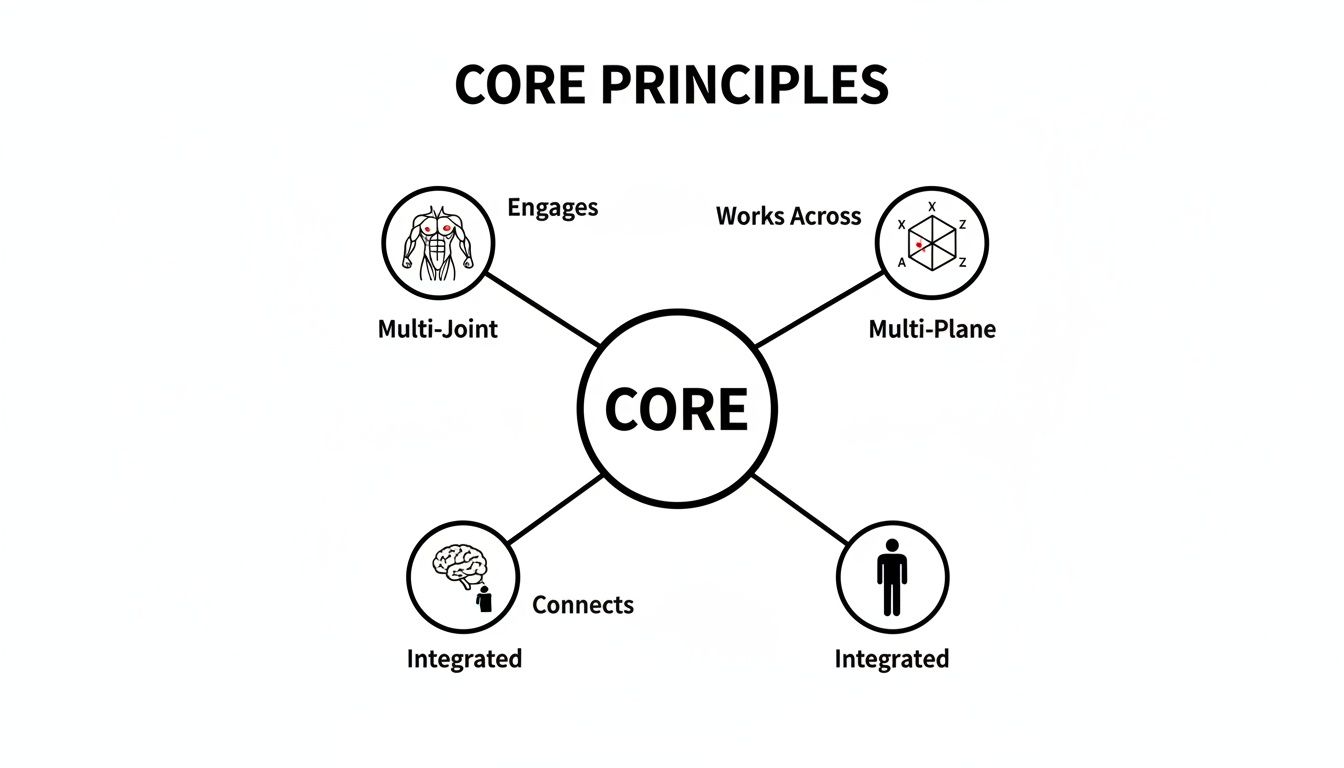
As you can see, it’s all built on a foundation of integrated, multi-joint movements that work across different planes of motion, all stemming from a strong, stable core.
Where does HYROX fit in?
So what about competitive fitness events like HYROX? These competitions are packed with functional movements like sled pushes and farmer's carries, but they represent a highly specialized application of those principles.
At its core, HYROX is a sport that tests work capacity and endurance under extreme fatigue.
While it uses functional exercises, the training is dialed in for the specific demands of the race. It’s less about general life preparedness and more about optimizing performance for a grueling series of running and strength-endurance stations.
A HYROX athlete uses functional movements to train, but their ultimate goal is sport-specific performance—getting better at a very particular set of challenges. This demands a much bigger emphasis on cardio and muscular endurance than a general functional strength program.
Ultimately, functional strength training is the foundation. You can use its principles just to make life easier, specialize them for a sport like HYROX, or even use them to build a powerful, muscular physique.
Comparing training styles functional vs hypertrophy vs HYROX
To make the differences crystal clear, let's put these three approaches side-by-side. This table should help you see exactly where your own fitness goals might fit.
| Aspect | Functional Strength | Traditional Hypertrophy | HYROX/Functional Fitness |
|---|---|---|---|
| Primary goal | Improve real-world capability, movement quality, and injury resilience. | Maximize muscle size and achieve a specific aesthetic or physique. | Maximize performance in a competitive event combining strength and endurance. |
| Typical exercises | Compound movements like squats, deadlifts, overhead presses, and loaded carries. | Isolation exercises like bicep curls, leg extensions, and pec deck flyes. | Sport-specific skills like sled pushes, wall balls, and intense cardio intervals. |
| Key metric | Improved performance in daily activities, better balance, and increased usable strength. | Increased muscle circumference, body composition, and visual definition. | Faster race times, higher rep counts under fatigue, and improved work capacity. |
| Focus | How the body works as an integrated system ("go" muscles). | How individual muscles look and their size ("show" muscles). | How long and fast you can sustain a high power output. |
Understanding these distinctions is the most important part of answering the question: what is functional strength training and how does it apply to you? It's a flexible system that builds a solid base for nearly any physical goal, whether that’s carrying groceries without back pain or crossing the finish line of your next race.
Essential exercises for building functional strength
This is where the theory hits the gym floor. Knowing the principles behind what is functional strength training is great, but building real-world power comes from doing the work. The beauty of it is its simplicity; you don't need a hundred different exercises. It all boils down to mastering a few fundamental human movements.
Think of these not just as exercises, but as core skills your body was designed to perform. Mastering them builds a foundation of strength that makes every physical task in your life feel easier and safer.
The squat: the foundation of lower body strength
The squat is king. It's the way we lower our center of gravity, whether we're picking up a toddler, getting out of a chair, or grabbing something from the bottom shelf. A good squat builds strong legs, healthy knees, and an unshakable core.
Its real-world translation is immediate. Every time you stand up, you're doing a bodyweight squat. By adding weight to this pattern, you’re making one of life's most common movements feel totally effortless while taking the strain off your lower back.
- Beginner progression: Start with Bodyweight Squats. Your only job is to perfect the form. Sit your hips back, keep your chest tall, and drive through your heels to stand up.
- Intermediate variation: The Goblet Squat is a game-changer. Holding a dumbbell or kettlebell at your chest acts as a perfect counterbalance, helping you stay upright and sink deeper into the squat.
- Advanced variation: A Barbell Front Squat is the next level. It forces your core and upper back to work overtime, building truly integrated lower-body power.
The hinge: mastering lifting mechanics
The hinge is all about bending at the hips while keeping your back flat. This is the correct way to lift things off the floor, period. It's the movement behind deadlifts and kettlebell swings, and it’s your best defense against back pain.
Think about it: you hinge every time you bend over to tie your shoes. A weak hinge is why so many people tweak their backs doing simple chores—they bend with their spine instead of their hips. Training this pattern builds powerful glutes and hamstrings, the real engine of your body.
By mastering the hinge, you're not just learning to deadlift; you're learning the lifelong skill of how to lift heavy things without hurting your back. It's one of the most powerful injury-prevention tools you can develop.
The push and pull: building upper body balance
Pushing and pulling are the two main jobs of your upper body. Pushing movements, like push-ups and overhead presses, build strength in your chest, shoulders, and triceps. These translate to pushing a heavy door, putting luggage in an overhead bin, or just getting up off the floor.
Pulling movements, like pull-ups and rows, are just as important. They strengthen your back, biceps, and grip—everything you need to pull-start a lawnmower or carry a heavy box. A smart program includes both horizontal (rows, push-ups) and vertical (pull-ups, overhead presses) movements to build well-rounded, balanced strength.
- Beginner push: Can't do a full push-up? Start with Incline Push-Ups, placing your hands on a bench or wall to reduce the load and focus on perfect form.
- Beginner pull: Inverted Rows, using a bar in a squat rack or TRX straps, are the perfect starting point for building the back strength needed for pull-ups.
The loaded carry: the ultimate functional test
Finally, we have the loaded carry. This might be the most direct translation of gym strength to real-world capability. It's as simple as it sounds: pick up something heavy and walk with it. The most common version is the Farmer's Walk, where you carry a weight in each hand, just like hauling grocery bags or suitcases.
This one simple act fires up nearly every muscle you have. It builds a crushing grip, a rock-solid core, and incredible full-body stability. It teaches your body to stay tight and organized while moving, which is the very definition of functional strength. You can also try a Suitcase Carry (weight in one hand) to seriously challenge your core's ability to fight against bending sideways.
No matter which exercises you choose, proper form is non-negotiable. It's the key to staying safe and getting results. Using a tool like the GrabGains app can be a massive help, giving you access to a library of over 350 exercises with clear video guides to make sure you’re doing every move right from day one.
How to structure your functional strength program
Knowing the right exercises is one thing, but stringing them together into a smart plan is where the real magic happens. Random workouts get you random results. A well-designed program, on the other hand, gives your body the consistent, intelligent challenge it needs to adapt and get stronger week after week.
Building a functional strength program isn't about making things complicated; it's about consistency and balance. The goal is simple: train the big movement patterns regularly and always ask for just a little bit more than you did last time.
Building your weekly template
The most effective way to start is with a full-body routine two to three times per week, leaving at least one rest day in between. This frequency gives you plenty of stimulus to grow without running you into the ground. It's a sweet spot for beginners and intermediates alike.
Forget "leg day" or "arm day." Instead, think in terms of "movement day." This shift in mindset ensures you build a balanced, capable body from head to toe.
A simple—but brutally effective—template for each workout looks like this:
- Lower body squat pattern: 1 exercise (e.g., Goblet Squat)
- Upper body push pattern: 1 exercise (e.g., Push-Up)
- Lower body hinge pattern: 1 exercise (e.g., Kettlebell Swing or Romanian Deadlift)
- Upper body pull pattern: 1 exercise (e.g., Dumbbell Row)
- Loaded carry: 1 exercise (e.g., Farmer's Walk)
This framework guarantees you’re hitting every major muscle group in a functional, integrated way every time you train.
The key to getting stronger: progressive overload
If there's one principle you need to understand for long-term progress, it's progressive overload. It might sound technical, but the idea is dead simple: to get stronger, you have to consistently make your workouts harder over time. If you lift the same weights for the same reps forever, your body adapts and then... stops changing.
Progressive overload is the art of giving your body a reason to change. By gradually increasing the demand, you force your muscles, bones, and connective tissues to adapt by becoming stronger and more resilient.
There are a few ways to apply progressive overload. The trick is to focus on improving just one thing at a time so you can actually track what's working.
- Increase the weight: Add a little weight to the bar or grab the next dumbbell up.
- Increase the reps: If you did 8 reps last week, shoot for 9 or 10 this week with the same weight.
- Increase the sets: Do one more set of an exercise than you did last time.
- Decrease the rest time: Shave a few seconds off your rest periods to make the workout denser.
This constant push for "just a little bit more" is what separates a real program from just messing around in the gym.
Taking the guesswork out of planning
While building your own plan is empowering, it can also be a headache. This is where modern tools come in, making sure your hard work is actually pointed in the right direction.
The demand for this kind of intelligent training isn't just a niche trend. Functional fitness has been a top-20 fitness trend since 2007, which is why gyms everywhere now have yokes, sandbags, and sleds. Combine that with a recent surge of 10 million new gym members, and you can see the massive shift toward performance-based goals. The home gym market is also exploding, with strength equipment expected to drive an 8.4% growth rate to hit USD 19.75 billion by 2031. You can read more about these fitness trends on the ACSM website.
For HYROX racers, home gym lifters, and beginners who want the results without the planning stress, platforms like GrabGains offer a much smarter path. The app uses adaptive AI to build a personalized functional strength program for you. It automatically tweaks your workouts based on how you perform, taking all the guesswork out of progressive overload.
With a library of over 350 video-guided exercises and clear visuals of your progress, you get a professionally structured plan that grows with you. It puts you on the most direct path to your goals, letting you focus on the work while the app handles the thinking.
Your functional strength questions, answered
As you get ready to dive in, it's natural for a few questions to come to mind. Let's tackle some of the most common ones to clear up any doubts and get you started with confidence.
Can you actually build muscle with functional training?
Absolutely. While the main goal isn't just getting bigger for the sake of it (hypertrophy), functional training is fantastic for building a strong, muscular physique. The focus on heavy, compound exercises like squats, deadlifts, and overhead presses creates a massive stimulus for growth across your entire body.
These big lifts recruit multiple muscle groups at once, which triggers a powerful hormonal response that encourages muscle growth. When you pair that with progressive overload—consistently adding a little more weight or a few more reps—you will build muscle. The result is a physique that's as capable as it looks.
How often should I do functional strength workouts?
For most people, aiming for 2 to 4 sessions per week is the sweet spot. That frequency gives your body enough stimulus to make real progress, but also enough time to recover, repair, and come back stronger.
Remember, the quality of your sessions and recovery is far more important than the quantity. Listen to your body and make rest a priority to avoid burnout.
If you're just starting out, two solid full-body workouts a week will deliver incredible results. As you get more experienced and your body gets better at recovering, you might find that three or four sessions feel right to keep the gains coming without overdoing it.
Do I need a gym membership to start?
Not at all. One of the best things about functional training is how adaptable it is. You can build a seriously strong and resilient foundation with nothing more than your own bodyweight.
Exercises that are the bedrock of functional strength can be done anywhere:
- Squats: Build powerful legs and a strong core.
- Push-ups: Develop upper-body pushing strength.
- Lunges: Improve balance and single-leg stability.
- Planks: Forge a rock-solid, integrated core.
Once you get stronger, you can add simple, affordable tools like resistance bands, a kettlebell, or a set of dumbbells to unlock hundreds of new exercises. You can get amazing results without ever setting foot in a commercial gym, making it a practical choice for anyone.
Ready to stop guessing and start building real-world strength with a plan that adapts to you? GrabGains uses intelligent programming to create functional workouts that evolve with your progress. Pre-register today for the app and be the first to experience your pocket personal trainer.
Get inspired and motivated