How to increase bench press strength and shatter your plateaus
Discover how to increase bench press strength with our proven guide. Learn actionable programming, form cues, and nutrition tips to build a powerful chest. Want to increase your bench press? The secret isn't just about slapping more plates on the bar. It’s about mastering your technique.
Perfecting your form can instantly add pounds to your lift, creating a stable and powerful base that prevents injury and makes every single rep count.


Building your foundation for a bigger bench press
Before you even think about your next PR, you have to lock in your foundation. A bigger bench starts with flawless technique, not brute force. Many lifters stall because they try to out-muscle bad form, which is a fast track to frustration and injury.
Think of this as your pre-flight checklist. We're going to break down the non-negotiable cues that unlock strength you probably don't even know you have.
Creating a rock-solid base
Your bench press doesn't start when you unrack the bar—it starts the second you lie down. The real secret to moving heavy weight safely is creating unwavering, total-body tension.
Built for progress
Take the guesswork out of training
Get a personalized workout plan built around your goal, equipment and schedule. Train smarter, track every rep and keep moving forward, one workout at a time.






- Plant Your Feet: Drive your feet hard into the floor and keep them flat. Your feet should be positioned just behind your knees, which helps fire up your quads and glutes. This is where your power actually begins.
- Engage Your Glutes: Squeeze your glutes like you mean it. This locks your hips to the bench and stops them from shooting up mid-lift—a classic power leak that kills your drive.
- Arch Your Back (Safely): Create a natural arch in your lower back, but make sure your glutes and shoulder blades stay glued to the bench. We're not talking about a crazy powerlifting arch, just a slight curve that puts your chest in a much stronger position to press from.
Securing your shoulders and grip
Your upper back and hands are your direct connection to the bar. If your setup is weak here, the whole lift is compromised. The goal is simple: turn your upper back into a solid platform.
A tight upper back is non-negotiable. By retracting and depressing your scapula, pulling your shoulder blades together and down: you create a solid shelf. This protects your shoulder joints and shortens the bar's path, making the lift more efficient.
Finding your ideal grip width is just as important. Go too wide, and you'll put unnecessary strain on your shoulders. Too narrow, and you're just doing a triceps exercise.
A great starting point is to place your hands just outside shoulder-width. When the bar is on your chest, your forearms should be perfectly vertical. This setup gives you the best blend of power from both your chest and triceps.
To see how this all fits into building real-world strength, check out our guide on what is functional strength training. Nailing these fundamentals is the single most important step on your journey to a bigger bench.
Before we move on, let's put all those cues together into a quick reference table.
Bench press technique at a glance
Use this table as a quick checklist before every set to ensure your form is locked in and ready for a powerful lift.
| Technical Cue | Why It Matters | How to Execute |
|---|---|---|
| Feet Planted Firmly | Creates a stable base and initiates leg drive for more power. | Drive your feet flat into the floor, positioned slightly behind your knees. |
| Glutes Engaged | Prevents hips from rising off the bench, maintaining a solid foundation. | Squeeze your glutes hard throughout the entire lift. |
| Shoulder Blades Retracted | Protects shoulder joints and creates a stable pressing platform. | Pull your shoulder blades together and down, as if tucking them into your back pockets. |
| Secure Grip | Ensures maximum control and power transfer to the bar. | Grip the bar just outside shoulder-width, ensuring forearms are vertical at the bottom. |
| Controlled Descent | Builds tension and sets you up for a more explosive press. | Lower the bar to your mid-chest in a controlled manner, not just letting it drop. |
| Full Body Tension | Unifies the body into a single, powerful unit to move maximal weight. | From your feet to your hands, stay tight and braced throughout the lift. |
Getting these details right isn't just about lifting more: it's about lifting smarter and safer for the long haul.
Programming for consistent strength gains
Perfecting your technique builds the foundation, but smart programming is the engine that actually drives your bench press numbers up. Just showing up and lifting heavy without a plan will only get you so far before you slam into a frustrating plateau.
The secret to long-term progress isn't complicated: it's a structured approach built around progressive overload.
Put simply, to get stronger, you have to consistently challenge your muscles to do more than they're used to. This doesn't always mean slapping more weight on the bar. It's about strategically tweaking variables like sets, reps, and intensity to force your body to adapt. You can get a deeper dive in our guide to progressive overload training.
Understanding your starting point
Before you can build a solid program, you need a baseline. This is your one-rep max (1RM)—the absolute most you can lift for a single rep with good form. But let's be real: testing a true 1RM can be risky and incredibly taxing.
A much safer and more practical route is to find your estimated 1RM (e1RM). You can figure this out by lifting a weight you can handle for 3-5 clean reps and plugging it into a calculator. For instance, if you bench 185 lbs for 5 solid reps, your e1RM is roughly 215 lbs. All your training percentages should be based on this number, not a wild guess.
Your program's effectiveness hinges on using the right numbers. Training with percentages based on an accurate e1RM ensures you're lifting heavy enough to spark growth but not so heavy that you risk injury or burnout.
Once you have your e1RM, you can start building your workouts around it. This number dictates every weight you'll use for your different training days and rep schemes.
Choosing the right progression model
How you apply progressive overload should change as you get more experienced. A beginner's path to a stronger bench looks completely different from an advanced lifter's.
- Linear Progression (Beginners): This is the most straightforward method. Each week, you simply add a small amount of weight to the bar: think 2.5-5 lbs, while keeping the sets and reps the same. This works like magic for new lifters whose bodies adapt incredibly fast.
- Block Periodization (Intermediate/Advanced): Once those easy linear gains dry up, you need a more sophisticated plan. Block periodization involves cycling through different training phases: like hypertrophy (building muscle), strength, and peaking: for several weeks at a time. This allows you to build a bigger muscular base first, then teach it how to express its full strength.
This flowchart breaks down the foundational steps that every single rep, in any program, must follow.
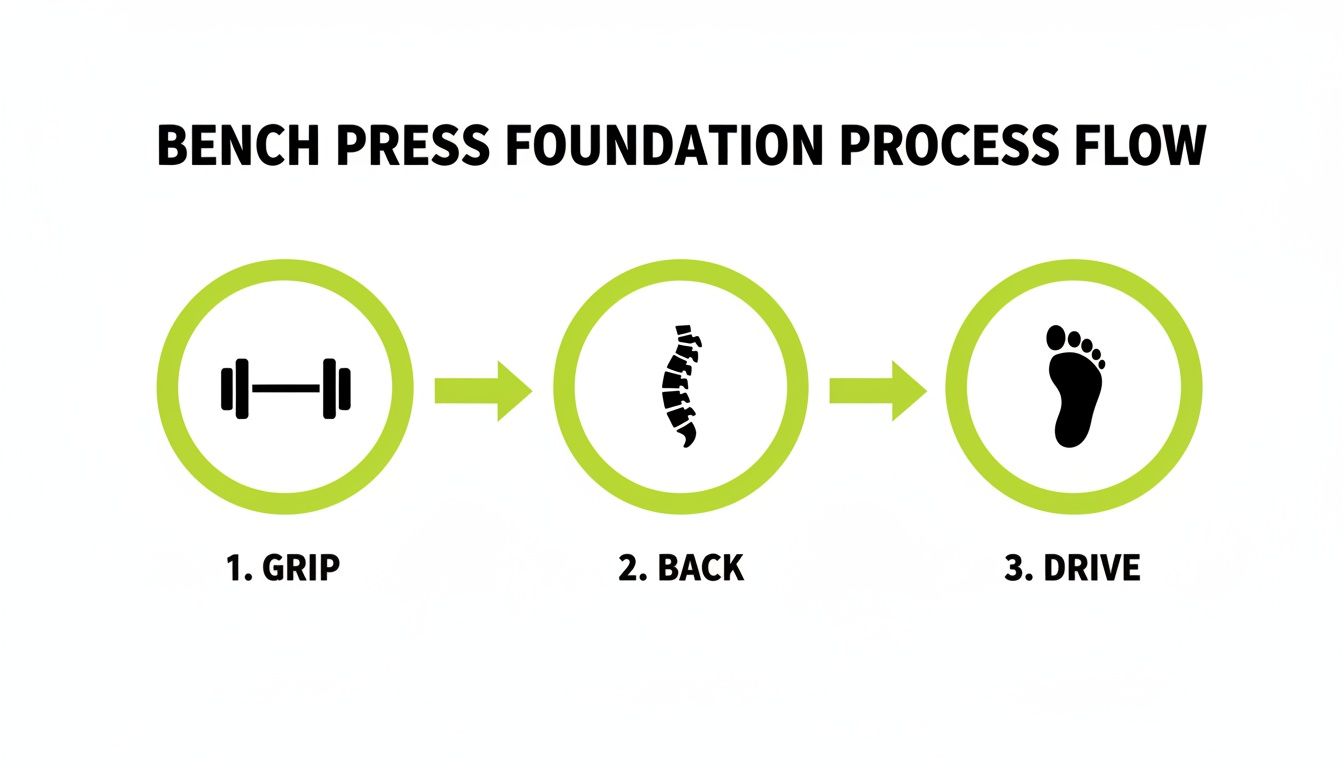
As you can see, a powerful bench press is a sequence of events. It all starts with the grip, moves to back tightness, and finishes with leg drive. This structure is critical for transferring force safely and efficiently through the bar.
Tracking and adapting for success
A program is only as good as your ability to follow and adapt it. Meticulous tracking isn't just for elite athletes; it's essential for anyone serious about getting stronger. The best lifters in the world prove that strength gains are directly tied to systematic training and measurable progress. Julius Maddox’s journey to a world-record 355 kg raw bench is a perfect example of how disciplined progression leads to incredible results.
For lifters trying to add pounds to their bench, this is a clear lesson: a structured, data-driven approach is the key to consistent improvement.
Make a habit of logging every set, rep, and weight you lift. This data tells you what's working and signals when it's time to make a change: whether that means adding weight, tweaking your rep scheme, or taking a much-needed deload week. If you're not tracking, you're just guessing.
Using accessory lifts to smash weak points
A monster bench isn't built by benching alone. If your numbers have stalled, the culprit is almost always a weak link somewhere in the chain. Accessory lifts are your secret weapon for hunting down and eliminating these weak points, building the muscular armor you need to handle heavier weight.
Think of it this way: your chest might be strong, but if your triceps give out before you can lock the weight, the lift is toast. Likewise, if your upper back is too weak to create a stable platform, you’ll leak power before the bar even moves. This is where smart accessory work becomes non-negotiable for anyone serious about their press.
Building bulletproof triceps for lockout power
One of the most common places to fail a heavy bench is at the lockout—that final push to full arm extension. When you get stuck here, it’s a glaring sign that your triceps need work. They're responsible for extending the elbow, and making them stronger directly translates to a more powerful finish.
A few exercises are absolute gold for this:
- Close-Grip Bench Press: This variation puts the focus squarely on the triceps and inner chest. Grab the bar just inside shoulder-width and keep those elbows tucked tight to your body.
- Dips: Whether on parallel bars or a bench, dips are a bodyweight powerhouse for building up the triceps and chest. Once you can knock out clean sets, add weight with a dip belt to keep pushing.
- Triceps Pushdowns: Using a cable machine keeps constant tension on the muscle through the entire rep, which is fantastic for building both size and endurance.
By dedicating real effort to these movements, you fortify the muscles that finish the lift, turning a weak point into a new source of strength.
Accessory work isn't just "extra" stuff—it's targeted training. Figure out where you fail—off the chest, midway, or at lockout—and you can pick the exact exercises to turn that weakness into a strength.
Fortifying your shoulders and upper back
Your shoulders and upper back are the foundation of your press. The front of your shoulders (anterior deltoids) are a primary mover, but it's your upper back (lats, rhomboids, traps) that creates the stable shelf you press from. Neglecting them is like trying to shoot a cannon from a canoe; all your force just dissipates.
Building up these support structures is crucial for both power and staying injury-free.
- Overhead Press (OHP): The OHP is the undisputed king of shoulder-building lifts. It builds raw pressing strength in your delts and triceps while demanding serious core stability.
- Heavy Rows: Barbell rows, dumbbell rows, and chest-supported rows are all essential. A strong back lets you pull your shoulder blades together hard, protecting your shoulders and shortening the bar's path.
- Face Pulls: Think of these as your shoulder health insurance policy. Face pulls strengthen the rear delts and external rotators, helping to balance out all that pressing and keep your shoulders healthy for the long haul.
If you want even more ways to build a bigger, stronger chest, take a look at our guide on the 7 best chest exercises for size, strength, and muscle growth. Integrating these movements makes sure your main lift is built on a solid foundation.
Top accessory lifts for a bigger bench
To help you choose the right tools for the job, here’s a quick breakdown of the best accessory lifts and how they directly contribute to a stronger bench press.
| Accessory Exercise | Primary Muscle Targeted | How It Boosts Your Bench |
|---|---|---|
| Close-Grip Bench Press | Triceps, Inner Chest | Directly improves lockout strength and power. |
| Overhead Press (OHP) | Shoulders, Triceps | Builds raw upper-body pressing power and shoulder stability. |
| Barbell Rows | Upper Back (Lats, Rhomboids) | Creates a stable platform to press from, protecting shoulders. |
| Dips | Triceps, Chest, Shoulders | Excellent for building triceps mass and lockout power. |
| Face Pulls | Rear Delts, Upper Back | Promotes shoulder health and structural balance. |
Picking the right movements based on your specific sticking points is the fastest way to see your bench numbers start climbing again.
Integrating accessories without burning out
Adding accessory work shouldn't mean spending three hours in the gym. The key is to program them smartly so they support, not sabotage, your main lifts. A great rule of thumb is to pick 2-3 accessory exercises to perform after your primary bench press work for the day.
Keep the volume and intensity in a range that promotes muscle growth without leaving you wrecked for your next session. A solid starting point for most accessory lifts is 3-4 sets of 8-12 reps. This hypertrophy-focused rep range is perfect for building bigger, stronger support muscles that will pay direct dividends on your bench press.
Fueling your lifts with smart nutrition and recovery
Real strength isn’t just built in the gym. It’s forged in the hours after you’ve racked the bar—in your kitchen and while you sleep. You can have the most dialed-in training program on the planet, but without proper fuel and repair, you're just spinning your wheels.
Think of it this way: your workouts are the signal to grow, but nutrition and rest are the raw materials and the construction crew that actually get the job done. If either is missing, your progress will screech to a halt.
Dialing in your macros for strength
To get stronger, you have to eat like you mean it. That comes down to getting your macronutrients—protein, carbs, and fats—right. Each one plays a critical role in pushing your bench press numbers up.
- Protein: This is non-negotiable. After a heavy bench day, you've created tiny tears in your muscle fibers. Protein provides the amino acids needed to patch them up and build them back stronger. Aim for 1.6 to 2.2 grams of protein per kilogram of your body weight.
- Carbohydrates: Carbs are pure performance fuel. They power you through tough sets and replenish the glycogen you burn during training. If you feel sluggish and weak in the gym, a lack of carbs is often the culprit.
- Fats: Don't fear the fats. Healthy fats are crucial for producing hormones like testosterone, which is a major driver of strength and muscle gain. They also help keep inflammation in check.
Getting these numbers sorted is fundamental. If you’re not sure what your daily targets should be, a macro calculator designed for your fitness goals can give you a solid starting point.
The power of a small caloric surplus
You can’t build a house without bricks. In the same way, you can’t build new muscle tissue without extra energy. To force your body to grow, you need to be in a caloric surplus—consuming slightly more calories than you burn each day.
This isn’t an excuse to go on a junk food free-for-all. A small, targeted surplus of 250-500 calories over your daily maintenance is the sweet spot. It provides just enough extra energy to fuel muscle growth while keeping fat gain to a minimum. It's a small daily investment that pays off big on the bench.
Smart strength building is a two-part equation: you provide the stimulus in the gym, and you provide the building blocks in the kitchen. One without the other will always lead to frustration and stalled progress.
Recovery strategies that go beyond the plate
Nutrition is only half the recovery equation. How you actively manage your downtime is what separates the stalled lifter from the one hitting new PRs. The bench press puts a ton of stress on your shoulders, so giving them some TLC is essential for staying in the game long-term.
These are the strategies that keep you healthy and ready for your next big session.
- Mobility Work: Spend 10-15 minutes every day working on your shoulder and thoracic spine mobility. Simple moves like band pull-aparts, face pulls, and foam rolling your upper back can do wonders for counteracting the stress of heavy pressing.
- Strategic Deloads: You can't redline your engine forever. A deload is a planned week of lighter weights and lower volume every 4-8 weeks. It gives your central nervous system and joints a much-needed break, preventing burnout and priming you for the next block of hard training. Think of it as taking one step back to take two giant leaps forward.
- Quality Sleep: This is the most powerful recovery tool you have, and it’s free. Aim for 7-9 hours of solid sleep a night. This is when your body releases growth hormone and gets to work on serious muscle repair. Skimping on sleep is like throwing your gains away.
Troubleshooting plateaus and sticking points
Hitting a plateau is a rite of passage for every lifter. One week the weight is flying up, and the next, it feels like it’s bolted to your chest. This is where smart, targeted training separates those who stay stuck from those who smash through to new PRs.
Instead of getting frustrated, it's time to play detective. A sticking point isn't just a failed lift—it's a clue that tells you exactly where the chain is breaking. By figuring out the exact moment you fail, you can pick the right exercises and technique tweaks to turn that weakness into a weapon.
This mindset transforms roadblocks into opportunities, giving you the tools to not just follow a plan but to adapt and overcome when progress grinds to a halt.
Failing right off the chest
If the bar feels glued to you the second you try to press, your issue is starting strength. You’re struggling to generate that initial force to get the bar moving. This usually points to a lack of pectoral power and explosiveness from a dead stop.
To fix this, we need to build power from the bottom up.
- Paused Bench Press: This is your best friend. Do your regular bench press, but pause the bar on your chest for a solid 2-3 seconds on every single rep. This kills the stretch reflex, forcing your chest to generate raw power.
- Explosive Push-Ups: Think about pushing the floor away as hard and fast as you can. If you're able, add a clap between reps to really dial in that explosive force production.
- Dumbbell Bench Press: Dumbbells give you a deeper stretch and a greater range of motion, strengthening your pecs in their most lengthened position where they're often weakest.
By bringing these moves into your routine, you’ll teach your body to blast the bar off your chest with authority.
Getting stuck at the midpoint
Failing halfway up is another classic. This usually means your shoulders (specifically the anterior delts) are tapping out, or your triceps aren't strong enough to take over and finish the job. It's that critical handover from chest power to triceps power that's failing.
A sticking point is just feedback. If you fail halfway up, your body is telling you that your shoulders and triceps need dedicated attention to handle the load as the bar travels away from your chest.
Strengthening these secondary movers is the key to pushing through this common wall.
- Incline Bench Press: This variation puts more stress on the upper chest and front delts, directly strengthening the muscles you need for that middle portion of the lift.
- Overhead Press (OHP): The OHP is the undisputed king of building raw shoulder strength. A stronger OHP almost always leads to a stronger, more stable bench press.
These exercises build the horsepower you need to drive the bar right through that stubborn midpoint.
Struggling with lockout
Can you get the bar most of the way up but just can't quite extend your elbows? Your triceps are the weak link. The lockout is almost all triceps, and if they aren't up to the task, the lift will die just inches from completion.
Luckily, triceps are pretty easy to target with the right isolation work.
- Close-Grip Bench Press: Bring your grip in to just inside shoulder-width. This simple change shifts the load heavily onto your triceps, making it a fantastic builder of lockout power.
- Weighted Dips: Dips are a phenomenal compound movement for building massive triceps. Once you can knock out bodyweight reps easily, add weight with a dip belt to keep the gains coming.
- Floor Press: By lying on the floor, you shorten the range of motion and take your legs out of the equation. This forces your triceps and chest to do all the work to lock out the weight.
The progress lifters have made over the decades shows just how much is possible with this kind of strategic training. The raw bench press world record has climbed dramatically, with Julius Maddox hitting an unbelievable 355 kg (782.6 lbs). This is a testament to how consistent work, better nutrition, and a smarter understanding of biomechanics allow lifters to shatter old limits.
If you aren't sure of your current max, our one-rep max calculator can give you a solid estimate without the risk of a true max-out attempt. By systematically find and attacking your specific sticking points, you can make sure your own numbers keep climbing.
Bench press FAQs
Even the best-laid plans run into questions. When you're chasing a bigger bench, a few solid answers can be the difference between hitting a new PR and getting stuck in a plateau. Let's tackle some of the most common things lifters ask.
How often should I bench press for strength?
This really boils down to your experience level and how fast you recover. There's no single magic number, but for most people, benching one to three times per week is the sweet spot.
If you're just starting out, one solid, heavy session a week is plenty to drive progress without frying your nervous system. As you get more advanced, your body adapts and can handle more work. That's when adding a second or even a third day can really speed things up.
A classic, effective approach is to have one heavy day focused on low reps and high intensity. Then, your second day can be for higher volume or a specific variation, like an incline or close-grip bench press.
Should I train to failure on the bench press?
Training to failure—pushing until you physically can't complete another rep—is a tool, not a rule. And for a big compound lift like the bench press, it's a tool you should use very, very carefully.
Going to absolute failure all the time is a surefire way to tax your central nervous system, leading to burnout, stalled lifts, and a higher risk of injury. A much smarter way to train is to leave one or two reps in the tank on most of your sets. In lifting circles, this is often called an RPE (Rate of Perceived Exertion) of 8 or 9.
Pushing to failure too often is a fast track to fatigue and plateaus. Save those all-out efforts for the very last set of an exercise, and only do it once in a while to shock the system.
By training hard but stopping just short of failure, you still get that crucial muscle-building stimulus but recover much faster between workouts. This is way more sustainable and leads to better, more consistent gains over the long haul.
How do I get over the fear of heavy weight?
The mental game is just as real as the physical one. That fear of getting pinned under a heavy bar can absolutely sabotage your attempts at a new PR. Building confidence under the bar is a process, but it's totally achievable.
Here are a few strategies that actually work:
- Always Use a Spotter: This is non-negotiable for heavy sets. Seriously. Just knowing someone has your back removes a huge mental block and lets you push without hesitation.
- Use Safety Pins or Spotter Arms: Training alone? Set up the safety arms in a power rack so they sit just an inch or two below your chest. This is your fail-safe. It gives you the peace of mind to go for it.
- Try Heavy Holds: Load the bar with a weight that's a little heavier than your one-rep max. Unrack it, hold it steady at the top for 5-10 seconds, and then re-rack it. This gets your body and mind used to the feel of truly heavy weight without the risk of a failed rep.
These tactics help desensitize you to heavy loads, turning that fear into focused aggression. It's a key part of learning how to increase bench press strength—you have to train your mind just as much as your muscles.
Is a 225 lb bench press good?
Absolutely. Benching 225 pounds—stacking two 45-pound plates on each side of the bar—is a classic milestone in the gym. It's a universally respected benchmark of upper-body strength for any recreational lifter. Hitting that number shows you've put in the time and have a solid foundation of strength.
For most guys, getting to 225 can take anywhere from one to two years of consistent, smart training. While elite powerlifters are obviously pushing much more, it's a huge accomplishment that puts you well ahead of the average person. It's a goal worth celebrating when you hit it.
Ready to stop guessing and start building a truly personalized plan to smash your bench press goals? GrabGains uses AI to create adaptive workout routines that evolve with you. With over 350 exercises, video guides, and smart progress tracking, it's like having a personal trainer in your pocket. Pre-register today and be the first to train smarter.
Get inspired and motivated