How to build muscle for skinny guys: a practical guide to serious gains
Discover how to build muscle for skinny guys with proven training, nutrition, and recovery strategies for real gains and lasting strength. This practical guide shows you exactly how to build muscle for skinny guys with proven training, nutrition, and recovery strategies designed to finally deliver real gains and lasting strength.


How to build muscle for skinny guys: a practical guide to serious gains
To pack on muscle as a skinny guy, you need two things: consistent, heavy resistance training and a caloric surplus. It's a simple formula. You'll focus on the big compound exercises and make sure you're eating enough protein to fuel new growth. This straightforward strategy flips your fast metabolism from a liability into a muscle-building advantage, helping you gain serious mass.
Why your lean frame is a hidden advantage
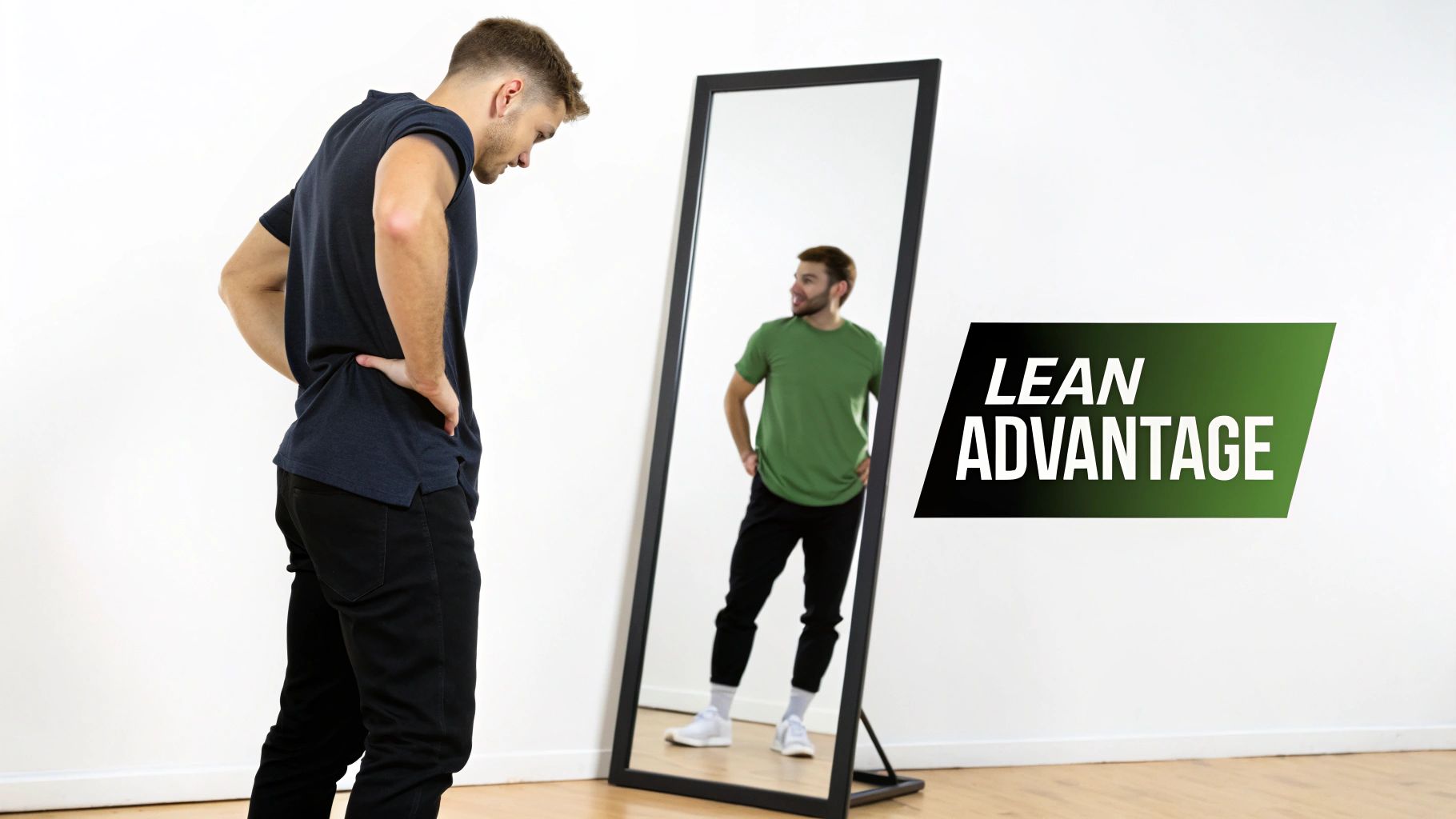
If you've spent years thinking your lean build is holding you back, it's time for a major mindset shift. Being naturally skinny isn’t a life sentence as a "hardgainer"—it's actually the perfect starting line for a dramatic transformation. Your body is primed for rapid growth once you give it the right signals.
One of the biggest perks of being lean? Visibility. Every single pound of new muscle you build stands out. Without a layer of excess body fat to hide your progress, gains in size and definition show up faster. Seeing those changes is an incredible motivator to keep you showing up.
Think of your fast metabolism not as a curse, but as a clean-burning engine. Once you provide it with the right fuel—a consistent caloric surplus—it can channel that energy directly into building lean tissue, not storing fat. Your body has untapped potential just waiting to be unlocked.
This biological head start is often called "newbie gains," and it's a very real phenomenon. When your muscles are introduced to the stimulus of resistance training for the first time, they respond by growing at a much faster rate than those of a seasoned lifter.
The science of newbie gains
For skinny guys, this initial growth phase is especially powerful. Your muscle cells are incredibly sensitive to the stress of lifting, which triggers a potent signal for hypertrophy (muscle growth). You're essentially starting with a blank slate, and your body is eager to adapt by building bigger, stronger muscle fibers.
This isn't just gym-bro science; it's backed by research. Studies consistently show that beginners can see impressive results in just a few weeks. One 2016 study, for example, found that strength training led to a 2.2 lb (1 kg) increase in lean mass in just 8 weeks for participants. It's solid proof that consistent resistance work kickstarts rapid growth. You can dig deeper into these early-stage gains with Nerd Fitness's guide on bulking up.
This means your naturally lean frame gives you the ability to:
- See visible changes quickly: Your newfound muscle definition will pop sooner, giving your confidence a massive boost.
- Build a lean foundation: You're adding quality mass from the get-go, without needing to cut through layers of fat first.
- Capitalize on hormonal response: As a beginner, your body's muscle-building hormonal response to training is at its absolute peak.
Bottom line: your genetic starting point is your greatest asset. This guide will show you exactly how to use it to get incredible results.
Getting the fundamentals right for muscle growth
Forget about secret exercises or overly complicated routines you see on social media. Building a strong, muscular frame comes down to mastering a few powerful, non-negotiable principles. If you're a skinny guy looking to pack on size, this is the absolute bedrock of your training.
At the heart of any solid muscle-building plan, you'll find compound movements. These are the big, multi-joint exercises that work several muscle groups all at once. We're talking about squats, deadlifts, bench presses, and overhead presses.
These lifts are your best friends. Why? Because they trigger a massive, body-wide muscle-building response. They force your body to recruit a huge number of muscle fibers and stimulate a much greater release of growth-promoting hormones—like testosterone and growth hormone—compared to isolation fluff like bicep curls.
The engine of all growth: progressive overload
If you only remember one thing from this guide, make it progressive overload. It's the single most important concept in strength training.
The idea is simple: for your muscles to grow, you have to force them to adapt to a stress that's slightly beyond what they're used to. You must consistently make your workouts more challenging over time.
Your body is an efficiency machine. It only builds as much muscle as it needs to handle the demands you place on it. If you lift the same weight for the same reps every single week, you're giving your body zero reason to change. You have to give it a new reason to grow.
So, how do you do that in the real world?
- Add more weight: The most obvious path. If you squatted 100 lbs for 8 reps last week, aim for 105 lbs this week.
- Do more reps: Can't bump up the weight just yet? No problem. Getting 9 reps with 100 lbs is still progress over getting 8.
- Add another set: Increasing your total workload by adding another set is another proven way to overload the muscle.
- Improve your form: This one is underrated. Performing an exercise with better control and a deeper range of motion makes it harder and more effective, even with the same weight.
By consistently applying progressive overload, you create a powerful cycle of adaptation. You challenge your muscles, they recover and grow stronger, and then you challenge them again with a slightly bigger stimulus. This is the engine that drives all muscle growth.
This isn't about destroying yourself in every session. It’s about being strategic and doing just a little bit more than you did last time. That consistent, measurable progress is what separates a program that works from one that stalls.
Why you must prioritize compound lifts
For naturally skinny guys, focusing on compound lifts is hands-down the most efficient way to gain mass. Nothing else comes close. Your training volume and your dedication to these big lifts are the cornerstones for packing on muscle.
Recent meta-analyses have shown that resistance training can add about 1.5 kg of muscle mass on average, but the key is managing your volume correctly. Doing too many sets can actually backfire and hurt your gains. You can find more details about these muscle-building findings on Strength Matters.
So, let's look at the foundational lifts that should form the core of your routine. These are your money-makers.
Your foundational compound movement toolkit
This table breaks down the non-negotiable lifts for any skinny guy serious about gaining size. Learn them, master them, and get strong in them.
| Compound Exercise | Primary Muscles Worked | Why It's Critical for Skinny Guys |
|---|---|---|
| Barbell Squat | Quads, Glutes, Hamstrings, Core | Builds a powerful lower body and a rock-solid core, triggering a growth response across your entire system. |
| Deadlift | Back, Glutes, Hamstrings, Core, Traps | The ultimate full-body strength builder. It teaches your body to work as a single, powerful unit. |
| Bench Press | Chest, Shoulders, Triceps | The gold standard for developing upper-body pushing strength and building a bigger, thicker chest. |
| Overhead Press | Shoulders, Triceps, Upper Chest | The single best lift for building broad, powerful shoulders and developing total upper-body stability. |
| Pull-Up / Lat Pulldown | Lats, Biceps, Mid-Back | This is the key to building a wide back and creating that coveted "V-taper" physique. |
| Barbell Row | Back, Biceps, Rear Shoulders | Develops thickness through your entire back and improves your posture, balancing out all the pressing work. |
Here's the takeaway: dedicate 80% of your gym effort to getting progressively stronger on these key lifts. The remaining 20% can go toward accessory movements that support these main lifts or target smaller muscles you want to bring up. This simple focus is your fastest path to real results.
Your actionable 12-week workout program
Theory is one thing, but walking into the gym with a plan is what gets results. This is your concrete, 12-week workout program designed from the ground up for a skinny guy's physiology and a busy schedule. We're cutting out all the guesswork so you can start building serious muscle from day one.
The entire plan is built around a simple and brutally effective full-body training split. You'll hit the gym three times a week on non-consecutive days (like Monday, Wednesday, and Friday), alternating between two different workouts: Workout A and Workout B. This schedule hits every major muscle group with the perfect frequency for growth without forcing you to live at the gym.
This timeline breaks down the core principles that make the program work so well.
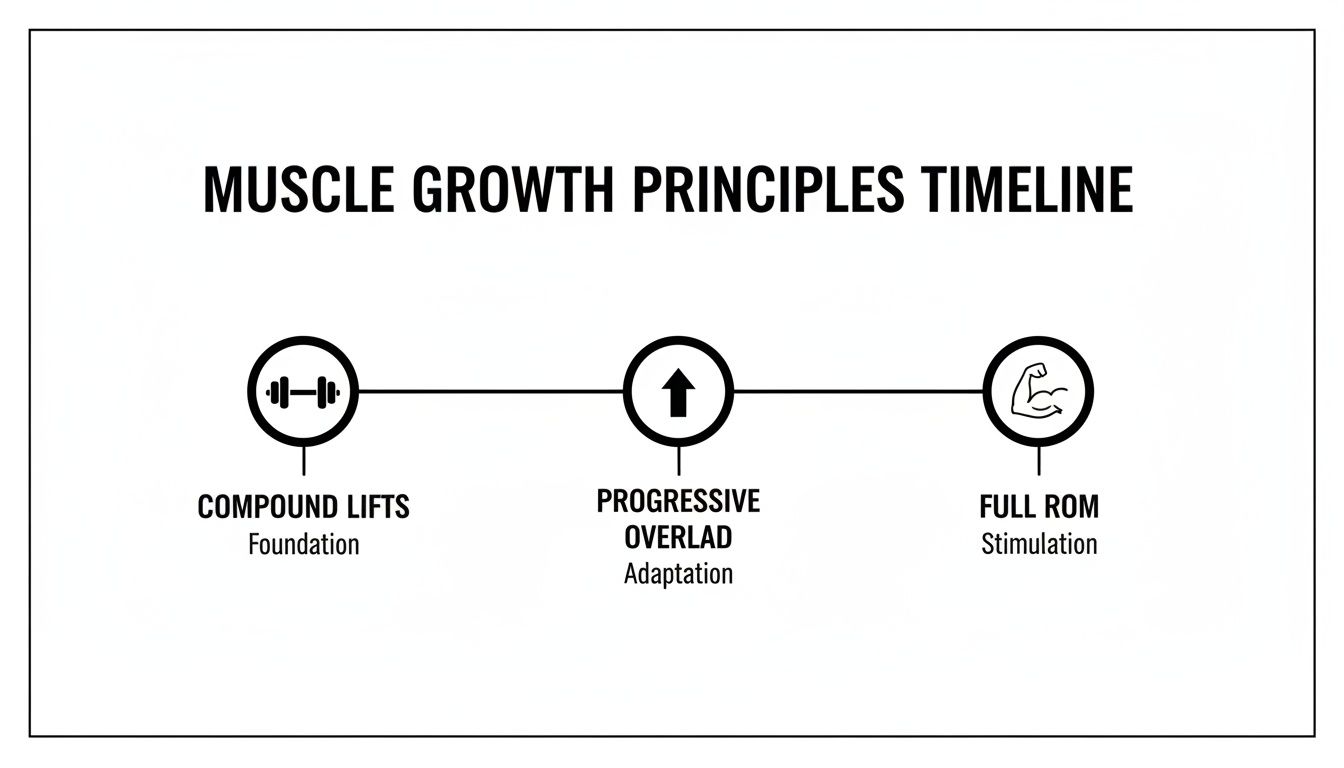
As you can see, your success really boils down to consistently applying compound lifts, progressive overload, and a full range of motion.
The A/B full-body split explained
This is a classic for a reason—it just works. For beginners, its beauty lies in its simplicity and raw effectiveness. Hitting your muscles three times a week provides a powerful stimulus for growth, which is exactly what you want to capitalize on those "newbie gains."
Here’s how your first couple of weeks will look:
- Week 1: Monday (Workout A), Wednesday (Workout B), Friday (Workout A)
- Week 2: Monday (Workout B), Wednesday (Workout A), Friday (Workout B)
You just keep that alternating pattern going for the full 12 weeks. It gives your body about 48 hours to recover between sessions, which is when the real muscle repair and growth happens.
Workout A: the pushing powerhouse
This routine is your foundation for building raw pushing strength. It targets your chest, shoulders, and triceps while building a powerful lower body with the king of all exercises: the squat.
| Exercise | Sets | Reps | Rest |
|---|---|---|---|
| Barbell Squats | 3 | 8-10 | 90-120 sec |
| Bench Press | 3 | 8-10 | 90-120 sec |
| Overhead Press | 3 | 10-12 | 60-90 sec |
| Triceps Pushdowns | 2 | 12-15 | 60 sec |
| Plank | 3 | Hold | 60 sec |
A quick tip on form: For squats, keep your chest up and go deep—thighs at least parallel to the floor. On the bench press, pull your shoulder blades back and plant your feet firmly. This creates a stable base to press from.
Workout B: the pulling & posterior chain builder
Time to build the other half of your body. This workout focuses on the pulling muscles of your back and biceps, and it hammers your posterior chain (glutes and hamstrings) with deadlifts. A strong back is non-negotiable for good posture and a balanced physique.
| Exercise | Sets | Reps | Rest |
|---|---|---|---|
| Deadlifts | 3 | 5-8 | 120-180 sec |
| Pull-Ups or Lat Pulldowns | 3 | 8-12 | 90 sec |
| Barbell Rows | 3 | 8-12 | 90 sec |
| Dumbbell Bicep Curls | 2 | 12-15 | 60 sec |
| Hanging Knee Raises | 3 | 10-15 | 60 sec |
A quick tip on form: Deadlifts are technical. Start light and obsess over keeping your back flat. If you can't do many pull-ups yet, use an assisted machine or just focus on the negative (jump up, then lower yourself as slowly as possible).
Program notes: your key to making this work
Look, just showing up and going through the motions isn't enough. To get real results from this program, you have to internalize a few key ideas. These are the details that separate a decent program from a great one.
The secret here isn't the specific exercises—it's the relentless pursuit of progressive overload. Your single most important mission each week is to do a little bit more than you did last time.
That doesn't always mean slapping more plates on the bar, though that's the main driver. Here’s how you’ll make sure you're always progressing:
- Lifting more weight: If you hit all your sets and reps last week, add the smallest amount of weight you can (usually 2.5-5 lbs).
- Adding more reps: Can't go up in weight yet? Fine. Aim for just one more rep than last time. If you got 8, 8, 7 on the bench press, your goal this week is 8, 8, 8.
- Improving your technique: Lifting the same weight with better control and a deeper stretch is a form of progressive overload. It makes the exercise safer and more effective.
Track everything. Seriously. Use a notebook or an app like GrabGains to log every single workout. Write down the exercise, weight, and the reps you hit for each set. This data isn't optional; it's your road map. Without it, you're just guessing.
Rest like you mean it. Muscles grow when you’re resting, not when you’re lifting. Aim for 7-9 hours of quality sleep every night. Overtraining is a real killer for skinny guys, so stick to the three workout days and let your body do its job.
This 12-week plan is your blueprint. It's simple, sustainable, and built on proven principles. Focus on consistency and progressive overload, and you will build a foundation of strength and size that changes everything.
The skinny guy's nutrition blueprint for gaining mass
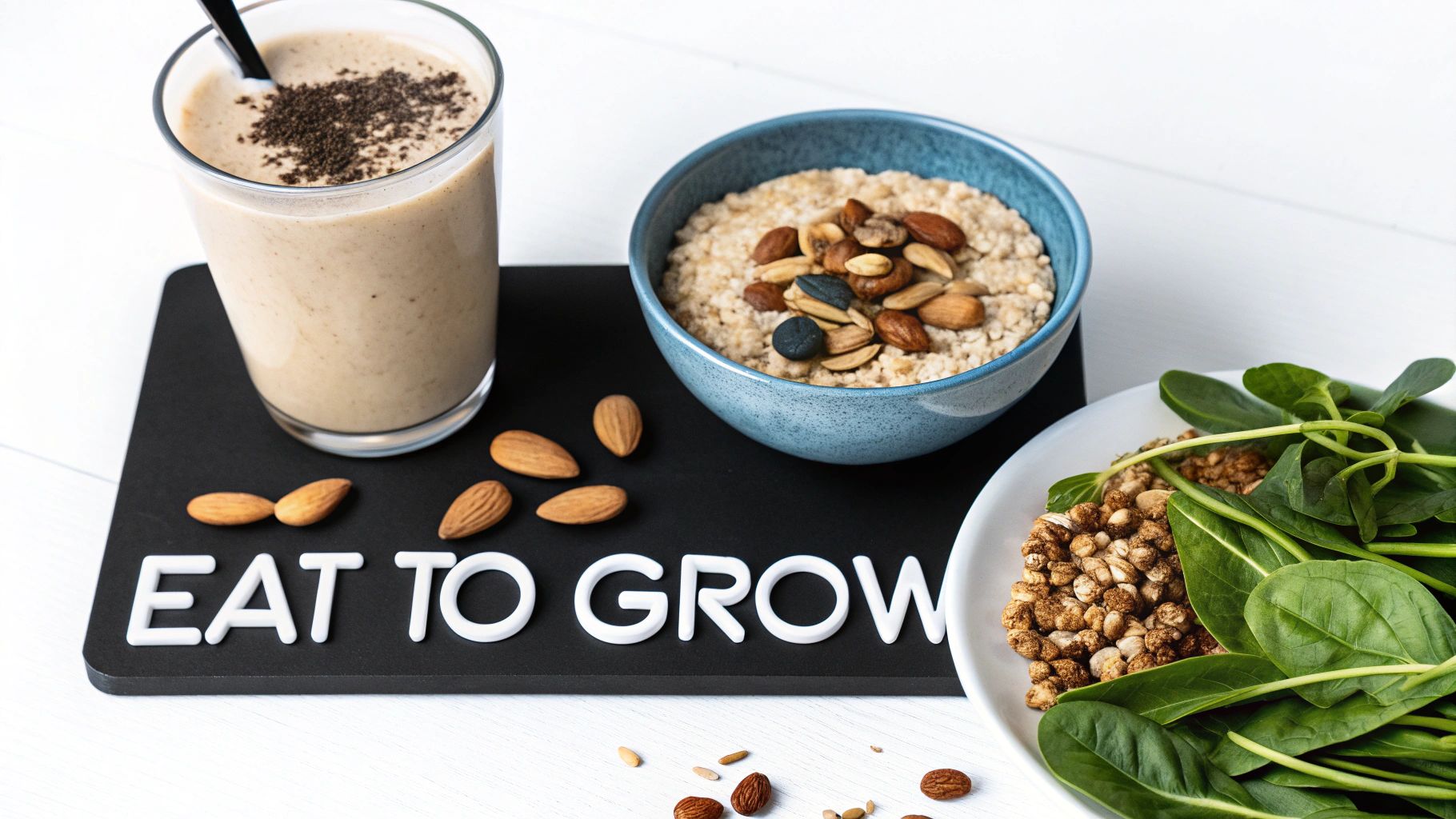
You can't build a house without bricks, and you absolutely cannot build muscle without calories. All that hard work in the gym only pays off when you give your body the raw materials it needs to repair and grow. This is your no-nonsense guide to eating for serious gains.
A lot of skinny guys think they're eating a ton, but when you actually track it, the numbers don't lie. Your faster metabolism means you can't just guess—you have to be deliberate and consistent.
Understanding the caloric surplus
Let's get one thing straight: the single most important rule for gaining mass is the caloric surplus. It just means you have to consistently eat more calories than your body burns every day.
Without those extra calories, your body simply doesn't have the energy to build new muscle tissue, no matter how hard you train. A small, sustainable surplus is the key to adding quality muscle without packing on a bunch of unwanted body fat.
Aim for a surplus of 300-500 calories over your daily maintenance level. This is the sweet spot. It's enough to fuel growth but not so much that you'll just be storing fat. If you want a more precise starting point, using a tool like our macro calculator can dial in your personal targets and take the guesswork out of it.
Your macronutrient breakdown for muscle
Calories come from three macronutrients: protein, carbs, and fats. Nailing the right balance is what separates effective bulking from just "getting fat."
1. Protein is your top priority Protein provides the amino acids that are the literal building blocks of muscle. After you train, your body is screaming for protein to rebuild those muscle fibers bigger and stronger.
For anyone trying to build muscle, the science points to a target of 1.6 to 2.2 grams of protein per kilogram of body weight (or about 0.7 to 1.0 grams per pound). Hitting this number every single day is non-negotiable.
2. Carbohydrates are your fuel source Carbs get a bad rap in weight-loss circles, but for a skinny guy trying to bulk up, they are your best friend. They give you the energy for intense workouts and help replenish the glycogen your muscles burn, which is critical for recovery and performance.
3. Healthy fats support hormone production Don't fear fats. Healthy fats are vital for overall health and play a huge role in producing muscle-building hormones like testosterone. Plus, they are incredibly calorie-dense, which makes them a skinny guy's secret weapon for hitting calorie goals without feeling stuffed.
Practical strategies for eating more
Knowing what to eat is one thing; actually getting it all down is another. Here are some strategies that work in the real world.
- Embrace liquid calories: Drinking your calories is way easier than chewing them. A good shake can easily pack 500-800+ calories and goes down in minutes.
- Increase meal frequency: Instead of forcing down three massive meals, try five or six smaller, more manageable meals and snacks throughout the day.
- Add calorie-dense toppings: Small additions make a huge difference. Drizzle olive oil on your veggies, throw a handful of almonds in your oatmeal, or add a big scoop of peanut butter to your apple slices.
- Choose calorie-dense foods: Focus on foods that pack a lot of calories without taking up a ton of space in your stomach.
Here’s a quick list of powerhouse foods to add to your grocery list:
| Macronutrient | Best Food Choices | Why It Helps |
|---|---|---|
| Protein | Chicken Breast, Salmon, Eggs, Greek Yogurt, Whey Protein | Provides essential amino acids for muscle repair and growth. |
| Carbohydrates | Oats, Brown Rice, Quinoa, Sweet Potatoes, Whole Grain Bread | Fuels your workouts and replenishes glycogen for better recovery. |
| Fats | Avocado, Nuts, Seeds, Olive Oil, Nut Butters | Supports hormone function and adds calories easily without much volume. |
Designing your muscle-building shake
Your blender is your most valuable player on this journey. A daily shake can ensure you hit your calorie and protein targets, even on the busiest days. Here’s a simple, effective recipe to get you started:
- Protein base: 1-2 scoops of whey or casein protein powder (25-50g protein)
- Carb source: 1/2 cup of uncooked oats (~27g carbs)
- Healthy fat: 1-2 tablespoons of peanut or almond butter (~8-16g fat)
- Fruit: 1 banana or a cup of mixed berries for flavor and micronutrients.
- Liquid: 12-16 oz of whole milk or water.
This simple shake can deliver over 600 calories and is an incredibly efficient way to fuel your growth. Don't be afraid to experiment—toss in some spinach (you won't taste it), Greek yogurt, or flax seeds to add even more nutritional punch.
Maximizing recovery and sidestepping common pitfalls
All your hard work in the gym is just the starting pistol. The real muscle-building magic happens while you're resting, not while you're grinding out another set. For skinny guys trying to pack on size, understanding recovery—and the common mistakes that derail it—is every bit as important as what you do with the weights.
Too many beginners get trapped in the "more is better" mindset. This is a fast track to burnout and stalled progress. Remember, your body builds muscle in the hours and days after you leave the gym. If you neglect that crucial recovery window, you're just spinning your wheels.
The non-negotiable role of sleep
If you’re wondering how to build muscle as a skinny guy, the most powerful tool you have is probably your bed. Sleep is king. During deep sleep, your body goes into overdrive producing growth hormone, the key player in repairing those muscle fibers you worked so hard to break down.
Aim for 7-9 hours of quality sleep every night. This isn't just a friendly suggestion; it's a hard requirement if you're serious about growth. Consistently skimping on sleep sabotages your body's ability to recover, tanks your energy for the next workout, and creates a vicious cycle of poor performance and zero results.
Think of it like this: your workout is the architect's plan, your nutrition provides the raw materials, and sleep is when the construction crew actually shows up. If the crew never arrives, all you’ve got is a blueprint and a pile of bricks.
Pitfall 1: program hopping
This is one of the biggest progress-killers out there. "Program hopping" is the habit of jumping from one workout plan to the next every few weeks, usually after seeing some new "ultimate" routine on social media. You get fired up, start the new program, and then ditch it before it ever has a chance to work.
Muscle growth is a slow game that hinges on progressive overload. Your body needs time and consistency to adapt to a specific stimulus. By constantly changing your exercises, you never give it the chance to get stronger and bigger.
A good plan you stick to for three months is infinitely better than a "perfect" plan you quit after two weeks. Consistency is the secret sauce.
Pick a solid, proven program—like the one in this guide—and commit to it for at least 12 weeks. Log your lifts, focus on adding a little weight or an extra rep, and trust the process. Real gains are built on consistency, not novelty.
Pitfall 2: chasing the pump with isolation work
It's easy to get drawn to bicep curls and tricep pushdowns. They give you that satisfying "pump" that makes your muscles feel huge for a little while. But for a skinny guy trying to build a solid foundation, they're a terribly inefficient way to train.
Your main focus should always be on heavy, compound movements. I'm talking about squats, deadlifts, bench presses, and overhead presses. These big lifts recruit multiple muscle groups at once, which triggers a far greater hormonal response and signals your entire body to grow.
- Compounds first: Always start your workouts with your heaviest compound lifts. This is when you're fresh and have the most energy to move serious weight.
- Isolation as a finisher: Treat isolation moves like accessories. Use them at the end of your workout to bring up a lagging muscle or add a little extra volume.
- Focus on strength: Prioritize getting stronger on your big lifts over chasing a pump. Adding weight to the bar is the most reliable sign that you're actually building muscle.
A bigger chest and back will transform your physique far more than slightly bigger arms ever will. Build the house first, then worry about painting the trim.
Pitfall 3: the classic blunder of under-eating
We've already talked about nutrition, but it's so critical that it deserves to be called out as a major pitfall. You could follow the world's best workout program and get nine hours of sleep a night, but if you're not eating enough food, you will not grow. Period.
Most skinny guys chronically underestimate how many calories they're really eating. With a faster metabolism, your margin for error is razor-thin. A caloric surplus isn't just a good idea—it's the fuel your body needs to build new muscle tissue.
If the number on the scale hasn't budged for two weeks straight, the answer is simple: you need to eat more. Add another 250-300 calories to your daily total, stay consistent for a couple of weeks, and see what happens. This measured, no-excuses approach to eating is the final piece of the puzzle that turns all your hard work into real, visible gains.
Your questions on building muscle answered
Getting started on the journey from skinny to strong always brings up a ton of questions. It’s easy to get lost in conflicting advice, wondering if you're even on the right track. Let's clear up some of the most common concerns I hear from guys just like you.
How long does it realistically take to see results?
This is the big one, and the honest answer is: it all comes down to consistency.
That said, you'll likely feel a difference long before you see one. Within the first 2-4 weeks of a solid program, you should feel stronger and more capable. Your lifts will start creeping up, and you’ll have more gas in the tank.
As for noticeable visual changes—fuller muscles, a bit more definition—those typically start showing up within 8-12 weeks. The good news is that as a beginner, you have "newbie gains" on your side. Your body is primed to build muscle faster than an advanced lifter's, so stick with it. Don't get discouraged in those first few weeks.
Are mass gainer supplements a good idea?
They can be a tool, but they should never be your first move. Most commercial mass gainers are just glorified sugar powders packed with cheap fillers. They’ll help you gain weight, sure, but a lot of it will be fat, and they can be rough on your digestion.
Your number one priority should always be getting your calories from real, nutrient-dense food.
If you’re genuinely struggling to eat enough, making your own high-calorie shake is a much better plan.
A homemade shake with whole milk, protein powder, oats, peanut butter, and a banana is cheaper, healthier, and gives you complete control over what you’re putting in your body. Use supplements to supplement a good diet, not replace it.
Can I build muscle working out at home?
Absolutely. The principles of muscle growth—progressive overload and consistency—work the same whether you’re in a commercial gym or your garage. The only thing that matters is finding ways to continually make your workouts harder as you get stronger.
- Master bodyweight moves: Get incredibly good at the basics: push-ups, pull-ups, and squats.
- Increase the difficulty: To keep progressing, you can slow down your reps (like a 3-second negative on a push-up), move to harder variations (like archer push-ups), or simply shorten your rest times.
- Invest smartly: A simple set of adjustable dumbbells or a few heavy resistance bands can open up a huge library of effective exercises you can do right from your living room.
How do I stay consistent with a busy schedule?
Listen, consistency beats perfection every single time. For most busy professionals, a 3-day full-body routine is a game-changer. It’s incredibly effective and only takes up about three hours of your entire week.
The real trick is to remove the friction that gets in your way.
When it comes to nutrition, meal prepping is your superpower. Spend a couple of hours on a Sunday cooking your main protein (chicken, ground beef) and carb sources (rice, quinoa) in bulk. This makes throwing together quick, on-target meals during a chaotic work week almost effortless. It completely eliminates the decision fatigue that pushes you toward bad food choices.
Ready to stop guessing and start building? GrabGains takes all these principles and builds a personalized, adaptive workout plan that grows with you. Track your lifts, watch your strength skyrocket, and finally see the results your hard work deserves. Pre-register today for the app and be the first to experience your pocket personal trainer.
Get inspired and motivated