Military Press vs Seated Dumbbell Press: Best Shoulder Exercise?
Both exercises press weight overhead. Both build your shoulders and triceps. But the standing barbell military press and the seated dumbbell shoulder press are very different experiences — and your choice between them affects more than just your shoulders.
Published: 2026-03-09
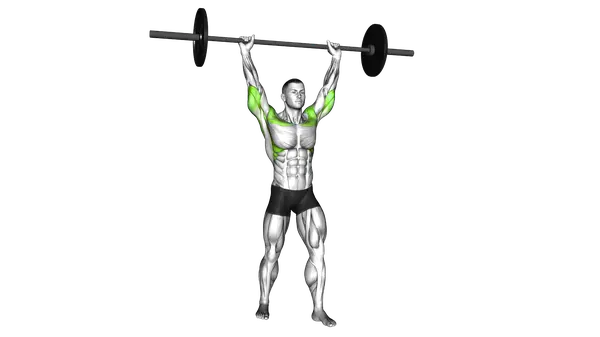
Barbell Standing Military Press
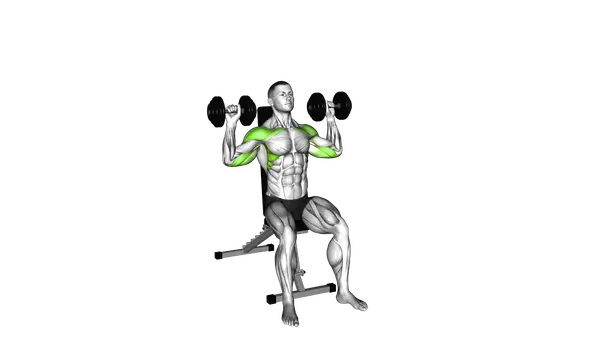
Seated Dumbbell Shoulder Press
Standing vs sitting: more than just comfort
When you stand and press a barbell overhead, your entire body works. Your core has to brace hard to keep you from tipping over [1]. Your legs provide a stable base. Your lower back stays tight. It's an overhead press, but it trains your whole body.
Sitting down removes all of that. The bench supports your back, so your core doesn't have to work as hard. This lets you focus entirely on your shoulders and triceps. It also means you can often press more weight because you're not limited by core stability.
Shoulder range of motion
Dumbbells give your shoulders more freedom. Each arm can move in its natural arc, which is slightly different for everyone. If one shoulder is tighter than the other, dumbbells let each side find its own comfortable path.
The barbell forces both hands into a fixed position. For some people this is fine. For others, especially those with tight shoulders or previous injuries, this fixed path can cause discomfort or even pain. If pressing a barbell overhead feels awkward, dumbbells are almost always the solution.
Building raw strength vs building muscle
The standing military press is the gold standard for overhead pressing strength. If you want to press the most weight possible overhead, this is the exercise. It's a staple in strength training programs for a reason.
For pure muscle building, the seated dumbbell press might actually be slightly better. The seated position eliminates body lean and momentum, so your shoulders do all the work. And the independent arm movement ensures both sides develop equally.
The practical choice
Standing overhead pressing with a barbell requires good shoulder mobility and a strong core. If you work a desk job and have tight shoulders, you might not have the mobility to press a barbell overhead safely.
Seated dumbbell presses are more forgiving. You need a bench and two dumbbells, and the technique is simpler to learn. Most people can start doing seated dumbbell presses on day one with good form.
The Bottom Line
Use the standing military press if you have good shoulder mobility and want to build total-body pressing strength. Use the seated dumbbell press if you want to isolate your shoulders more, have mobility limitations, or want a more joint-friendly option. Both build great shoulders — the military press just asks more of the rest of your body.
What is your fitness goal?
Pick one and the app builds your program around it, your equipment and the days you can train.
At a Glance
Barbell Standing Military Press
Seated Dumbbell Shoulder Press
Common Questions
Why can I seated press more than I can standing press?
When seated, your core and balance aren't limiting factors. All your energy goes into pushing the weight up. Standing requires significant core stabilization which reduces how much you can press.
Is the standing military press bad for your back?
Not if done correctly. The issue is when people lean back excessively to push the weight up. Keep your core tight and don't arch your back. If you find yourself leaning back, the weight is too heavy.
Scientific References
[1] Understanding Bench Press Biomechanics-The Necessity of Measuring Lateral Barbell Forces.
Mausehund L, Werkhausen A, Bartsch J et al. · Journal of strength and conditioning research (2022)
Paoli A, Marcolin G, Petrone N · Journal of strength and conditioning research (2010)
[3] Reconstruction of Irreparable Pectoralis Major Tears.
Ghenbot S, Hoyt BW, Riccio CA et al. · Military medicine (2026)
Sources are peer-reviewed academic publications from PubMed.
Full exercise guide
Barbell Standing Military Press
Full exercise guide
Seated Dumbbell Shoulder Press