Core-driven lower-body strength and control
Leg exercises with stability ball
Leg exercises with a stability ball combine lower-body strength training with a heightened demand for balance and core control. The unstable surface forces greater muscle coordination, making these exercises especially effective for posterior-chain activation, joint stability, and movement control. Stability ball leg exercises are commonly used in functional training, rehabilitation settings, and recovery-focused strength programs. By integrating instability into leg training, these movements support controlled strength development while reducing excessive joint loading.
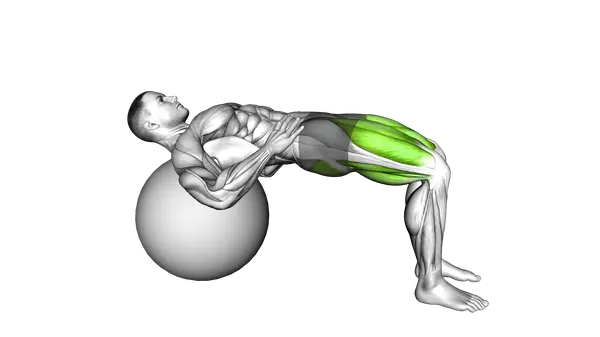
Lying Hip Lift (On Stability Ball)
The Lying Hip Lift is a controlled hip lift variation that challenges strength and stability while keeping the movement smooth and supported.
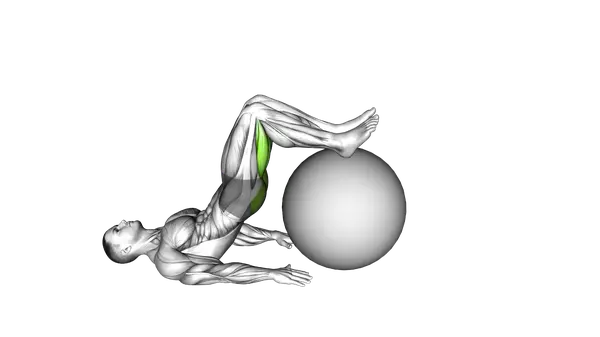
Stability Ball Leg Curl
The Stability Ball Leg Curl is a bodyweight exercise that trains the back of the legs while challenging control and lower-body stability.
Balance, control and posterior-chain engagement
Why train legs with a stability ball
Stability balls introduce controlled instability, encouraging deeper muscle activation and improved neuromuscular coordination during leg-focused movements.
Key advantages:
- Increased core engagement during lower-body exercises
- Enhanced balance and movement control
- Strong emphasis on posterior-chain activation
- Joint-friendly loading and recovery support
- Effective integration of strength and stability training
Controlled movements for strength and activation
Core leg exercises with stability ball
The following exercises represent the primary stability ball movements used for leg training. Together, they focus on hip extension, hamstring engagement, and integrated core control.
- Lying hip lift (on stability ball): A posterior-chain–focused movement that emphasizes glute activation while challenging trunk stability.
- Stability ball leg curl: A controlled hamstring-dominant exercise that combines knee flexion with core and pelvic stability.
Exercise overview
| Exercise | Primary focus | Training goal |
|---|---|---|
| Lying hip lift (on stability ball) | Glutes & core | Posterior-chain activation |
| Stability ball leg curl | Hamstrings | Strength & control |
Supporting stability, recovery and movement quality
Programming leg exercises with stability ball
Stability ball leg exercises are best used as accessory movements within a balanced leg training program. They are especially effective during warm-ups, recovery sessions, or training blocks focused on movement quality and muscular control. Due to their lower external loading and increased stability demands, these exercises can be performed frequently without excessive fatigue. They pair well with barbell, dumbbell, or machine-based leg training by reinforcing core control and posterior-chain engagement. Create your personal training program in the app tailored to your goals, fitness level, and schedule.
Frequently asked questions about stability ball leg exercises
Yes. They are commonly used in recovery, mobility, and injury-aware training blocks.
They are best used as a complement to free-weight or machine-based leg exercises.
They can typically be trained two to four times per week, depending on overall program volume.
They primarily target the glutes, hamstrings, and core stabilizers.
Yes. While they use lower external loads, the instability increases muscle activation and control demands.