Reverse Grip Dumbbell Wrist Curl (Over Bench)
The Reverse Grip Dumbbell Wrist Curl (Over Bench) strengthens the forearms by lifting the dumbbells with the backs of your hands.
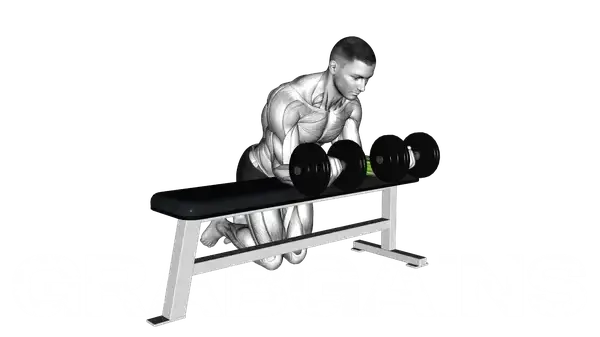
Reverse Grip Dumbbell Wrist Curl (Over Bench)
Muscles Worked: Reverse Grip Dumbbell Wrist Curl (Over Bench)
The reverse grip dumbbell wrist curl over a bench mainly trains your arms, especially the top side of your forearms that lift your hands back up against the weight. Your grip muscles also work hard to keep the dumbbell steady while your wrist moves through a short range. Because the forearm muscles are small, this exercise is more about clean tension than heavy loading. You should feel a strong burn along the top of the forearm, and using a full but controlled range makes that work more consistent from rep to rep.
Built for progress
Take the guesswork out of training
Get a personalized workout plan built around your goal, equipment and schedule. Train smarter, track every rep and keep moving forward, one workout at a time.






Technique and form
How to perform the Reverse Grip Dumbbell Wrist Curl (Over Bench)
- Sit on a bench with your forearms resting on your thighs, palms facing down, and your wrists extending just beyond your knees.
- Grasp the dumbbells with an underhand grip (palms facing upward) so that your hands are in a supinated position.
- Allow the dumbbells to roll down to your fingertips, creating a full stretch in your forearms while maintaining a firm grip.
- Keep your forearms stationary on your thighs and exhale as you curl your wrists upward as far as possible, focusing on contracting your forearm flexors.
- Hold the contracted position for a brief moment at the top of the movement, maximizing forearm engagement.
- Inhale as you slowly lower the dumbbells by extending your wrists, controlling the descent until you feel a stretch in your forearms again.
- Maintain a neutral spine and relaxed shoulders throughout the movement, preventing any upper body swinging or assistance.
- Repeat for the desired number of repetitions, keeping your elbows stable and preventing them from lifting off your thighs.
Important information
- Choose a weight that allows you to maintain proper form throughout the entire set – typically lighter than what you'd use for standard wrist curls.
- Keep your movements slow and controlled, avoiding any bouncing or momentum that could reduce effectiveness and increase injury risk.
- Make sure your forearms remain in contact with your thighs throughout the entire exercise to isolate the forearm muscles properly.
- If you experience wrist pain (not normal muscle fatigue), reduce the weight or check your form before continuing.
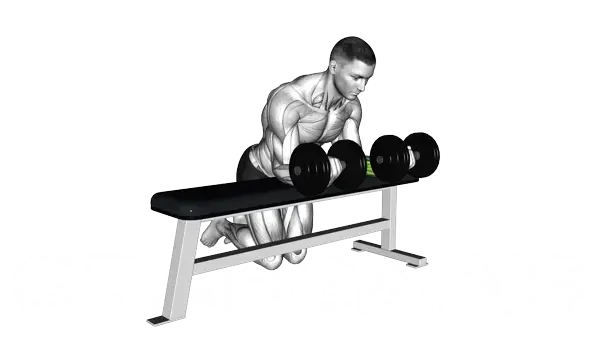
Is the Reverse Grip Dumbbell Wrist Curl (Over Bench) good for muscle growth?
Yes. The Reverse Grip Dumbbell Wrist Curl (Over Bench) can help build your forearms because it puts steady tension on the muscles that lift your wrist, and repeated resistance training is a proven way to drive muscle growth over time. It is not a big mass-builder like rows or carries, but it is useful when your forearms are a weak point.
- Targets the often-missed side of the forearm — Most people do more gripping and palm-up curling than wrist extension work. This move trains the top side of the forearm directly, which can help balance out forearm development and support wrist strength for other lifts.
- Bench support keeps tension where you want it — Resting your forearm on a bench cuts down on cheating from the shoulder and elbow. That makes it easier to keep the work on the wrist muscles instead of turning the rep into a sloppy arm swing.
- Light weight works well here — Forearm muscles respond well to clean reps and enough total volume. You do not need big dumbbells to make this effective, and low-load resistance training can still improve strength and size when the muscles are challenged hard enough.
- Pairs well with the opposite pattern — If you already use Dumbbell Wrist Curl (Over Bench), this reverse-grip version helps train the other side of the forearm. That gives you more complete forearm work than only doing one wrist curl style.
Programming for muscle growth
Do 2-4 sets of 12-20 reps with 45-75 seconds rest, 2-3 times per week. Use a weight you can move through a full range without your forearm lifting off the bench. Add reps first, then add small amounts of weight once you can hit the top of the rep range with a strong squeeze and no swinging.
Reverse Grip Dumbbell Wrist Curl (Over Bench) Variations
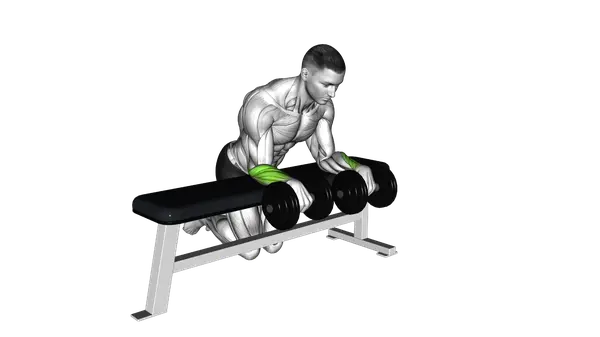
Alternative Exercises
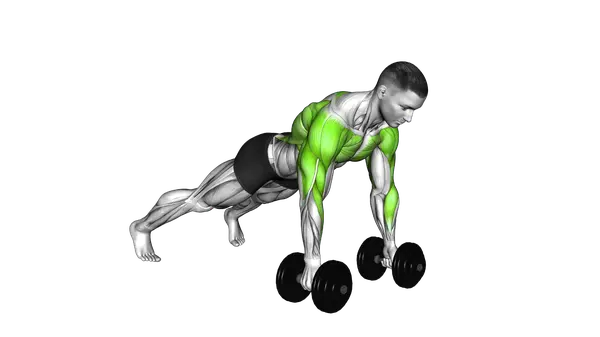
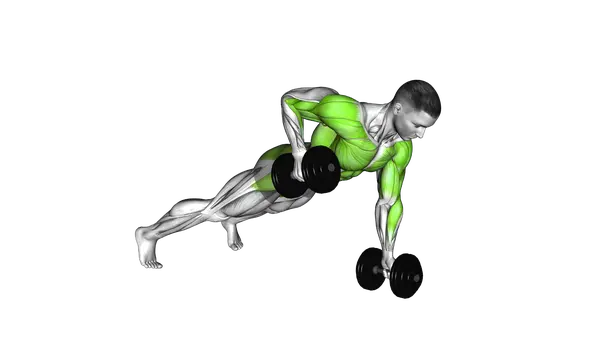
FAQ - Reverse Grip Dumbbell Wrist Curl (Over Bench)
This exercise primarily targets the extensor muscles on the top of your forearms, including the extensor carpi radialis and extensor digitorum. These muscles are responsible for wrist extension and are often underdeveloped compared to the flexor muscles on the underside of your forearms.
Sit on a bench with your forearms resting on your thighs and wrists extending beyond your knees, holding dumbbells with palms facing down. Keep your forearms stationary while slowly curling your wrists upward as high as possible, then control the descent back to the starting position. Focus on isolating the movement to your wrists only, avoiding any forearm rotation or elbow movement.
Start light—typically 5-15 pounds depending on your strength level—as the extensor muscles are generally weaker than flexors. Focus on controlled movement and complete range of motion rather than heavy weight, gradually increasing resistance only when you can perform 12-15 perfect repetitions.
For optimal forearm development, include this exercise 1-2 times weekly, typically at the end of your pulling workouts or on arm days. Forearm muscles recover relatively quickly, but still require 48 hours between training sessions for growth and recovery.
The most common mistake is rushing through the movement without focusing on the quality of the rolling motion. Other errors include using excessive tension rather than controlled movement, and failing to achieve full range of motion through all three planes of shoulder movement (flexion, depression, and retraction).
Reverse Grip Dumbbell Wrist Curl (Over Bench)
Thank you for your feedback!
Thank you for your feedback!