Can you workout twice a day to maximize your fitness gains?
Wondering can you workout twice a day? Discover the science, benefits, risks, and sample plans to see if this advanced training method is right for you. Yes, you absolutely can work out twice a day. It’s a powerful strategy many athletes use to pack in more training volume and speed up their progress. But it's not as simple as just doing your normal workout twice. Getting it right comes down to smart programming and putting just as much focus on recovery as you do on the training itself.


The short answer to working out twice a day
Thinking about hitting the gym twice in one day? You're not alone. This is a go-to method for dedicated lifters and athletes looking to break through a plateau or get an edge. The secret isn't just about working harder; it’s about working smarter by splitting your training into two focused, high-quality sessions.
When you split your workout, you can bring more energy and intensity to each session. Imagine trying to do heavy squats, bench presses, and then an hour of conditioning all in one go. By the end, your form is shot and your intensity drops off a cliff.
Instead, you could hit your heavy strength work in the morning and come back in the evening for cardio or skill practice. This split allows you to attack each session fresh, which almost always leads to better results.
Built for progress
Take the guesswork out of training
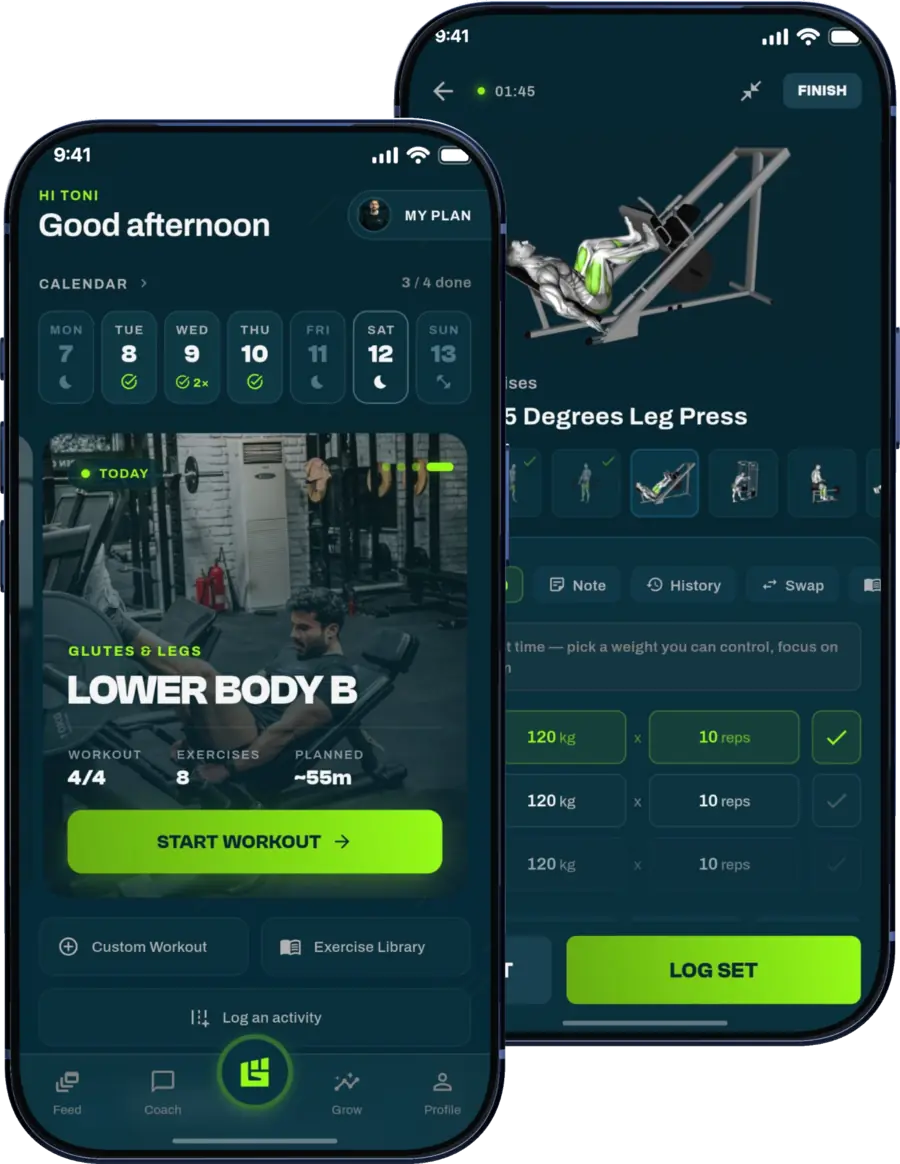
Get a personalized workout plan built around your goal, equipment and schedule. Train smarter, track every rep and keep moving forward, one workout at a time.






Here’s a quick look at why it works:
- Increased training volume: You can simply get more quality work done in a day without the session dragging on forever. More quality volume is a key driver for growth.
- Better performance: By separating different training styles—like strength and endurance—you give each one your full attention and energy.
- Sharper focus: Let's be honest, it's easier to stay mentally locked in for two 45-minute sessions than one grueling 90-minute marathon. Better focus means better form and fewer injuries.
This guide will walk you through exactly how to set up your two-a-day plan, from programming and nutrition to recovery. With the right approach, and maybe a little help from tools like the GrabGains app to keep your plan on track, you can make it work safely and effectively.
Understanding the science of two-a-day training
Splitting your workouts isn't just a scheduling trick—it’s a strategy grounded in exercise physiology. When people ask, "can you work out twice a day?", the real answer lies in how we can optimize the body's natural cycle of adaptation and growth. Done right, it taps into key mechanisms that can deliver better results than one long, grueling session.
Think of your body's muscle-building ability as a construction crew. After a workout, this crew gets to work repairing and strengthening muscle tissue in a process called muscle protein synthesis (MPS). A single training session flips the switch for this response, but the effect starts to fade after about 24-48 hours. By training twice, you essentially hit that switch again, keeping the "construction crew" busy for more hours of the day.
This approach is a bit like eating two well-portioned meals instead of one giant feast. Your body can absorb and use the nutrients more efficiently from smaller meals. In the same way, your muscles can respond better to two focused, high-quality training sessions than one marathon workout where fatigue eventually tanks your form and intensity.
Enhancing performance and recovery
The time between the two workouts is just as crucial as the workouts themselves. With several hours to recover, your body starts to replenish glycogen—your muscles' main fuel source—and clear out metabolic byproducts. This means you walk into your second session feeling fresher, with more energy and mental focus than you'd ever have at the tail end of a single long workout.
This infographic breaks down the core components of training twice a day.
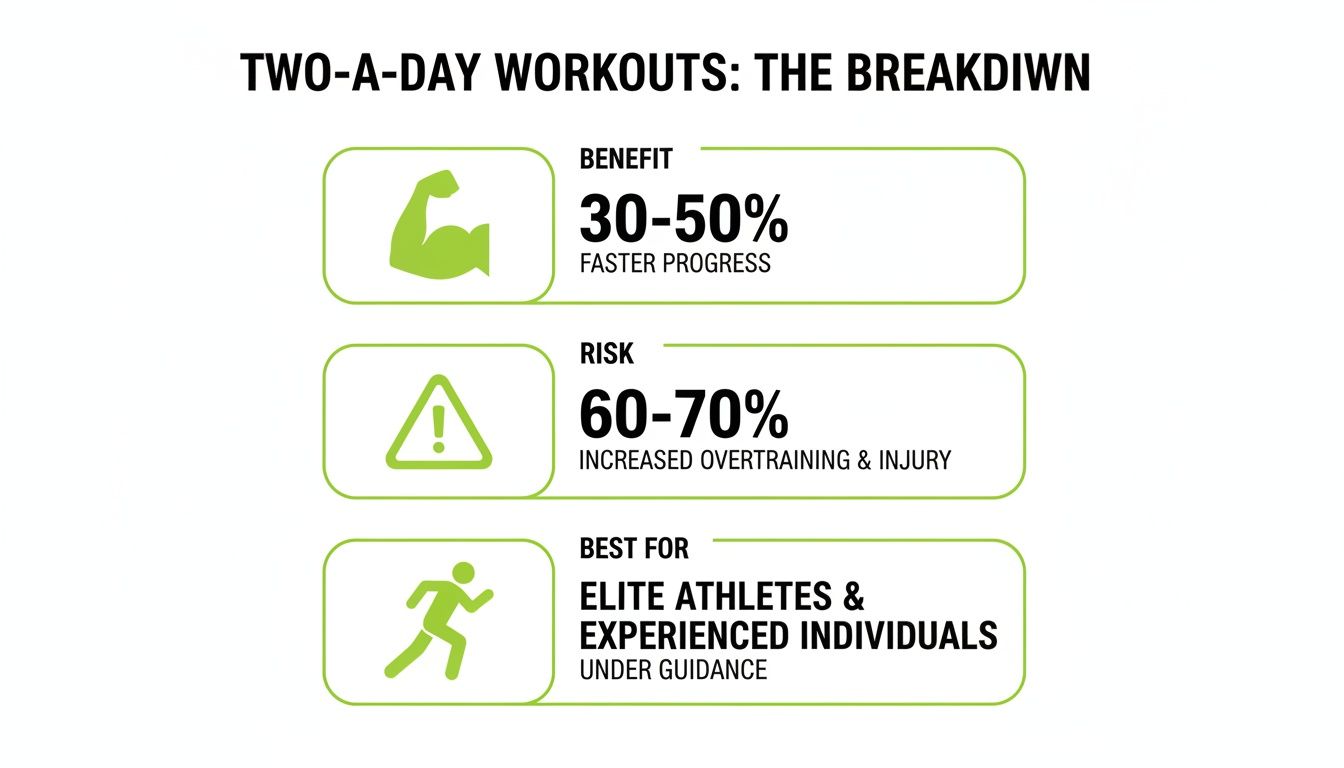
As you can see, the biggest upside is accelerated progress. But that comes with a very real risk of overtraining if you don't manage it carefully, which is why this method is best suited for disciplined, experienced athletes.
Backed by research
This isn't just gym talk; there's solid research to back it up. A 2022 study in the Journal of Sports Medicine and Physical Fitness provided some compelling evidence. The study took resistance-trained men and found that those who worked out twice a day saw a massive 16.1% increase in their one-rep max back squat. That's more than double the 7.8% gain seen in the group that trained just once daily. It shows that for pure strength goals, splitting your volume can be far more effective without holding back muscle growth. You can dive deeper into the study's findings on workout frequency and strength gains at Gold's Gym.
The science shows that two-a-day training works. It increases the frequency of muscle-building signals, allows for more total training volume, and boosts the quality of each session by keeping fatigue in check.
By planning your sessions strategically, you create an environment where your body is primed to adapt, recover, and grow stronger. It's a method that allows you to accumulate more high-quality work over time—and that's the ultimate driver of long-term progress.
Who benefits most from working out twice a day
While the idea of speeding up your gains is tempting, working out twice a day isn’t for everyone. It's a powerful tool, but it only really works for people whose goals and lifestyle can handle the extra demand. This isn't about being "advanced"—it's about having the right reasons and the recovery to back it up.
So, who is this training style actually a good fit for? A few specific groups can get some serious advantages by splitting up their sessions.
The time-crunched professional
For busy professionals, the biggest roadblock to fitness is almost always time. Squeezing a solid 90-minute workout into a packed schedule feels next to impossible. But finding two separate 45-minute slots—one before work and another in the evening—is often way more realistic.
This approach gives you a practical way to stay consistent without letting your workout quality slide. Instead of one rushed, half-hearted session, you get two focused, high-energy workouts. Splitting them up lets you bring full intensity to both, which beats trying to push through a single session on fumes.
The competitive athlete
Athletes training for something specific, like a HYROX race or a powerlifting meet, often have to build multiple skills at once. Trying to train for strength, endurance, and technique in a single session is tough because one quality usually ends up interfering with another.
A two-a-day schedule allows for what’s known as concurrent training. This is where you train different physical attributes in separate sessions to maximize the results for each one.
By splitting their training, athletes can give each goal the attention it deserves.
- Morning Session: This could be dedicated to heavy, neurologically demanding work like squats or deadlifts when your central nervous system is fresh. You can check out a bunch of effective options in our guide to the best leg exercises.
- Evening Session: This session can then be used for endurance work, skill practice, or conditioning, without the leftover fatigue from heavy lifting getting in the way.
Separating the work like this ensures every skill gets the focused effort it needs to improve—a crucial strategy for anyone trying to hit peak performance.
The dedicated lifter breaking plateaus
If you're an experienced lifter focused on strength or muscle growth, you know that progress eventually starts to slow down. A two-a-day split is a smart way to crank up your training volume and intensity, which are the two main drivers for busting through a plateau.
Think about a brutal leg day. By the time you’ve powered through heavy squats and leg presses, you have almost nothing left in the tank for accessory work like leg extensions and hamstring curls. Your form gets sloppy, and the muscle-building stimulus drops off.
By splitting that workout, a lifter could hit their heavy compound lifts in the morning with maximum power. Later that day, they can come back fresh for a second session focused entirely on high-volume accessory work, hammering specific muscles with renewed energy. This makes sure both the primary strength work and the muscle-building isolation movements are done at the highest quality, creating a powerful new stimulus for growth.
How to structure your two-a-day workout plan

Alright, let's move from theory to practice. A great two-a-day plan lives and dies by its structure. Just winging it with two random workouts is a recipe for burnout, not results. You need a solid blueprint that lines up with your goals.
The golden rule? Give your body enough time to recover between sessions. Aim for at least 4-6 hours. This gap lets your energy stores start to refill and gives your nervous system a much-needed break, so you can bring real intensity to that second workout. Think of it as hitting a reset button before round two.
Pairing sessions for maximum gains
The real magic here is in smart workout pairing. The idea is to make sure one session doesn't sabotage the other. A tried-and-true method is to keep your neurologically demanding workouts separate from your less taxing ones.
For instance, if you're chasing strength, you’d hit your heavy compound lifts—like squats and deadlifts—in the morning. These movements fry your central nervous system (CNS). Then, in the evening, you can focus on lighter, muscle-building accessory work. This lets you rack up volume for hypertrophy without completely draining your CNS.
Sample two-a-day workout splits by goal
How you actually split your sessions comes down to what you're trying to achieve. An endurance runner's day will look completely different from a bodybuilder's.
Here’s a quick look at how you can structure your training based on a few common goals:
| Goal | AM Session (Morning) | PM Session (Evening) |
|---|---|---|
| Strength & Hypertrophy | Heavy, low-rep compound lifts (e.g., Squats, Bench Press, Deadlifts) | Higher-rep accessory work (e.g., Bicep Curls, Leg Extensions) |
| Endurance & Cardio | Long-distance cardio (e.g., Running, Cycling, Rowing) | Shorter, high-intensity intervals or cross-training |
| Functional Fitness (HYROX) | Technical skill work or heavy strength (e.g., Sled Pushes, Wall Balls) | Endurance run or metabolic conditioning circuit |
| General Fitness | Full-body strength training (30-45 mins) | Light cardio or mobility work (e.g., Yoga, Brisk Walk) |
These examples show how you can prioritize your high-energy work when you're fresh and save the supplementary training for later. This approach ensures both sessions are productive.
If you want to take the guesswork out of it, a smart workout builder can help you create a balanced plan that fits your schedule and goals perfectly.
Splitting workouts isn't just for elite athletes; it can be a powerful tool for improving overall health and longevity. Harvard research highlighted in a 2022 meta-analysis found that just 30-60 minutes of strength training per week can reduce all-cause mortality by 10-20%. By splitting your day into two 20-30 minute sessions, you can easily meet and exceed these guidelines, maximizing benefits without overloading your system. Learn more about the research on strength training time benefits.
Fueling your body for double sessions

If you're going to train twice a day, you're asking your body to perform and recover at double speed. This puts a massive strain on your energy stores and repair systems. Get your fuel and recovery wrong, and you're not building yourself up—you're just tearing yourself down.
Think of it like running a high-performance race car. You wouldn't expect to win by filling it with cheap gas and skipping the pit stops. For anyone tackling a two-a-day plan, nutrition and recovery are your premium fuel and essential maintenance. They're non-negotiable.
Mastering your macronutrients and timing
Your nutrition plan needs to be dialed in, focusing not just on what you eat, but when. That window between your two sessions is everything. It's your prime opportunity to refuel and get ready for round two. If you skip that crucial meal, you’ll be running on fumes.
Carbohydrates and protein are your two biggest priorities here. Carbs are your body's main fuel, stored in your muscles as glycogen. Your first workout burns through a huge chunk of those stores, and your second session will tank without a proper top-up.
- Carbohydrates: Get some fast-digesting carbs in—like fruit, white rice, or potatoes—within an hour of your first workout to kickstart glycogen replenishment.
- Protein: Pair those carbs with a lean protein source like chicken, fish, or a quick protein shake. This delivers the amino acids your muscles need to start the repair process immediately.
- Hydration: Don't just chug water during your workouts. Sip it consistently all day. Even slight dehydration can kill your performance and lead to fatigue or cramping.
The goal isn’t just to shovel in more food; it's to eat the right food at the right time. Strategic nutrient timing turns every meal into a powerful recovery tool, making sure your body has all the raw materials it needs to repair, adapt, and come back stronger.
The critical role of recovery and sleep
The work you do in the gym is only half the battle. The real magic—the growth and adaptation—happens when you’re resting. When you're training twice a day, recovery isn't a luxury; it’s an essential part of the program itself.
Your most powerful recovery tool? Sleep. It's during deep sleep that your body releases growth hormone, which is absolutely vital for repairing and rebuilding muscle tissue. Trying to increase your training volume while skimping on sleep is a fast track to overtraining and injury.
Aim for 7-9 hours of quality sleep every single night. On top of that, active recovery techniques can help you manage soreness and improve blood flow. Think light stretching, foam rolling, or even just a casual walk. These gentle activities help flush out metabolic waste without piling more stress onto your body.
For many, splitting workouts can actually make elite-level gains more accessible. One study found that trained men who performed two daily sessions boosted their back squat strength by 16.1%, more than doubling the 7.8% gain seen in those training once a day, with similar muscle growth. You can discover more about how splitting volume can accelerate strength gains safely.
Warning signs to avoid overtraining
When you start training twice a day, your excitement can easily get ahead of your body's ability to keep up. Pushing your limits is how you get stronger, sure, but ignoring your body’s distress signals is a fast track to burnout, injury, and a frustrating plateau. Training smart means knowing when to pull back.
Learning to listen to your body is probably the most important skill you can develop on a two-a-day schedule. Pushing through real pain isn't tough—it's just a sign that a setback is around the corner. If you can spot the early signs of overtraining, you can make smart adjustments and make sure all that hard work actually pays off.
Physical red flags
Overtraining often disguises itself as normal tiredness, but it has a nagging, persistent quality that’s hard to shake. Pay close attention if you notice these physical symptoms starting to pile up.
- Persistent muscle soreness: If your muscles still feel achy and heavy days after a workout, your body just isn't getting enough time to repair itself.
- Nagging aches and pains: Are new, unfamiliar joint pains popping up? Or are old injuries suddenly flaring up? This can be a clear sign that your body is under too much stress.
- Elevated resting heart rate: Check your heart rate first thing in the morning, right after you wake up. If it's consistently 5-10 beats per minute higher than your usual baseline, your system is working overtime just to recover.
Performance and mood indicators
Sometimes, the first signs you're overdoing it aren't in your muscles but in your performance and your head. Your brain and central nervous system get just as fried from fatigue as your body does.
Taking an unscheduled rest day isn't a failure; it’s an intelligent decision made by an athlete who prioritizes long-term, sustainable progress over short-term gratification.
Keep an eye out for these less obvious signals:
- Sudden performance drop: If you're suddenly struggling with weights you normally handle with ease or your cardio just tanks, your body is waving a big red flag.
- Irritability and mood swings: Feeling unusually cranky, anxious, or just plain unmotivated? That can be a direct result of the hormonal mess caused by too much physical stress.
- Poor sleep quality: Overtraining can wreck your sleep. You might find it hard to fall asleep or stay asleep, which just digs the recovery hole even deeper.
For more ideas on how to target specific muscle groups without overdoing it, check out our extensive library of back exercises. Catching these signs early lets you adjust, recover, and keep your training both impressive and sustainable.
Frequently asked questions
Even with a perfect plan on paper, it's normal to have some questions pop up when you're seriously considering working out twice a day. This is a demanding approach, so let's clear up some of the most common questions about how to do it safely and make it work for you.
Can I do two strength workouts in one day?
Absolutely, but you have to be smart about how you split them up to avoid running yourself into the ground. A great way to do this is to tackle your heavy, neurologically taxing compound lifts (think squats or deadlifts) in your first session of the day. Your central nervous system is fresh, letting you move maximum weight with solid form.
Later on, in your second session, you can shift your focus to lighter, higher-rep accessory work like bicep curls, lateral raises, or leg extensions. Splitting it this way prevents the fatigue from your heavy lifts from ruining your second workout, so you can give your full effort to both strength and muscle-building goals. Just make sure to leave at least 4-6 hours between the two sessions.
Is working out twice a day good for weight loss?
It can be a fantastic way to speed up weight loss, mainly because it cranks up your total daily energy expenditure. By training twice, you’re essentially giving your metabolism two separate boosts throughout the day, which means you burn more calories overall.
For the best results, try mixing different types of training. A really effective combo is lifting weights in the morning and doing cardio in the evening. The morning strength session builds muscle—which raises your resting metabolic rate—while the evening cardio burns off extra calories. It's a powerful one-two punch for fat loss. You can see how this gets programmed by exploring the features of the GrabGains app.
The standard recommendation is to wait at least four to six hours between workouts. This gives your body a chance to start restocking glycogen, rehydrating, and clearing out some of the metabolic junk from your first session. If your morning workout was a real grinder, pushing that rest period closer to eight hours is even better.
At the end of the day, the number one rule is to listen to your body. If you feel totally wiped out from your first workout, forcing a second one is a recipe for disaster. It’s always smarter to postpone, lighten the load, or just take a rest day.
Ready to build a smarter, adaptive two-a-day plan that works for you? GrabGains creates personalized workouts that adjust to your performance, helping you maximize gains while minimizing the risk of overtraining.
Get inspired and motivated