Does training to failure build more muscle? 2026 Guide
Does training to failure build more muscle? Discover the science of hypertrophy, potential risks, and evidence-based tips for optimal gains in 2026. Most gym advice gets this wrong.
People hear “no pain, no gain” and turn it into “every set should end in collapse.” That sounds hardcore, but it's not the same as smart programming. If your goal is muscle growth, effort matters. A lot. But the essential question isn't whether a set hurts. It's how close you get to the point where another good rep isn't there.
That distinction changes everything.
A motivated lifter usually doesn't need permission to work harder. They need help deciding when pushing to failure helps, when it just adds fatigue, and when it hinders progress. That's especially true if you're balancing training with work, sleep debt, travel, or a packed schedule. More suffering isn't automatically more stimulus.
The better way to think about this is simple. Proximity to failure is a training variable, just like load, reps, and sets. You can adjust it based on your goal, your exercise selection, and your experience level. Sometimes pushing to the limit makes sense. Sometimes stopping a little earlier gives you nearly the same muscle-building effect with less cost.
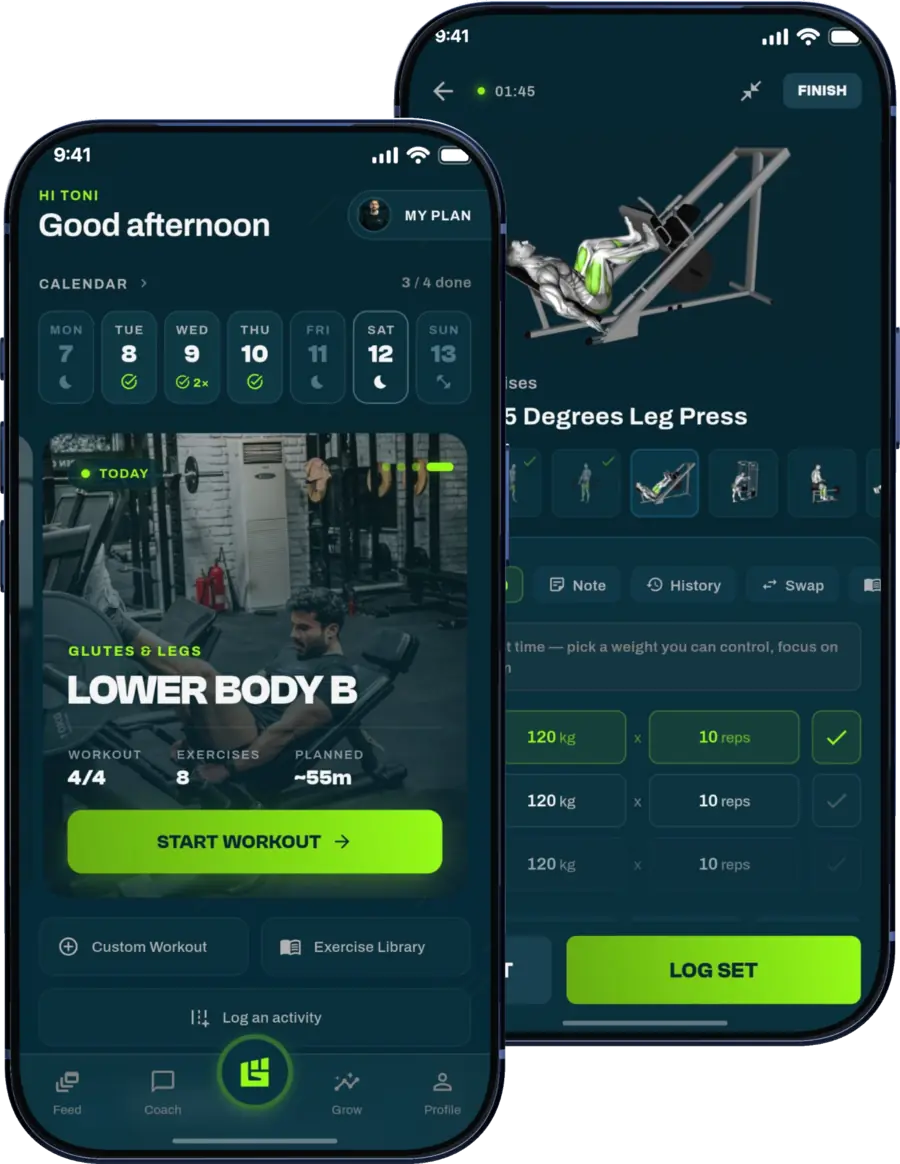
That's why smart planning matters more than gym bravado. Tools like GrabGains workouts are built around that idea: match training effort to the person, the day, and the goal instead of treating every set like a test of willpower.
Built for progress
Take the guesswork out of training
Get a personalized workout plan built around your goal, equipment and schedule. Train smarter, track every rep and keep moving forward, one workout at a time.






So, does training to failure build more muscle?
The honest answer is yes, training closer to failure can improve muscle growth, but going to absolute failure on every set is rarely the best move. The useful answer is more specific: it depends on what you're training for, how advanced you are, and what exercise is in your hands.
Introduction beyond the grind
The problem with the old-school message is that it confuses effort with exhaustion. Those aren't the same thing. A productive set should challenge the target muscle. It doesn't always need to wreck your next set, your next workout, or your recovery for the rest of the week.
That matters because most lifters don't fail from lack of motivation. They fail from poor calibration. They stop too early when the set gets uncomfortable, or they push too far on the wrong lifts and pay for it with sloppy reps and stalled progress.
Practical rule: Muscle growth responds well to hard sets. It doesn't require turning every exercise into an all-out grind.
A better approach starts with one question: what are you trying to improve? If the answer is muscle size, training close to failure deserves a bigger role. If the answer is maximal strength, the answer changes. If you're a beginner, the answer changes again. If you're doing lateral raises, that's different from a heavy squat.
This is why blanket rules don't work. “Always train to failure” is too crude. “Never train to failure” is too crude too. Good coaching lives in the middle, where effort is matched to context.
What training to failure really means
A lot of confusion starts with the word failure itself.
Some lifters think failure means a set felt brutal. Others think it means the rep slowed down. In practice, coaches usually separate two moments that happen near the end of a hard set.
Technical failure and muscular failure
Technical failure is when your form breaks down enough that the next rep would no longer look like the exercise you intended to perform. Your torso shifts on a curl. Your squat turns into a good morning. Your bench press path gets messy.
Momentary muscular failure is stricter. It's the point where you can't complete another rep with proper form because the muscle can't produce enough force.
For many lifters across various programs, technical failure is the more useful boundary. It protects exercise quality and lowers the chances that fatigue changes the movement into something risky or less effective.
RIR and RPE made simple
To use failure well, you need a way to estimate how close you are to it. Two tools dominate that conversation.
RIR means reps in reserve. If you finish a set and think you could've done:
- 3 more reps, that was 3 RIR
- 2 more reps, that was 2 RIR
- 1 more rep, that was 1 RIR
- No more reps, that was 0 RIR, or failure
Think of RIR like a fuel gauge. If your tank says 2 RIR, you're almost empty, but not completely.
RPE means rating of perceived exertion. In lifting, higher RPE usually means fewer reps left. So an RPE near the top of the scale means the set was very close to failure.
Where many lifters get it wrong
Many lifters don't misread easy sets. They misread hard ones.
A set at 3 RIR can feel intense, especially on high reps or machine work. But “that burned” doesn't always mean “I was at failure.” That's one reason occasional calibration matters. You need to learn the difference between discomfort and the true end of a set.
The key practical point is this: you often don't need to hit zero reps left to grow well. According to a 2022 systematic review on training to failure and muscle growth, training within 1 to 3 reps in reserve produced hypertrophy gains statistically equivalent to training to complete failure across 15 studies.
If you stop with one to three good reps left, you're still in the zone where muscle-building stimulus is high.
That's why experienced coaches don't just ask, “Did you go to failure?” They ask, “How close did you get, and was that the right place to stop?”
What the latest science says about muscle growth
The clearest answer to “Does training to failure build more muscle?” is that proximity matters more than drama. The science doesn't support the idea that every productive set must end in total collapse. It does support the idea that drifting too far from failure can leave growth on the table.
A useful summary comes from a 2024 meta-analysis discussed here. It found that training closer to failure significantly boosts muscle growth, and that sets stopped at 0 to 1 RIR produced superior hypertrophy compared with sets stopped 3+ RIR away. The same analysis reported approximately 0.46% greater relative hypertrophy gains per additional repetition in reserve closer to failure, and it covered 15 studies involving over 300 participants.

What that means in plain English
If you regularly stop a set too early, the target muscle may never experience the level of fatigue and fiber recruitment that drives its strongest growth signal. The final challenging reps matter because they force your body to bring more muscle fibers into the work.
But there's another important detail. The same 2024 analysis found no significant difference in 1-rep max strength gains between training very close to failure and stopping several reps short. That creates a useful split:
- For hypertrophy, getting very close to failure appears helpful
- For maximal strength, stopping a bit earlier can work just as well
That's a big deal because it explains why lifters get mixed advice. A bodybuilder, a powerlifter, and a beginner in a commercial gym aren't all trying to solve the same problem.
Why this doesn't mean every set should hit failure
The data favors getting close. It doesn't mean every working set needs to be all-out.
The practical interpretation is that hard sets near failure are productive, especially for muscle growth. But “near failure” and “at failure” aren't the same thing. Those last few reps before failure often provide the stimulus you want without the full recovery cost of grinding until the rep dies.
For lifters who want a better handle on progression overall, Master Strength Gains with Smart Progressions is a useful companion read because effort only works when it fits inside a broader plan for load, reps, and recovery.
The answer changes with your goal
A lot of confusion disappears once you stop asking a single yes-or-no question.
If your top priority is muscle size, training very close to failure deserves a regular place in your plan. If your top priority is strength performance, failure is less important and may even get in the way when fatigue starts to blunt rep quality. That doesn't make failure bad. It makes it specific.
The smartest reading of the evidence is simple. Closer is generally better for size. Absolute failure is optional.
That's the difference between training hard and training with intent.
The physiological triggers behind failure and growth
To understand why hard sets work, you need a simple picture of what the muscle is responding to. Muscle growth isn't rewarded because a set looked intense. It's rewarded because the set created the kind of tension and fatigue that forced your body to adapt.
The muscle only calls in all its workers when it has to
A helpful way to think about this is a work crew.
At the start of a set, your body uses the amount of muscle fiber help it needs for the job. As the set gets tougher and fatigue builds, it has to recruit more fibers, including the bigger, stronger high-threshold motor units. Those are the fibers you especially care about for growth.
That's why easy sets often don't do much, even if you did the movement correctly. The set never became demanding enough to require the full team.
Tension, fatigue, and the growth signal
Training close to failure creates a strong hypertrophy environment because it combines a few things at once:
- Mechanical tension: the fibers are producing force under load
- Broad recruitment: more motor units get involved as fatigue rises
- Fatigue accumulation: the muscle has to keep working while resources drop
You don't need a physiology degree to apply this. You just need to know that a challenging set creates a different internal signal than a comfortable one.
If you want a cleaner understanding of how muscles produce force during different phases of a rep, this Lake City Physical Therapy muscle mechanics overview helps clarify what's happening during the lifting and lowering portions of an exercise.
Why close often beats careless
A common mistake is assuming that if some fatigue is good, maximal fatigue must be better. It doesn't work that way.
The muscle needs enough challenge to recruit the fibers that adapt. But the body also pays a price for pushing to the edge. Once technique breaks down or local fatigue turns into system-wide exhaustion, the quality of work can drop fast. That's why the best hypertrophy programs usually chase high-quality hard reps, not random suffering.
Your muscle doesn't care whether the set looked heroic. It cares whether the set created enough tension, enough recruitment, and enough repeatable effort to justify adaptation.
That's the core logic behind training close to failure without treating total failure as a requirement.
The risks and rewards of going to failure
Failure training has real upside. It also has real cost. If you ignore either side, your programming gets worse.
The reward is straightforward. Pushing a set to 0 RIR can make it obvious that you trained hard enough. It can also help experienced lifters avoid stopping too early, especially on lower-risk isolation work where the target muscle is easy to feel and technique is easier to control.
The cost is less glamorous, but more important. Failure creates a lot of fatigue. That fatigue can reduce rep quality, cut down what you do in later sets, and make recovery harder than the muscle-building payoff justifies.
The main trade-off
Research summarized in this strength-focused review describes a clear split: muscle size responds better as training gets closer to failure, while maximal strength gains are similar whether athletes train close to failure or far from it. That matters because strength depends heavily on neural efficiency, and excessive fatigue can work against that.
So the question isn't “Is failure good or bad?” The better question is “Is the extra fatigue worth it for this goal and this exercise?”
Training to failure vs training near failure
| Factor | Training to Failure (0 RIR) | Training Near Failure (1-3 RIR) |
|---|---|---|
| Muscle-building stimulus | Very high when technique stays solid | Also very high and usually easier to repeat |
| Fatigue cost | High | Moderate and more manageable |
| Form breakdown risk | Higher, especially on complex lifts | Lower |
| Set-to-set performance | More likely to drop | Easier to maintain |
| Best use case | Selective use on safer movements | Default choice for most hypertrophy work |
When the reward is worth it
Failure can make sense when:
- The exercise is low risk. Think leg extensions, curls, machine rows, lateral raises.
- It's the last set. You're not trying to preserve output for more work after it.
- You're experienced enough to judge effort well. Advanced lifters usually benefit more from this tool.
- You need calibration. Occasionally reaching failure teaches you what 1 RIR or 2 RIR feels like.
When the cost is too high
Failure is harder to justify when your recovery is already strained. Poor sleep, work stress, calorie restriction, or high overall training volume can all make the extra fatigue less worthwhile.
If your joints feel beat up or your performance is sliding, watch for overtraining symptoms before you assume the answer is to push even harder. Some lifters also benefit from support work outside the gym, such as RMT sports massage, when dense training blocks leave them carrying too much muscle tension.
The short version is simple. Failure can increase stimulus, but it can also increase cost faster than it increases benefit. That's why smart lifters use it selectively.
How to program failure into your workouts
The right way to use failure depends on three things: your goal, your training age, and the exercise itself. These factors make the conversation practical.
Start with your training age
A Florida Atlantic University summary on proximity to failure research notes that a 2016 review found failure training is often unnecessary for beginners but can be advantageous for trained lifters. The same source also points to a 2025 to 2026 trend toward tech-personalized effort, including AI-driven RIR estimation, rather than a one-size-fits-all rule that everyone should always train to failure.
That fits what coaches see in real life.
Beginners usually need reps they can control. They benefit most from learning setup, bracing, tempo, range of motion, and exercise consistency. Advanced lifters already own those basics, so they can use proximity to failure more aggressively when they need a stronger hypertrophy push.
Match failure to the exercise
Not all lifts deserve the same intensity strategy.
Use more caution on technical compound lifts, where fatigue can spread across many muscles and form breakdown has bigger consequences. Use more freedom on stable isolation lifts, where the target muscle is easier to challenge without turning the rep into chaos.
A useful rule set looks like this:
- Heavy compounds
Stop shy of failure most of the time. Squats, deadlifts, and heavy presses usually respond better to crisp reps and repeatable output than to grinders. - Machine and cable work
These are often better candidates for very hard sets. Stability is higher, and the risk from a missed rep is lower. - Isolation lifts Many people find failure fits best with these lifts. A final hard set of curls, leg extensions, or lateral raises is often productive and practical.
Coaching cue: Save your ugliest effort for your safest exercise, not your most technical one.
Use simple rules in the real world
If you want muscle growth without overcomplicating things, start here:
- Keep most working sets close, not maximal
Aim to finish most hypertrophy sets with a small number of reps left. - Use true failure selectively
Save it for the final set of an exercise, especially on lower-risk movements. - Don't chase failure when recovery is poor
Bad sleep and high life stress change what “smart hard training” looks like. - Reassess if your performance drops
If later sets collapse, the first set may have been too aggressive.
For lifters who want help applying those decisions consistently, one option is GrabGains, which builds adaptive routines, tracks performance, and supports effort-based training choices instead of relying on fixed plans alone. If you want a deeper framework for effort-based programming, this guide on mastering RPE, RIR, VBT is worth reading.
A simple weekly mindset
You don't need to prove toughness every session. You need enough hard, repeatable work to grow over time.
That means some sets should feel challenging but controlled. A few should get very close to the edge. A small number may reach true failure when the exercise and timing make sense. That's a better system than using the same intensity on everything and hoping your body sorts it out.
Conclusion finding your optimal intensity
So, does training to failure build more muscle?
Training close to failure clearly matters for hypertrophy. Actual failure can help, but it isn't mandatory. That's the cleanest takeaway. If you want size, your sets need to be challenging enough that the target muscle has to do serious work. If you stop too early all the time, you'll probably undershoot the stimulus.
But there's a second takeaway that matters just as much. Failure is a costly tool. It creates more fatigue, raises the chance of sloppy reps, and can interfere with the quality of the rest of your workout. That makes it useful in the right places, not everywhere.
For most lifters, the sweet spot is this:
- train close to failure often enough to drive growth
- use true failure selectively
- reserve your hardest pushes for exercises that are safer and easier to control
- let your goal and recovery decide how aggressive to be
That's how experienced lifters keep progressing. They don't turn every set into a survival test. They apply effort where it pays.
The long-term winners in the gym usually aren't the people who suffer the most in one workout. They're the people who can stack months of high-quality hard training without burning themselves out.
If you want a more structured way to apply RIR, progression, and recovery to your own training, GrabGains offers adaptive workout planning, performance tracking, and tools that help turn effort into a repeatable system instead of a guess.
Get inspired and motivated