How much training volume do you really need?
How much training volume do you really need - Find out how much training volume you really need? Our guide simplifies the science & gives practical ranges for The majority of lifters build muscle best with 10 to 20 hard sets per muscle group per week. That's the evidence-based starting range, not the full answer, because the right amount depends on what you can recover from, not just what you can survive. That's where the popular advice falls apart. One coach says three sets are enough. Another tells you to annihilate a muscle with marathon workouts. Both can be wrong for you.


How much training volume do you really need? Usually less than the gym's hardest worker is doing, and more than the average undertrained lifter is doing. The useful target sits in the middle: enough effective volume to force adaptation, not so much that fatigue smothers performance.
The mistake is treating all sets as equal. They aren't. A focused set taken near failure counts. A lazy set done half-distracted at the end of a workout often doesn't. If you only count total sets, you can end up chasing more work when what you really need is better work.
A simple way to think about volume is baking a cake. Sets are the layers. Reps are the size of each layer. Load is the richness. Throwing in more ingredients doesn't automatically make the cake better. At some point, you just ruin it. Training works the same way. More volume only helps when the added sets are still productive and recoverable.
Built for progress
Take the guesswork out of training
Get a personalized workout plan built around your goal, equipment and schedule. Train smarter, track every rep and keep moving forward, one workout at a time.






The More-Is-Better Myth of Training Volume
Gym culture loves extremes. People either brag about doing endless sets or they chase minimalist routines that promise maximum results from almost no work. Neither approach teaches you how to judge whether your training is productive.
Most lifters don't need more punishment. They need a better filter for what counts.
More work is not always more stimulus
A set only matters if it creates enough tension and effort to give your body a reason to adapt. Once fatigue gets too high, later sets often turn into junk volume. You still spend time and energy, but the return drops.
That's why copying high-volume routines from advanced lifters usually backfires. You're seeing the visible workload, not the years of training behind it, the recovery habits around it, or the fact that some of those plans include work that's only useful for that specific athlete.
Practical rule: If your later sets are dramatically worse in quality, control, or intent, volume is probably outrunning your recovery.
The same exercise can be productive in one dose and wasteful in another. Four hard sets of rows with strong reps and controlled technique can move you forward. Turning that into ten sets when your low back is fried and your grip is failing often just adds fatigue.
Why people get confused about volume
Part of the problem is that “volume” gets used in different ways. Some people mean total tonnage. Others mean sets. Others mean workout length. In practice, muscle growth is most useful to track through hard weekly sets, not just by multiplying weight x reps x sets.
That doesn't mean reps and load stop mattering. It means they shape whether a set is worth counting. A set done with enough effort and good execution is part of your real volume. A mailed-in set is just activity.
Here's what usually doesn't work well:
- Copying bodybuilder split volumes blindly because they look impressive on paper.
- Adding sets every week by default without checking whether performance is still improving.
- Mistaking soreness for progress and assuming a wrecked muscle means an optimal session.
- Ignoring lifestyle stress and pretending recovery only depends on your training plan.
The fix is more disciplined than glamorous. Count the sets that are hard enough to matter. Watch how you recover. Keep the work that drives progress. Cut the work that only makes you tired.
What Is Training Volume and Why It Matters
More training is easy to count. Useful training is harder to judge.
Training volume matters because it gives you one of the clearest ways to adjust the size of the stimulus in your program. For resistance training, the number that matters most in practice is not total tonnage or session length. It is how many hard, repeatable sets you complete that drive adaptation and still fit your recovery.
A 2018 systematic review on PubMed supports using sets performed to failure or near failure across a broad rep range as a practical way to quantify hypertrophy-focused volume when intensity and frequency are otherwise controlled.

If you want a practical breakdown of how to measure gym volume accurately, start there. The useful shift is simple. Track effective sets, not just total sets.
Hard sets are what give volume meaning
A hard set is one done with enough effort, control, and intent to challenge the target muscle. In the gym, that usually means the set finishes close enough to failure that it has a reason to count.
That standard changes how volume should be read. Two lifters can log twelve sets for chest in a week and get very different outcomes. One lifter uses stable exercises, keeps reps honest, and finishes most working sets with real effort. The other adds sets after performance has already dropped, shortens rest to save time, and turns later sets into low-quality work. The spreadsheet shows the same weekly total. The training effect is not the same.
This is the trade-off many motivated lifters miss. More sets can help until the added work stops producing high-quality reps and starts cutting into recovery for the next session.
Why volume only matters if you can recover from it
The goal is to create productive volume that stimulates adaptation, rather than piling on work that only adds fatigue. That is why volume cannot be separated from exercise selection, execution, rest periods, sleep, nutrition, and stress outside the gym.
A set of leg presses taken hard with controlled reps may be easy to recover from. A set of barbell rows done late in the session with a tired low back may cost much more. On paper, both are one set. In a real program, they do not ask the same thing of your body.
Coaches who build performance training for local athletes deal with this constantly. The right amount of volume depends on whether the athlete can keep training well next week, not whether the session looked impressive that day.
Use four questions to judge whether your current volume is doing its job:
- Did the set get close enough to failure to matter?
- Did technique stay consistent enough to train the intended muscle?
- Did performance across the session stay within a useful range?
- Can you recover in time to repeat or improve that work?
That is why I prefer the term effective volume. It pushes attention to the sets that are hard enough to count and recoverable enough to repeat. That is also where a tool like GrabGains becomes useful, because your effective volume is not fixed. It shifts with your training age, exercise choices, stress, sleep, and how you are performing week to week.
Your Weekly Volume Guide for Any Fitness Goal
More sets do not automatically mean more progress. The weekly target that works best depends on what you are trying to improve, how hard those sets are, and whether you can recover well enough to repeat them.
For hypertrophy, a practical target for many lifters is 10 to 20 hard sets per muscle group per week. That range is useful because it captures what usually works in the gym without pretending every set carries the same value. A sloppy set done far from failure does not belong in the same bucket as a controlled set taken hard on an exercise that fits you well. If you want a strength-specific breakdown, this guide on how many weekly sets for strength gains is a useful companion.

Weekly volume recommendations by goal
| Training Goal | Beginner (0-1 Year) | Intermediate (1-3 Years) | Advanced (3+ Years) |
|---|---|---|---|
| Hypertrophy | 10-12 sets | 12-18 sets | 15-20+ sets |
| Strength | 6-8 sets | 8-12 sets | 10-15 sets |
| Maintenance | 3-6 sets | 3-6 sets | 3-6 sets |
Treat these as flexible starting points. They work best when the sets are challenging, technique stays clean, and your recovery habits match the workload.
Why the same weekly number doesn't fit every muscle
Different muscles often respond to different amounts and types of work. In practice, quads, delts, calves, back, and arms do not all fatigue the same way or recover on the same schedule. Exercise choice matters too. Ten hard sets of hack squats and split squats create a very different recovery bill than ten sets of leg extensions.
That matters when you are trying to fix a lagging area. If your triceps are flat but your biceps are progressing, giving both muscles the same weekly set count can miss the underlying problem. Adjust your plan based on whether a muscle needs more effective sets, better exercise selection, or better execution from set to set.
This is one reason I prefer tracking effective volume instead of total volume. The number on the spreadsheet only helps if those sets are hard enough to stimulate change and recoverable enough to keep performance moving up.
Use the guideline, then adjust for your context
A newer lifter usually grows well on the lower end. An intermediate lifter often benefits from adding work gradually once performance and recovery stay stable. Advanced lifters may need higher volumes during specialization blocks, but only when sleep, food, stress, and exercise selection support that push.
Your sport and schedule matter just as much as your goal. Someone training for size can often tolerate more local muscle fatigue than someone also doing sprint work, field sessions, or conditioning. Athletes looking at broader development can also benefit from examples outside bodybuilding-style plans, such as this guide to performance training for local athletes, because the right weekly volume has to fit the full week, not just the lifting sessions.
The useful question is simple. How many hard sets can you perform for a muscle, recover from, and improve on next week? That is the number that counts. GrabGains helps dial that in by adjusting your target volume to your actual performance and recovery, instead of locking you into a fixed set number that may stop fitting after a stressful week or a change in exercise selection.
Personalizing Volume Based on Your Experience and Recovery
A weekly set target is only useful if your body can turn it into progress. Your actual goal is finding how many hard, effective sets you can recover from and repeat with quality next week.
That number changes faster than many lifters expect.
Training age matters, but it is only part of the picture. A beginner can grow on relatively little work because almost everything is a new stimulus and technique is still improving. An advanced lifter usually needs more exposure to keep adapting, yet that does not mean piling on sets across the board. More work only earns its place when performance stays solid, form holds up, and recovery keeps pace.
That is why I prefer using volume landmarks as ranges, not rules carved in stone:
- MEV is the amount that starts driving progress.
- MAV is the range where progress is usually strongest.
- MRV is the upper limit you can recover from before performance, motivation, or joint comfort starts to slide.
Those landmarks shift with sleep, food intake, stress, exercise selection, and proximity to failure. A high-stress work week can lower your recoverable volume even if your program on paper stays the same.
Effective sets are what matter here. A set counts when it is hard enough to stimulate adaptation, performed well enough to target the muscle you want, and recoverable enough that it does not reduce the quality of the next few sessions. If your plan says 16 sets for quads but the last 4 are sloppy, your knees are irritated, and your squat performance is dropping by Friday, you are not getting 16 useful sets. You are getting 12 productive ones and 4 expensive ones.
That trade-off shows up within the same program too. Some muscle groups respond well to more work. Others stop benefiting long before the spreadsheet says they should. As noted earlier, higher volume does not produce the same payoff for every muscle group, so chasing perfect symmetry in set counts is usually a mistake.
Use a simple decision process:
- Start at the low end. Pick a recoverable number of hard sets for each muscle.
- Watch the right signals. Track reps, load, rep quality, soreness trends, and whether performance improves session to session.
- Add sets where the return is clear. Bring volume up for muscles that are not progressing, while recovery and execution still look good.
- Cut sets that are adding fatigue without results. Flat pumps, declining performance, joint irritation, and dragged-out soreness are common signs.
Fixed templates fall short for this reason. They can suggest a starting point, but they cannot tell whether 14 sets for your back is productive this month or just leftover fatigue from poor sleep, extra conditioning, and hard rows taken too far.
GrabGains solves that by focusing on your effective volume instead of a static weekly total. It adjusts targets around your actual performance and recovery, which is how volume should be personalized in practical training environments.
How to Program and Progress Your Volume Over Time
Most lifters don't fail because they picked the wrong weekly set target once. They fail because they never adjust it. Good programming treats volume as something you build, monitor, and pull back when needed.
The volume landmarks from the hypertrophy model are a useful map. In the summary based on meta-analytic evidence, Maintenance Volume (MV) sits at about 6 sets, Minimum Effective Volume (MEV) at about 10, Maximum Adaptive Volume (MAV) around 12 to 18, and Maximum Recoverable Volume (MRV) around 20 to 25. That framework is outlined in the review on resistance training volume landmarks.
Template one for a beginner chasing muscle
A beginner usually doesn't need to flirt with MRV. Starting near MEV makes more sense.
A simple setup could look like this:
- Chest with pressing and one isolation movement across the week
- Back with a vertical pull and a row
- Legs with one squat pattern, one hinge, and a leg isolation
- Arms and shoulders with modest direct work after compounds
The goal here is practice plus stimulus. You want enough hard sets to grow, not so many that soreness ruins consistency.
Template two for an intermediate focused on strength
An intermediate strength block often keeps weekly set counts tighter because heavy work costs more to recover from. The priority is quality on the main lifts and enough secondary work to support them.
That week might emphasize:
- Primary lifts first with low-rep, high-focus work
- Backoff work to build skill and force production
- Targeted accessories for weak links, not random exhaustion
Lifters often make the mistake of mixing a powerlifting-style top end with bodybuilding-style accessory bloat. The session looks serious, but recovery gets buried.
Coach's cue: Add volume only while bar speed, rep quality, and motivation stay stable. If all three drop, you've likely hit your ceiling for that block.
Template three for an advanced lifter running a specialization phase
Advanced trainees can benefit from pushing one muscle group harder while holding others closer to maintenance. That's usually smarter than trying to push every muscle at once.
A practical specialization block might work like this:
| Muscle Group | Weekly Approach |
|---|---|
| Priority muscle | Push toward MAV, possibly near MRV briefly |
| Secondary muscle groups | Hold around productive moderate volume |
| Non-priority muscle groups | Keep near maintenance volume |
This setup respects the logarithmic dose-response described in the evidence. Early increases in volume pay off well. Later increases pay less and cost more. That's why adding sets forever is a poor strategy.
A better progression model is simple:
- Start near MEV
- Add small amounts of volume only if progress and recovery stay solid
- Spend most of the block in MAV
- Back off with a deload before fatigue forces it
You don't need to live at the top end to make progress. You need to visit it carefully.
Troubleshooting Common Volume Problems
The most common volume mistake isn't undertraining. It's doing more than your life can support, then blaming yourself when progress stalls.
Static volume plans look clean on paper. Real life rarely is. Work stress, family obligations, poor sleep, travel, and inconsistent meal timing all reduce what you can recover from. If you ignore that, even a well-built program can stop working.
Busy people hit recovery limits faster
One useful reality check comes from the broader discussion of recovery capacity in hypertrophy planning. Sustainable weekly workload can vary widely, from 45 to over 80 weekly sets, depending on the person, and busy professionals often sit on the lower end when job stress and sleep problems pile up, as discussed in this article on hypertrophy training volume and recovery limits.
That doesn't mean busy people can't make progress. It means they need cleaner programming. Fewer wasted sets. Better exercise choices. Better timing. Less ego.
Signs your volume is too high
Overreaching doesn't always announce itself dramatically. It often starts as training that feels flat.
Watch for patterns like these:
- Performance stalls even though effort stays high
- Motivation drops before sessions you usually enjoy
- Soreness lingers longer than normal
- Small aches build up across joints or tendons
- Session quality falls off after the first few exercises
If several of those show up together, don't assume you need more discipline. You may need less volume.
What to change first
When a plan stops delivering, use this order:
- Remove obvious junk volume. Cut the sets that are least focused, least stable, or most redundant.
- Keep the hard sets that matter. Preserve compounds and high-value accessories.
- Check recovery basics. Sleep, food, and schedule often explain more than the spreadsheet does.
- Deload if needed. Pull volume down and let performance rebound.
If you're seeing repeated warning signs, this guide on avoiding training plateaus with GrabGains can help you distinguish normal fatigue from a plan that's overshooting your recovery.
Most plateaus are not a sign that your body needs punishment. They're a sign that your program needs better targeting.
How GrabGains Adapts Your Volume for You
The hard part of volume isn't learning the general recommendation. It's managing the moving target. Your best weekly volume changes with your goal, recovery, exercise choices, and how your performance is trending right now.
That's exactly where static programs fall short. They can tell you where to start, but they can't think. They can't notice that your pressing performance is climbing while your arm work is just creating fatigue. They can't see that your sleep has been poor and your previous week's volume needs to hold steady instead of increasing.
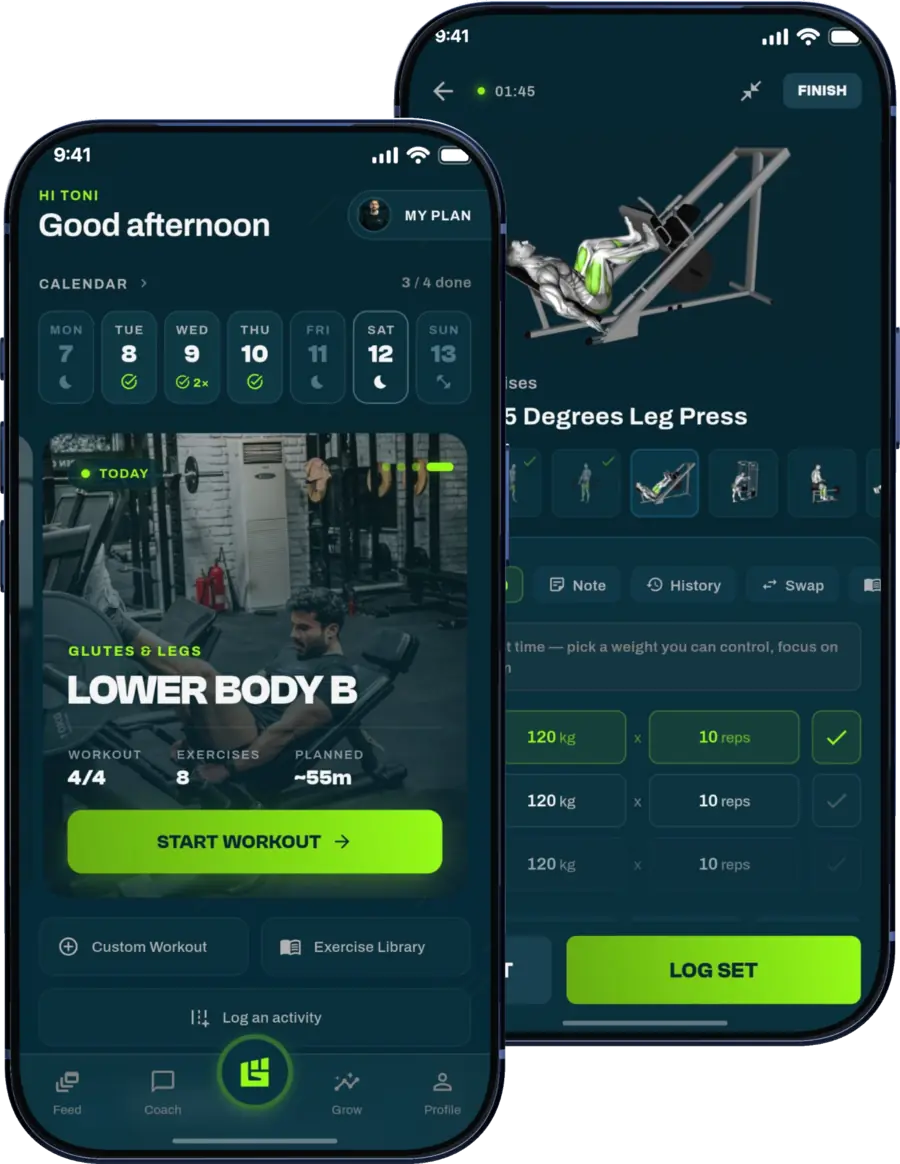
GrabGains is built for that problem. The platform uses your logged training, progress trends, and workout performance to keep your plan aligned with the amount of work you can benefit from. Instead of guessing whether you should add sets, hold steady, or back off, you get a program that adapts around your response.
That matters whether you're a beginner trying to avoid burnout, a busy professional who needs efficient sessions, or an experienced lifter pushing hard without tipping into junk volume. The best volume plan isn't the one with the biggest number. It's the one that keeps you progressing.
If you want a smarter way to find your effective volume instead of guessing from generic set ranges, try GrabGains. It helps you build adaptive workouts, track performance clearly, and keep your training volume matched to what your body can recover from.
Get inspired and motivated