How many sets per muscle group per week?
Unlock your muscle-building potential. Our guide explains the ideal sets per muscle group per week to maximize hypertrophy and strength gains. If you’re trying to build muscle, the science-backed “sweet spot” is between 10–20 sets per muscle group, per week. Let's get right into what that means for you.
Think of it like watering a plant. Too little, and it won't grow. Too much, and you’ll just drown it. The goal is to find that perfect amount of training that sparks growth without overwhelming your body's ability to recover and adapt. This guide will walk you through exactly how to find that number for your experience level and goals.


Finding your optimal number of sets
Volume—the total amount of work you do—is one of the biggest drivers of muscle growth. But it’s not just about piling on more sets for the sake of it. The real goal is to find the right amount of quality work that forces your muscles to adapt without running you into the ground.
You can think about your training volume on a spectrum. On one end, you have the Minimum Effective Dose (MED), which is just enough work to see some progress. On the other, you have your Maximum Recoverable Volume (MRV)—the absolute most you can handle before your recovery and performance start to tank. The magic happens somewhere in between.
Your training experience matters most
Where you land on that spectrum depends almost entirely on how long you've been lifting. A beginner's body is incredibly responsive to new challenges, so even a little bit of training can trigger impressive gains. An advanced lifter, on the other hand, has adapted over years and needs much more work to keep progressing.
Built for progress
Take the guesswork out of training
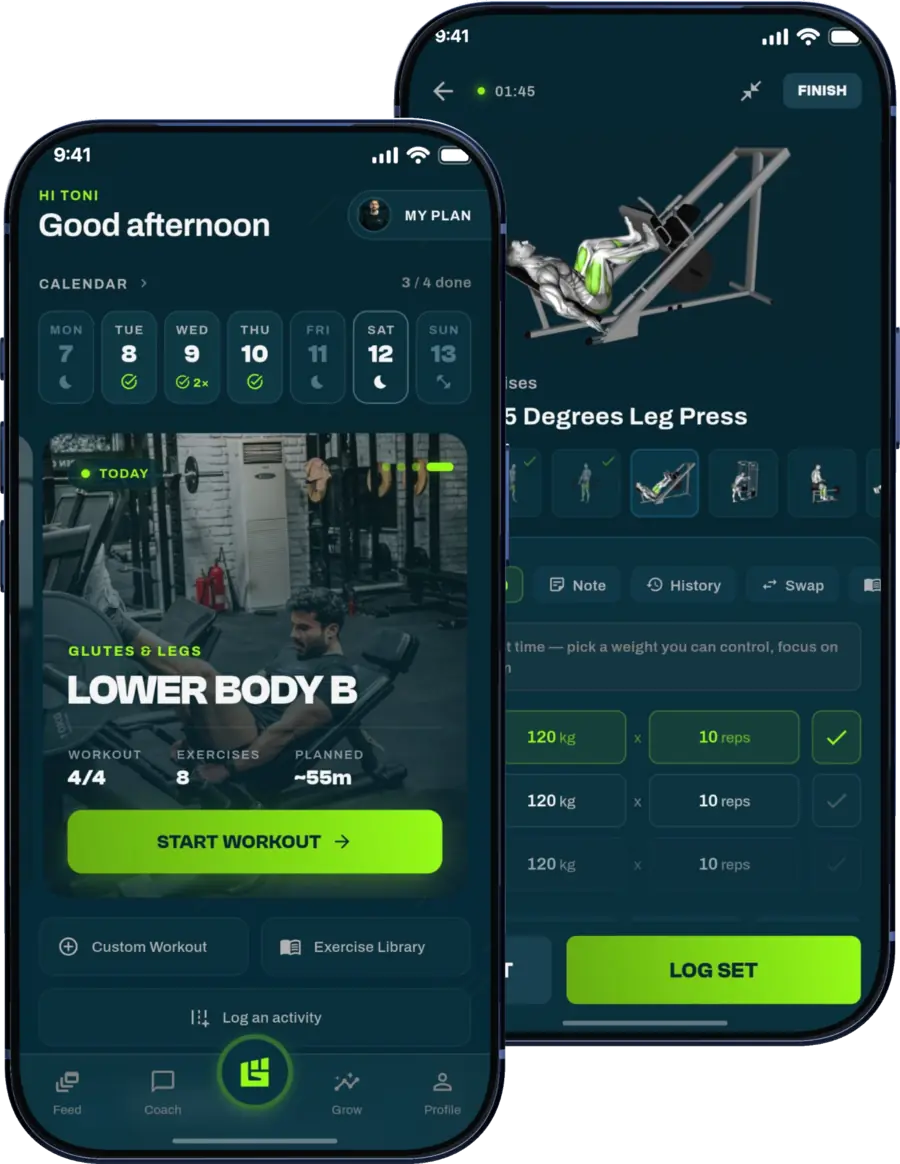
Get a personalized workout plan built around your goal, equipment and schedule. Train smarter, track every rep and keep moving forward, one workout at a time.






- Beginners: Your job is to nail down your form and build a solid base. You’ll see great results with relatively low volume.
- Intermediates: You've built that foundation and now need to slowly add more volume to keep breaking through plateaus.
- Advanced: Progress comes much slower now. You’ll need higher, more strategic training volumes and dialed-in recovery to keep moving forward.
This graphic gives you a clear visual of how your weekly set counts might evolve over time.

As you can see, the training volume needed to drive progress ramps up significantly as you move from novice to advanced.
A quick summary of weekly set recommendations
To make this simple, here’s a quick reference table outlining the general weekly set recommendations for different goals and experience levels.
Weekly set recommendations at a glance
| Experience Level | Hypertrophy (Muscle Growth) | Strength Gains |
|---|---|---|
| Beginner | 10-12 sets per muscle | 8-10 sets |
| Intermediate | 12-18 sets per muscle | 10-15 sets |
| Advanced | 16-20+ sets per muscle | 15-20 sets |
Use this table as a starting point, but remember to adjust based on how your body is responding.
What the science says
These numbers aren't just pulled out of thin air. A landmark meta-analysis was one of the first to show that 10+ weekly sets delivered the biggest muscle-building response.
More recent research has refined this, showing that while you can see some growth with as few as four sets a week, the real "goldilocks zone" is closer to 12–24 weekly sets. Hitting this range has been shown to increase muscle cross-sectional area by up to 3.8% more than doing half that volume.
The bottom line is that training volume is dose-dependent. More is often better—but only up to the point where you can still recover effectively. At GrabGains, we help you find that perfect balance for your body and your goals.
To see how you can organize this volume across your week, check out this guide on finding the best workout split for hypertrophy.
How training for strength differs from training for size
While people often chase them at the same time, building muscle size (hypertrophy) and building raw strength are two very different goals. Unsurprisingly, they respond best to different training styles—especially when it comes to how many sets you do each week.
Think of it this way: a bodybuilder is like a sculptor, chipping away with dozens of small, precise strikes to create a larger, more detailed statue. A powerlifter is like a demolition expert, focused on delivering one single, overwhelmingly powerful blow. Both work with the same material, but their methods couldn't be more different.
Building muscle is mostly a volume-driven process. It’s about creating enough total stress to signal your muscles that they need to grow bigger to handle future workouts. This accumulated work triggers muscle protein synthesis, the biological engine that drives growth.
Strength, on the other hand, is mostly a skill-driven process. It’s less about making the muscle bigger and more about teaching your nervous system how to fire the muscle you already have more effectively. Strength training is a neuromuscular adaptation—your brain gets better at recruiting more motor units and making them all fire at once.

This is the key difference that dictates how much volume you should do. Because muscle growth relies on cumulative stress, it responds incredibly well to higher weekly set counts, generally in that 10-20 set range. But because strength is about peak performance, it demands much lower volumes to avoid frying your central nervous system (CNS).
Volume for hypertrophy: the bodybuilder approach
A bodybuilder's one and only goal is to maximize muscle size. Their training is designed to generate as much metabolic stress and mechanical tension as possible to force the muscle to adapt and grow. This means more sets, more reps, and pushing closer to failure.
- High Volume: They need enough sets to trigger growth, typically 12-20+ per week for a given muscle group.
- Moderate Intensity: The weight is heavy enough to be a challenge but light enough to allow for reps in the 8-15 range, which maximizes time under tension.
- Focus on Fatigue: The entire point is to completely exhaust the muscle fibers, sparking the repair and growth cycle.
This higher volume is essential because the body adapts quickly. What once felt hard enough to stimulate growth soon becomes just another workout. Progressively adding more sets over time is one of the most reliable ways to keep building muscle.
Volume for strength: the powerlifter approach
A powerlifter’s goal is simple: lift the heaviest weight possible for a single rep. Their training is all about perfecting the skill of lifting heavy, which means every set needs to be crisp, powerful, and technically sound. Too much volume just leads to fatigue, sloppy reps, and a tired nervous system.
When you're training for strength, quality demolishes quantity. Every heavy set is a practice session for your nervous system to fine-tune its recruitment strategy. Too many sets just teach you how to perform sloppy, weak reps—the exact opposite of what you want.
This is why strength-focused training looks so different:
- Low Volume: Fewer total sets are performed, keeping the nervous system fresh and ready for maximum-effort lifts.
- High Intensity: The weights are very heavy, often 85% or more of a one-rep max, and lifted for low reps (1-5).
- Focus on Performance: Each rep must be explosive and perfect. There's no room for grinding out sloppy reps.
Modern research really highlights this contrast. For pure strength gains, studies show that even one heavy set per week can deliver noticeable improvements. The benefits start to level off fast after four sets, with the sweet spot sitting at around just two heavy sets weekly.
This is a world away from hypertrophy, where a systematic review found that trained men need 12-20 weekly sets for optimal growth in muscles like the quads and biceps.
Ultimately, the number of sets you do has to match what you’re trying to achieve. If you use bodybuilding volume to chase maximum strength, you’ll burn out. If you use powerlifting volume to get bigger, you’ll leave a ton of potential gains on the table.
Knowing the difference is the first step, and using a smart tool like the GrabGains app can help you build a personalized plan that gets the volume just right for your specific goals.
Tailoring your weekly volume from beginner to advanced
Training volume isn’t a one-size-fits-all number. It’s a dial you need to turn up or down as you get stronger and more experienced in the gym. Giving a beginner an advanced lifter's program is like handing a professional chef's recipe to someone who's never boiled an egg—it's a recipe for disaster. Your number of sets per muscle group per week has to evolve with you.

This progression is absolutely critical for long-term success. Sticking with the same volume forever is the fastest way to hit a plateau, but jumping to advanced numbers too soon will just lead to injury and burnout. Let's break down how to manage your volume based on where you are right now.
The beginner phase: building a foundation
If you're new to lifting (less than a year of consistent training), your body is primed to respond to almost anything. This is the magic of "newbie gains," where even a small amount of training can spark incredible results. Your goal isn't to crush yourself with volume; it's to master the fundamentals.
For beginners, it's all about quality over quantity. Think of each set as a chance to learn proper form, build a strong mind-muscle connection, and lay down a solid base of strength. Piling on too many sets right now is just counterproductive.
Your nervous system is learning a brand-new skill. Overwhelming it with too much volume is like trying to learn a language by listening to ten people talk at once. Start simple, get it right, and then add more.
Here’s what this looks like in practice:
- Recommended Volume: Stick to around 10-12 total sets per muscle group per week. This is plenty to stimulate growth without wrecking your form or recovery.
- Focus: Perfecting technique on the big compound lifts (squats, deadlifts, presses, rows) is everything.
- Frequency: It’s often better to hit each muscle group 2-3 times per week with a few sets each time, rather than trying to annihilate it in one high-volume session.
This approach gives your muscles, tendons, and ligaments time to adapt to the new stress of lifting safely.
The intermediate phase: pushing past plateaus
After a year or two of consistent training, you'll find yourself in the intermediate phase. Those easy "newbie gains" will start to slow down, and you'll notice that what used to work isn't getting you the same results. This is a clear sign your body has adapted and needs a bigger challenge.
This is where you start to strategically dial up your sets per muscle group per week. The foundation is built; now it’s time to add more bricks. Increasing your training volume is one of the most reliable ways to smash through plateaus and spark new growth.
- Recommended Volume: Gradually bump your weekly sets into the 12-18 range.
- Strategy: You can do this by simply adding a set to your main exercises or by bringing in new accessory movements to hit muscles from different angles.
- Monitoring: Listen to your body. If you feel constantly beat up, sore, or your strength is stalling, you probably increased volume too quickly.
This phase is all about progressive overload. You’re not just lifting heavier weights; you're also handling more total work over time.
The advanced phase: intelligent volume management
Once you have several years of serious training under your belt, you’re playing a different game. Progress is slow and hard-won. At this point, your body is highly resistant to change and needs a much greater—and smarter—application of stress to keep growing.
Advanced lifters often push into the 16-24+ sets per week range to see results. But this isn't a constant, year-round grind. Managing this kind of volume requires careful planning to avoid overtraining. It often involves periodization: cycling through high-volume "accumulation" phases followed by lower-volume "deloads" to allow for full recovery and growth.
- Recommended Volume: Work within 16-24+ sets, but make sure you schedule strategic deloads.
- Specialization: Advanced lifters often run specialization cycles, where they hammer one body part (like their legs) with high volume while pulling back on others. If you're looking to bring up your lower body, check out our guide on effective leg exercises.
- Recovery Is Key: With this much volume, things like sleep, nutrition, and stress management become non-negotiable if you want to make any progress at all.
For the advanced athlete, volume becomes a precision tool—something you use strategically to chisel out small, incremental gains over the long haul.
Customizing sets for different muscle groups
You wouldn’t use a sledgehammer to hang a picture frame, right? The same logic applies to training. While the general 10-20 sets per week rule is a solid starting point, smart training means treating each muscle group a little differently. Some muscles thrive on a ton of work, while others grow perfectly fine with a more focused, lower-volume approach.
This all comes down to a few key factors: muscle size, its day-to-day function, and how much "free" work it gets from other exercises. Big, powerful muscles like your back are designed for heavy lifting and can handle a lot of stress. Smaller ones like your biceps, however, are already putting in a shift during your back workouts, so they don’t need nearly as much direct attention.
Large vs small muscle groups
Just think about your quads versus your biceps. Your quads are a massive muscle group responsible for carrying you around all day. They’re built for powerful movements like squats and can take a beating in the gym before they’re overworked.
Your biceps, on the other hand, are much smaller and mostly just bend your elbow. They’re the star of the show during a curl, sure, but they’re also working hard every time you do a pull-up, row, or chin-up. That indirect volume adds up fast. If you’re already hitting 12 sets of back work for the week, your biceps have taken a pretty good hit before you’ve even thought about a single curl.
It’s a classic mistake to hammer small muscles with the same volume you use for large ones. This is a fast track to angry joints and stalled progress. The goal is efficiency—giving each muscle exactly what it needs to grow, and not a single wasted set more.
This is why you can often get away with fewer direct sets for smaller muscles. Here’s how it generally breaks down:
- Large Muscles (Back, Quads, Glutes, Chest): These powerhouses can handle higher volumes. Advanced lifters might need 16-20+ sets per week to keep making progress.
- Small Muscles (Biceps, Triceps, Calves, Shoulders): Since they get so much indirect work, they often only need 8-12 direct sets to grow. If you're looking for ideas on how to target specific muscles, check out our guide to building a bigger chest.
Factoring in muscle fiber and function
Another piece of the puzzle is muscle fiber type. While every muscle has a mix, some are more slow-twitch (built for endurance), while others are more fast-twitch (built for explosive power).
- Slow-twitch dominant muscles, like your calves and forearms, tend to respond well to higher reps and can be trained a bit more often.
- Fast-twitch dominant muscles, like your hamstrings and glutes, love heavier loads and more powerful, explosive movements.
This doesn't mean you need to completely overhaul your weekly set counts, but it might change how you perform those sets. For calves, you might find that sets in the 15-20 rep range work wonders, while for hamstrings, you’ll likely get more out of heavier sets of 6-10 reps.
The table below gives you a practical starting point for dividing up your weekly volume. Think of it as a template, not a rulebook. Pay attention to how you feel and adjust based on your own recovery and progress.
Sample weekly set ranges by muscle group
Here are some general guidelines for distributing your weekly training volume across different body parts, accounting for their size and recovery needs.
| Muscle Group | Recommended Weekly Sets (Direct Work) | Recovery Consideration |
|---|---|---|
| Back | 14-22 sets | Large and complex; can handle high volume and frequency. |
| Chest | 12-20 sets | Recovers moderately well; be mindful of shoulder strain with high volume. |
| Quads | 12-20 sets | Very large muscle group; can handle high volume but requires significant recovery. |
| Hamstrings | 10-16 sets | Often undertrained; responds well to a mix of heavy and moderate loads. |
| Shoulders | 10-16 sets | Gets indirect work from pressing; focus direct sets on medial and rear delts. |
| Biceps | 8-14 sets | Gets significant indirect work from all pulling movements. |
| Triceps | 8-14 sets | Gets significant indirect work from all pressing movements. |
| Calves | 10-16 sets | Can be trained frequently with higher reps due to slow-twitch fiber dominance. |
| Glutes | 10-16 sets | Responds well to a mix of heavy compound lifts and lighter isolation work. |
Use these numbers as your starting line. From here, the real progress comes from listening to your body and making small, smart adjustments over time.
Building your weekly workout plan
Theory is great, but results are built in the gym. This is where we turn the science of training volume into a real, actionable weekly schedule. Below are two sample templates that show you exactly how to structure your training based on your goals, experience, and how much time you have.
Think of these less as rigid prescriptions and more as blueprints. They show you how to properly count your sets per muscle group per week by tracking both direct and indirect work. Use them to build your own perfect week.
The time-efficient upper/lower split
This one is for the busy person who needs to get the most out of every minute in the gym. An upper/lower split lets you hit every muscle group twice a week—perfect for growth—while keeping your weekly volume in that sweet spot of 10-12 sets. The strategy here is to focus on big, compound movements that deliver the most bang for your buck.
Weekly Schedule: 4 Days/Week
- Day 1: Upper Body
- Day 2: Lower Body
- Day 3: Rest
- Day 4: Upper Body
- Day 5: Lower Body
- Day 6 & 7: Rest
Upper body workout (example)
| Exercise | Sets x Reps | Primary Muscle | Indirectly Worked |
|---|---|---|---|
| Barbell Bench Press | 3 x 6-8 | Chest | Shoulders, Triceps |
| Bent Over Rows | 3 x 8-10 | Back | Biceps, Rear Delts |
| Overhead Press | 3 x 8-10 | Shoulders | Triceps |
| Lat Pulldowns | 3 x 10-12 | Back | Biceps |
| Tricep Pushdowns | 2 x 12-15 | Triceps | - |
| Bicep Curls | 2 x 12-15 | Biceps | - |
Weekly Volume Check: After two of these sessions, your chest gets 6 direct sets, triceps get 4 direct sets + 6 indirect, back gets 12 direct sets, and biceps get 4 direct sets + 6 indirect. This lands you squarely in the optimal zone without having to live in the gym.
Lower body workout (example)
| Exercise | Sets x Reps | Primary Muscle | Indirectly Worked |
|---|---|---|---|
| Barbell Squats | 4 x 6-8 | Quads, Glutes | Hamstrings |
| Romanian Deadlifts | 3 x 8-10 | Hamstrings, Glutes | - |
| Leg Press | 3 x 10-12 | Quads | Glutes |
| Leg Curls | 2 x 12-15 | Hamstrings | - |
| Calf Raises | 3 x 15-20 | Calves | - |
Run this workout twice a week, and your quads will get 14 direct sets and your hamstrings will get 10 direct sets—a powerful stimulus for growth.
The advanced hypertrophy push/pull/legs split
This setup is for the experienced lifter chasing maximum muscle growth by pushing weekly volume into the 18-20+ set range. The Push/Pull/Legs (PPL) split is perfect for this job. It groups muscles by function, allowing you to absolutely hammer them with high volume while ensuring other groups are recovering. It's demanding, no doubt, but incredibly effective for smashing through plateaus.
Weekly Schedule: 6 Days/Week
- Day 1: Push
- Day 2: Pull
- Day 3: Legs
- Day 4: Rest
- Day 5: Push
- Day 6: Pull
- Day 7: Legs (or Rest, alternating weekly)
Push workout (chest, shoulders, triceps)
- Incline Dumbbell Press: 4 sets x 8-12 reps
- Flat Barbell Bench Press: 3 sets x 6-10 reps
- Seated Dumbbell Shoulder Press: 3 sets x 8-12 reps
- Cable Crossover: 3 sets x 12-15 reps
- Lateral Raises: 4 sets x 12-15 reps
- Skull Crushers: 3 sets x 10-12 reps
Pull workout (back, biceps)
- Weighted Pull-Ups: 4 sets x 6-8 reps
- Barbell Rows: 4 sets x 8-10 reps
- Single-Arm Dumbbell Rows: 3 sets x 10-12 reps
- Face Pulls: 3 sets x 15-20 reps
- Barbell Curls: 4 sets x 8-12 reps
Legs workout (quads, hamstrings, glutes, calves)
- Back Squats: 4 sets x 6-10 reps
- Leg Press: 4 sets x 10-15 reps
- Romanian Deadlifts: 4 sets x 8-12 reps
- Leg Extensions: 3 sets x 15-20 reps
- Seated Leg Curls: 3 sets x 12-15 reps
- Standing Calf Raises: 5 sets x 10-15 reps
When you run this PPL routine twice a week, it drives your chest volume to 20 sets, your back to 22 sets, and your shoulders to 14 sets, pushing your body’s adaptive limits. After you've figured out your ideal weekly volume, knowing what to eat after lifting weights becomes critical for fueling recovery from this kind of demanding schedule.
These templates give you a solid foundation, but the best plan is always the one that’s built for you. For a truly personalized approach, a smart workout builder can create a routine that lines up perfectly with your specific goals and schedule.
Frequently asked questions about training volume
Even after you've mapped out the perfect plan, questions always pop up. Let's clear up some of the most common points of confusion around training volume so you can apply these ideas with confidence and get the most out of your time in the gym.

What counts as a working set?
This is probably the most important question because it defines what you actually track. Not every set you do in a workout is created equal when it comes to building muscle.
A working set, sometimes called a "hard set," is any set you take close to muscular failure. A good rule of thumb is that you should have no more than 3-4 reps left in the tank when you rack the weight. If you could have easily cranked out another five reps, it probably wasn't challenging enough to count toward your weekly total.
The difference is all about the intensity of your effort. A set of 12 where you’re grinding out that last rep is a true working set. A set of 12 that feels like a warm-up is not.
This also means that your warm-up sets, which are just there to get your muscles and joints ready for the real work, do not count. You should only be logging the sets that are genuinely stimulating enough to force your muscles to adapt and grow.
How do I know if my volume is too high or too low?
Your body is giving you feedback all the time—the trick is learning to listen to it. The best way to know if your sets per muscle group per week are on point is to monitor how you're performing and recovering.
You might be doing too little volume if:
- You pretty much always feel fresh and are never sore.
- Your strength and muscle growth have hit a wall for weeks on end.
- You don't get a noticeable "pump" during your workouts.
On the flip side, you might be doing too much volume if:
- You feel constantly tired, irritable, and have zero motivation to train.
- Your strength is actually going down instead of up.
- You're dealing with nagging aches and pains that just won't go away.
- Your sleep has gone downhill, or you're having trouble falling asleep.
Finding your sweet spot is all about making small adjustments. If you think your volume is too low, try adding one or two sets to your main lifts for a few weeks and see what happens. If you're feeling burned out, a smart deload week where you cut your volume in half can do wonders for your recovery and set you up for progress down the road.
Should I adjust my volume when dieting for fat loss?
Absolutely. When you're in a calorie deficit to lose fat, your body's ability to recover takes a significant hit. You simply have less energy coming in, which means you have fewer resources to repair the muscle damage from your training.
Trying to stick with a super high-volume routine while dieting is a classic mistake. It's a fast track to losing muscle, not just fat. During a cut, your goal is to preserve the muscle you have, not necessarily build new tissue.
Here’s the game plan:
- Keep Intensity High: The number one signal to your body to hang onto its muscle is to keep lifting heavy. Don't let your main lifts turn into cardio.
- Cut Your Volume: This is where you make the big change. Drop your weekly sets by about 30% from whatever you were doing in a surplus. So, if you were hitting 18 sets for your back, dialing it back to around 12-14 is a smart move.
- Watch Your Recovery Like a Hawk: Pay even closer attention to those signs of overtraining. If you're feeling totally wiped out, don't hesitate to pull the volume back even more.
Think of it as a balancing act between stimulus and fatigue. You need just enough stimulus to convince your body to keep its muscle, but not so much fatigue that your compromised recovery system can't handle the load.
How should I distribute my weekly sets?
How you spread your volume out over the week is just as crucial as the total number of sets you do. The research is pretty clear on this: splitting your weekly sets for a muscle across two or more sessions is far better for growth than cramming it all into one marathon workout.
For example, if your goal is 16 sets for your chest per week, you'll almost certainly get better results doing 8 sets on Monday and another 8 on Thursday than you would from blasting through all 16 sets in one go.
This approach has some major advantages:
- Higher Quality Sets: Your performance is always best at the start of a workout. By splitting the volume, more of your sets are done when you're fresh, strong, and can give them your all.
- More Growth Signals: Hitting a muscle twice a week means you trigger muscle protein synthesis twice, giving you more opportunities to grow.
- Easier Recovery: It’s a lot easier for your body to recover from two moderately tough sessions than it is from one single, muscle-annihilating workout.
This is exactly why popular training splits like Upper/Lower, Push/Pull/Legs, and Full Body are so effective. They're built on the principle of hitting each muscle group multiple times a week, which lets you handle a productive amount of volume without running yourself into the ground in any single workout.
Ready to stop guessing and start building a workout plan that adapts to you? GrabGains creates truly personalized routines based on your goals, performance, and schedule. Download GrabGains on iOS or Android today and experience the future of smart training.
Get inspired and motivated