The difference between strength and hypertrophy training
Learn the difference between strength and hypertrophy training. This 2026 guide reveals optimal reps, sets, rest, tracking, and program design for your goals. You're in the gym staring at two options. One program says to squat heavy for a few crisp reps with long rests. Another says to chase hard sets, shorter rests, and enough volume to leave your legs shaking. Both claim they build results. Both are right, but they're solving different problems.
This is where many trainees face uncertainty. They've heard that strength means lifting more weight and hypertrophy means building more muscle, but they don't know how that informs their weekly workouts. They also don't know whether they need to pick one approach or if an effective plan can blend both.


The difference between strength and hypertrophy training matters because the wrong emphasis creates the wrong adaptation. If your goal is a bigger total on the barbell, a pump-heavy plan with rushed rest periods will hold you back. If your goal is more muscle, living only in low-rep heavy work can leave growth on the table. For most lifters, especially hybrid athletes and busy professionals, the key skill is learning how to combine both without turning training into a mess.
Strength vs hypertrophy which training style is right for you
A dedicated lifter often asks the same question after a few months of consistent training. “Should I keep pushing heavier weights, or should I back off a bit and do more reps to grow?” That question usually shows up when progress starts to split in two directions. Your lifts might be climbing, but your physique isn't changing much. Or you're adding size, but your top-end strength feels stale.
A simple way to frame it is this. Strength training is about producing maximal force. Hypertrophy training is about increasing muscle size. Those goals overlap, but they aren't identical, and they reward different programming decisions.
Built for progress
Take the guesswork out of training
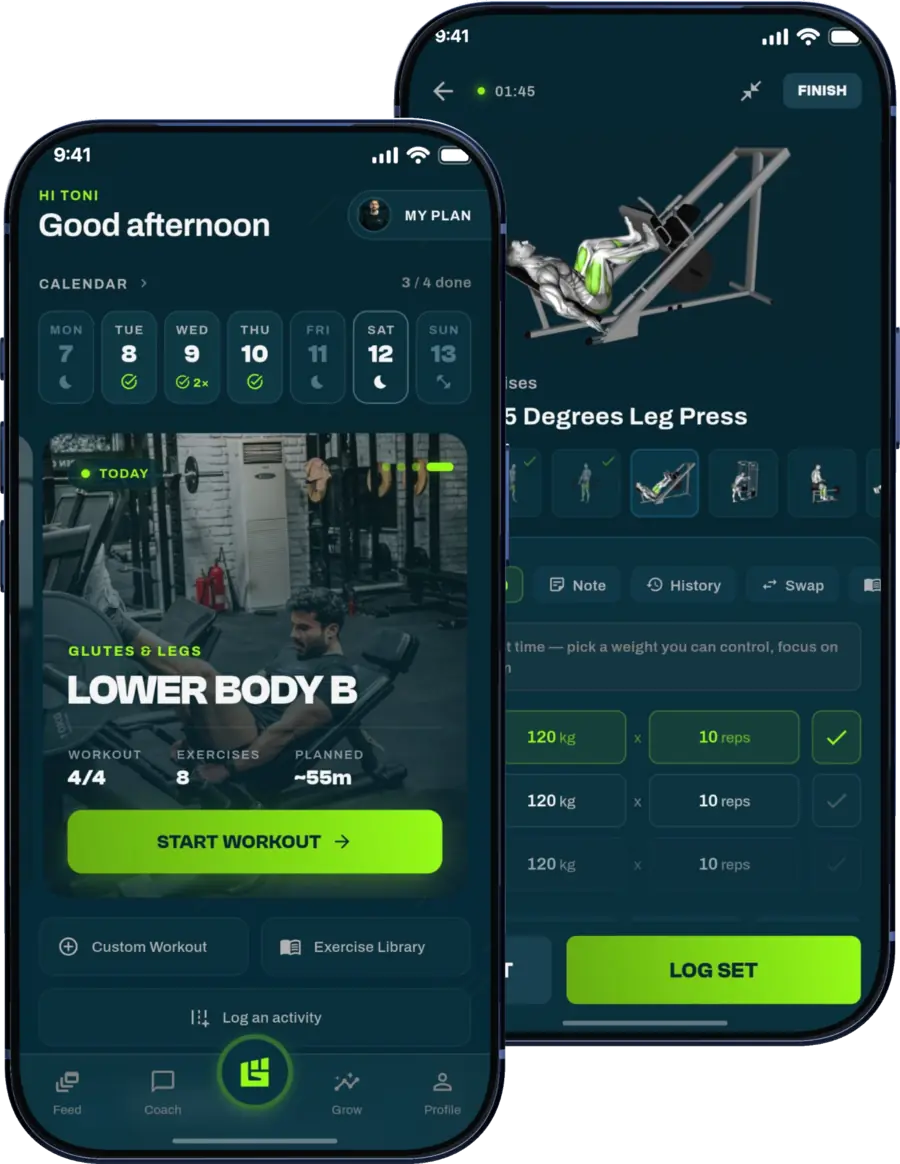
Get a personalized workout plan built around your goal, equipment and schedule. Train smarter, track every rep and keep moving forward, one workout at a time.






Here's the fast comparison often needed first:
| Focus | Strength training | Hypertrophy training |
|---|---|---|
| Main goal | Lift more weight | Build more muscle size |
| Typical rep style | Lower reps | Moderate to higher reps |
| Rest periods | Longer | Shorter |
| Primary adaptation | Neural efficiency | Muscular growth |
| Best fit | Powerlifters, athletes, performance-focused lifters | Bodybuilders, physique-focused trainees, general muscle gain |
| Hybrid use | Builds force output | Builds the tissue that supports future strength |
The mistake is treating these as opposing camps. They're not. A stronger lifter can often create more tension over time, which supports muscle growth. A more muscular lifter usually has more raw potential for later strength development. The choice isn't always either-or. Often it's about emphasis.
Most lifters don't need to ask which style is superior. They need to ask which adaptation they need most right now.
If you're training for a meet, strength takes priority. If you want more visible muscle, hypertrophy should drive the plan. If you want both, the answer is periodization, exercise order, and honest recovery management.
The science behind your gains neural vs muscular adaptations
Strength and hypertrophy look similar from the outside because both involve resistance training. Under the hood, they lean on different primary adaptations. If you understand that, the rep schemes and rest periods stop feeling arbitrary.

How strength adapts through the nervous system
Early strength gains are heavily tied to neural adaptation. Your brain and nervous system get better at recruiting muscle fibers, coordinating joints, and producing force with better timing. Envision this as improving the software that runs an engine. The engine may not be much bigger yet, but it performs better because the system controlling it is sharper.
That's why heavy compound lifts matter so much for strength work. Squats, presses, deadlifts, and pulls teach you to apply force under demanding conditions. You practice the skill of lifting heavy, not just the act of getting tired.
A stronger nervous system also changes how a set feels. A weight that once pinned you down starts to move with control. That doesn't mean the work got easier. It means your body learned how to express force more efficiently.
How hypertrophy builds the tissue itself
Hypertrophy shifts the emphasis toward muscular adaptation. The goal is to expose muscle fibers to enough tension, effort, and total work that the body responds by building more muscle tissue. If strength work upgrades the software, hypertrophy work makes the engine bigger.
A key point from a 2017 meta-analysis in the Journal of Strength and Conditioning Research is that maximal strength gains are significantly greater with high-load training, while changes in muscle size are similar between high-load and low-load conditions when sets are taken to failure. That matters because it breaks a common myth. You don't need to live exclusively in very heavy low-rep work to build muscle.
Coaching takeaway: Heavy loads are best when the goal is maximizing strength. Muscle growth is more flexible if effort and volume are high enough.
This is why a lifter can grow well with machines, dumbbells, cables, and moderate loads, especially when sets are pushed hard. It's also why chasing only bar speed and top sets can leave a physique-focused trainee underdosed on total stimulus.
Why the overlap matters
The difference between strength and hypertrophy training isn't a clean wall. It's a shift in emphasis. Heavy training can still build muscle. Higher-volume training can still improve strength. The primary adaptation changes based on how you organize load, reps, effort, and fatigue.
That's what good programming solves. It decides which adaptation gets first priority instead of hoping both happen equally from random hard work.
How programming variables shape your results
The fastest way to understand the difference between strength and hypertrophy training is to compare the variables that drive adaptation. Programs aren't magic. They're combinations of load, reps, sets, rest, frequency, and progression.

The side by side comparison that matters
According to evidence-based guidelines summarized here, strength work usually sits around 1 to 5 reps per set with 3 to 5 minute rest periods, while hypertrophy training usually uses 6 to 12 reps per set with about 60 to 90 seconds of rest.
| Variable | Strength emphasis | Hypertrophy emphasis |
|---|---|---|
| Reps | 1 to 5 | 6 to 12 |
| Rest | 3 to 5 minutes | 60 to 90 seconds |
| Load feel | Heavy and crisp | Challenging with more sustained fatigue |
| Session goal | High output on key lifts | More total work for target muscles |
| Exercise bias | Big compound lifts | Compounds plus more accessories |
Those ranges aren't prison bars. They're starting points. Strength blocks often work because long rests preserve output quality. Hypertrophy blocks often work because shorter rests and more total work create more stimulus across the week.
What each variable is really doing
Load drives specificity. If you want to get good at lifting heavy, you need to lift heavy enough to practice that demand. Very light work doesn't prepare you well for maximal-force performance.
Volume matters more for hypertrophy than many lifters want to admit. Muscle usually responds well when you accumulate enough hard work over time. That means more sets, more target-muscle exposure, and enough weekly work to justify adaptation.
Rest periods shape performance within the session. Long rest gives your nervous system and prime movers enough recovery to attack the next heavy set properly. Shorter rest keeps fatigue in the picture, which can be useful when the goal is to accumulate hypertrophy-focused work.
Exercise selection changes with the goal too. Strength plans tend to revolve around lifts you want to improve directly. Hypertrophy plans can use a broader menu because the target is the muscle, not only the movement.
If your heavy sets keep getting worse because you're rushing rest, you're not doing efficient strength work. If your hypertrophy work never gets close to hard muscular effort, you're not giving the muscle enough reason to grow.
What progression should look like
Progressive overload still runs both systems, but it doesn't look identical. In a strength phase, overload often means adding load to key lifts, tightening technique under heavier weights, or improving repeatability across work sets. In a hypertrophy phase, overload can also come from more reps, more hard sets, better execution, or more weekly volume.
If you want a clear explanation of how overload works in practical training terms, Flourish-Everyday's progressive overload insights are a useful companion read. For a more training-plan view, the GrabGains insights on progressive overload break down how progression can be tracked across different goals.
What works and what usually fails
A few common mistakes show up repeatedly:
- Strength mistake: turning every session into fatigue management theater. Too many accessories, too little rest, and no real focus on the primary lift.
- Hypertrophy mistake: lifting moderate weights casually. The reps are there, but the sets aren't hard enough and volume is too low.
- Hybrid mistake: trying to max out and chase a bodybuilder pump in the same exercise block with no structure.
- Busy lifter mistake: changing the whole plan every week, which kills skill practice and makes progress impossible to read.
Good programming is less exciting than random hard training. It's also what gets results.
Measuring what matters tracking progress for each goal
A plan only works if you can tell whether it's moving in the right direction. Strength and hypertrophy need different scoreboards. Too many lifters use the wrong one and conclude a good program isn't working.

What to track for strength
Strength progress should center on performance in key lifts. That can mean your current one-rep max, an estimated one-rep max, or your ability to do more reps with a fixed load while keeping technique solid. The main point is that your output on specific movements should trend upward.
You should also track how sets feel. A lift that moves faster, looks cleaner, or leaves more reps in reserve is progress even before a formal max test. That matters because not every strength cycle should end with testing.
What to track for hypertrophy
Muscle gain is harder to read from the bar alone. You can get stronger without looking much bigger, and you can build muscle while your top set numbers move slowly. For hypertrophy, better markers include progress photos, body measurements, how clothes fit, and whether you're sustaining more quality training volume over time.
Research highlighted by Florida Atlantic University notes that for muscle hypertrophy, training closer to muscular failure is a significant factor for growth, while strength gains show no clear impact based on proximity to failure. That changes how you judge set quality. A hypertrophy session filled with easy sets may look productive on paper but miss the actual target.
A strength set can be effective without grinding to failure. A hypertrophy set often needs to get much closer to that line to count as high quality.
How to keep tracking practical
Most people don't need a lab. They need consistency. Use the same lifts, the same camera angles for photos, and the same basic conditions for measurements. Don't react to one workout. Look for trends across weeks.
For people who want one place to log lifts, estimate maxes, and monitor training trends, GrabGains includes tools like a 1RM calculator, progress tracking, and adaptive workout planning. That kind of setup is useful when you're trying to separate normal day-to-day noise from actual progress.
A simple rule works well. If your goal is strength, ask whether your main lifts are moving better. If your goal is hypertrophy, ask whether your target muscles are handling more hard work and visibly changing over time.
Sample routines for strength and hypertrophy
Theory matters, but most lifters need to see what this looks like in a real session. A strength day should feel different from a hypertrophy day even when both train the same body part.
Sample lower body strength session
Use this when the main goal is improving force output on the squat pattern.
- Back squat
Work up to several heavy work sets of 1 to 5 reps. Rest 3 to 5 minutes between sets so output stays high and technique doesn't break down. - Paused squat or front squat
Lower volume assistance work for controlled reps. The goal is to reinforce positions and build specific strength, not chase fatigue. - Romanian deadlift
Moderate sets to build the posterior chain that supports your main lift. - Weighted plank or bracing drill
Keep the trunk strong enough to transfer force under heavy load.
This session is narrow on purpose. The squat gets the best effort, the longest rest, and the cleanest focus. Assistance work supports the lift instead of competing with it.
Sample lower body hypertrophy session
Use this when the goal is to accumulate muscular work for the quads, glutes, and hamstrings.
- Leg press
Moderate to higher reps with controlled depth and constant tension. - Walking lunges
Use a load that makes the set hard through the target rep range without turning balance into the limiting factor. - Leg extension
Push these sets close to muscular failure with clean form. - Hamstring curl
Focus on full range and hard contractions rather than moving the stack recklessly. - Calf raise
Add deliberate pauses and enough reps to keep the muscle under tension.
A common myth is that hypertrophy only happens in the classic middle rep zone. Evidence reviews summarized in this Fitbod article on hypertrophy vs strength training note that muscle growth can happen across a broad load spectrum, including lighter loads, as long as sets are taken close to muscular failure. That's why a hypertrophy day can use more variety and doesn't have to worship one exact rep prescription.
Why these two sessions feel so different
The strength session protects performance quality on the first lift. The hypertrophy session spreads stress across several movements and asks the muscles to do more total work. Both are hard. They're just hard in different ways.
If you want prebuilt workout options that line up with either goal, you can optimize your fitness journey by browsing goal-based routines and selecting the training style that fits your current phase.
Periodization strategies for long term progress
Most committed lifters eventually realize that training only one way creates blind spots. Stay in hypertrophy work too long and your top-end strength may stall. Stay in pure strength work too long and your joints, motivation, or muscle gain may start to lag. Periodization solves that by changing emphasis over time instead of demanding everything at once.

Block periodization for focused phases
Block periodization is the cleanest model for many lifters. You spend a phase focused mostly on hypertrophy, then shift to a phase that emphasizes strength. The logic is straightforward. Build more muscle first, then teach that tissue to produce more force under heavier loads.
Practitioner guidance summarized in this F45 article on hypertrophy vs strength training points out that hypertrophy and strength are highly complementary. More muscle can raise strength potential, while strength work improves neural drive that can later support hypertrophy phases.
This approach works well for lifters who like clear priorities. During a hypertrophy block, you can tolerate more accessory volume and more target-muscle work. During a strength block, you narrow the exercise menu, increase specificity, and protect recovery for heavy lifts.
Daily undulating periodization for hybrid goals
Daily undulating periodization works better for lifters who need both qualities live at the same time. Instead of changing the goal every few weeks, you change the emphasis across the week. One day might feature heavy triples on squat. Another might use higher-rep leg work and accessories.
That setup is often practical for HYROX athletes, functional fitness participants, and busy professionals who can't afford long single-goal phases. They need enough heavy exposure to stay strong and enough volume to keep building or maintaining muscle.
Train the lift heavy when you need skill and force. Train the muscle with more volume when you need size and resilience.
How to choose the right model
Use block periodization if you have one priority that clearly outweighs the other for a while. Use weekly undulation if your sport, schedule, or preferences demand a more blended approach.
Both models still need discipline. Don't turn your heavy day into a high-volume marathon. Don't turn your hypertrophy day into casual pump work with no progression. If your training has gone flat, structured planning can help you break plateaus with training periodization.
Recommendations for your specific training goal
The right answer depends less on theory and more on who you are in the gym right now. Your goal should decide the emphasis, not internet arguments about the perfect rep range.
If your main goal is maximal strength
Prioritize heavy compound lifts, clean technique, and long rest periods. Your week should revolve around practicing the lifts that matter most to your performance. Keep accessory work useful but limited. If it hurts bar speed, position quality, or recovery on your primary lifts, it's too much.
This approach fits powerlifters, strength athletes, and anyone who cares most about moving more weight.
If your main goal is muscle size
Make volume, execution, and effort the backbone of your plan. Use compounds, but don't be afraid of machines, cables, and dumbbells if they let you train a muscle hard with control. Push the right sets close enough to failure to make them count. Don't confuse sweat with stimulus.
This approach fits physique-focused trainees and general lifters who want a more muscular look.
If you want both size and strength
Use a blended plan with clear priorities inside the week. Put heavy compound lifts early when you're fresh. Follow them with hypertrophy-focused accessory work that builds the muscle groups supporting those lifts. Keep the goals from bleeding into each other too much within a session.
This is usually the most realistic path for hybrid athletes and dedicated recreational lifters.
If you're a busy professional
Use full-body or upper-lower training that covers both bases efficiently. Start each session with one strength-focused main lift, then move into a small number of hypertrophy accessories. That structure works well when you only have a few training days and can't waste them on junk volume or random exercise hopping.
Recovery and nutrition matter more when time is limited. If you need practical food ideas that support lifting goals, these high protein meal prep recipes can help simplify the week.
The difference between strength and hypertrophy training isn't just academic. It changes how you choose exercises, how long you rest, how hard you push sets, and how you measure progress. Pick the adaptation you need most, then build the program around it. If you want both, use structure instead of trying to chase everything at once.
If you want a simpler way to organize your training, GrabGains offers adaptive workout planning, exercise guidance, and progress tracking built around goals like strength, hypertrophy, endurance, and hybrid performance.
Get inspired and motivated