Overtraining symptoms: recognize the signs and recover effectively
Discover the most common overtraining symptoms, what they mean, and actionable tips to recover, prevent injury, and regain your training gains. Every driven athlete understands the urge to push just a little bit harder. But there’s a massive difference between productive effort and the kind of damage that comes from overtraining. The most common overtraining symptoms—like persistent fatigue, a drop in performance despite trying harder, and nagging injuries—are your body’s warning signs. Learning to spot them early is the key to protecting your progress and your health.


The fine line between pushing limits and pushing too far
There's a special kind of satisfaction that comes from pushing your body to its absolute limits. That last gut-wrenching rep, that final mile you didn't think you had in you—that's where growth is forged. But there’s a tipping point. When the demands you place on your body consistently outrun its ability to recover, you cross a dangerous line from productive training into overtraining syndrome (OTS).
Think of your body like a high-performance engine. It’s exhilarating to redline it for a few seconds, but hold it there for too long, and you’re headed for a total breakdown. Overtraining is that breakdown. It’s a state where your body simply can't keep up with repairing the microscopic muscle damage from your workouts, triggering a cascade of negative effects that can sideline you for weeks, or even months.
Spotting the red flags early
Unlike the satisfying ache after a tough workout, the symptoms of overtraining are deep, persistent, and get worse over time. They don't just live in your muscles; they creep into your performance, your mood, and your overall health. It’s more common than you might think—studies show that up to 60% of elite athletes and 30% of non-elite endurance athletes run into overtraining at some point in their careers.
Built for progress
Take the guesswork out of training
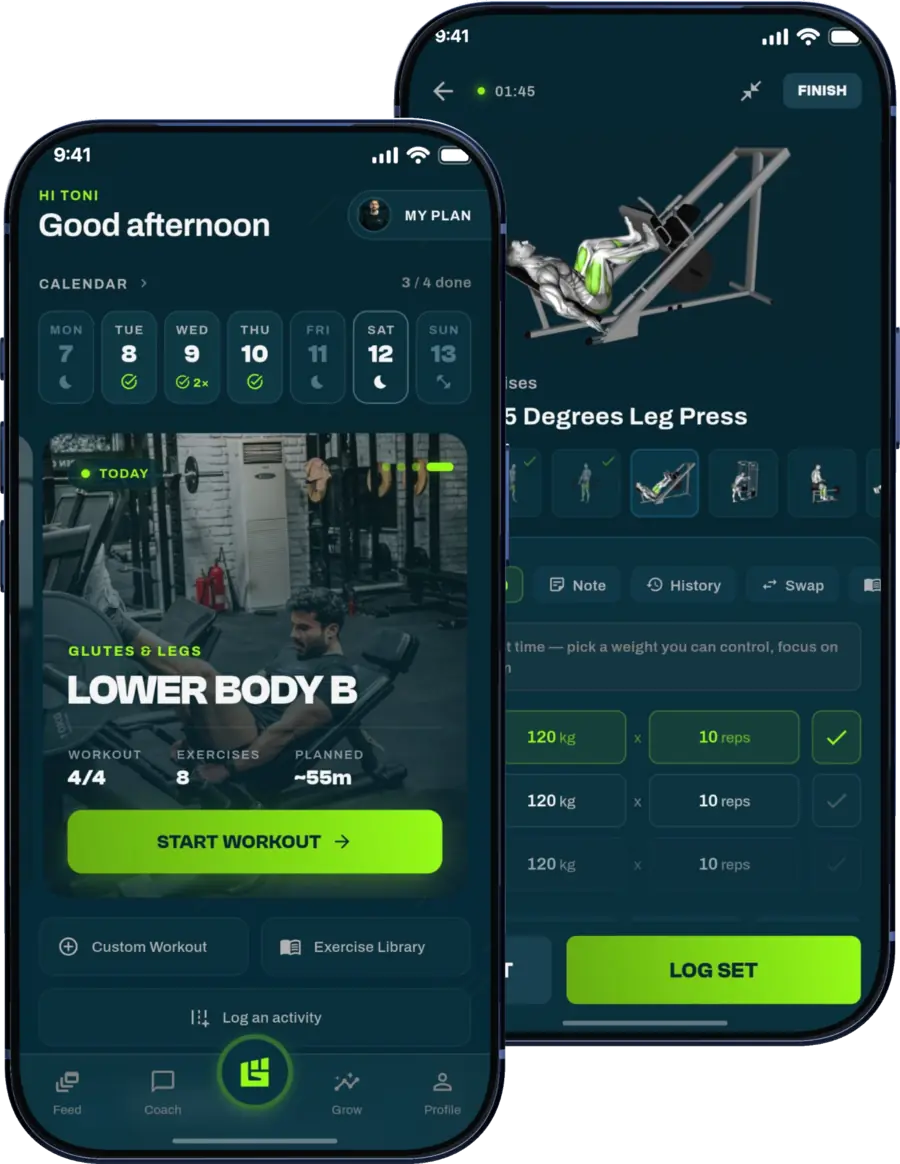
Get a personalized workout plan built around your goal, equipment and schedule. Train smarter, track every rep and keep moving forward, one workout at a time.






The trick is learning to tell the difference between normal training fatigue and the chronic exhaustion that signals a much bigger problem. Post-workout soreness and tiredness should fade with a day or two of good rest. Overtraining symptoms, however, just hang around. They linger, creating a frustrating cycle where you train harder but only get weaker.
Overtraining syndrome isn't just about feeling tired. It's a physiological state where your body's recovery systems are overwhelmed, leading to declines in physical performance, hormonal disruption, and mental burnout.
To help you get a quick read on whether you're pushing too far, we’ve broken down the main categories of symptoms. Paying attention to these signs is your first step toward building a smarter, more sustainable training plan.
A quick guide to spotting overtraining symptoms
This table gives you a simple, high-level summary of the most common signs of overtraining, organized into categories for an easy self-check.
| Symptom Category | Common Signs to Watch For |
|---|---|
| Physical Symptoms | Persistent muscle soreness, frequent illness or infections, and an elevated resting heart rate. |
| Performance Symptoms | A noticeable drop in strength or endurance, loss of coordination, and hitting a plateau you can't break. |
| Psychological Symptoms | Increased irritability, loss of motivation for training, trouble sleeping, and feelings of burnout or brain fog. |
Keep these signs in mind as you train. They are your body's way of telling you it needs a break to rebuild, not another punishing session.
Listening to your body's physical warning signs

When you're all-in on your training, it’s easy to ignore your body's polite requests for a break. But if you keep pushing, those quiet whispers eventually become deafening screams. Learning to spot these physical overtraining symptoms early is your first line of defense against turning a small problem into a long-term setback.
These signals are a world away from the usual delayed onset muscle soreness (DOMS). While DOMS is a sign of a good workout and fades in a day or two, the aches from overtraining are stubborn. They stick around, even on your rest days, leaving you in a constant state of soreness and fatigue.
Persistent aches and recurring injuries
One of the loudest warning signs is pain that just won't go away. This isn’t the satisfying ache of progress; it’s a chronic, nagging pain in your muscles and joints that’s there day after day. It's the kind of deep soreness that makes even a simple warm-up feel like a huge effort.
This constant state of stress is the perfect breeding ground for injuries. When your body never gets a chance to fully repair, your muscles, tendons, and ligaments stay in a weakened state. A slight misstep on a run or a tiny break in your lifting form can suddenly lead to a strain or sprain that feels like it came from nowhere.
This is because overtraining directly skyrockets your injury risk. As fatigue sets in, your form breaks down, your coordination gets sloppy, and your ability to absorb impact tanks. Research shows a clear link here; one study on marathon runners found an overall injury prevalence of 42.6%, with overuse injuries climbing as training volume increased. The data made it clear: as overtraining symptoms went up, so did the number of injuries. You can dig into the full research on training frequency and injury risk to see the connection for yourself.
Overtraining creates a vicious cycle. You feel weak, so you push harder to make up for it, but your tired body can't handle the load. This just makes you even more likely to get hurt. It’s like trying to patch a hole in a tire while it's still spinning at 60 mph.
The feeling of heavy legs and dead arms
Another classic sign is a deep, unshakable heaviness in your limbs. Runners often call it "heavy legs," where an easy jog feels like you're wading through wet cement. For lifters, it might show up as "dead arms," making weights you normally handle feel impossibly heavy right from the first set.
This feeling isn't just in your head—it's a real physiological event. When you're overtrained, your muscles can't properly replenish their glycogen stores, which is their main source of fuel. This energy deficit is what causes that lack of power and the constant, sluggish feeling during your workouts.
Subtle signs you shouldn't ignore
Beyond the obvious aches and heaviness, your body sends out other critical warnings. Pay close attention to these three key indicators:
- Elevated Resting Heart Rate (RHR): Take your pulse first thing in the morning before you even get out of bed. If your RHR is consistently 5-10 beats per minute higher than your usual baseline, it’s a strong signal that your nervous system is working overtime and not recovering.
- Weakened Immune System: Feel like you're catching every cold that goes around? Overtraining suppresses your immune system, leaving you wide open to illnesses and infections. If you're getting sick more often than usual, your training load might be the real culprit.
- Disrupted Sleep: Even though you're exhausted, you might struggle to fall asleep or find yourself waking up throughout the night. Overtraining messes with the hormones that manage your sleep-wake cycle, leading to restless nights and that awful feeling of waking up tired.
Ignoring these physical overtraining symptoms is a fast track to burnout and injury. Learning to listen to your body and give it the recovery it needs isn't a sign of weakness—it's the mark of a smart, sustainable athlete.
When your performance suddenly stalls or declines
It’s the classic, maddening gym scenario: you’re putting in more work than ever, but your numbers are going backward. You add an extra session, chase more reps, and crank up the intensity, but the logbook doesn’t lie. Your performance is dropping.
This isn't just an off day. It's a persistent, measurable decline that leaves you feeling weaker and slower, despite giving it your all. Your body is trying to tell you something important—its recovery systems are redlining and can't keep up anymore.
Losing strength on your key lifts
One of the most undeniable signs of a performance nosedive is losing raw strength. That squat weight that felt solid last month is suddenly a grinder. You might fail a bench press rep you’ve hit for weeks, or your deadlift feels like it's bolted to the platform at a weight you used to warm up with.
This isn’t a mystery. It’s a direct result of accumulated fatigue in your central nervous system (CNS) and muscles. When you're overtrained, your body simply can't repair muscle fibers or restock energy between workouts. The outcome is a real, noticeable drop in your ability to generate force.
It’s a vicious cycle. You see your lifts stall, so you double down and train even harder to push through it. But that extra stress just digs you deeper into a recovery hole, making everything worse. This isn't a failure of effort; it's a failure to recover.
Think of it like trying to build a brick wall (strength) without letting the mortar (recovery) dry between layers. Pretty soon, the whole thing gets shaky and starts to fall apart. Your nervous system just can't fire with the same power and speed when it’s constantly running on fumes.
Watching your endurance capacity shrink
This isn't just for the lifters, either. Endurance athletes often feel this as a sudden hit to their stamina. That 5k time you were methodically chipping away at starts creeping back up. That bike route that was once a breeze now leaves you totally wiped out.
This happens for a few key reasons when you're in the red:
- Glycogen Depletion: Your muscles are running on fumes. Overtraining keeps your body from fully restocking its crucial glycogen stores, so you hit the wall much, much sooner.
- Increased Perceived Exertion: Every activity feels harder. A pace that once felt like a 6/10 effort now feels like a 9/10. This isn't just in your head; it’s your body physically working harder for the same output.
- Elevated Heart Rate: You might see your heart rate is way higher than usual during familiar workouts. That's a clear signal your cardiovascular system is under serious strain.
A runner might find they can’t hold their goal pace for more than a few minutes, or a swimmer feels their form break down halfway through a set they normally cruise through. Your body's engine is sputtering because it hasn't had time for a proper tune-up.
Feeling clumsy and uncoordinated
Ever go into a workout and just feel… off? Like you’re clumsy or less agile than usual? This loss of motor control is a subtle but very real sign of overtraining. Movements that are normally automatic—the footwork for a box jump, the timing of a kettlebell swing—suddenly feel awkward and out of sync.
This is your CNS fatigue showing up again. It messes with the communication between your brain and your muscles. The sharp, fast signals needed for complex movements get sluggish. You might find yourself tripping more, fumbling with your grip, or just feeling like you have no "pop" in your movements.
Seeing these performance drops as a warning sign—not a personal failure—is the key to making progress for the long haul.
The hidden toll on your mood and hormones
Overtraining goes way beyond just sore muscles. It messes with your head and throws your hormones completely out of whack. These mental symptoms are easy to ignore—we’ve all brushed them off as a "bad day" or just being in a funk.
But make no mistake: these shifts are real, measurable red flags that your body is buried under too much stress.
The connection between too much training and your mood is incredibly direct. Push past your recovery point, and your body doesn't just get sore. It sets off a chemical chain reaction in your brain that changes how you feel, think, and even how you deal with people.
The overflowing stress bucket
Think of your body's ability to handle stress as a bucket. Everything pours into it: your tough training sessions, deadlines at work, family life, and not enough sleep. Smart training adds a little stress, your body adapts, and you get stronger.
Overtraining is like leaving the faucet running on full blast. The bucket overflows, triggering a massive physiological stress response. Your body gets stuck in a "fight or flight" mode, pumping out stress hormones like cortisol. This constant state of high alert is what’s behind the mental side of being overtrained.
Feeling burnt out isn't just a state of mind; it's a physiological reality. When your stress bucket overflows, your central nervous system becomes dysregulated, leading to a host of mental and emotional symptoms that are just as real as muscle soreness.
This non-stop hormonal and neurological strain is the real reason you feel moody, foggy, and can't find the motivation to get to the gym.
From irritability to apathy
One of the first signs you’ll notice is a change in your mood. You might find yourself getting angry over nothing, snapping at people for tiny things that you’d normally just let go. This isn’t you being a jerk; it’s a classic symptom of CNS fatigue and sky-high cortisol.
This irritability is often followed by a crushing loss of motivation, a state known as anhedonia. The one thing you used to love—training—suddenly feels like a chore. The thought of hitting the gym fills you with dread. That's not laziness. It’s your brain’s self-defense system screaming for a break.
The mental fog that kills your focus
Another tell-tale sign is a persistent "brain fog" that hangs over you. It can show up in a few ways that mess with your training and your life:
- Difficulty Concentrating: You can't seem to focus during your sets, your form gets sloppy, and that mental haze spills over into your work, making even simple tasks feel draining.
- Poor Decision-Making: When your brain is shot, so is your judgment. You might make dumb calls in the gym, like going for a risky PR when your body is clearly telling you no.
- Memory Lapses: You forget what exercise is next or can't remember details from a conversation you just had. This mental sluggishness is a clear signal that your brain is just as fried as your muscles.
These cognitive problems happen because chronic stress messes with your prefrontal cortex—the part of your brain that handles planning, focus, and good judgment.
When sleep stops being restful
Maybe the most maddening symptom of all is when your sleep goes bad. You feel exhausted all day but can't fall asleep at night. Or you wake up constantly, staring at the ceiling at 3 a.m. with your mind racing.
This is because high cortisol levels disrupt your body's natural sleep-wake rhythm. You’re stuck in a state of hyperarousal, unable to shut down and get the deep sleep you need to actually recover. It’s a vicious cycle: poor sleep makes you more tired, which digs you deeper into an overtrained hole.
For anyone dealing with the mental fallout from overtraining, looking into local counselling options can be a huge help. Acknowledging that these symptoms are real and treatable is the first step to getting back on track.
Your action plan for recovery and rebuilding
Figuring out you're overtrained is the first big step, but just hitting the brakes on your training isn't enough. Real recovery is an active process—a structured plan to rebuild your body and mind from the ground up. This isn't about "just resting." It's a strategic roadmap to get you from burnout back to peak condition.
Think of all the stress you've accumulated—from training, work, and life—as pouring into a bucket. Eventually, it overflows, and that overflow shows up as brain fog, fatigue, and all the other symptoms you're feeling.

Recovery isn't just about stopping the flow of stress into the bucket. It's about actively managing what's already in there.
Step 1: Differentiate rest from recovery
When you feel fried, your first instinct is probably to become one with the couch. And while complete rest—taking a few days completely off from structured exercise—is often the right first move, the real goal is to shift into active recovery.
Active recovery means light, low-impact activity that gets blood flowing without piling on more stress. Complete rest puts a stop to the damage, but active recovery is what actually speeds up the repair work. Gentle movement helps deliver nutrient-rich blood to your muscles and flushes out the metabolic junk that makes you sore.
A few solid active recovery options include:
- Gentle Walks: Keep the pace relaxed. If you can’t hold a conversation, you’re going too hard.
- Light Cycling: Hop on a stationary bike, keep the resistance low, and just spin your legs.
- Swimming: The water’s buoyancy takes all the impact off your joints while boosting circulation.
- Dynamic Stretching: Think full-range movements like leg swings and torso twists, not static holds. The goal is mobility, not strain.
Step 2: Optimize sleep for healing
Sleep is when your body’s repair crew clocks in. It's prime time for rebuilding muscle tissue and balancing the hormones that manage stress and growth. When you're overtrained, high-quality sleep is non-negotiable.
Just lying in bed for hours doesn’t cut it. You need to dial in your sleep hygiene to encourage deep, restorative rest. Aim for 7-9 hours of quality shut-eye by making your bedroom cool, dark, and quiet. Ditch the screens for at least an hour before bed; that blue light messes with your body's natural sleep-wake cycle.
Sleep is the most powerful recovery tool you have. During deep sleep, your body releases human growth hormone (HGH), which is essential for repairing the micro-tears in your muscles caused by exercise. Skimping on sleep is like trying to build a house without a construction crew.
Step 3: Fuel your body for repair
Your nutrition plan needs to switch gears from fueling performance to fueling repair. Overtraining often leaves your body in a massive energy hole, so the absolute last thing you should do is restrict calories. You have to give your body the raw materials it needs to rebuild.
Make sure your diet is on point with:
- Adequate Calories: Your body’s repair processes burn energy. Under-eating will only drag out your recovery.
- Sufficient Protein: Protein provides the amino acids needed to rebuild damaged muscle. Get a steady supply throughout the day.
- Nutrient-Dense Foods: Load up on whole foods packed with vitamins, minerals, and antioxidants to fight inflammation and support your immune system.
Overtraining isn’t a rare problem. Research shows that between 7% and 20% of athletes across all sports show signs of the syndrome. It’s even more common among elite distance runners, with studies finding that up to 66% of male and 64% of female runners have been hit by it at some point.
Step 4: Reintroduce training gradually
After a period of rest and active recovery, you can't just dive back into your old routine. That's a surefire way to end up right back where you started. Reintroducing training has to be slow and methodical.
The mental and emotional fatigue of overtraining can feel a lot like professional exhaustion. If you're struggling with that side of things, learning how to recover from burnout can offer some incredibly useful strategies.
Start with low-volume, low-intensity sessions—think around 50% of your previous workload—and listen carefully to your body. Track your energy levels, mood, and sleep quality. If any of your old symptoms creep back in, pull back immediately. This phased approach ensures you don’t just recover, you come back stronger and more resilient.
How to train smarter and prevent future burnout
Getting over a bout of overtraining is one thing, but making sure it never happens again is the real win. Training smarter isn’t about doing less—it’s about making every ounce of effort count without driving your body into the ground.
This is where intelligent programming comes in. Instead of just blindly following a static plan you found online, your routine should adapt based on your body’s real-time feedback. This prevents the slow creep of fatigue that eventually leads to burnout.
Let technology be your guide
Think of modern training technology as a spotter for your recovery. It uses your own performance data to make informed decisions about training load, moving you from guesswork to a data-driven approach.
For example, a smart system can detect if your strength is starting to dip on key lifts or if your endurance is faltering. It can then automatically adjust your next workout—maybe by trimming the volume or dialing back the intensity—to give you a chance to recover before you slide into a deeper state of fatigue.
Overtraining is almost always caused by a mismatch between the work you're doing and your body's ability to recover. Smart training systems bridge this gap by using your own performance data to ensure your workout intensity is always productive, never destructive.
This isn't about taking it easy. It's about training with precision. A comprehensive Personalized strength training app can be your strongest ally here, using intelligent programming to keep you on a path of steady, sustainable gains.
The power of visualizing your progress
One of the best ways to head off burnout is to have a clear, objective view of your performance trends. A slight decline that you might brush off as a “bad day” becomes an unmissable trend when you see it on a graph.
Seeing your progress visualized in charts gives you an honest look at how you’re really doing.
This kind of tracking lets you be proactive. Instead of waiting for the classic signs of overtraining to hit you like a ton of bricks, you can spot a potential decline early and make adjustments. It’s the difference between patching a small leak and waiting for the flood.
When you pair smart technology with a huge exercise library and clear instructions, you get more than just a workout plan. You get a sustainable system designed to help you hit your goals without sacrificing your long-term health.
Frequently asked questions about overtraining
It’s natural to have questions when you realize you might be overtrained. As you shift from a “push harder” mindset to a “recover smarter” one, clear answers are everything. Let’s tackle some of the most common questions to help you get back on track.
How long does it take to recover from overtraining?
There's no single answer here—your recovery timeline depends entirely on how far you've pushed yourself into the red. If you catch a mild case early, a week or two of active recovery and lighter training might be all you need.
But for true Overtraining Syndrome (OTS), the timeline gets much longer. Full recovery can take several weeks, and in serious cases, even months. The most important thing is to listen to your body and fight the urge to jump back into your old routine too soon. A slow, patient return is the only way to make sure you don't end up right back where you started.
The deeper you dig the hole by pushing through symptoms, the longer it will take to climb out. Catching it early is your best bet for a quick turnaround.
What is the difference between overreaching and overtraining?
This is a critical distinction, and one that trips up a lot of athletes.
Functional overreaching is a deliberate strategy. It’s a short, planned block of intense training designed to push you past your current limits. You feel wiped out, but after a proper deload week, you bounce back stronger. It’s a powerful tool for progress.
Overtraining, on the other hand, is what happens when that stress becomes chronic and you don't recover. It’s an unplanned state of decline where your body simply can't adapt anymore. Performance drops, your mood tanks, and fatigue is constant. Think of overreaching as a strategic sprint; overtraining is tripping during that sprint and just staying on the ground.
How do I manage recovery when I do both lifting and cardio?
Juggling multiple training styles makes recovery even more important. When you start seeing signs of overtraining, you have to lower the total stress from all your activities, not just one.
- Pick your priority: Decide what’s more important to maintain right now—your strength or your endurance. Keep one, but dramatically cut the volume and intensity of the other.
- Embrace active recovery: Swap your high-intensity cardio sessions for light walking, gentle cycling, or swimming. Instead of heavy lifting, shift your focus to mobility work and light, full-range movements.
- Listen to your body, period: The combined fatigue from lifting and cardio adds up fast. You'll likely need more complete rest days than an athlete focused on just one discipline.
Stop guessing and start progressing. With GrabGains, you get a personalized plan that adapts to your performance, preventing overtraining before it starts. Download GrabGains on iOS or Android today and train smarter.
Get inspired and motivated