A complete guide to auto regulation training
Discover auto regulation training and master RPE, RIR, and VBT for smarter strength gains. Stop guessing your workouts and start building real results. Autoregulation training is the simple but powerful idea of adjusting your workout based on how you feel on any given day. It’s the difference between following a rigid, unforgiving plan and having one that works with your body’s real-time signals.
By listening to what your body is telling you, you can tweak your workout’s intensity or volume to get the most out of every single session—making your training safer, more effective, and a lot more sustainable.
What is auto regulation training

Think of a traditional workout program like a fixed road map printed on paper. It tells you exactly which roads to take and how fast to drive, without any consideration for traffic, detours, or how you’re feeling behind the wheel. On a clear day, the route works perfectly. But on a day with heavy rain or unexpected construction, that same plan becomes stressful and inefficient.
This is how most people approach their training: blindly following pre-set weights, reps, and sets, regardless of their daily energy levels.
Built for progress
Take the guesswork out of training
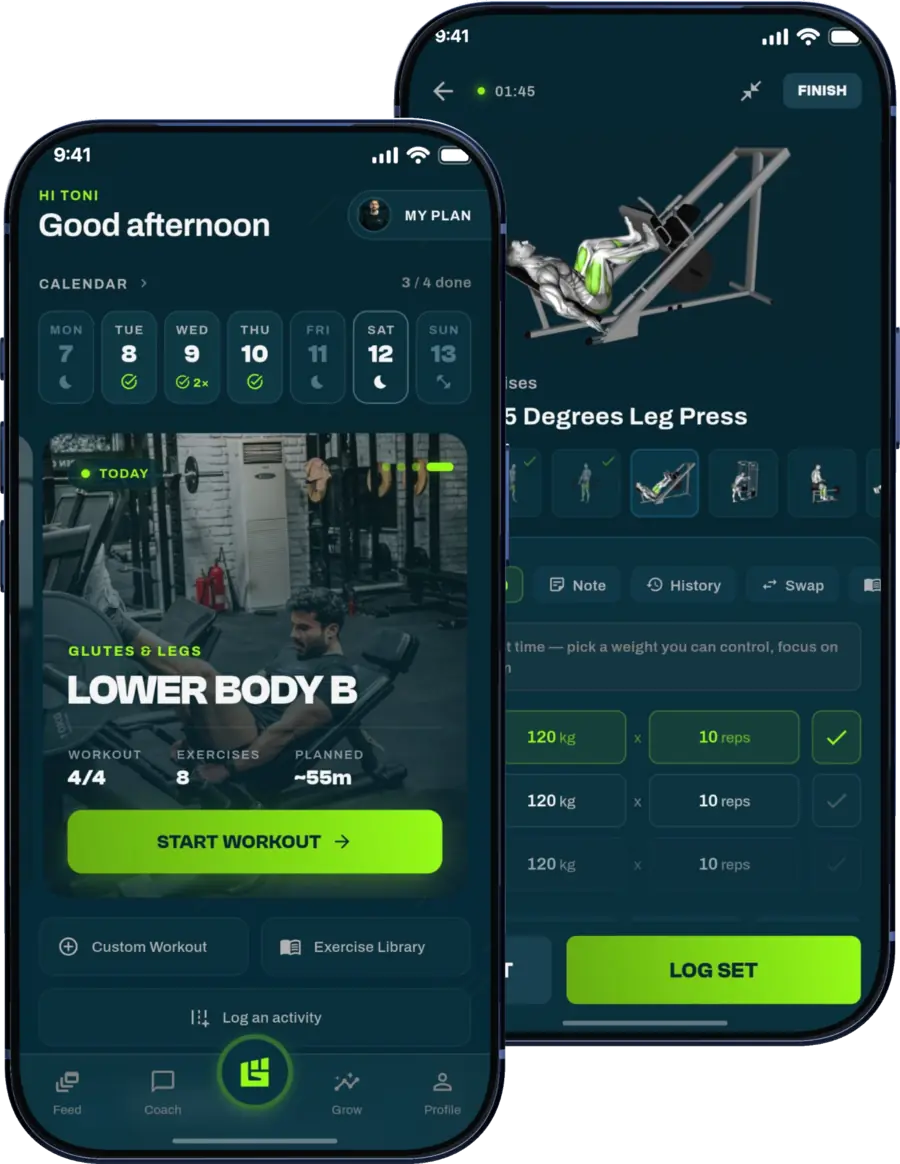
Get a personalized workout plan built around your goal, equipment and schedule. Train smarter, track every rep and keep moving forward, one workout at a time.






Auto regulation training, on the other hand, is like using a real-time GPS. It constantly checks current conditions—your sleep quality, stress levels, nutrition, and overall recovery—to find the best possible route to your destination. It gives you the green light to push harder on days you feel strong and offers a smarter, alternative path on days you’re running on empty.
This adaptive approach makes sure you’re always applying the right dose of training stress to drive progress, without tipping the scales into overtraining, injury, or burnout.
To understand the practical difference, let's compare the two philosophies side-by-side.
| Aspect | Traditional Fixed Plan | Auto Regulation Training |
|---|---|---|
| Workout Adjustments | Plan is static; numbers are set in stone for the week/month. | Adjustments are made daily based on readiness and performance. |
| Flexibility | Low. Ignores life stress, poor sleep, or good days. | High. Adapts to your real-world energy and recovery levels. |
| Progress Metric | Based on hitting pre-planned percentages of a theoretical 1RM. | Based on consistent effort and performance on the day. |
| Injury Risk | Higher, as it can force heavy lifts on unprepared days. | Lower, as it encourages scaling back when the body isn't ready. |
| Motivation | Can lead to burnout from failing to meet rigid targets. | Promotes consistency by matching the challenge to your capacity. |
In short, auto regulation replaces the guesswork of a static plan with a responsive system that honors your body's daily fluctuations.
The problem with rigid plans
Static workout programs often look perfect on paper but fail in the real world because they ignore everything that happens outside the gym. A stressful week at work, a few nights of bad sleep, or a change in your diet all have a massive impact on your strength.
Sticking to a rigid plan that doesn't account for this can cause a few major problems:
- Stalled Progress: Grinding through a session on a low-energy day creates excessive fatigue. This tanks your recovery and stops you from actually getting stronger over time.
- Increased Injury Risk: Forcing a heavy lift when your body, nervous system, and joints aren't prepared is one of the fastest ways to get hurt.
- Burnout and Frustration: The mental drain of constantly missing your prescribed lifts is incredibly demotivating. It can make you dread your workouts and eventually lead to quitting.
Autoregulation isn't an excuse to take it easy; it's a strategy to train smarter. It's about making sure that every workout—whether it's a heavy day or a lighter one—serves a productive purpose in your long-term journey.
How auto regulation solves this
Instead of treating your strength as a fixed number, auto regulation acknowledges that your true one-rep max (1RM) fluctuates daily. It gives you a framework to listen to your body’s feedback and make smarter decisions in the moment.
Think about cooking. You wouldn't blast every dish on the highest heat setting and walk away. You adjust the flame based on what you’re making and how it’s responding. You turn it down to a simmer or crank it up to get a good sear.
Auto regulation training is the same principle applied to your training. By respecting your body’s readiness, you can build strength more consistently, smash through frustrating plateaus, and enjoy the process a whole lot more.
Why science says auto regulation works better
"Listen to your body" is easy advice to give, but auto regulation training turns that idea into a powerful, science-backed system for getting stronger. This isn't just about going easy when you're tired; it's a proven method for making faster, more sustainable gains.
The core idea is simple: your strength isn't a fixed number. It changes day-to-day based on your sleep, nutrition, and life stress. Old-school, percentage-based programs ignore this fact, forcing you to hit a specific weight whether you're feeling beat up or ready to conquer the world. Auto regulation fixes that by matching the workout to what you can actually do on any given day.
Think of it this way: traditional plans prescribe the destination, while auto regulation provides the best route to get there based on the day's conditions. This small shift in perspective leads to massive differences in results.
The evidence for smarter training
The proof is in the research. Study after study shows that when you match your training load to your daily readiness, you get stronger—faster. The data is clear: autoregulated programs don't just work, they flat-out outperform traditional fixed-load plans.
And it’s not a small difference. One major meta-analysis found that athletes using autoregulation saw far greater increases in their one-rep max (1-RM). In some studies, lifters using auto regulation training strategies increased their 1-RM by nearly 50% more than groups following a rigid plan. You can dig into the detailed findings yourself and see just how impressive the outcomes are.
The reason is that auto regulation helps you stack up more high-quality training volume over time. Instead of spinning your wheels on bad days or leaving gains on the table during good ones, you’re always applying the right dose of stress to trigger growth.
How auto regulation drives superior gains
So, how does this actually work in the real world? It all comes down to optimizing your effort and managing fatigue. Auto regulation gives you a system to do both.
Here’s the breakdown:
- Capitalizing on good days: When you walk into the gym feeling strong and rested, auto regulation training lets you push the intensity. You can add a little weight or squeeze out a few extra reps, turning a good day into a great one and accelerating your progress.
- Protecting you on bad days: On the flip side, when stress is high and sleep was poor, auto regulation gives you permission to pull back. This prevents you from overtraining, lowers your injury risk, and lets you get a productive session in without digging yourself into a recovery hole.
By dodging the burnout that plagues so many rigid programs, you create a path for consistent, long-term gains. The science is crystal clear: adapting your training isn't taking it easy—it's just training smarter.
How to use auto regulation methods in your workouts
Now that you know why auto regulation training works, let’s get into the practical stuff. Putting these ideas into practice is simpler than you might think. You don’t need a degree in sports science or a bunch of fancy gear—just a few simple tools to help you listen to your body and make smart adjustments on the fly.
Think of these methods as different ways to measure your effort. Some are based on how you feel, while others use objective data to give you a more black-and-white picture.
Rating of perceived exertion (RPE)
The Rating of Perceived Exertion (RPE) scale is one of the most popular and straightforward tools for auto regulation. It's a simple 1-10 scale that helps you rate how hard a set felt. Instead of locking into a specific weight, you aim for a specific level of effort.
For example, your plan might say to perform squats at an "RPE 8." This just means you need to pick a weight where you finish the set feeling like you definitely had two more good reps left in the tank.
An RPE 9 means you had one more rep left, but it would have been a serious grind. An RPE 10 is an all-out, maximum effort where you couldn't have possibly done another rep with good form.
Reps in reserve (RIR)
Reps in Reserve (RIR) is basically the flip side of RPE, and for many people, it’s even more intuitive. Instead of rating how hard the set was, you just state how many reps you could have done before hitting failure.
It’s a direct and honest assessment of your capacity. Here’s how RPE and RIR match up:
- 3 RIR is the same as an RPE 7 (You had 3 reps left).
- 2 RIR is the same as an RPE 8 (You had 2 reps left).
- 1 RIR is the same as an RPE 9 (You had 1 rep left).
- 0 RIR is the same as an RPE 10 (You hit total failure).
The decision-making process becomes incredibly simple. If you show up feeling great, you add a little weight to hit your target RPE/RIR. If you're tired, you lighten the load.
This flowchart perfectly illustrates the daily decision-making process.

On a good day, you can add weight. On a tired day, you reduce it to maintain the right effort level. This ensures every workout is productive.
And the science backs this up. A systematic review found that lifters using RPE and RIR protocols saw greater strength gains than those on rigid, percentage-based plans. Why? Because they could capitalize on good days and intelligently scale back on bad ones, making their training more effective over time. You can discover more insights on these autoregulation studies.
Objective auto regulation methods
Beyond just how you feel, you can also bring in technology for more data-driven adjustments. These methods take the guesswork out of the equation.
- Velocity-Based Training (VBT): This approach uses devices to measure how fast you move a barbell. Because bar speed is directly tied to how heavy the weight feels relative to your max, you can use it to pick your training loads. For example, you might aim for a specific speed on your squats to make sure you’re training for strength without overdoing it.
- Readiness Scores: Wearables like smartwatches and rings are getting better at measuring key recovery metrics like Heart Rate Variability (HRV), sleep quality, and resting heart rate. These devices then package that data into a simple "readiness" or "recovery" score, giving you an objective signal on whether you should push hard or focus on recovery for the day.
Real-world examples of auto regulation training
Theory is one thing, but seeing auto regulation in the wild is where it all clicks. Let's break down how this works for different people with different goals, because the whole point is to make your training fit your life—not the other way around.
These examples show just how flexible this approach is, whether you're building muscle, chasing strength, or just trying to stay fit while juggling a chaotic schedule.
Workout template for the busy professional
If you're a busy professional, you know your energy can be all over the map. A high-stress week, long hours, and travel can drain your batteries fast. A rigid workout plan is just asking for frustration, but an autoregulated one guarantees you always get a productive session in.
The main dial we're turning here is volume (total sets) based on how you feel that day.
Sample Monday Workout (Chest & Triceps):
- Barbell Bench Press: 3 sets of 5 reps @ RPE 8
- Incline Dumbbell Press: Aim for 3 sets of 8-10 reps @ RPE 7-8
- Cable Triceps Pushdowns: Aim for 3 sets of 12-15 reps @ RPE 8
- Dumbbell Lateral Raises: 3 sets of 15 reps @ RPE 9
The Thought Process: Let’s say you had a great night's sleep and feel fantastic. You’ll probably hit all your sets, maybe even add a little weight. But what if you’re dragging after a brutal day of back-to-back meetings? You adjust.
Maybe you do two good sets of bench press instead of grinding through a third, or you cut a set from your assistance work. The goal is to get quality work done without digging yourself into an even deeper recovery hole.
Workout template for hypertrophy
When your goal is hypertrophy (building muscle), you need to rack up enough high-quality volume close to failure. Reps in Reserve (RIR) is the perfect tool for this job, making sure you push hard enough to trigger growth without redlining on every single set.
Sample Leg Day Workout:
- Barbell Squats: 3 sets of 6-8 reps @ 2 RIR
- Leg Press: 3 sets of 10-12 reps @ 1-2 RIR
- Romanian Deadlifts: 3 sets of 8-10 reps @ 2 RIR
- Leg Extensions: 2 sets of 12-15 reps @ 0-1 RIR (Take one set to failure)
The Thought Process: Using RIR helps you pick the right weight for the day. If your first set of squats at 225 lbs feels like a solid 2 RIR, you stick with that weight. But if it felt way too easy (say, a 4 RIR), you know you have room to bump up the load on the next set to hit your target.
This method guarantees your working sets are always in that sweet spot—challenging enough to force your muscles to adapt. You aren't just going through the motions; you're actively hunting for the level of effort that science tells us builds muscle.
Workout template for the hybrid athlete
Hybrid athletes, like those training for a HYROX event, are in a constant balancing act between strength and endurance. Managing fatigue isn't just important; it's everything. Auto regulation lets them dial the intensity up or down based on feel, which is critical for avoiding burnout.
Sample Hybrid Session:
- A) Power Cleans: 5 sets of 3 reps @ RPE 7 (Focus on speed and technique, not max weight)
- B) Back Squats: Top set of 5 reps @ RPE 8, then 2 back-off sets at -10% weight.
- C) Conditioning: 3 Rounds for Time of:
- 500m Row (at RPE 8 effort)
- 15 Burpees
- Rest 90 seconds
The Thought Process: Imagine the athlete had a long, grueling run the day before and their legs feel heavy. This is where RPE saves the session. An RPE 7 on power cleans might mean using 135 lbs today instead of the 155 lbs they used last week. The row is based on effort, not a rigid pace.
This flexible approach allows them to get a high-quality training stimulus without flirting with injury or overtraining—a non-negotiable for long-term hybrid performance.
The future of auto regulation: training with AI
While methods like RPE are incredibly effective, they still depend on one thing: your ability to be a good judge of your own effort. But what if technology could handle the number-crunching for you? That's exactly where the next step in auto regulation training—often called "Autoregulation 2.0"—is heading, thanks to artificial intelligence.
Think of it like having an expert coach living in your phone, making the smart adjustments for you. This new wave of tech goes way beyond just asking how you feel. It analyzes a huge stream of data—your past workouts, sleep quality, HRV, and daily feedback—to figure out exactly how ready you are to train.
This data-first approach is a massive leap forward. By tweaking your training in real-time, it’s proven to be a game-changer for managing injury risk. In fact, one study found that autoregulated programs cut the odds of a training-related injury to nearly three times lower than rigid, old-school plans. You can read the full research about these data-driven training systems.
How AI puts your training on autopilot
AI-driven platforms take the best parts of auto regulation and automate them. They watch your performance on every single set and rep, learning how you respond to different weights and volumes. Over time, the system gets smarter and starts to understand your unique strength curves and fatigue patterns—sometimes even better than you do.
This isn't just about tracking what you've lifted; it's about predicting what you should lift. The AI can see that after two nights of bad sleep, your bench press tends to drop by 5%, and it will automatically lower your starting weight for you.
This kind of hyper-personalized coaching used to be reserved for elite athletes with a team of sports scientists. Now, it's becoming available to anyone with a smartphone. To really appreciate how this technology works, it helps to understand the basics of AI Agent Frameworks.
Your personal trainer, built into an app
Platforms like GrabGains are now building this intelligence right into their workout plans. An AI workout builder can map out a long-term program and then fine-tune it every single day based on your data. It gives you the structure of a proven plan with the day-to-day flexibility of a world-class coach.
This automated approach delivers a few huge wins:
- Optimal Progress: It keeps you in that sweet spot—training hard enough to grow, but not so hard that you can't recover.
- Injury Prevention: By spotting signs of fatigue before you even feel them, the AI helps you avoid the nagging injuries that come from pushing too hard on an off day.
- Effortless Consistency: It takes away the mental guesswork of deciding what to do. All you have to do is show up and follow the plan, making it easier than ever to stay on track.
This is where smart training is going. It's a system where science-backed programming adapts to your unique biology, helping you get stronger and fitter with incredible precision.
Common questions about auto regulation training
It’s normal to have questions when you first hear about auto regulation. The concepts sound complicated, but they’re much simpler in practice. Let's clear up a few of the most common ones so you can get started with confidence.
How do I get better at judging my RPE or RIR?
Getting a feel for your Rating of Perceived Exertion (RPE) and Reps in Reserve (RIR) is a skill, and just like any other lift, it takes practice. The best way to learn is to get some honest feedback.
Pull out your phone and record your big lifts. After the set, compare how it felt with how it looked. Did you think you only had one rep left (RPE 9), but the bar was still moving pretty fast? You were probably closer to an RPE 7 or 8.
Here’s a simple cheat sheet to help you calibrate that internal scale:
- RPE 10 / 0 RIR: This is true technical failure. You couldn't have done another rep with good form, no matter what.
- RPE 9 / 1 RIR: You are absolutely certain you had one more rep in the tank, but it would have been a real grinder.
- RPE 8 / 2 RIR: The last rep you did was challenging, but you're confident you had two more good ones left.
When in doubt, always underestimate your RPE. It’s much better to be a little conservative than to go too hard, too soon. Over time, you'll get dialed in.
Is auto regulation training good for beginners?
Yes, absolutely. In fact, it's one of the safest and most effective ways for a beginner to start building strength. A rigid, old-school plan might force a new lifter to use a weight that’s either way too heavy or just not challenging enough.
Auto regulation changes the game by focusing on effort, not just the number on the plate. Using RIR is a perfect way to start.
For example, a workout might say: "Dumbbell Bench Press for 10 reps, leaving 3 reps in the tank (3 RIR)."
This does two things. First, it gives the beginner the power to choose a weight that feels right for them on that specific day. Second, it starts teaching them the most important skill in lifting: how to listen to their body.
Does auto regulation only apply to strength training?
Not at all. While auto regulation got its start in the powerlifting world, the principles are universal. It's all about managing effort, and that applies just as much to your cardio as it does to your deadlift.
Let’s look at a running workout.
- A traditional plan might say: Run 3 miles at a 9:00/mile pace.
- An autoregulated plan would say: Run 3 miles at an RPE 7 (a comfortable, conversational pace).
On a day you’re feeling amazing, that RPE 7 might be an 8:45/mile pace. If you’re tired and dragging from a long week, it might be a 9:15/mile pace. The effort stays the same, which means you get the right training stimulus without burning yourself out. This is a huge advantage for hybrid athletes juggling fatigue from different types of training.
What equipment do I need for auto regulation?
One of the best things about auto regulation is how accessible it is. You can start today with absolutely no special equipment.
The most common methods, RPE and RIR, are totally subjective. All you need is your own body and the willingness to pay attention to how your sets feel. This makes it a perfect fit for anyone, whether you're in a fully-stocked gym or training at home.
Sure, there are more advanced tools out there, like devices for Velocity-Based Training (VBT) that measure bar speed. But those are extras, not requirements. You can build an incredible amount of strength and fitness just by learning to use the RPE or RIR scale.
Ready to take the guesswork out of your training for good? The GrabGains AI workout builder uses the principles of auto regulation to create and adapt your plan in real-time. It analyzes your performance, recovery, and goals to tell you exactly what to do every day to get stronger, faster. Sign up today and let AI build your perfect workout.
Get inspired and motivated