Your ultimate chest builder workout for serious muscle growth
Tired of slow progress? This chest builder workout uses science-backed exercises and plans to help you build a stronger, more defined chest, faster. Stuck staring at the bench press, wondering why the results aren't showing up? A real chest builder workout is more than just slinging heavy weight around—it’s a smart plan rooted in the science of how muscles actually grow. The best routines are built around exercises that fire up your pecs, using principles like progressive overload to force your muscles to get bigger and stronger.
Your blueprint for building a powerful chest
Let's cut through the gym myths and lay out a clear, science-backed blueprint for your chest workouts. Building a powerful chest is about more than just showing up and doing a few sets of presses. It's about understanding the why behind every exercise, every set, and every rep.
The goal here is to get you away from just picking exercises at random and into a deliberate plan that guarantees you're always moving forward. This whole approach is grounded in fundamental training principles that just plain work, no matter where you're starting from.
Built for progress
Take the guesswork out of training
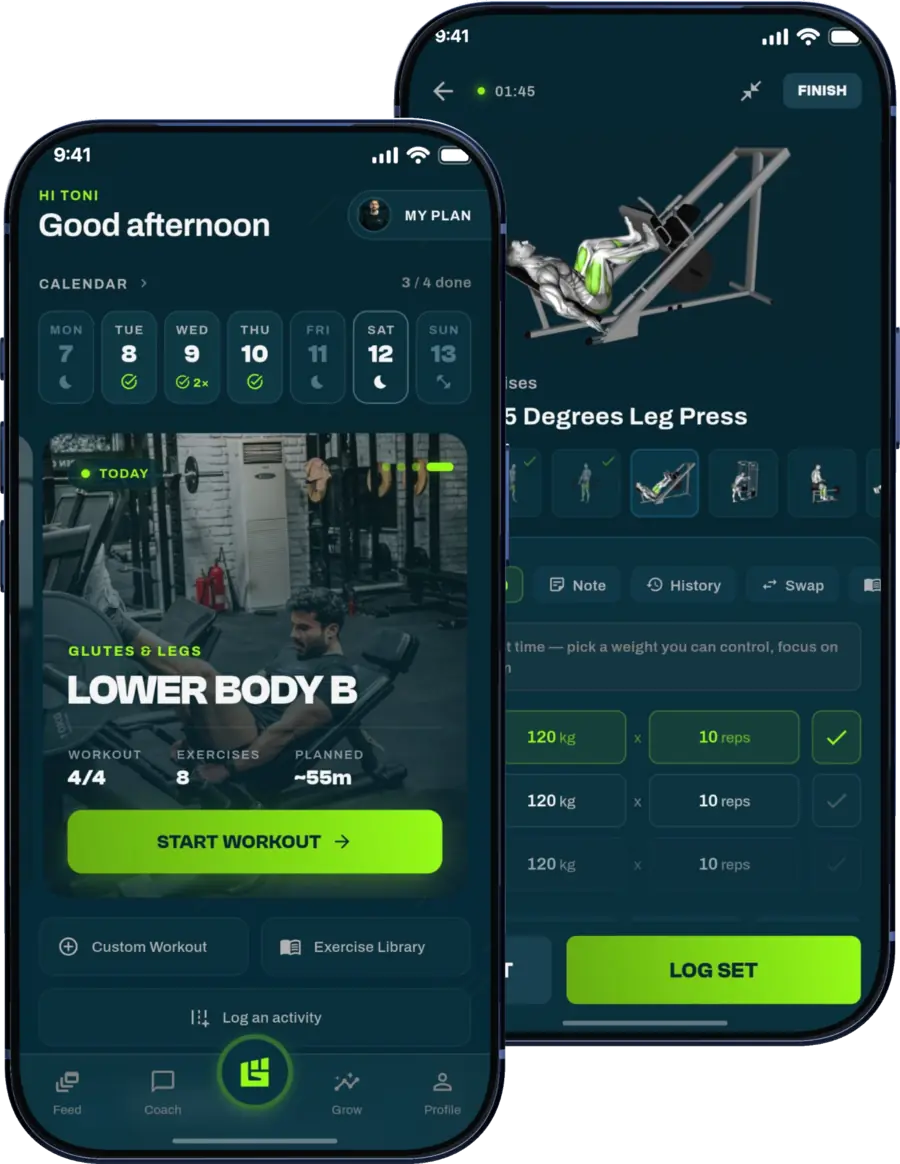
Get a personalized workout plan built around your goal, equipment and schedule. Train smarter, track every rep and keep moving forward, one workout at a time.






The science behind smart chest training
When it comes to building muscle, two concepts matter more than anything else: mechanical tension and progressive overload. Think of mechanical tension as the force your chest muscles feel when they stretch and contract under a heavy load, like during a solid bench press. Progressive overload is simply the idea that you have to gradually increase that demand over time.
You can't do the same workout forever and expect to keep growing. Your body is way too smart for that; it adapts. To keep the gains coming, you have to consistently give it a new reason to get stronger. You can do this by:
- Lifting heavier weight: The most obvious one. Add a little more weight to the bar or dumbbells.
- Doing more reps or sets: Increasing your total training volume forces more adaptation.
- Improving your form: Better technique puts more direct stress right where you want it—on the chest.
- Reducing rest times: This makes your workouts denser and more challenging for your muscles.
A well-designed chest builder workout isn't a quick fix; it's a long-term strategy. It’s all about creating a system where every session builds on the last, so you never hit those frustrating plateaus.
Choosing the right exercises for maximum growth
Not all chest exercises are created equal. Far from it. To build a complete chest, you need a smart mix of movements that put tension on the muscle fibers in the right way. And luckily, research gives us a pretty clear roadmap.
To help us figure out which exercises deliver the most bang for our buck, an American Council on Exercise (ACE) study used EMG machines to measure muscle activation during nine popular chest exercises. The results were telling.
Top 3 chest exercises by muscle activation
| Exercise | Pectoralis Major Activation | Key Benefit |
|---|---|---|
| Barbell Bench Press | 100% | The gold standard for overall chest mass and strength. Allows for the heaviest loading. |
| Pec Deck Machine | 98% | Offers constant tension and isolates the chest without needing stabilizer muscles. |
| Bent-Forward Cable Crossovers | 93% | Provides a unique line of pull and a powerful peak contraction for the inner chest. |
This data shows us that while the barbell bench press is the undisputed king, other exercises like the pec deck and cable crossovers are incredibly effective and shouldn't be overlooked.
This is our starting point. We can build our workouts around these proven muscle-builders. From there, you can use a tool like the GrabGains app to track your numbers and make sure you're applying progressive overload week after week. It’s the foundation for building a chest you’re proud of, based on what actually works.
Mastering the core four chest exercises
Alright, let's move from theory to action. This is where the real muscle gets built. We're going to get hands-on with the four foundational movements that will become the bedrock of your chest development.
These aren't just random exercises. They're strategically chosen to hit every part of your pectoral muscles, from the upper clavicular fibers down to the broad sternal head. Nailing the form on these is the difference between just going through the motions and actually forcing your muscles to grow. We'll break down the technique, troubleshoot common mistakes, and give you cues you can use on your very next rep. This is how you start feeling your chest work like never before.
Barbell bench press: the king of mass
The barbell bench press is a legend for a reason—it lets you move the most weight, creating immense mechanical tension across your entire chest. It's your number one tool for building raw strength and overall pectoral mass. But sloppy form can quickly dump the load onto your shoulders and triceps, robbing your chest of the stimulus it needs.
To get it right, lie down and plant your feet firmly on the floor. Grip the bar just a bit wider than your shoulders. Before you even unrack the weight, pull your shoulder blades together and down. This creates a stable base and a slight arch in your upper back, which is non-negotiable for both power and shoulder safety.
As you lower the bar, think about tucking your elbows to a 45-60 degree angle from your torso—never flared out at 90 degrees. Control the bar down until it lightly touches your mid-to-lower chest, then drive it back up explosively. A great mental cue is to think about pushing yourself away from the bar, not just pushing the bar up.
Incline dumbbell press: for upper chest development
If you want a full, three-dimensional chest, you simply can't ignore the upper pecs. The incline dumbbell press is the perfect tool for the job. By setting the bench to a 30-45 degree angle, you shift the focus squarely onto the clavicular head of the pec major, helping you build that coveted "shelf" at the top of your chest.
Using dumbbells also gives you a greater range of motion and forces each side of your body to work on its own, which is fantastic for ironing out muscle imbalances. Sit on the bench, kick the dumbbells up to your shoulders, and make sure to keep those shoulder blades retracted with your chest held high.
Lower the dumbbells slowly until they're just outside your chest, feeling a deep stretch. As you press up, imagine bringing your biceps toward each other. This little trick really helps maximize the squeeze at the top. Just be sure not to let the dumbbells drift too wide or let your shoulders roll forward.
Dumbbell flyes: to isolate and stretch
While presses are your mass-builders, flyes are for isolation and creating that full, wide look. The dumbbell fly stretches the pectoral fibers under load, which is a powerful trigger for hypertrophy. The key here is to leave your ego at the door. Use a weight that allows for perfect, controlled form.
Lie on a flat or slight incline bench with the dumbbells pressed over your chest, palms facing each other. Keep a slight, soft bend in your elbows, and make sure that angle stays locked throughout the entire movement. Think of it like you're hugging a giant tree.
Slowly lower the weights out to your sides in a wide arc, feeling that deep stretch across your chest. Only go as low as your shoulder flexibility comfortably allows. To come back up, squeeze your pecs to reverse the motion. Want a great cue? Imagine trying to squeeze your pinkies together at the top to really light up the inner chest. You can find more targeted isolation movements in our comprehensive guide to chest exercises.
Pro Tip: Don't let the dumbbells touch at the top of a fly. Stopping just short of them touching keeps constant tension on your chest muscles throughout the entire set, preventing them from getting a momentary rest.
Dips: the lower chest sculptor
Dips are a phenomenal bodyweight exercise for hammering the lower chest fibers. This is what creates that sharp, defined line at the bottom of your pecs. The trick to hitting your chest instead of your triceps is to lean your torso forward.
Grip the parallel bars, press yourself up, and then as you lower your body, let your torso lean forward significantly while your elbows flare out slightly. Go down until you feel a good stretch in your chest, which is usually when your shoulders are just below your elbows.
Drive back up by focusing on squeezing your chest. Form is everything here. If you can't do dips with a forward lean and a full range of motion, use an assisted dip machine or bands to help until you've built up the strength. The impact of perfect form cannot be overstated. In fact, a 2020 experiment from Built With Science showed that simply tweaking form on exercises like push-ups could increase chest activation by as much as 150%. The same principles apply to every exercise in your chest builder workout, turning average movements into powerful muscle builders.
Finding your ideal workout volume and frequency
Nailing your form is huge, but it's only one side of the coin. To actually build a bigger chest, you need a smart plan for how much and how often you train. This is where we stop guessing and start programming your chest workouts like a pro for results that stick.
Volume and frequency sound complicated, but they're not. Volume is just the total work you do (think sets x reps x weight). Frequency is how often you train a muscle group—in this case, your chest. Getting this balance right is the real secret to unlocking consistent growth and smashing through plateaus.
How many sets should you actually do for chest growth?
"How many sets?" is probably one of the most debated questions in the gym. Luckily, we don't have to rely on bro-science anymore. The goal is to find that sweet spot: enough stimulus to force growth, but not so much that you can't recover.
A landmark 2017 meta-analysis published in the Journal of Sports Sciences finally gave us some clear answers. Researchers found a direct dose-response relationship between weekly sets and muscle growth.
The study is pretty clear. Performing fewer than 5 weekly sets led to about 5% muscle growth. Kicking it up to 5-9 sets boosted growth to 7%, and pushing it to 10+ sets resulted in nearly 10% growth. For your chest, this means a range of 4-12 total weekly sets across all your presses and flyes is the money zone for maximizing growth without running yourself into the ground.
The table below breaks down these findings, showing how your weekly volume directly influences your potential for muscle growth.
Weekly sets vs. muscle growth potential
| Weekly Sets Per Muscle Group | Average Muscle Growth (%) | Ideal For |
|---|---|---|
| < 5 Sets | ~5% | Maintenance, beginners, or low-volume phases |
| 5-9 Sets | ~7% | Most intermediates, solid and steady gains |
| 10+ Sets | ~10% | Advanced lifters, focused growth phases |
This data gives us a powerful framework. More volume usually means more growth, but only up to your recovery limit.
Key Takeaway: More volume generally leads to more growth, but only up to a point. A bulletproof strategy is to start on the lower end (6-8 sets per week) and gradually add more as you get stronger and your recovery improves.
The art of progressive overload
Progressive overload is the engine that drives all muscle growth. It's the simple principle of making your workouts harder over time. If you don't give your body a reason to adapt, it won't.
Most people think this just means piling more weight on the bar, but that's just one tool in the toolbox. You can apply progressive overload in a bunch of different ways:
- Add Reps: Did 8 reps last week? Go for 9 or 10 this week with the same weight. Simple.
- Add Sets: If you did 3 sets of bench press, try for 4 next time.
- Improve Form: This one is underrated. Slowing down your tempo or increasing your range of motion makes the same weight feel way harder and more effective.
- Cut Rest Time: Dropped your rest between sets from 90 seconds to 75? You just increased your workout density and challenged your muscles in a new way.
The chart below shows just how much good form can change the game, turning an average set into a powerful growth stimulus.
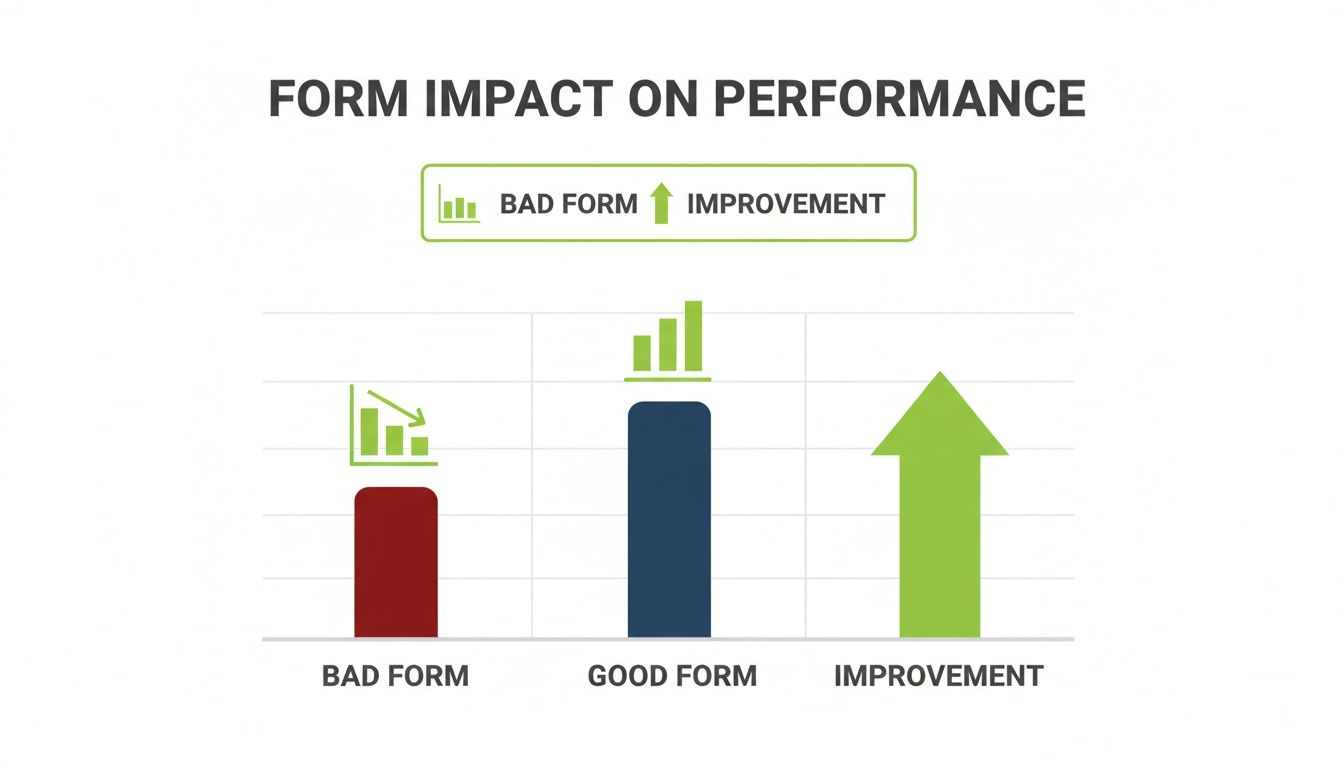
As you can see, the gap between sloppy reps and clean, controlled execution is massive. It directly impacts muscle activation and, ultimately, how much you grow.
Training frequency: how often to hit chest
So, should you blast your chest once a week or hit it more often? For most lifters, training chest twice a week is the sweet spot. This lets you get in enough weekly volume for growth while giving your muscles plenty of time to repair and come back stronger.
A classic split might look something like this:
- Monday: Heavy chest day (focus on compound presses in lower rep ranges, maybe 4-6 total sets).
- Thursday: Lighter chest day (focus on isolation work and machines in higher rep ranges, another 4-6 sets).
This setup splits your total weekly volume (8-12 sets) across two productive sessions. It prevents you from getting wrecked by one marathon chest day and keeps muscle protein synthesis elevated more consistently throughout the week. A smart workout builder can help you structure these sessions to make sure you're hitting your volume targets without programming conflicting exercises.
Three proven chest builder workout programs
 Theory is one thing, but action is what builds muscle. Knowing the right exercises and how many reps to do is a start, but a structured plan ties it all together. Below are three complete, ready-to-use chest builder workouts designed for your specific experience level.
These aren't just random lists of exercises. Think of them as actionable templates you can take to the gym today. Each one is built around the principles of progressive overload and smart exercise selection we've already covered, setting you up for success from your very first rep.
The beginner foundation workout
If you're new to lifting or have been training for less than a year, your job is simple: build a solid foundation. This program focuses on compound movements to give you the most bang for your buck, teaching your body how to properly fire up your chest muscles.
The name of the game here is quality over quantity. Don't rush. Control the weight on the way down and press with purpose. Your goal is to learn what a good, hard set feels like and to add just a little weight or an extra rep each week.
Workout A (Chest Focus)
| Exercise | Sets | Reps | Rest |
|---|---|---|---|
| Barbell Bench Press | 3 | 6-8 | 90-120 sec |
| Incline Dumbbell Press | 3 | 8-10 | 90 sec |
| Dumbbell Flyes | 2 | 10-12 | 60 sec |
| Push-Ups (to failure) | 2 | Max Reps | 60 sec |
This is a simple yet brutally effective starting point. Run this workout once or twice a week, and make sure you give yourself at least 48 hours of recovery between sessions.
The intermediate plateau buster program
Been training consistently for a year or more but feel like your progress has flatlined? This intermediate program is designed to smash through those plateaus by introducing more volume, exercise variety, and different rep ranges to spark new muscle growth.
We're splitting the chest work into two distinct days. One day is all about heavy strength work, while the second day hones in on hypertrophy with higher reps and more isolation. This approach lets you push harder on both fronts without burning out.
By varying the stimulus between strength-focused and hypertrophy-focused days, you challenge your muscles in new ways. This is a classic strategy for kickstarting growth when your body has adapted to your old routine.
Day 1: Heavy Strength Focus
- Barbell Bench Press: 4 sets of 4-6 reps
- Weighted Dips: 3 sets of 6-8 reps
- Incline Dumbbell Press: 3 sets of 8-10 reps
Day 2: Hypertrophy Focus
- Incline Barbell Press: 3 sets of 8-12 reps
- Dumbbell Flyes: 3 sets of 12-15 reps
- Low-to-High Cable Crossovers: 3 sets of 12-15 reps
This two-day split ensures you’re hitting your chest with enough weekly volume to grow while also building serious pressing strength. Of course, a well-rounded physique also needs strong shoulders, which are critical in all pressing movements. Learn more about effective ways to program your shoulder training to support your chest work.
The advanced high-intensity workout
For the seasoned lifter, just adding more weight isn't always the answer. This advanced program brings in intensity techniques like supersets to maximize metabolic stress and muscle damage—two key drivers of hypertrophy. This is a high-volume, high-intensity chest builder designed for those with solid recovery capabilities.
A superset means doing two exercises back-to-back with zero rest. In this workout, we’ll pair a heavy compound press with an isolation move to pre-exhaust the chest and push it past its normal limits.
Advanced Superset Chest Workout
- Superset 1:
- Incline Dumbbell Press: 4 sets of 8-10 reps
- Incline Dumbbell Flyes: 4 sets of 12-15 reps (use lighter weight)
- Rest 90 seconds after completing the flyes.
- Flat Barbell Bench Press: 3 sets of 5 reps (heavy)
- Rest 2-3 minutes between sets.
- Superset 2:
- Weighted Dips: 3 sets to failure
- High-to-Low Cable Crossovers: 3 sets of 15-20 reps
- Rest 60-90 seconds after completing the crossovers.
This workout is no joke. It's demanding and should only be performed once per week to give your body enough time to recover and grow. It’s a powerful way to shock your muscles and trigger a new wave of progress when you’ve hit a wall.
Fueling your growth beyond the gym
What you do in the final 23 hours of the day matters just as much as the one hour you spend lifting. Your chest won't grow without the right fuel and recovery in place. A killer chest workout is the stimulus, but nutrition and rest are where the actual muscle repair and growth happen.
Think of your body as a construction site. The workout is the work crew tearing things down to build back bigger and stronger. But without raw materials (food) and downtime (sleep), the crew can't rebuild anything. This is the strategy that ties it all together.
Dialing in your nutrition for muscle growth
You can't build a bigger chest out of thin air. Muscle growth—hypertrophy—is a demanding process that requires a surplus of energy and protein. This just means you need to eat slightly more calories than your body burns to provide the building blocks for repair.
First up, you need a slight caloric surplus. Aim for around 250-500 calories above your daily maintenance level. This gives you enough extra energy to fuel growth without piling on a ton of body fat. A slow, controlled surplus is always better than a "dirty bulk," which usually leads to more fat gain than muscle.
Next is protein—the single most important macro for building muscle. Hard training increases your body's demand for it, so you need to keep it supplied.
- How much? Aim for 1.6 to 2.2 grams of protein per kilogram of body weight (or about 0.7 to 1.0 grams per pound). This range is consistently shown to maximize muscle protein synthesis.
- When to get it? While the post-workout "anabolic window" isn't as critical as we once thought, spreading your protein intake evenly across 4-5 meals is a smart move. It ensures a steady supply of amino acids for your muscles all day long.
Eating for growth doesn't have to be complicated. Prioritize whole foods, hit your protein target, and stay in a small caloric surplus. Consistency here is what separates good results from great results.
The unspoken heroes of recovery
Beyond the kitchen, your recovery habits are what truly unlock your growth potential. This is when your body gets to work releasing crucial hormones and repairing the microscopic muscle tears from your workout.
Sleep is completely non-negotiable. It’s during deep sleep that your body releases the highest amount of growth hormone, a key player in muscle repair. Skimping on sleep can sabotage even the most dialed-in workout and nutrition plan. Just aim for 7-9 hours of quality sleep every night.
Finally, don't overlook a bit of mobility work. Intense pressing can lead to tight pecs and shoulders, which can mess with your posture and even your lifting form down the line. A few simple drills can make a world of difference.
- Pec Stretches: A simple doorway stretch, holding for 30 seconds on each side, can help lengthen tight pectoral muscles.
- Shoulder Dislocates: Using a resistance band or PVC pipe, this movement improves shoulder mobility and health—crucial for anyone doing heavy pressing.
Adding a few minutes of mobility work on your rest days or after your workouts can improve recovery, cut down on soreness, and even sharpen your pressing technique over time. It's this complete, 360-degree approach that makes sure the hard work you put into your chest builder workout actually pays off.
Let technology handle the progression
Here’s a hard truth: any workout plan, no matter how good it is, has an expiration date. The routine that feels tough today will eventually become your new warm-up. When that happens, your progress hits a wall.
Real, lasting gains don't come from a static piece of paper. They come from a program that adapts with you.
This is where smart tech stops being a gimmick and becomes a powerful training partner. Instead of guessing when to add another 5 pounds to the bar, you can let data guide your decisions. It’s the difference between just showing up and making every single workout count.
Your personal trainer, right in your pocket
An app like GrabGains takes the guesswork out of the equation to build a truly personalized chest builder workout. Its adaptive platform looks at your performance in every session and makes smart adjustments on the fly.
- Automated Progressive Overload: The app tells you exactly when it's time to add weight or reps. This eliminates the confusion around progression, ensuring you're always challenged just enough to trigger new muscle growth.
- Perfecting Your Form: With a library of video demonstrations, you can see precisely how to perform every single exercise. It turns your phone into a pocket form-checker, which is crucial for hitting your chest properly and keeping injuries at bay.
- Visual Progress Tracking: Nothing is more motivating than seeing your hard work pay off. Watching your strength numbers climb on a graph gives you tangible proof that you're getting stronger, week after week.
A static plan is a roadmap to a plateau. An adaptive plan is like a GPS for your fitness goals, constantly recalculating the best route based on your real-time progress.
Technology bridges the gap between effort and actual results. It makes sure the hard work you’re putting in is always moving you forward.
If you’re ready to see what a data-driven approach can do for your training, you can discover the GrabGains app and see how it works.
Clearing up your biggest chest training questions
Let's cut through the noise and tackle the questions that come up time and time again when you're trying to build a bigger chest. Here are some straight-up answers to help you dial in your training.
How long does it really take to see chest growth?
This is the big one, right? If you're a beginner hitting your chest workouts consistently and eating enough protein, you should start seeing some real, noticeable changes in size and strength within about 8-12 weeks.
Of course, this all depends on where you're starting from, how locked-in your training is, and if you’re actually fueling your body for growth. Be patient, stay consistent, and the results will come.
Can I get a big chest with just push-ups?
Push-ups are an incredible exercise for building a solid base. No doubt about it. But if you want to truly maximize chest growth, they have their limits. Your muscles need progressive overload—the act of making things harder over time—and that’s just way easier to do with weights.
You can definitely make push-ups more challenging by elevating your feet or throwing a weight plate on your back. But sooner or later, you'll want to bring in exercises like the dumbbell or barbell press to keep adding serious load and drive long-term progress.
What if I only feel my shoulders during chest presses?
If you're feeling your presses more in your shoulders than your chest, you're not alone. This is an extremely common issue, and almost always, it comes down to form. Your main goal here is to build a stronger mind-muscle connection with your pecs.
The fix? Swallow your pride and drop the weight—way down. Concentrate on pulling your shoulder blades back and together, almost like you're trying to pinch a pencil between them. Slow down the lowering part of the lift. This forces you to feel the chest muscles stretch under load and then contract hard to push the weight back up.
Ready to stop guessing and start building a chest that actually grows? The GrabGains app creates a personalized chest builder workout that tells you exactly when to add weight or reps, adapting every session to your performance. Take the next step and download the GrabGains app on iOS or Android today.
Get inspired and motivated