Effective reps for hypertrophy: a science-backed guide
Discover effective reps hypertrophy science and fast-track gains with a practical, science-backed guide to smarter workouts and programming. The concept of effective reps for hypertrophy boils down to a simple truth: not all reps in a set are created equal. The final, grinding reps you perform close to muscular failure are the ones that give your muscles the most powerful reason to grow.


What are effective reps for muscle growth?
Let’s look past just counting reps and get into what actually builds muscle.
Imagine you're trying to push a stalled car up a small hill. The first few shoves get it rolling, but they aren't the real work. The real effort comes in those last few agonizing pushes that finally get the car over the crest. Those final, all-out efforts are your effective reps.

In the gym, effective reps are the handful of repetitions you do with intense muscular effort as you approach failure. You’ll know you’re there when your rep speed starts to slow down on its own, even though you’re pushing as hard as you can.
Built for progress
Take the guesswork out of training
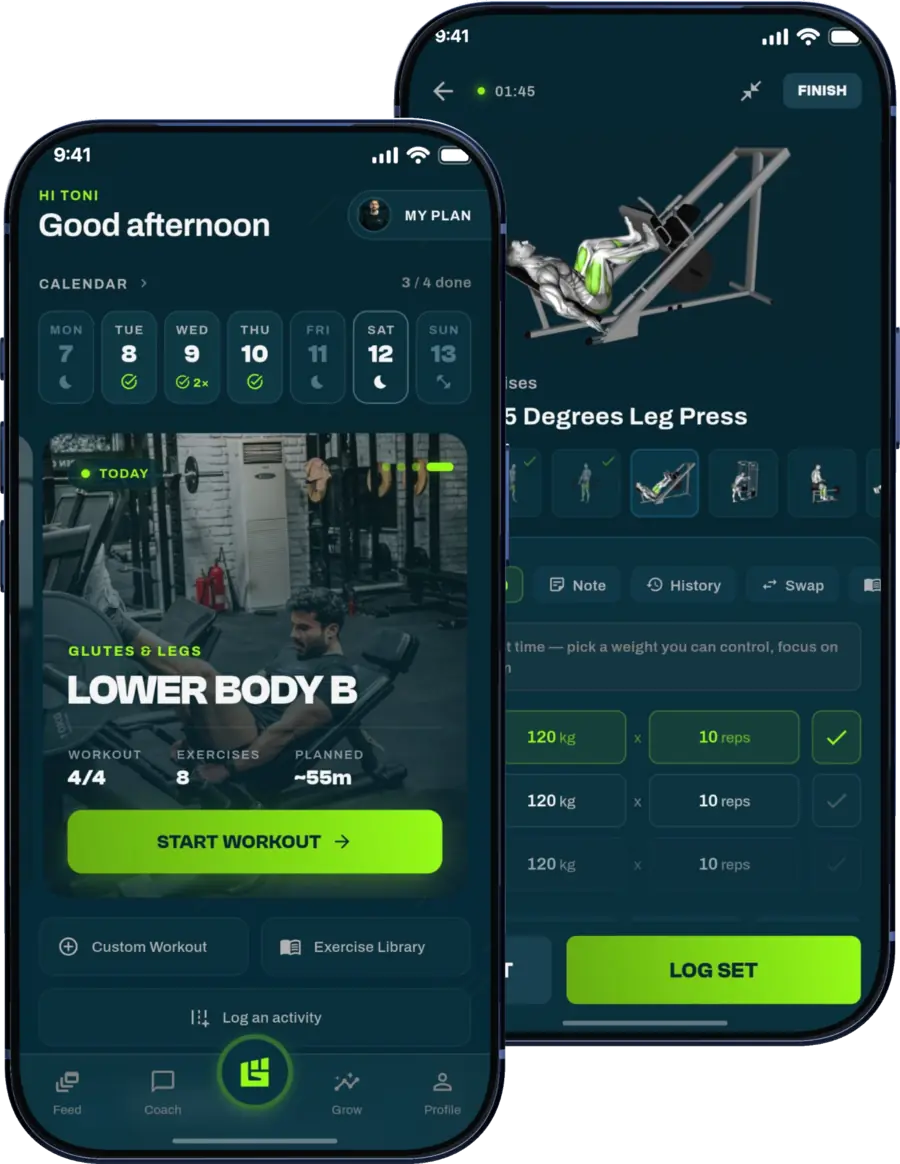
Get a personalized workout plan built around your goal, equipment and schedule. Train smarter, track every rep and keep moving forward, one workout at a time.






These are the reps that send the loudest possible signal to your body: adapt and build more muscle.
The driving force behind muscle adaptation
Why are these reps so special? They’re the ones that flip the switch on the key physiological triggers for muscle growth. When you push your muscles that hard, two critical things happen:
- Maximum motor unit recruitment: Your nervous system is forced to call in its largest and most powerful muscle fibers. These are the fibers with the most growth potential, and your body only uses them when it absolutely has to.
- High mechanical tension: These last few reps place immense mechanical tension on the muscle fibers. This tension is the primary stimulus that signals your muscle cells to repair themselves and grow back bigger and stronger.
This entire approach reinforces the idea of focusing on quality over quantity in strength training. It doesn't matter if you're lifting a heavy weight for 5 reps or a lighter one for 20—the goal is always to make those last few reps count.
To clarify this, let's compare the reps at the beginning of a set to the ones at the end.
Traditional reps vs effective reps at a glance
This table breaks down the differences between the "easy" reps at the start of a set and the growth-promoting reps at the end.
| Characteristic | Early-Set Reps (Reps 1-5 of a 10-Rep Set) | Effective Reps (Reps 6-10 of a 10-Rep Set) |
|---|---|---|
| Effort Level | Low to moderate. Feels relatively easy. | High to maximal. A true grind. |
| Rep Speed | Fast and consistent. | Involuntarily slow, despite maximum effort. |
| Motor Unit Recruitment | Primarily smaller, endurance-focused fibers. | Recruits the largest, high-growth potential fibers. |
| Mechanical Tension | Low to moderate. Not enough to force adaptation. | High to maximal. The primary trigger for hypertrophy. |
| Hypertrophic Stimulus | Minimal. These reps are "warm-ups." | Maximal. These are the reps that build muscle. |
Seeing it laid out like this makes it clear: the back half of a challenging set is where the real magic happens for muscle growth.
The magic isn't in the specific rep number; it's in the high effort you exert during the final, effective reps of that set. Your body responds to the challenge, not just the count.
Understanding this concept is the first step toward building a smarter training program. It allows you to structure your workouts, like those in our guide to chest exercises, to make sure every set you do is productive and pushing you closer to your muscle growth goals.
The science behind effective reps and muscle growth
To understand why those last few grinders in a set are so important, we need to look at what’s happening under the hood. The link between effective reps and hypertrophy isn’t just some gym-bro theory; it’s grounded in how your nervous system recruits muscle fibers when things get tough.
When you start a set, the first few reps feel pretty easy. That’s because your brain is only calling on the smaller, more endurance-focused motor units to get the job done. A motor unit is a nerve and the bundle of muscle fibers it controls.
But as you push deeper into the set and fatigue builds, your nervous system has to call for backup. This is where the real growth stimulus kicks in.
Waking up the high-growth fibers
To keep the weight moving, your body is forced to recruit its biggest, most powerful motor units. This is called high-threshold motor unit recruitment, and it's one of the primary drivers of muscle growth. These high-threshold units are wired to the muscle fibers with the most potential for getting bigger and stronger, but your body keeps them in reserve until they're absolutely needed.
Think of it like a company’s staff. For day-to-day tasks, the junior employees can handle it. But when a massive, make-or-break project lands on the desk, the senior specialists—the most experienced and capable people—are brought in. Effective reps are that make-or-break project for your muscles.
The bottom line is simple: to make a muscle grow, you have to give it a reason to. Forcing it to recruit its most powerful fibers by training close to failure is the most reliable way to send that signal, no matter what weight is on the bar.
This is all explained by a classic concept in exercise science called Henneman's Size Principle. It states that motor units are always recruited in order from smallest to largest, based on how much force is needed. Those final, difficult reps guarantee you've climbed that ladder and activated the fibers that truly matter for growth.
The power of mechanical tension
It’s not just about recruitment. Those challenging reps also create a massive amount of mechanical tension—the physical force placed on your muscle fibers as they work. This is widely seen as the single most important ingredient for kicking off muscle protein synthesis, the process that repairs and rebuilds your muscles bigger and stronger.
The involuntary slowing of your reps toward the end of a hard set is a dead giveaway that you're generating high levels of mechanical tension. Every available fiber is straining to contribute, creating the perfect chemical and mechanical environment to trigger a growth response. This is why the effort you put in is more important than the specific number on the dumbbell.
The research is clear on this. One landmark meta-analysis found that training within 0-5 reps of failure is the sweet spot for muscle growth. When lifters using moderate loads (60-80% of their one-rep max) trained close to failure, their quad and bicep thickness grew by an average of 10.67%. This was even slightly better than the 9.17% gains from heavy, low-rep sets, showing that effort, not just load, drives the outcome. You can dive deeper into the research on hypertrophy training if you're curious.
Why light and heavy weights both build muscle
This brings us to a crucial point: both heavy and light weights can build muscle, as long as you take the set close to failure.
- Heavy weights (e.g., 5-8 reps): The load is so demanding that your biggest motor units are called into action almost right away. You get into the "effective reps" zone very quickly.
- Light weights (e.g., 15-30 reps): You have to do more reps to tire out the smaller, endurance-oriented fibers first. But once they fatigue, your body has no choice but to recruit the big-gun motor units to finish the job, creating the same muscle-building stimulus.
This scientific backbone confirms that effective reps are the universal currency for muscle growth. By focusing on effort and pushing your sets close to failure, you're making sure you provide the stimulus your muscles need to adapt and grow. You're turning hard work into real results.
How to program your workouts for effective reps
Knowing the science is one thing, but turning it into a real-world gym strategy is where the magic happens. Structuring your workouts to maximize effective reps isn’t about memorizing complicated formulas. It’s about focusing on a few key variables that dial in your training effort.
The goal here is to move past just counting to 10 or 12 and start making every set a powerful stimulus for growth. This means shifting your focus from if you're lifting the weight to how you're lifting it, especially as you start to get tired. We'll break this down into three core pillars: proximity to failure, rep ranges, and total weekly volume.
This simple diagram shows the flow: high effort is the trigger, which kicks off the muscle growth we’re all after.

As you can see, applying high muscular effort is what forces your body to recruit the motor units needed to signal real growth.
Proximity to failure: the RIR scale
The single most important tool for making sure your reps are effective is managing your proximity to failure. Instead of just guessing when a set is hard enough, we can use a simple metric called Reps in Reserve (RIR).
RIR is a way of rating how close you are to failing at the end of a set. All you do is ask yourself, "How many more reps could I have done with good form?"
- 0 RIR: Absolute failure. You couldn’t have squeezed out another rep.
- 1 RIR: You had exactly one more good rep in the tank.
- 2 RIR: You could have done two more reps.
- 3 RIR: You could have managed three more reps.
For muscle growth, the sweet spot for most of your work is in the 0-3 RIR range. Pushing into this zone guarantees you’ve recruited those high-threshold motor units and created the mechanical tension needed to grow.
Living at 0 RIR all the time is a recipe for burnout, but hanging out at 4 RIR or higher often isn't stimulating enough. For most people, most of the time, aiming for 1-2 RIR on your sets is a sustainable and highly effective strategy.
Finding your ideal rep ranges
One of the biggest myths in fitness is that you have to train in the "8-12 rep range" to build muscle. The effective reps model blows this idea out of the water. As long as the effort is high and you’re training near failure, you can build muscle across a huge spectrum of rep ranges.
Here’s a look at how it breaks down:
- Heavy (5-8 Reps): When you’re lifting heavy, you get into the effective reps zone almost right away. Every rep is a high-effort rep, making this range fantastic for building both strength and size.
- Moderate (8-15 Reps): The classic "bodybuilding" range. It’s a great blend of mechanical tension and metabolic stress, and it’s mentally a bit easier to push close to failure here.
- Light (15-30+ Reps): With lighter weight, the first half of the set is basically a warm-up, fatiguing the smaller muscle fibers. But those final reps become just as hard—and just as effective—as the reps in a heavy set.
The main takeaway? The number itself matters far less than the effort you put in. Pick a rep range you enjoy that feels good for a given exercise, then just apply the RIR principle. For those who want to get even more precise, advanced methods like Velocity Based Training (VBT) can help you dial in the intensity of every single repetition.
Optimizing your weekly set volume
Finally, let's talk about how much to do. The goal isn’t just to do more sets; it’s to do more high-quality sets—the ones taken to that 0-3 RIR target.
A solid evidence-based guideline for most people is to hit 10-20 hard sets per muscle group per week. If you’re just starting out, you’ll see great progress on the lower end. More advanced lifters might need to creep toward the higher end to keep the gains coming.
Systematic reviews show that higher weekly volumes can absolutely drive more growth, but only if those sets contain effective reps. For example, some studies have found that 28-30 sets per muscle can produce nearly double the growth of just 6-10 sets in trained lifters. Even in older adults, moderate volume at a high effort leads to big gains in muscle size and power.
This is where a little planning goes a long way. You can use tools like our intuitive workout builder to spread this volume across your training week, making sure every muscle gets the stimulus it needs without wrecking your recovery.
Example routines for maximizing hypertrophy
Theory is great, but it’s what you do in the gym that actually builds muscle. To show you how to put the effective reps for hypertrophy principle into action, we’ve laid out two sample routines. Think of these as clear, no-nonsense templates designed to get you started.
One plan is built for pure efficiency—perfect if you're juggling a busy schedule. The other is a more traditional split for those who can dedicate more time to training. Both are built on the same core idea: push your sets close to failure to make every rep a growth-triggering rep.
3-day full body routine for time-crunched lifters
This routine is all about getting the most bang for your buck, hitting every major muscle group three times a week. That frequency delivers a powerful growth stimulus without forcing you to live in the gym. The key here is to focus on hitting your RIR targets on every single set.
Make sure to rest at least one day between workouts (e.g., Monday, Wednesday, and Friday).
Here’s a sample weekly plan showing how you could structure your training.
3-day full body routine for effective reps
| Day | Exercise | Sets x Reps | Target RIR |
|---|---|---|---|
| Workout A | Squats (or Leg Press) | 3 x 6-10 | 2 RIR |
| Bench Press (Dumbbell or Barbell) | 3 x 8-12 | 1 RIR | |
| Barbell Rows (or Seated Cable Rows) | 3 x 8-12 | 1 RIR | |
| Lateral Raises | 3 x 12-15 | 0-1 RIR | |
| Bicep Curls | 2 x 10-15 | 0 RIR | |
| Workout B | Deadlifts (or Romanian Deadlifts) | 3 x 5-8 | 2 RIR |
| Overhead Press (Dumbbell or Barbell) | 3 x 8-12 | 1 RIR | |
| Pull-Ups (or Lat Pulldowns) | 3 to failure (or 8-12 reps @ 1 RIR) | 1 RIR | |
| Triceps Pushdowns | 3 x 12-15 | 0 RIR | |
| Leg Curls | 2 x 10-15 | 0-1 RIR |
This simple A/B rotation provides a balanced stimulus across the week. For example, you’d do Workout A on Monday, Workout B on Wednesday, and then Workout A again on Friday.
You’ll notice the RIR targets are a little higher (2 RIR) for the big, neurologically taxing lifts like squats and deadlifts. This is intentional. It helps you manage fatigue and keep your form sharp, while smaller isolation moves are pushed closer to actual failure (0-1 RIR) to chase that pump and maximize stimulus.
This structure makes sure you collect enough high-quality, effective reps throughout the week to drive growth everywhere. And since you're hitting the full body each session, recovery is paramount—so don’t slack on your sleep and nutrition. If you want to switch things up, check out our guide on the best leg exercises for more ideas.
4-day upper/lower split for hypertrophy enthusiasts
If you have more time and want to dedicate more volume to specific muscles, a 4-day upper/lower split is a tried-and-true classic. This approach lets you hammer specific muscle groups with more focus each session, which can be great for bringing up stubborn body parts.
With this split, you'll train each muscle group twice a week. A popular schedule is training on Monday (Upper), Tuesday (Lower), Thursday (Upper), and Friday (Lower), with rest days in between.
Sample upper/lower split
| Day | Focus | Exercise | Sets x Reps | Target RIR |
|---|---|---|---|---|
| Day 1 | Upper Body (Strength Focus) | Barbell Bench Press | 3 x 6-10 | 2 RIR |
| Pull-Ups (Weighted if needed) | 3 x 6-10 | 1 RIR | ||
| Seated Dumbbell OHP | 3 x 8-12 | 1 RIR | ||
| Dumbbell Rows | 3 x 8-12 | 1 RIR | ||
| Triceps Dips | 2 x 10-15 | 0-1 RIR | ||
| Day 2 | Lower Body (Strength Focus) | Barbell Back Squats | 3 x 6-10 | 2 RIR |
| Romanian Deadlifts | 3 x 8-12 | 2 RIR | ||
| Leg Press | 3 x 10-15 | 1 RIR | ||
| Calf Raises | 4 x 10-15 | 0 RIR | ||
| Day 3 | Upper Body (Hypertrophy Focus) | Incline Dumbbell Press | 3 x 10-15 | 1 RIR |
| Lat Pulldowns | 3 x 10-15 | 1 RIR | ||
| Lateral Raises | 4 x 12-20 | 0 RIR | ||
| Seated Cable Rows | 3 x 12-15 | 1 RIR | ||
| Dumbbell Bicep Curls | 3 x 12-15 | 0-1 RIR | ||
| Day 4 | Lower Body (Hypertrophy Focus) | Leg Extensions | 3 x 15-20 | 0-1 RIR |
| Leg Curls | 3 x 15-20 | 0-1 RIR | ||
| Goblet Squats | 3 x 12-15 | 1 RIR | ||
| Hip Thrusts | 3 x 10-15 | 1 RIR |
This split has room for more isolation work, which is perfect for targeting specific muscles you want to grow. The mix of a strength day (lower reps) and a hypertrophy day (higher reps) also keeps training interesting by providing a varied stimulus.
At the end of the day, both routines are built on the same foundation: making the last few reps of every set the most effective reps for your muscle-building goals.
How GrabGains automates your effective reps training
Knowing the theory behind effective reps for hypertrophy is a great start, but putting it into practice week after week is the real challenge. Manually tracking your Reps in Reserve (RIR), figuring out when to add weight, and ensuring every set lands in that growth zone can feel like a full-time job. This is where the right technology can do the heavy lifting for you.
Instead of guessing, you can have a smart training partner that bakes these evidence-based principles right into your program. It automates the decision-making so you can put all your energy into your effort and performance.
Taking the guesswork out of intensity
The concept of effective reps lives and dies by training with the right intensity—specifically, staying in that productive 0-3 RIR zone. But how do you know if you’re actually there? And what should you do for your next workout? The GrabGains app was built to solve this exact problem.
You don't have to manually track RIR or adjust weights yourself. The app’s algorithm handles it. You just log how many reps you did and how hard it felt. Based on that feedback, the app intelligently adapts your next session.
If you consistently hit your rep target at a 2 RIR, the system knows you’re getting stronger. It will then automatically increase the load for your next session to ensure you stay in that challenging, growth-producing zone.
This takes the mental load off your shoulders. Your only job is to show up, give it your best effort, and log your sets honestly. The app takes care of the complex math behind the scenes to keep you moving forward.
Smart progression for consistent gains
Progressive overload is the cornerstone of muscle growth, but applying it perfectly is tough. Go too fast, and you risk burnout or injury. Go too slow, and your gains grind to a halt. GrabGains automates this by creating a live feedback loop between you and your program.
This adaptive planning ensures every workout is dialed in to your current strength level. The platform is engineered to keep you accumulating those crucial effective reps for hypertrophy by:
- Intelligently adjusting loads: The app increases or maintains weight based on your actual performance, not a rigid, pre-set plan.
- Optimizing your training intensity: It works to keep your "hard sets" in that sweet spot of 0-3 RIR, maximizing the muscle-building signal from each session.
- Providing visual feedback: Smart tracking features give you clear data on your performance, showing you how many high-effort sets you’re racking up over time.
This turns your training data into real-world insights, confirming that your hard work is translating into the stimulus needed for measurable growth.
Your pocket personal trainer
At the end of the day, GrabGains acts like a smart training partner that understands the science of muscle growth. It takes the proven principles of effective reps and proximity-to-failure and weaves them into a personalized, adaptive plan that grows with you.
You get all the benefits of an advanced, evidence-based training strategy without needing a degree in exercise science. The system makes sure you’re always challenged just enough to spark growth, giving you a clear and effective path to your goals.
Common questions about effective reps training
Even after you get the big picture of effective reps, a few practical questions always seem to pop up when it's time to hit the gym. It’s one thing to know that training close to failure is where the magic happens, but it's another thing entirely to apply that idea correctly and consistently. This section cuts through the confusion and tackles the most common sticking points head-on.
Think of this as your quick-reference guide for troubleshooting your training. We'll give you clear, no-nonsense answers to help you dial in your approach, so you can keep making progress without all the guesswork.
Do I have to train to complete failure on every set?
This is a big one, and the short answer is no. In fact, taking every single set to absolute failure (0 RIR) is usually a bad idea. While it technically guarantees you’re getting all your effective reps, going to that well too often creates a ton of fatigue, tanks your recovery, and can increase your risk of injury. It completely backfires by limiting how much quality work you can actually do each week.
The sweet spot for most people and most exercises is hanging out in the 1-3 Reps in Reserve (RIR) range. This ensures you're pushing hard enough to trigger a powerful growth stimulus without drowning in the fatigue that comes from constantly redlining it.
A smarter way to program this is to save true failure for very specific moments. For example:
- Compound lifts: On the big stuff like squats, deadlifts, and bench presses, it's wise to stay around 2-3 RIR. The risk of your form breaking down is much higher, and the full-body fatigue they generate is no joke.
- Isolation lifts: For simpler exercises like bicep curls, triceps pushdowns, or leg extensions, pushing that last set to 0-1 RIR is much safer. It can provide a fantastic muscle-building kick without wrecking you for your next workout.
Is the 8 to 12 rep range for hypertrophy a myth?
It's less of a myth and more of an incomplete story. The 8-12 rep range became the classic "bodybuilding range" for a good reason—it’s a very practical sweet spot. It lets you use a weight that’s heavy enough to feel challenging while giving you enough reps to build up fatigue and get close to failure.
However, a mountain of modern research confirms that you can build muscle just as well across a huge spectrum of rep ranges. Studies have shown similar muscle growth with sets as low as 5 reps and as high as 30 or more, but only if one critical condition is met: the set must be taken close to muscular failure.
The magic isn't in the number 12. It is in the high level of effort you put into those last few grinding reps, no matter how many came before them. Choosing a rep range is more about your personal preference, the exercise you're doing, and how you want to manage fatigue—not about some single "best" range for growth.
How can I accurately measure my reps in reserve?
Gauging RIR is a skill, and just like any other skill, you get better at it with honest practice. After you finish a set, just pause and ask yourself, "Realistically, how many more reps could I have done with perfect form?" If the honest answer is two, you just finished at a 2 RIR.
To really calibrate your internal effort-meter, it helps to occasionally find out what true failure actually feels like in a safe environment.
A great way to practice is to take the very last set of a safe isolation exercise (like a machine chest press or a leg curl) to absolute, can’t-move-it-another-inch failure. Experiencing what 0 RIR feels like makes it much easier to accurately estimate 1, 2, or 3 RIR on your other lifts.
Another huge clue to watch for is involuntary rep slowing. When you're pushing with everything you've got but the bar or dumbbell just starts moving slower on its own, you are officially in the effective reps zone. That's a clear signal that you’re getting close to your RIR target and the set is becoming highly productive for growth.
Can I get effective reps with bodyweight exercises?
Absolutely. The rules of hypertrophy don't care where the resistance comes from—a barbell, a dumbbell, a machine, or your own body. The key is, and always will be, high effort near the point of failure.
For someone just starting out, a standard set of push-ups might be challenging enough to hit 1-2 RIR within 10-15 reps. But as you get stronger, you'll have to find ways to make it harder to keep getting into that effective reps zone without doing a hundred reps.
You can do this by moving to more difficult variations:
- From push-ups to archer push-ups or decline push-ups.
- From bodyweight squats to pistol squats or shrimp squats.
- From inverted rows to a single-arm version or adding a pause at the top.
The goal never changes: pick an exercise variation that makes the last few reps a genuine struggle. This ensures your body has no choice but to recruit its most powerful motor units and send that unmistakable signal to grow. If you’re looking for smart ways to apply this, you can discover the app to see how it handles progressive overload for all types of exercises.
Ready to stop guessing and start building muscle with a plan that adapts to you? With GrabGains, you get personalized workouts that automatically adjust to keep you in the growth zone. Download GrabGains on iOS or Android now and start training smarter.
Get inspired and motivated