High reps vs low reps: which is better for your goals?
Uncover the science behind high reps vs low reps. Learn how to structure your training for muscle growth, strength, and endurance for maximum results. The classic gym debate over high reps vs. low reps is simpler than it appears. The right answer always depends on your specific goal. If you're chasing maximal strength, lifting heavy for low reps is your best bet. For building muscular endurance, high reps with lighter weight are the way to go. And if your aim is to build muscle size? The good news is, both can get the job done.
This guide will break down the science behind rep ranges so you can build a smarter, more effective workout plan.


A practical guide to rep ranges
After choosing an exercise, your next decision—how many repetitions to perform—is crucial for shaping your results. It's not about one rep range being inherently "better," but about matching the tool to the job. Coaches refer to this concept as the repetition continuum.
Think of it as a spectrum. On one end, you have heavy, low-rep sets of 1-5 reps, which are supreme for building raw strength. On the opposite end are high-rep sets of 15+ reps, perfect for teaching your muscles to fight off fatigue. Right in the middle is the classic 6-12 rep "hypertrophy" zone, which offers a great mix of size and strength.
Understanding the repetition continuum
Each rep range sends a different signal to your body, triggering a unique set of adaptations.
Built for progress
Take the guesswork out of training
Get a personalized workout plan built around your goal, equipment and schedule. Train smarter, track every rep and keep moving forward, one workout at a time.






- Low Reps (1-5): This range maximizes mechanical tension—the sheer force your muscles must produce. Lifting heavy weight forces your nervous system to recruit your largest and strongest muscle fibers, leading to significant strength gains.
- Moderate Reps (6-12): Often considered the sweet spot for bodybuilders, this range provides a balanced dose of mechanical tension and metabolic stress, which is the "burn" you feel as byproducts accumulate in the muscle during a challenging set.
- High Reps (15+): These sets excel at creating metabolic stress. They improve your muscles' ability to buffer waste products and resist fatigue. Don't be fooled by the lighter weight; taking these sets close to failure provides a powerful stimulus for muscle growth.
This visual breaks down how your primary goal should guide your rep selection.

The key takeaway is that your "why" always determines your "how." Your goal should be the first thing you consider when deciding how many reps to perform.
For a quick summary, this table puts everything in one place.
Rep range quick guide for your fitness goals
| Training Goal | Typical Rep Range | Primary Adaptation |
|---|---|---|
| Maximal Strength | 1-5 reps | Neuromuscular efficiency and power |
| Muscle Size (Hypertrophy) | 6-12 reps | Balanced mechanical tension and metabolic stress |
| Muscular Endurance | 15+ reps | Metabolic stress resistance and fatigue delay |
Use this as your cheat sheet. Match your goal to the rep range, and you’ll be on the right track to getting the specific results you're after.
How reps build muscle and strength
To settle the "high reps vs. low reps" debate, it's important to understand what happens inside your muscles during training. Lifting isn’t just about moving weight; it’s about sending specific signals that force your body to adapt. Every rep plays a part in this process.
The three main drivers of muscle growth, or hypertrophy, are mechanical tension, metabolic stress, and muscle damage. Think of them as different languages you can use to tell your muscles, "Get bigger and stronger." The rep range you choose determines which language you’re speaking most fluently.
The role of mechanical tension
Mechanical tension is the physical force your muscles generate to overcome a heavy weight. It is the most direct signal for building pure strength. When you lift heavy for low reps, you maximize this tension, forcing your nervous system to recruit the largest, most powerful muscle fibers.
These are your Type II, or "fast-twitch," fibers, which have the greatest potential for both growth and force production. By consistently challenging them with heavy loads, you not only build the muscle itself but also enhance the connection between your brain and your muscles. This improved neuromuscular efficiency is why low-rep training is unmatched for building maximal strength.
Low-rep training is the fast track to strength because it's a direct conversation with your nervous system. You're teaching your brain how to fire all cylinders to move the heaviest possible weight, leading to powerful neural adaptations.
However, a common myth suggests that muscle can only be built with heavy weights. While mechanical tension is a huge part of the equation, it’s not the only path to growth. Understanding the relationship between effective reps vs. volume for hypertrophy helps clarify how different training styles can lead to similar results.
Metabolic stress and the pump
If low reps are the masters of tension, high reps are the experts at creating metabolic stress. This is the deep, acidic "burn" you feel when grinding out a long, tough set. As your muscles continue to work, byproducts like lactate and hydrogen ions build up, creating a specific environment inside the muscle cell.
This chemical soup achieves two key things:
- It signals growth: The cellular swelling (the "pump") and accumulation of these metabolites directly trigger anabolic pathways that contribute to building muscle.
- It builds endurance: Your muscles learn to clear out these byproducts more efficiently, allowing you to resist fatigue for longer in the future.
This is where your Type I, or "slow-twitch," muscle fibers excel. They are built for endurance and are heavily taxed during high-rep training. While they don’t have the same growth potential as fast-twitch fibers, training them is still crucial for overall performance and contributes to muscle size.
So which rep range is better for size?
For decades, the bodybuilding world was convinced that a moderate "hypertrophy range" was the only way to build muscle. However, modern science paints a more flexible picture. As long as you take your sets close to muscular failure, the difference in muscle growth between low, moderate, and high reps is surprisingly small.
A major meta-analysis found that when comparing low reps (1-5) to moderate reps (6-15), the difference in muscle growth was negligible. The same held true when comparing moderate reps to high reps (20+). Any slight advantage for one range often disappeared once researchers accounted for other variables. For example, in raw performance, low reps only came out ahead of the study means by 1% compared to moderate reps. You can explore these hypertrophy range findings on Stronger by Science to see the data for yourself.
The real takeaway is that you can build muscle effectively with both high and low reps. The "magic" isn't in the number itself but in pushing your sets hard enough to recruit all available muscle fibers, whether that happens on rep 5 or rep 25.
When to use low reps for maximum strength

When your primary goal is to get as strong as humanly possible, the answer is simple: lift heavy. This means working primarily in the 1-5 rep range, the undisputed champion for building raw, maximal strength.
This approach is effective because it focuses on training your nervous system, not just growing muscle. Each heavy lift commands your brain to recruit the maximum number of motor units—the nerve and muscle fiber teams that generate force. You are teaching your body to become incredibly efficient at producing power on demand.
Neuromuscular adaptations and power
Low-rep training is a direct line to your central nervous system (CNS). Every heavy set strengthens the connection between your brain and muscles, improving how quickly and synchronously they fire. Over time, your body learns to activate its strongest, highest-threshold motor units almost instantly, allowing you to move weights that were once impossible.
This is the bread and butter for certain athletes for a reason:
- Powerlifters: Their sport is a pure test of a one-rep max, making low-rep training non-negotiable.
- Olympic Weightlifters: The snatch and clean & jerk require explosive, top-end power built on a foundation of absolute strength.
- Strength Athletes: Strongman competitors depend on this style to build the brute force needed to lift cars, stones, and logs.
But it’s not just for competitors. If your goal is pure strength, you will get the most bang for your buck by prioritizing the 1-5 rep range on your main compound lifts.
The core benefit of low-rep training isn't just muscle growth; it's neural optimization. You are programming your body to become exceptionally good at one thing: producing maximal force on demand.
The evidence for strength gains
The idea that heavy, low-rep sets build the most strength isn't just gym folklore; it's backed by solid science. A well-known 2016 study compared lifters training in a low-rep range (2-4 reps) with those in a moderate-rep range (10-12 reps). The results were clear: the low-rep group saw significantly greater strength gains, demonstrating the specificity of our body's adaptations.
The downsides and how to manage them
While incredibly effective, low-rep training is demanding. The heavy loads put immense stress on your joints, connective tissues, and CNS. This high-stakes environment means your injury risk increases if your form breaks down even slightly.
Recovery is paramount. Due to the high neural demand, you cannot grind out heavy sets every day. Rest periods between sets also need to be longer—often 3-5 minutes or more—to give your nervous system enough time to recharge for the next all-out effort.
To make this style work for you, keep these points in mind:
- Prioritize Perfect Form: Never sacrifice technique to lift more weight. Every rep must be clean.
- Manage Your CNS Fatigue: Listen to your body. If you feel mentally drained or consistently flat, it's likely time for a deload.
- Use It Strategically: Save your heaviest work for big, multi-joint exercises like squats, deadlifts, and presses, where strength gains matter most.
For lifters chasing maximum strength, proper nutrition and supplementation can also make a real difference. Products like creatine supplementation are proven to aid performance and recovery. Ultimately, low-rep training is a powerful tool, but its intensity must be respected.
Using high reps for endurance and hypertrophy
While heavy, low-rep sets reign supreme for raw strength, shifting to the other end of the spectrum unlocks a different world of adaptation. High-rep training—typically anything involving 15 or more reps per set—is a masterclass in building muscular endurance and a surprisingly effective way to build muscle.
Instead of chasing pure mechanical force, high-rep training creates massive amounts of metabolic stress. This is the deep, burning sensation you feel when a set becomes brutally difficult. Your muscles fill with metabolic byproducts like lactate, creating a unique cellular environment that signals your body to adapt and grow.
The power of the pump and endurance
The most obvious effect of high-rep training is the "pump." As you perform reps, blood floods into the working muscles faster than it can exit. This phenomenon, known as cell swelling, is thought to be one of the pathways to hypertrophy, sending its own distinct signal for muscle growth.
But it’s about more than just a temporary cosmetic effect. High-rep work is the best way to improve muscular endurance. By consistently pushing through that burn, you train your body to clear metabolic waste more efficiently and resist fatigue for longer.
This is a game-changer for:
- Functional Fitness Athletes: Anyone doing CrossFit or HYROX needs their muscles to fire repeatedly without failing.
- Endurance Athletes: Runners and swimmers rely on fatigue-resistant muscles to maintain performance over long distances.
- Everyday Life: From carrying groceries to playing with your kids, better muscular endurance makes daily activities feel easier.
A joint-friendly approach to building muscle
One of the biggest practical benefits of high-rep training is its forgiving nature on your joints. The lighter loads mean less shear force and compressive stress on your tendons and ligaments compared to grinding out heavy, low-rep sets. This makes it a fantastic tool for anyone managing nagging joint pain or seeking a more sustainable way to train.
This makes it an ideal strategy for:
- Beginners: Lighter weight allows new lifters to perfect their form and technique without the risk or intimidation of heavy loads.
- Older Adults: High reps provide a safe, effective stimulus for maintaining muscle and strength with age.
- Injury Recovery: It’s a great way to work around an injury, keeping muscles engaged without aggravating sensitive areas.
Research confirms that when sets are taken close to muscular failure, high-rep training with light weight builds just as much muscle as low-rep training with heavy weight. The key isn't the weight on the bar; it's the effort you put into the set.
The mental and physical demands of high reps
Don't mistake "joint-friendly" for easy. High-rep training presents its own unique challenges. While it might be kinder to your elbows and knees, it’s incredibly taxing on your cardiovascular system and mental grit. Pushing through the fire of a 20-rep set of squats requires a completely different kind of toughness than a heavy triple.
The main downsides are the intense cardiovascular fatigue and the mental battle required to stay in the set. Many people quit early simply because the burn becomes unbearable, not because their muscles have actually failed. To make high reps effective for muscle growth, you must be willing to get comfortable with being uncomfortable and push until you have only 1-2 reps left in the tank. This ensures you’ve recruited all available muscle fibers, including the powerful fast-twitch fibers that only activate when a set gets truly hard.
How to structure your training program
Knowing the theory behind high and low reps is a great start, but applying it to a smart, effective program is what truly counts. The best plans don't force you to choose a side. Instead, they strategically combine different rep ranges to build a complete athlete who is strong, muscular, and resilient.
This is where periodization comes in. Periodization is a structured way of planning your training long-term. Instead of doing the same routine week after week, you cycle through different training styles or "blocks" to keep your body guessing, force new adaptations, and break through plateaus.
It’s the secret sauce that separates people who just go to the gym from athletes who make consistent, year-after-year progress. By varying your rep ranges, you provide your body with a fresh stimulus to adapt to, ensuring you continue to build strength and muscle without getting stuck.
Linear periodization: the classic approach
Linear periodization is the most straightforward model. You start with a block of training focused on higher volume and lower intensity, then gradually shift toward lower volume and higher intensity over several weeks. It's a logical progression from building a base to peaking your strength.
A classic linear plan might look like this:
- Weeks 1-4 (Hypertrophy Block): Focus on higher reps (8-15 per set) to build muscle mass and increase work capacity.
- Weeks 5-8 (Strength Block): Transition to heavier weights and lower reps (3-6 per set) to convert that new muscle into raw strength.
- Weeks 9-12 (Peaking Block): Go even heavier with very low reps (1-3 per set) to test your limits and hit new personal records.
This approach is perfect for beginners because it's simple to follow, and it's also ideal for anyone training for a specific event like a powerlifting meet, where the goal is to peak on a certain day.
Daily undulating periodization: the dynamic method
A more advanced and flexible strategy is Daily Undulating Periodization (DUP). Instead of changing your focus every few weeks, you change it with every workout. This means you might have a heavy strength day, a hypertrophy day, and a muscular endurance day all within the same week.
This method keeps training engaging and allows you to pursue multiple goals at once. For example, you could build pure strength on Monday with heavy low-rep squats, drive muscle growth on Wednesday with moderate-rep leg presses, and boost your endurance on Friday with high-rep lunges.
Daily Undulating Periodization is like teaching your body to be fluent in multiple languages. You’re training it to speak the language of strength, size, and endurance all at once, which makes you a more well-rounded and plateau-proof athlete.
DUP is incredibly effective because it lets you practice different rep ranges more frequently, helping you get better and stronger in each of them faster.
A sample weekly split
So, what does this look like in a training week? Here’s a simple way to set up your workouts using a DUP model. This structure guarantees you’re hitting all the important rep ranges for a balanced stimulus.
This sample table shows how you can assign different goals to different days, using Daily Undulating Periodization to your advantage.
Sample weekly training split with varied rep ranges
| Day | Focus | Main Lifts (Example) | Rep Range | Accessory Lifts (Example) | Rep Range |
|---|---|---|---|---|---|
| Monday | Strength | Barbell Squat (3 sets) | 3-5 reps | Leg Press (3 sets) | 6-8 reps |
| Wednesday | Hypertrophy | Bench Press (4 sets) | 8-12 reps | Dumbbell Flyes (3 sets) | 10-15 reps |
| Friday | Endurance/Power | Deadlift (5 sets) | 3-5 reps | Kettlebell Swings (4 sets) | 15-20 reps |
This example shows just one way to organize your week to hit different athletic qualities. The main takeaway is that the high reps vs low reps debate isn't about making a single choice—it’s about having a full toolbox. By using periodization, you ensure you get the best of both worlds.
Let GrabGains handle the programming
Building your own training program can be a lot of work. Juggling periodization, figuring out when to use high versus low reps, and knowing how to progress can feel like a second job. That’s where smart technology can help by taking the guesswork out of the equation.
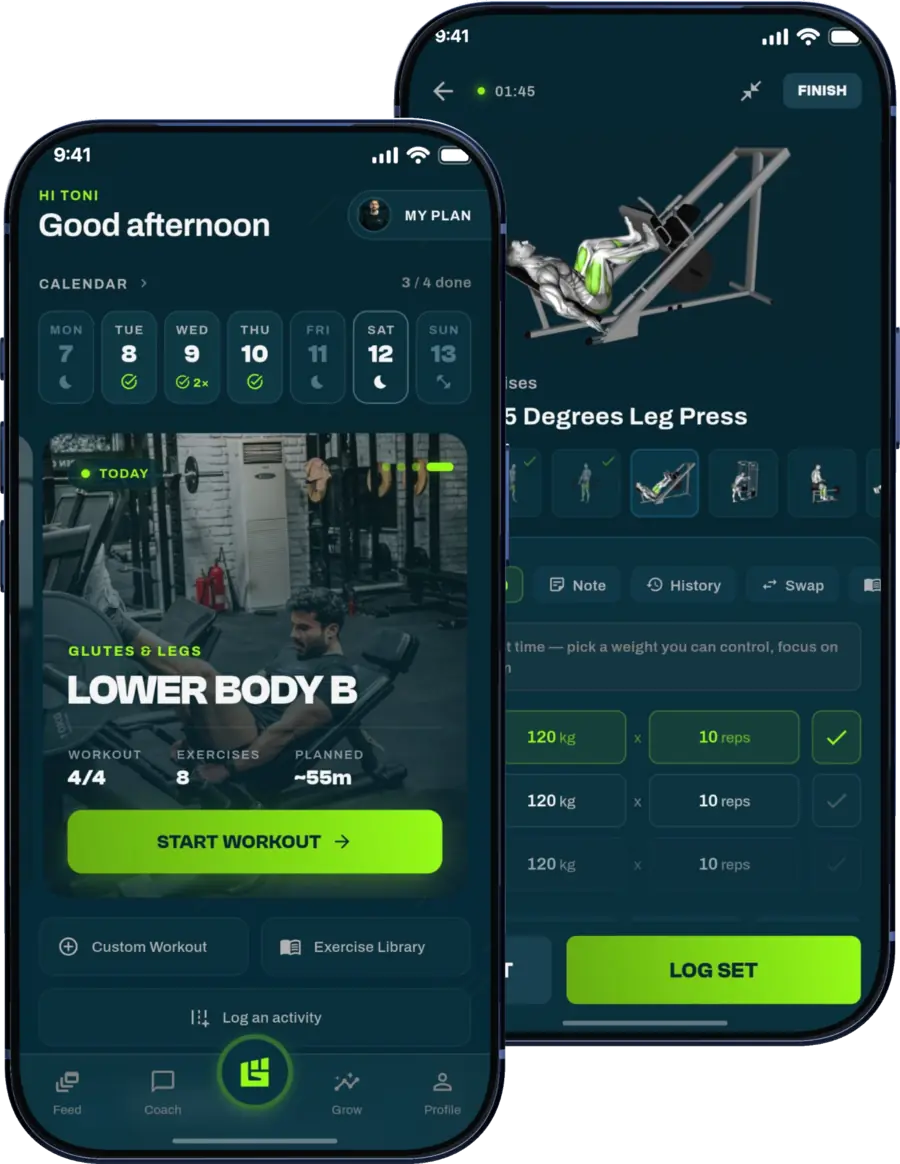
GrabGains was built to solve this exact problem. It acts as a personal coach in your pocket, translating complex training science into a straightforward, actionable plan that adjusts to your performance in real time. You never have to second-guess whether you’re doing the right thing for your goals.
Get a plan that matches your goal
Whether you’re training for pure strength, maximum muscle size, or better endurance, GrabGains designs a routine specifically for you. The app uses your goals to generate a plan that automatically programs the right rep ranges.
You get all the benefits of a smart, well-structured program without needing a degree in exercise science.
- For Strength: Your plan will focus on heavy compound lifts in the lower rep ranges, built around progressive overload to drive your one-rep max up.
- For Hypertrophy: You’ll get a mix of moderate and high reps to maximize both mechanical tension and metabolic stress—the two key drivers of muscle growth.
- For Endurance: Workouts will use higher rep schemes with shorter rest periods to build your muscular stamina and push back fatigue.
This level of detail ensures every single workout is effective. Instead of following a generic template, you get a plan that understands the high-rep vs. low-rep debate and applies it for you.
Training that adapts and grows with you
A program that never changes is a program that will eventually fail. Your body adapts quickly; what worked last month might not be what you need today. This is where the adaptive programming in GrabGains truly makes a difference.
The system tracks your performance on every set. Once you consistently hit your rep targets, the app automatically applies progressive overload by intelligently increasing the weight or reps for your next session. It automates the core principles of effective training.
GrabGains takes the mental load out of workout planning. It handles the periodization, rep selection, and progression so you can put 100% of your energy into execution and effort.
Whether you're a beginner who needs clear direction or an experienced lifter who wants a smarter way to manage your training, our workout builder helps you train with total confidence. The app also includes a massive library of exercises, all with video demonstrations, so you can master your form and train safely.
Common questions about rep ranges
Even when you understand the science, applying it in the gym can bring up new questions. Let's clear up the common "what ifs" that arise when programming high vs. low reps, so you can build your workouts with confidence.
Should I use the same rep range for all exercises?
Not necessarily. In fact, mixing rep ranges within the same workout is a smart and effective strategy. This hybrid approach lets you target multiple goals at once and is a cornerstone of effective programming.
For example, you could start your session with a big compound lift like squats or bench press in a low rep range (3-6 reps) to build pure strength. Afterward, you can move to accessory work like leg extensions or dumbbell flyes in a moderate to high rep range (8-15+ reps). This way, you get the best of both worlds—foundational strength and the metabolic stress needed for muscle growth—all in one session.
How do I know if the weight is right for my rep target?
The real secret isn't the number on the dumbbell; it’s the effort. The key is to train close to muscular failure, regardless of your rep target. Whether you're aiming for 5 reps or 20, the last couple of reps in a set should feel extremely difficult to finish with good form.
This is often tracked using Reps in Reserve (RIR), where you aim to end a set with just 1-2 RIR.
- If you complete 5 reps and feel like you could have easily done 5 more, the weight is too light.
- If you aimed for 15 reps but could only manage 10, the weight is too heavy.
Focusing on consistent, high effort is far more important than the exact weight you're lifting. As long as you push your sets near failure, you are sending a powerful signal for your muscles to adapt and grow.
Can I really build muscle with high reps and light weight?
Absolutely. This is one of the biggest myths in fitness, but research has settled the debate. As long as you take your sets close to muscular failure, high-rep training with lighter weights is just as effective for building muscle (hypertrophy) as traditional heavy, low-rep training.
The main difference is the type of stimulus. High reps create more metabolic stress (the "burn"), while low reps generate more mechanical tension. Both are proven pathways to muscle growth. Just remember, high-rep training won't do much for your one-rep-max strength—that's where heavy lifting still reigns supreme.
How often should I change my rep ranges?
A proven strategy is to stick with a specific training focus for a "block" lasting anywhere from 4 to 8 weeks. For instance, you could run a 6-week strength block focused on low reps, then switch to a 6-week hypertrophy block using more moderate reps. This gives your body enough time to adapt to the stimulus.
More advanced lifters might use undulating periodization, where rep ranges change daily or weekly. Regardless of the method, the most critical factor is consistently applying progressive overload. Hopping between routines without a plan will just spin your wheels, so a structured approach is always your best bet.
Stop guessing and start progressing. The GrabGains workout builder automates all of this for you, intelligently programming your rep ranges, applying periodization, and adjusting your workouts based on your performance. Let our app handle the science so you can focus on your effort.
Get inspired and motivated