How long to build muscle a science-backed timeline
Curious how long to build muscle? Discover realistic timelines based on science for every fitness level. See what to expect and how to speed up your results. So, you're hitting the gym and want to know when you'll see the results. It's the number one question on everyone's mind, and the honest answer is that you'll feel stronger way faster than you'll look stronger. Those initial strength boosts happen within a few weeks, but seeing noticeable muscle definition in the mirror usually takes 8 to 12 weeks of consistent effort. Building a significantly more muscular physique is a longer game—think six months, a year, or even more.
This guide will break down the science of muscle growth, set realistic expectations, and give you a clear, actionable timeline so you can understand exactly what's happening in your body and how long it will take to build the muscle you want.
Setting realistic muscle gain expectations

When you first start lifting, your body makes rapid improvements in strength. But that initial surge isn't actually from bigger muscles. It's your brain and nervous system getting better at talking to each other.
Built for progress
Take the guesswork out of training
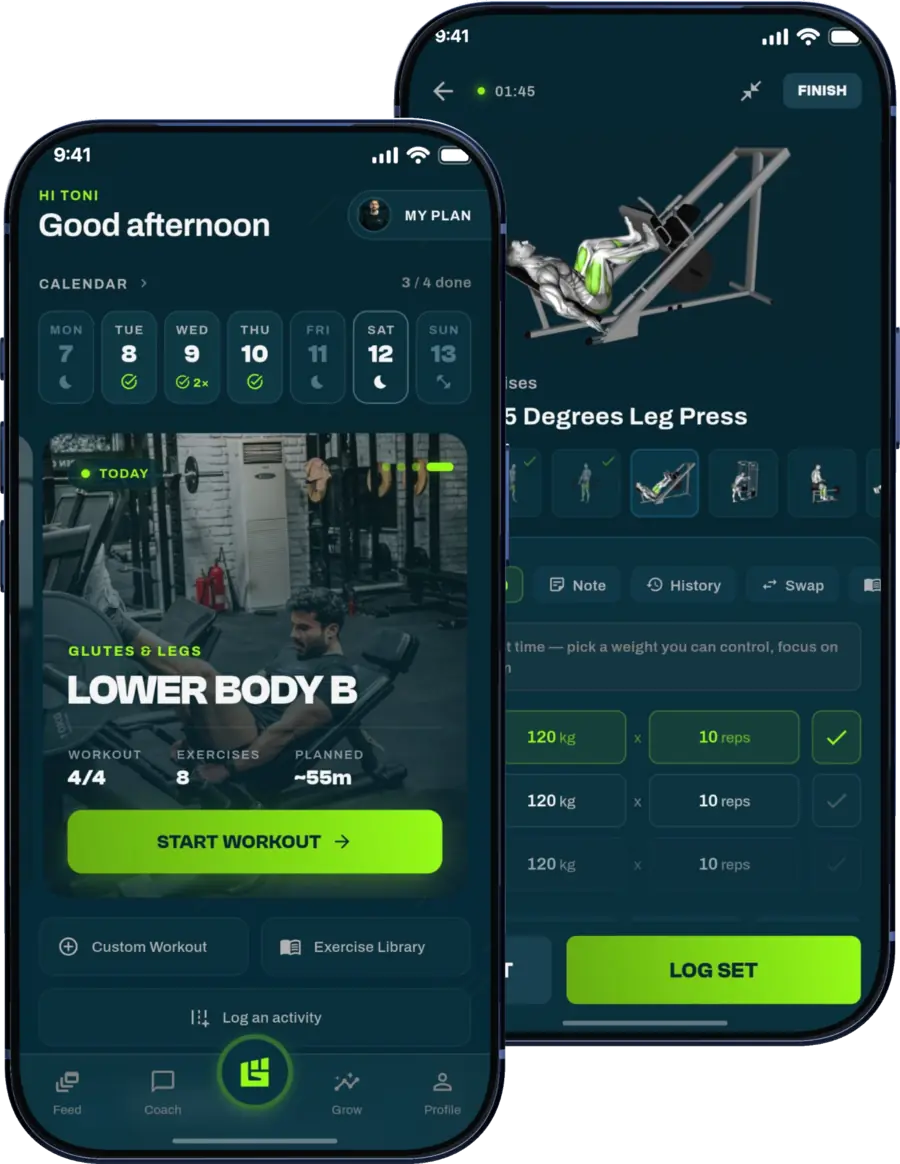
Get a personalized workout plan built around your goal, equipment and schedule. Train smarter, track every rep and keep moving forward, one workout at a time.






Think of it like learning to ride a bike. At first, you're wobbly and inefficient. Soon, your body figures out the mechanics, and it becomes second nature. The same thing happens with lifting. This is called neuromuscular adaptation. Your muscles learn to fire more effectively, making you stronger long before they get physically larger.
The two phases of initial progress
It helps to think about your first few months in two distinct stages. This keeps you from getting discouraged when you don't see massive changes overnight.
- Phase 1: The "feeling stronger" stage (weeks 1-6): Your nervous system is in overdrive, learning how to lift. You'll add weight to the bar or do more reps pretty quickly. This is the foundation you're building.
- Phase 2: The "looking stronger" stage (weeks 6-12+): Once your body gets the hang of the movements, it shifts gears and starts building new muscle tissue. This is when the visual changes really start to appear.
This timeline lines up with what experts generally advise. The Cleveland Clinic notes that initial muscle gains come after the body first re-educates its neuromuscular pathways. How fast you move through these phases depends on your training, nutrition, sleep, and genetics.
The key takeaway is simple: strength comes first, and size follows. Don't get discouraged if you don't look like a bodybuilder after your first month. You are building an essential foundation for the visible growth that is on its way.
Estimated monthly muscle gain by training experience
When you're new to lifting, your body is primed for growth and adapts very quickly. As you get more experienced, the rate of muscle gain naturally slows down because you're getting closer to your genetic potential. This table breaks down what's realistic.
| Experience Level | Estimated Monthly Muscle Gain (as % of Body Weight) | Realistic Monthly Gain (in lbs/kg) |
|---|---|---|
| Novice | 1.0% - 1.5% | 1.5 - 2.5 lbs (0.7 - 1.1 kg) |
| Intermediate | 0.5% - 1.0% | 0.75 - 1.5 lbs (0.3 - 0.7 kg) |
| Advanced | 0.25% - 0.5% | 0.4 - 0.75 lbs (0.2 - 0.3 kg) |
As you can see, a beginner might pack on muscle 2-4 times faster than someone who has been training consistently for several years. This is completely normal. The journey shifts from making rapid changes to fighting for small, incremental improvements.
Understanding the science of muscle growth
So, what's really happening inside your body when you lift a weight? To answer the question of how long it takes to build muscle, you first need to understand the why behind your workouts. The whole process, known scientifically as muscle hypertrophy, is your body's incredible response to being challenged.
Think of it like this: when you lift a challenging weight, you create microscopic tears in your muscle fibers. This isn't a bad thing—it's a signal. Your body’s internal repair crew gets the message loud and clear: "We need to rebuild this area, but this time, make it stronger to handle this stress again!"
This rebuilding process is triggered by three key factors. When your workouts hit all three, you create the perfect environment for growth. This is the difference between just exercising and training with purpose.
The three pillars of hypertrophy
To get your muscles to grow, your training needs to strategically send a few specific signals. Each one plays a unique role in telling your body it's time to get bigger and stronger.
- Mechanical tension: This is the force your muscles experience when you lift. Pushing or pulling a weight that's genuinely challenging is the single most important driver for muscle growth. It's the direct command that tells your muscle fibers to adapt by getting larger.
- Muscle damage: These are the microscopic tears we just talked about. This "damage" kicks off an inflammatory response, which activates your body’s repair systems to not only fix the fibers but reinforce them. It's also why you sometimes feel sore a day or two after a tough workout.
- Metabolic stress: Ever feel that "burn" or "pump" during a high-rep set of squats or bicep curls? That’s metabolic stress. It’s the buildup of byproducts like lactate inside the muscle, which causes the cell to swell and sends even more signals to grow.
While all three play a part, mechanical tension is king. Consistently challenging your muscles with progressively heavier weight is the foundation for long-term gains.
Finding the sweet spot for growth
So how much tension is enough? You don't need to lift your absolute max every single time you're in the gym. In fact, research points to a clear "sweet spot" for hypertrophy.
Recent mathematical models from the University of Cambridge have found that lifting around 70% of your one-rep max (1RM) provides the best balance of tension and volume to kickstart protein synthesis—the core process of actually building muscle. Train much lighter than that, and the signal for growth just isn't strong enough. You can see more about these findings in muscle growth research from Cambridge.
Training in the 70-80% 1RM range—which for most people lines up with 8-12 reps per set—is widely considered the sweet spot. It creates enough mechanical tension to spark growth without causing too much fatigue or raising injury risk.
How close to failure should you train?
Training to complete failure—the point where you physically can't do another rep with good form—has its place, but it's a tool, not a rule. It also creates a massive amount of fatigue, which can mess with your recovery and hurt your performance in your next workout.
A much smarter, more sustainable approach is to train close to failure. This means finishing your sets with just 1-3 reps left in the tank. You're still pushing hard and creating a powerful stimulus for growth, but you’re also managing fatigue, which allows you to train with high quality and consistency for the long haul.
A comprehensive meta-analysis backs this up, concluding that for hypertrophy, training anywhere from 0-5 reps from failure is effective. For most people, that 1-3 "reps in reserve" range is the perfect sweet spot—it ensures you’re doing enough to grow without running yourself into the ground.
The key factors that control your muscle building speed
Ever notice how two people can follow a similar routine, but one packs on muscle way faster? While genetics certainly play a part, the truth is you have massive control over how quickly you build muscle. It's not a mystery—it's a result of a few key factors you can manage every single day.
Think of these as the dials on your muscle-building machine. When you tune them correctly and keep them there, you create the perfect environment for your body to repair, rebuild, and grow stronger. Let's break down the most important factors that control your progress.
Consistent training and progressive overload
The number one rule of building muscle is simple: show up. Consistency is the engine of muscle growth. Without it, the best workout plan in the world is useless. Your body adapts to stress, but if that stress is random or infrequent, the signal to grow is too weak to matter. You have to commit to a structured training plan 2-4 times per week. That's non-negotiable.
But just going through the motions isn't enough. You have to give your muscles a reason to get bigger. This is where progressive overload comes in. It's a simple concept: you must consistently increase the demands placed on your muscles over time.
You can apply progressive overload in a few different ways:
- Increase the weight: The classic method. If you squatted 100 lbs for 8 reps, try for 105 lbs next time.
- Increase the reps: Lift the same weight for more reps than your last session.
- Increase the sets: Simply perform more sets of an exercise.
- Improve your form: Lifting with better control and a fuller range of motion puts more tension on the target muscle, which is a form of overload itself.
Without progressive overload, your body has no reason to change. You're just maintaining, not building.
The non-negotiable role of nutrition
You can train like a machine, but if your nutrition is a mess, you'll get nowhere fast. Your body can't build something out of thin air. The right foods provide the raw materials—the bricks and mortar—for new muscle.
Two parts of your diet are absolutely critical:
- Sufficient protein intake: Protein is made of amino acids, the direct building blocks of muscle. Training creates tiny tears in your muscle fibers, and your body needs protein to repair them. A solid, evidence-based target for active people is 1.6 to 2.2 grams of protein per kilogram of body weight (that’s about 0.7 to 1.0 gram per pound).
- A modest caloric surplus: Building new tissue takes energy. That means you need to eat slightly more calories than your body burns each day. Aim for a surplus of 250-500 calories over your maintenance level. This gives you enough energy for growth without piling on excess body fat.
Your workouts are the signal for growth, but your diet provides the fuel and building blocks. Neglecting nutrition is like telling a construction crew to build a skyscraper without delivering any steel or concrete.
The power of recovery and sleep
Muscle isn't built in the gym; it's built while you rest. Your training sessions are just the stimulus. The actual growth happens when you recover. Skimping on this part of the equation is one of the biggest mistakes you can make, and it will bring your progress to a crawl.
Sleep is your most powerful recovery tool. It’s when your body releases key muscle-building hormones like growth hormone and testosterone. It's also when muscle protein synthesis—the actual process of repairing and building muscle—hits its peak. Aim for 7-9 hours of quality sleep per night. Anything less is a compromise.
Beyond training intensity, one of the most critical factors influencing your muscle building speed is how well you optimize your post-workout recovery, as true gains are often forged during this period. This includes managing stress, taking planned rest days, and using recovery techniques to keep your body ready for the next session.
The influence of age and genetics
Finally, we have to talk about the factors you can't control. Your genetics set your baseline potential for things like body type, muscle fiber distribution, and your natural hormonal profile. It's true: some people are just born with a genetic blueprint that makes building muscle easier.
Age also plays a big role. As we get older, hormonal shifts, like a natural decline in testosterone, can make it tougher to build and maintain muscle. But this doesn't mean it's impossible. Far from it. Studies consistently show that older adults can still achieve significant muscle growth with smart, consistent training. It might take a bit more time and attention to detail, but the rules of progressive overload, nutrition, and recovery work at any age.
Your realistic muscle growth timeline from day one
Building muscle isn't a sprint with a clear finish line; it’s more like a long-haul road trip with different speed limits along the way. Knowing what to expect at each stage helps you set realistic goals, push through the inevitable slow patches, and understand what your body is doing behind the scenes.
This visual roadmap shows how your rate of muscle gain changes over time, and how things like training, nutrition, and recovery become more critical the longer you’re in the game.

The biggest takeaway here? Everyone gets a fast start, but progress slows down as you get more experienced. That's when you have to get smarter about everything you do.
The first month: the adaptation phase
The first month of training is a wild ride. You feel like a superhero as weights that felt impossible on day one suddenly become manageable. Your strength shoots up almost every week. But when you look in the mirror, you might wonder where all the new muscle is.
Don't get discouraged—this is completely normal. This is the neuromuscular adaptation phase. Your brain is just getting better at talking to your muscles. It's learning to fire them more powerfully and in the right sequence. You're building the foundation, even if you can't see the house yet.
Months 2 to 6: the newbie gains phase
Get ready for the fun part. Once your nervous system is up to speed, your body starts focusing on actually building new muscle tissue. This is the era of the legendary "newbie gains," and it’s the fastest you'll ever see your body change.
During these months, your muscles are incredibly responsive to training. As long as you’re consistent and eating enough calories and protein, you’ll see real, visible results. Your shirts will get tighter around the arms and shoulders. You'll look bigger. This is where the addiction starts.
This is a critical window of opportunity. Capitalize on it by staying disciplined with your training and nutrition, as the rate of progress you experience here will not last forever.
Research lines up perfectly with this timeline. Studies show that with a solid training plan, you can see measurable gains in lean muscle in just two to four weeks. According to research on muscle hypertrophy timelines, hypertrophy really kicks in after six weeks as protein starts to accumulate, with visible fiber growth appearing around week seven.
Year 1 and beyond: the intermediate plateau
After about six to twelve months of solid training, you'll officially graduate from being a newbie. The downside? That lightning-fast progress starts to slow down—a lot. This isn't a sign you're doing something wrong; it's just the natural next step.
Your body has adjusted to the initial shock of lifting, so it needs a much smarter approach to keep growing. From here on out, progress is measured in small, hard-earned wins, not dramatic weekly transformations. A lot of people get frustrated and quit here, but this is where real dedication pays off.
To bust through this slowdown, you have to level up your game by:
- Introducing more variety with different exercises, set schemes, and rep ranges.
- Perfecting your form to make sure every single rep creates maximum tension on the target muscle.
- Being more precise with your nutrition and recovery, leaving less to chance.
The advanced years: the refinement phase
Once you have several years of serious, dedicated training under your belt, you’ve reached the advanced stage. You're now closing in on your genetic ceiling, and any new muscle is incredibly slow and difficult to build. Adding just a single pound of lean muscle in a year is a massive victory.
At this level, it's all about refinement. Progress comes from meticulous programming, dialing in your nutrition with surgical precision, and optimizing every last detail of your recovery. You’re not chasing 20-pound PRs on your bench anymore. Instead, you're hunting for small improvements in muscle definition, symmetry, or lifting technique. This phase is for those who truly love the process.
How to actually measure your muscle gain progress
If you're asking "how long does it take to build muscle," you need a good way to see the answer for yourself. And let's be clear: relying only on the bathroom scale is one of the fastest ways to get frustrated.
Your body weight can swing wildly day-to-day thanks to water, food, and hormones. More importantly, the scale has no idea whether that pound you gained is hard-earned muscle or fat.
To see what's really happening, you need to track metrics that show changes in your body composition. This is where you get the real proof that your training is working, which is far more motivating than watching a number bounce around.
Use a camera and a tape measure
Two of the oldest tools in the book are still two of the best: a camera and a simple tape measure. They give you clear, visual proof that your body is changing for the better, even when the scale won’t budge.
Take progress photos every 4-6 weeks. Find a spot with consistent lighting, wear the same thing (like shorts or a swimsuit), and snap photos from the front, side, and back. When you put them side-by-side, you'll spot changes in muscle definition you would’ve completely missed otherwise.
Along with photos, grab a tailor's tape measure and log these key spots once a month. This gives you the hard data on where you're actually growing.
- Chest: Measure around the fullest part, right under your armpits.
- Arms: Measure the midpoint of your bicep, both relaxed and flexed.
- Waist: Measure around your belly button, without sucking in.
- Hips: Measure around the widest point of your hips and glutes.
- Thighs: Measure the midpoint of your upper leg.
Seeing your arm and chest measurements go up while your waist measurement stays put (or even shrinks) is the ultimate sign you’re building muscle and losing fat.
Track your performance in the gym
Another undeniable sign of muscle growth is getting stronger. Your workout logbook is the source of truth here. If you aren't tracking your lifts, you're flying blind.
The goal is progressive overload—always aiming to do a little more than you did before. Did you lift more weight? Squeeze out one more rep with the same weight? Add an extra set? That's progress. That newfound strength is a direct result of your muscles adapting and getting bigger.
Performance is proof. If your lifts are going up consistently over weeks and months, you are building muscle. It's a physiological certainty.
Leverage smart tracking tools
Of course, you don’t have to juggle notebooks and spreadsheets anymore. Modern apps can do all the heavy lifting for you, turning your workout data into clear, motivating insights.
This is where a tool like the GrabGains app really shines. It automatically tracks your performance and displays it in simple charts, so you can see your strength trending upward over time.
Instead of guessing, you get objective data that confirms your training is paying off. It takes all the guesswork out of measuring your progress and keeps you focused on what matters: getting stronger.
Frequently asked questions about building muscle
Let's cut through the noise. When you're trying to build muscle, you’ll hear conflicting advice everywhere—from gym bros to online forums. Here are some straight answers to the questions that come up most often on the journey.
Can I build muscle and lose fat at the same time?
Yes, you absolutely can, but your experience level is the biggest factor here. This process, often called body recomposition, is a common and exciting perk for beginners. When you're new to lifting, the training stimulus is so powerful that your body can pull from fat stores for energy while using protein to build new muscle, even in a slight calorie deficit.
For seasoned lifters, it’s a much tougher game. Their bodies are far more efficient and strongly resist building new muscle tissue without a dedicated calorie surplus. It's not impossible, but it requires meticulous planning around your nutrition and training.
How much protein do I really need to build muscle?
The fitness world loves to overcomplicate protein, but the science is actually pretty straightforward. If you're actively training to build muscle, aim for 1.6 to 2.2 grams of protein per kilogram of body weight (or about 0.7 to 1.0 grams per pound). This range gives your body all the amino acids it needs to repair and grow after a tough workout.
And what about the infamous "anabolic window"? That 30-minute rush to slam a protein shake post-workout? Modern research shows it’s not the make-or-break moment we once thought. While getting protein in after you train is a good habit, your total daily intake is what truly drives long-term growth.
The real secret is consistency. Hitting your daily protein target day in and day out is far more powerful than perfectly timing one shake.
What are the biggest mistakes stopping muscle growth?
If your progress has hit a wall, chances are one of these common culprits is to blame. These are simple to fix, but they can completely sabotage your results if you ignore them.
- Inconsistency: Skipping workouts or following an erratic schedule sends a weak signal to your body. Muscle growth is an adaptation to consistent stress. You have to show up, week after week.
- Poor nutrition: You simply can't out-train a bad diet. If you’re not eating enough calories—or more importantly, not hitting your protein goal—you're starving your muscles of the raw materials they need to rebuild and grow.
- Inadequate sleep: This is the silent progress killer. Your muscles don't grow in the gym; they grow while you rest. Skimping on sleep robs your body of critical recovery time and blunts the hormonal responses that fuel muscle repair.
Train smarter to build muscle faster
So, you have the roadmap. You understand the science, the timelines, and what it really takes to grow. That's the first half of the battle. The second half is putting it all into action—day after day—with smart, consistent effort and a program that actually grows with you.
This is where the real work begins. Trying to juggle every variable, from reps and sets to meals and sleep, can feel like a full-time job. It’s easy to get stuck wondering if you’re even making the right moves. This is exactly where technology can give you a serious edge.
Let technology be your personal trainer
Imagine having a training expert in your pocket, one that removes all the guesswork. That’s the idea behind an adaptive platform like GrabGains. It’s built to be your ultimate training partner, making sure every single workout pushes you closer to your goal.
Instead of sticking to a generic, one-size-fits-all plan, a personalized strength training app gives you workouts that truly adapt. It looks at your performance in real-time and adjusts your program on the fly, helping you break through the plateaus that stall most people’s progress.
Precision in every part of your training
A smarter approach isn’t just about the workouts. To speed up muscle growth, you need to be precise with everything. That means cleaning up your technique, knowing your actual strength levels, and giving your body the right fuel.
Knowing how long it takes to build muscle is one thing. Using the right tools to get there faster is another. Smart programming and precise tracking are what separate slow progress from real results.
An intelligent platform gives you the tools you need for this kind of precision.
- Perfect your form: With a library of exercises demonstrated by professionals, you can perform every movement safely and effectively. This maximizes the tension where it matters—on the target muscle.
- Know your numbers: Integrated tools like a 1RM calculator help you program your weights correctly, keeping you in that sweet spot for hypertrophy, around 70-80% of your max.
- Dial-in your nutrition: A built-in macro calculator takes the guesswork out of your diet, making it simple to hit the protein and calorie targets you need to actually build new tissue.
Stop wondering if you're doing enough and start training with data-driven confidence. When you pair your hard work with smart programming, you'll finally start seeing the results you’ve been working for.
Ready to stop guessing and start growing? GrabGains builds an adaptive workout plan that evolves with you, taking the guesswork out of your fitness journey.
Get inspired and motivated