The difference between hypertrophy training vs strength training
Discover the key differences between hypertrophy training vs strength training, and learn how to tailor programs to your goals for better gains. When you boil it down, the difference between hypertrophy training vs. strength training is all about the main goal. Are you training to look bigger, or are you training to lift bigger?
Hypertrophy training is all about packing on muscle size. Think higher volume, moderate weights, and chasing that "pump." Strength training, on the other hand, is laser-focused on increasing your maximal force—how much weight you can physically move for a single, all-out rep. This means heavy weights and lower volume.


Hypertrophy and strength: what is the real difference?
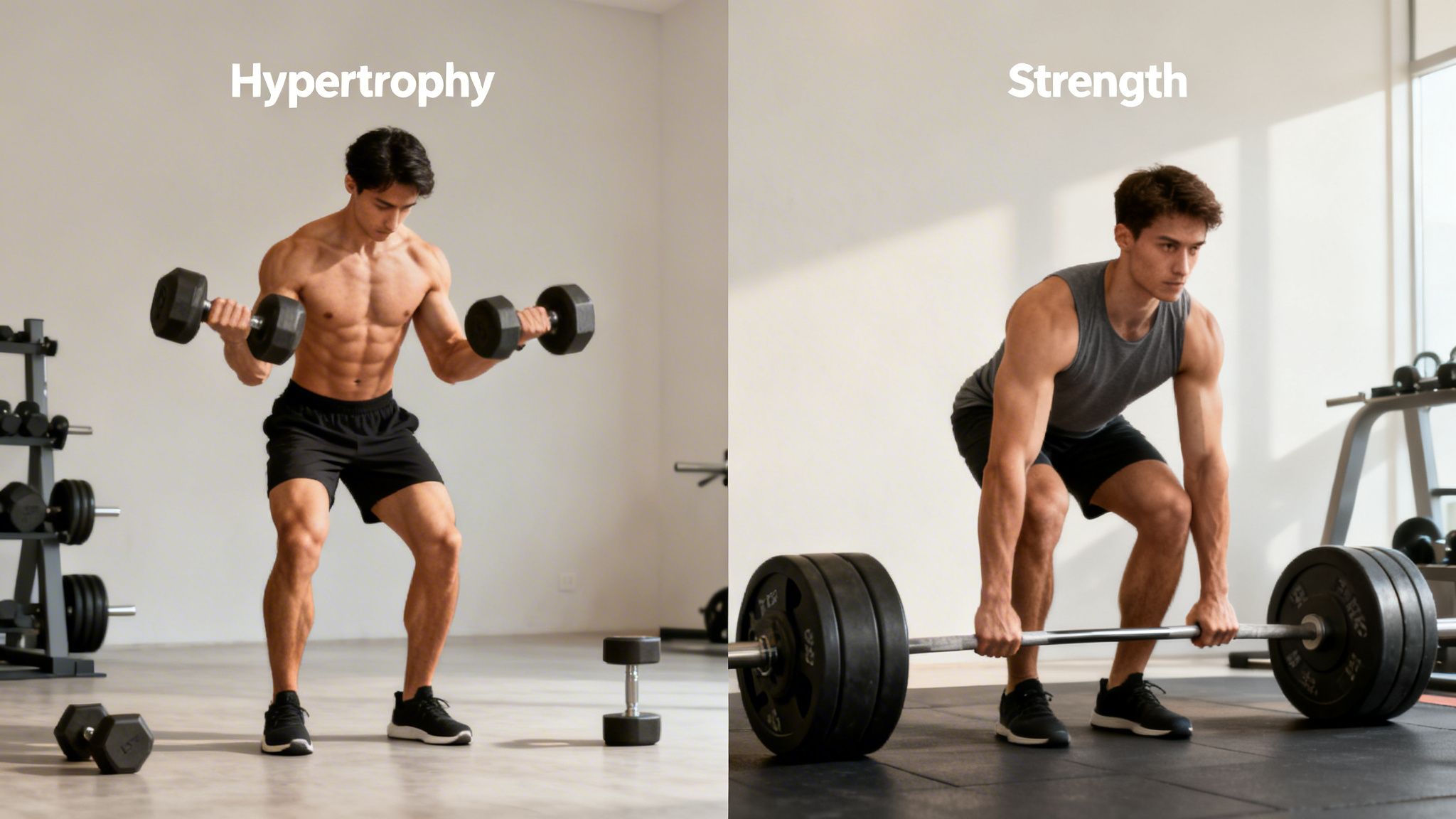
Sure, both styles will make you stronger and build some muscle. You can't separate them completely. But the primary objective dictates everything you do in the gym, from the exercises you pick to how long you rest between sets. One builds the engine, and the other fine-tunes it for pure, raw output.
I like to think of hypertrophy as being an architect. Your job is to build a larger physical structure by stimulating muscle protein synthesis. You achieve this by creating mechanical tension, muscle damage, and metabolic stress, which forces your muscle fibers to repair themselves and grow back thicker and bigger.
Built for progress
Take the guesswork out of training
Get a personalized workout plan built around your goal, equipment and schedule. Train smarter, track every rep and keep moving forward, one workout at a time.






Strength training is more like being an electrician upgrading the building’s wiring. The focus shifts to making your central nervous system (CNS) more efficient. It’s about teaching your brain to recruit more motor units and fire them all at once, letting you tap into more of the muscle you already have to move a seriously heavy load.
Comparing core goals and mechanisms
Getting the "why" behind each approach is what makes it all click. Hypertrophy training is a game of fatigue and volume accumulation—it's that deep muscular burn that signals growth. Strength training is all about improving neural drive and coordination to conquer heavier weights.
Both paths lead to an impressive physique, but they take different physiological routes to get there.
The best lifters don't just pick one and stick with it forever. They understand when to use each. Many advanced athletes periodize their training, cycling between hypertrophy phases to build new muscle tissue and strength phases to teach that new muscle how to produce maximal force. This is where a smart planner like GrabGains can be a game-changer, helping you structure these distinct training blocks into a cohesive, long-term plan.
Here’s a quick side-by-side look at what sets them apart:
| Feature | Hypertrophy Training (Building Size) | Strength Training (Building Power) |
|---|---|---|
| Primary Goal | Maximize muscle cross-sectional area (size) | Maximize neuromuscular force production |
| Main Driver | Metabolic stress and accumulated volume | High-intensity neural stimulation |
| Typical Look | Bodybuilder physique with visible muscle mass | Powerlifter or functional athlete build |
| How It Feels | Muscular burn, fatigue, and the "pump" | Heavy, demanding, CNS-taxing efforts |
At its core, hypertrophy asks, "How can I make this muscle grow bigger?" Strength training asks, "How can I teach this muscle to produce more force?" This fundamental question shapes every decision you make in the gym.
What this means for you
So, which one is for you? The choice between hypertrophy vs. strength training comes down to what you want to accomplish. Is your goal purely aesthetic—building muscle and definition for a certain look? Or is it performance-based, like hitting a new personal record on your squat, bench, or deadlift?
Nailing down this distinction is the single most important step in designing a workout program that actually works for you. Once you have that foundation, we can dive into the nitty-gritty variables—sets, reps, rest, and exercise choice—that bring each training style to life.
The science behind building muscle and gaining power

When you dig into hypertrophy training vs strength training, you find they trigger very different responses in the body. While both will make you stronger and more muscular, they don’t work the same way. Hypertrophy is all about building a bigger engine, while strength training is about fine-tuning the computer that controls it for maximum horsepower.
Think of hypertrophy as a construction project going on inside your muscles. The goal is to make the muscle fibers physically larger. This happens through three main drivers:
- Mechanical Tension: This is the force your muscles experience when you lift. It's the most important signal for growth.
- Muscle Damage: High-volume training creates tiny micro-tears in muscle fibers. Your body responds by repairing them, building them back bigger and tougher than before.
- Metabolic Stress: This is the "pump" you feel from higher-rep sets—that buildup of byproducts like lactate that signals growth pathways.
These factors kickstart muscle protein synthesis, which is just the scientific term for your body using protein to repair and build new muscle tissue.
How muscles grow bigger
Muscle growth isn't a one-size-fits-all deal. There are actually two types of hypertrophy. Knowing the difference helps explain why different training styles create such different results.
First, you have myofibrillar hypertrophy. This is an increase in the size and number of the contractile proteins (actin and myosin) that actually make your muscles contract. This type of growth creates denser muscle that can produce more force. It's primarily triggered by lifting heavy.
The second type is sarcoplasmic hypertrophy. This is an increase in the volume of non-contractile stuff inside the muscle cell, like glycogen, water, and other fluids. This leads to that fuller, more "pumped" look and adds to muscle size without adding much to your one-rep max. Higher-rep, bodybuilding-style training is great for this.
A truly well-rounded physique comes from chasing both. You build dense, strong muscle fibers with heavy lifting, then fill them out with increased cell volume for that powerful, impressive look.
How the body gets stronger
Strength training, on the other hand, is less about building up the muscle tissue itself and more about upgrading your central nervous system (CNS). When you lift heavy, you're not just training your muscles; you're teaching your brain how to fire them more efficiently.
This neural fine-tuning happens in a few key ways:
- Increased Motor Unit Recruitment: Your brain gets better at activating more motor units at once. A motor unit is just a nerve and the muscle fibers it controls. More units firing together means more force.
- Improved Firing Rate: The signals from your brain to your muscles become faster and more powerful, causing a much more forceful contraction.
- Enhanced Synchronization: Your motor units learn to fire in a more coordinated, efficient sequence, maximizing force for a specific lift.
This is why you can get a lot stronger without necessarily getting a lot bigger. Research backs this up. One study found that after a few weeks of resistance training, leg extensor force shot up by 21% on average, while the muscle's actual cross-sectional area only grew by 7%. Some people even gained strength with no size increase at all, proving how much of a role neural efficiency plays in power. You can browse our guide on leg exercises to find great movements for training your lower body.
Ultimately, these neural adaptations let you tap into more of your muscle's existing potential. It's the difference between having a powerful engine and knowing how to redline it for peak performance.
Comparing the key training variables
Knowing the science behind muscle growth is one thing, but actually turning that into a workout that gets results? That's what really matters. The whole hypertrophy vs strength training debate really just boils down to how you set a few key dials in your training.
These variables—intensity, volume, rest periods, frequency, and exercise selection—are what you'll adjust to tell your body whether to focus on building bigger muscles or generating more raw power. Let's dig into how they differ and, more importantly, why those differences create such distinct outcomes.
Intensity how heavy you lift
Intensity, which is just a simple way of saying what percentage of your one-rep max (% of 1RM) you're lifting, is probably the biggest difference between the two styles. It has a direct impact on the kind of stress you put on your muscles and nervous system.
For strength training, the name of the game is lifting as heavy as you possibly can to trigger neural adaptations. This means you need to be working with loads that are 85% or more of your 1RM. Pushing weights in this range essentially trains your central nervous system to fire on all cylinders, recruiting the maximum number of motor units to improve how much force you can produce.
On the other hand, hypertrophy training is all about finding that sweet spot in a more moderate intensity zone, usually somewhere between 65% and 85% of your 1RM. This is just heavy enough to create serious mechanical tension but still light enough that you can crank out the higher reps needed for metabolic stress and muscle-building volume.
Volume sets, reps, and total workload
Volume is the total amount of work you get done, calculated as sets x reps x weight. This is where the two approaches really start to look different, and it affects everything from how tired your muscles get to how long you need to recover.
- Hypertrophy Training: Here, the main goal is to rack up enough volume to kickstart muscle protein synthesis. The classic recipe is 3-5 sets of 6-12 repetitions per exercise. This range gives you the perfect blend of mechanical tension and metabolic stress that muscles need to grow.
- Strength Training: The focus flips from total volume to the quality of each individual lift. Rep ranges are way lower, typically 1-5 reps for 3-6 sets. You’re not trying to chase a pump; you’re trying to move a heavy load with perfect form and maximum force on every single rep.
Rest periods the recovery between sets
How long you chill out between sets isn't just wasted time; it’s a strategic part of the plan. When it comes to training variables, finding the optimal rest between sets for muscle growth can make or break your results.
For hypertrophy, you'll often see shorter rest periods of 30-90 seconds. This strategy prevents full recovery, which dials up the metabolic stress—a key ingredient for sarcoplasmic hypertrophy. That sustained "pump" you feel from shorter rests is a powerful signal for your muscles to get bigger.
For pure strength training, longer rest periods are non-negotiable. Taking a full 2-5 minutes between heavy sets is critical for letting your ATP-PC energy system and your central nervous system completely recharge. If you don't rest long enough, you simply won't be able to generate the explosive force you need for the next heavy set.
Key Takeaway: Hypertrophy training uses incomplete recovery to create a metabolic environment ripe for growth. Strength training demands complete recovery to ensure every set is a maximal effort.
Exercise selection and training frequency
Finally, the exercises you pick and how often you hit the gym also change depending on your main goal.
Strength training programs are almost always built around the "big lifts"—compound movements like the squat, bench press, deadlift, and overhead press. These multi-joint exercises let you move the most weight and have the best carryover to your overall strength. Lifters often train these specific lifts more frequently to practice the skill, but they manage the volume carefully in each session to avoid burnout.
Hypertrophy training, however, embraces a much wider variety of exercises, mixing in both compound and isolation movements. You'll see more machines, dumbbells, and cables used to hit muscles from every possible angle and make sure no muscle group gets left behind. If you're looking for new exercise ideas, the GrabGains app has plenty of options perfect for building muscle. Training is often structured around body-part splits (like a dedicated chest day or leg day) to allow for higher volume on each muscle while giving it plenty of time to recover before the next session.
Here’s a quick table to help you visualize how these variables stack up against each other.
Hypertrophy vs strength training a head-to-head comparison
This table gives you a clear side-by-side look at the core programming differences between training for size and training for power.
| Training Variable | Hypertrophy Training (For Size) | Strength Training (For Power) |
|---|---|---|
| Intensity (% of 1RM) | 65-85% | 85%+ |
| Rep Range | 6-12 reps | 1-5 reps |
| Sets per Exercise | 3-5 sets | 3-6 sets |
| Rest Periods | 30-90 seconds | 2-5 minutes |
| Exercise Selection | Compound & Isolation | Primarily Compound |
As you can see, the path to building muscle and the path to building strength diverge significantly in how you structure your workouts. Neither is better—they're just different tools for different jobs.
How to choose the right training path for your goals
Deciding between hypertrophy and strength training really boils down to one simple question: what do you want to accomplish right now? Once you get past the science, your primary goal is the only compass you need. There’s no "best" path—only the one that gets you where you want to go.
If your goals are mainly aesthetic—you want to build bigger muscles, sharpen your definition, and chase that classic bodybuilding look—then a hypertrophy-focused program is your most direct route. It’s all about maximizing muscle size through targeted volume and metabolic stress.
But if your ambitions are tied to performance, strength training needs to be your priority. This is the path for powerlifters, athletes in sports like football, or anyone who just loves the feeling of hitting a new PR on a major lift. Here, the game is all about maximizing raw force production.
Aligning your training with your ambitions
To make the right call, you have to be honest with yourself about what success looks like. Is it adding an inch to your arms, or is it adding 20 pounds to your squat?
- Choose Hypertrophy if: Your main driver is changing your physique by adding muscle mass. You enjoy the feeling of the "pump" and want to focus on specific muscle groups, like building a bigger chest. You can find some great options in our library of chest movements to start building your routine.
- Choose Strength if: You measure progress by the numbers on the bar. You’re motivated by performance milestones and want to teach your body to move the heaviest weight possible with maximum efficiency.
This chart breaks down the core programming differences at a glance.
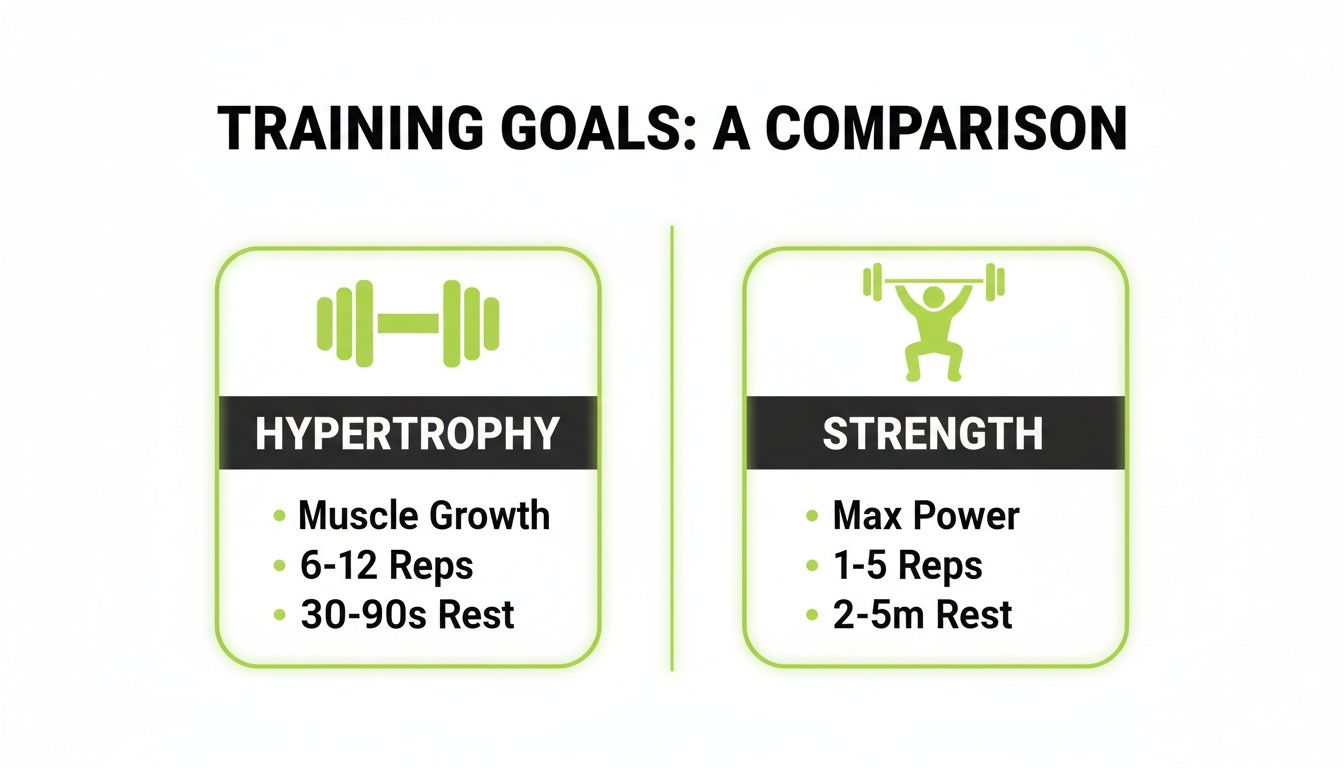
As you can see, hypertrophy training leans on higher reps with shorter rest, while strength training demands low reps and much longer recovery periods to keep power output high.
It’s also crucial to remember you can get stronger without getting significantly bigger. A landmark 2016 study showed that after months of training, participants increased their leg force by an average of 21%, while their quad muscle size only grew by 7%. This proves just how powerful neural adaptations are for strength gains, and why your training focus is so critical.
The power of periodization
The good news? You don’t have to pick one path and stay on it forever. In fact, the most successful lifters never do. They use a strategy called periodization, cycling between different training styles to build well-rounded progress.
Periodization is like building a bigger, more capable engine with hypertrophy, then fine-tuning it for maximum horsepower with a dedicated strength phase. This synergy is the key to long-term, sustainable gains in both size and strength.
A common and effective strategy is block periodization. You might spend 8-12 weeks in a "hypertrophy block," hammering away with higher volume to build new muscle tissue. After that, you could switch to a 6-8 week "strength block," where you drop the volume, crank up the intensity, and teach all that new muscle how to fire on all cylinders.
This approach not only helps you smash through plateaus but also reduces your risk of overuse injuries by constantly changing the stimulus. By planning your training in phases, you guarantee your efforts stay productive and perfectly aligned with your evolving goals.
Integrating both styles with smart programming

The whole hypertrophy training vs strength training debate isn't about picking a side and sticking to it forever. The smartest, most well-rounded athletes know these two styles aren't mutually exclusive—they’re two sides of the same coin. The real magic happens when you blend them: first building a solid foundation of muscle, then teaching that new muscle to produce maximum force.
Instead of getting locked into one method, you can use periodization to get the best of both worlds. This is just a structured way to vary your training over time to keep making progress, bust through plateaus, and avoid burnout. Two of the most proven ways to combine these styles are block periodization and daily undulating periodization (DUP).
Building in phases with block periodization
Block periodization is a classic, battle-tested strategy. You dedicate specific training cycles, or "blocks," to a single goal before moving on to the next. It’s a logical way to build one quality on top of another.
A common approach is to kick things off with a hypertrophy block to pack on size. For 4-8 weeks, your workouts would be all about higher volume and moderate intensity to build new muscle tissue. Once that phase is done, you transition into a strength block.
During the strength block, which might run for another 4-6 weeks, you'll dial back the volume and crank up the intensity. The mission here is to take the new muscle you’ve built and improve its neural efficiency—essentially, teaching it to fire harder and generate more force. If you need help structuring this, a good strength training plan for building serious muscle will often incorporate these principles.
Here’s what a simple three-month cycle might look like:
- Months 1-2 (Hypertrophy Block):
- Focus: Muscle growth and work capacity.
- Intensity: 65-80% of 1RM.
- Volume: 3-5 sets of 8-12 reps.
- Example Split: Chest Day, Back Day, Leg Day, Shoulders/Arms Day.
- Month 3 (Strength Block):
- Focus: Maximal force production.
- Intensity: 85-95% of 1RM.
- Volume: 3-5 sets of 2-5 reps.
- Example Split: Upper Body Strength Day, Lower Body Strength Day.
Mixing it up weekly with daily undulating periodization
Daily Undulating Periodization, or DUP, flips the script. Instead of dedicating long blocks to one goal, DUP has you training for both hypertrophy and strength within the same week. This approach keeps your body guessing and constantly adapting to different stimuli.
For example, on a DUP program, you might squat three times a week, but each day has a different purpose:
- Monday (Hypertrophy): 4 sets of 8-10 reps at a moderate weight.
- Wednesday (Power): 6 sets of 3 reps, focusing on explosive bar speed.
- Friday (Strength): Work up to a heavy top set of 3-5 reps.
This model lets you practice key lifts more often while still hitting the varied stimuli needed for both muscle growth and neural upgrades. It’s a fantastic choice for intermediate and advanced lifters who can handle the recovery. For anyone wanting to take the guesswork out of this kind of programming, a smart workout builder can automate DUP principles based on your goals and progress.
The ultimate goal of smart programming is synergy. Use hypertrophy phases to build a bigger, more capable engine, then use strength phases to tune that engine for maximum horsepower. This cyclical process is the key to unlocking your full potential.
Whether you choose the structured phases of block periodization or the weekly variety of DUP, the lesson is the same. It’s not about which style is "better," but how to intelligently weave both into your long-term plan. Do that, and you'll create a powerful cycle of growth and performance that leads to consistent, sustainable results.
Frequently asked questions
Even after you nail down the programming differences between hypertrophy and strength training, a few common questions always seem to surface. Let’s clear up the confusion so you can build your plan with confidence.
Can I build strength while training for hypertrophy?
Absolutely. You will get significantly stronger when you train for muscle size, especially if you’re a beginner or intermediate. The mechanical tension and progressive overload needed to build muscle are also powerful drivers for strength.
But here's the catch: the strength you build is more of a byproduct than the main event. Your one-rep max won’t shoot up as fast or hit the same peak as it would on a dedicated strength program. Those programs are specifically designed to optimize neural efficiency for maximum force production.
Think of it this way: hypertrophy training builds your strength potential by creating bigger, more capable muscle fibers. A strength phase then teaches those new fibers how to fire together for maximum power.
Which is better for fat loss: hypertrophy or strength?
Both are fantastic for fat loss, and honestly, neither is clearly better than the other. The real secret to fat loss is building and holding onto metabolically active muscle, which cranks up your daily calorie burn. Both training styles are champs at this.
The minor differences are in when you burn the calories.
- Hypertrophy training, with its higher volume and shorter rest, tends to burn more calories during the workout.
- Strength training is so intense that it can create a bigger "afterburn" effect (EPOC), meaning your metabolism stays elevated for hours after you’re done.
Ultimately, the best style is the one you’ll actually stick with. Your top priority for losing fat is always a calorie deficit, and a solid lifting program—either style—is the best way to make sure the weight you lose comes from fat, not precious muscle.
How do I know when to switch training phases?
Listen to your body—plateaus are its way of telling you it's time for a change. If you've been grinding out a hypertrophy phase for 8-12 weeks and your growth has stalled or you're just feeling bored, that's the perfect signal to switch things up.
Moving into a strength phase can smash through that plateau by hitting your body with a new kind of stress: heavy loads and intense neural demands. This can even re-sensitize your muscles to volume, making your next hypertrophy block more effective.
On the flip side, if you’ve just wrapped up a tough strength cycle and your joints are screaming from the constant heavy lifting, shifting to a higher-rep hypertrophy block is a smart move. It gives your body a form of active recovery while you keep building valuable muscle. Your progress log and how you feel are your best guides.
Do I need different nutrition for each training style?
The fundamentals, especially high protein, don't change. But you'll want to tweak your calories slightly to match your main goal.
For a dedicated hypertrophy phase, a small but consistent calorie surplus is key. This gives your body the extra energy and raw materials it needs to build new muscle tissue without adding unnecessary fat.
For a pure strength phase, your calories are more about fueling brutal sessions and driving recovery. A big surplus isn't required. Eating at maintenance or just slightly above is usually enough to support strength gains.
No matter which style you’re following, a high protein intake of around 1.6-2.2 grams per kilogram of body weight is non-negotiable for both. This ensures your muscles have the building blocks they need to repair and grow stronger.
Ready to stop guessing and seamlessly blend both hypertrophy and strength into your routine? GrabGains creates genuinely personal workout plans that adapt to your goals and performance, keeping you on the fastest path to results. Download GrabGains on iOS or Android today and start training smarter.
Get inspired and motivated