What actually causes muscle growth?
Our complete guide to muscle growth explained. We break down the science of hypertrophy, training, nutrition, and recovery to help you build real strength. Muscle growth, known in the science world as hypertrophy, isn't complicated. It all boils down to one simple idea: you have to challenge your muscles beyond what they’re used to. This stress creates tiny, microscopic tears in the muscle fibers. Your body then goes to work, not just repairing the damage but rebuilding the muscle bigger and stronger than before. This cycle is the absolute bedrock of getting stronger.


The three triggers for building muscle
So, what does "challenging your muscles" actually mean? When we break it down, there are really three core physiological triggers that tell your body it's time to build new muscle. Think of them as the secret ingredients in the recipe for growth.
You don’t need a biology degree to get this. These three triggers are the "why" behind every effective workout you'll ever do, from a heavy, grinding squat to that deep burn you feel at the end of a high-rep set of curls.
What actually drives growth
At its core, your body is an adaptation machine. It doesn’t build muscle just for the sake of it; it builds muscle to better handle the stress you throw at it. That's why just showing up to the gym and going through the motions isn't enough. You have to consistently give your body a reason to change.
Built for progress
Take the guesswork out of training
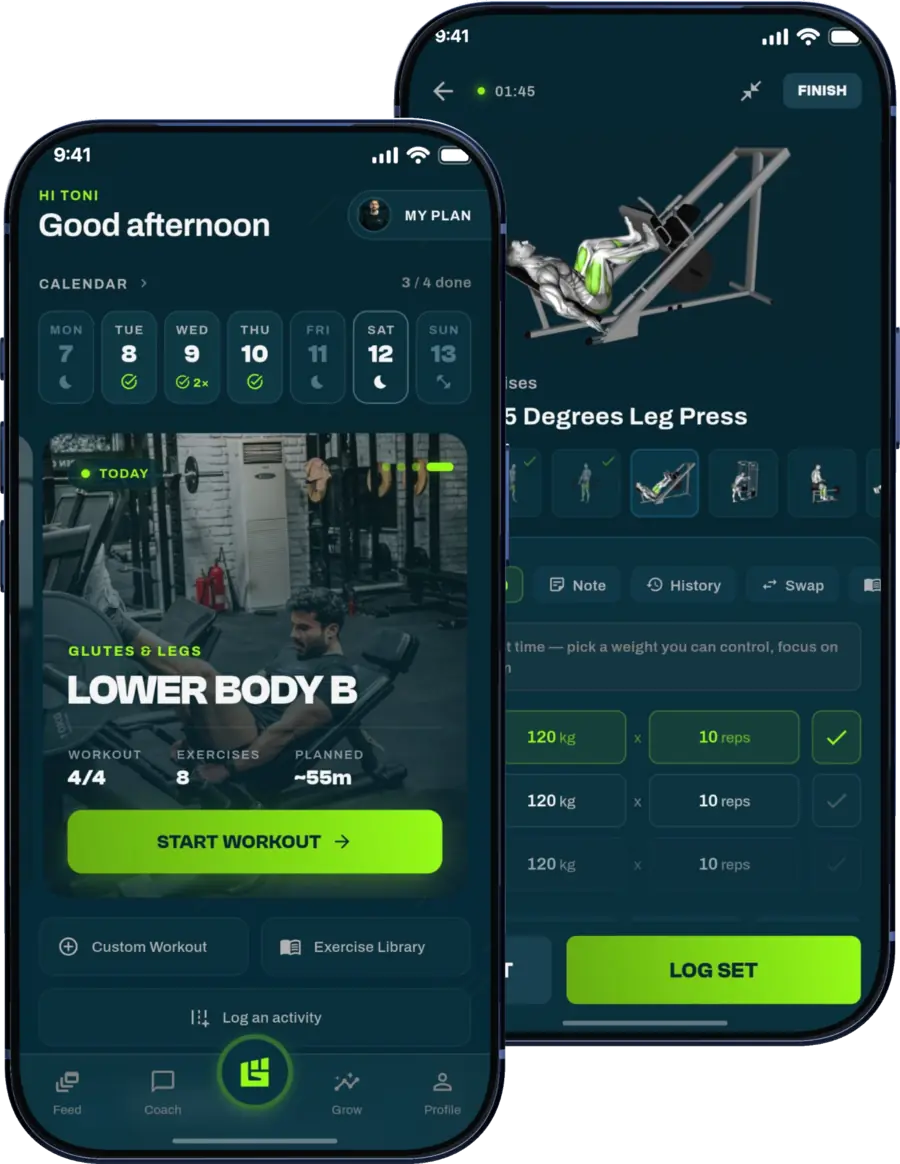
Get a personalized workout plan built around your goal, equipment and schedule. Train smarter, track every rep and keep moving forward, one workout at a time.






That "reason" comes in three distinct flavors:
- Mechanical Tension: This is the force your muscles generate when you lift a challenging weight through its full range of motion. It’s the single most important driver of growth, signaling to your body that it needs to get stronger to handle similar loads in the future. A heavy deadlift or a tough set of bench presses is a perfect example of maximizing mechanical tension.
- Metabolic Stress: You know that deep "burn" or "pump" you feel during high-rep sets with short rest? That’s metabolic stress. It’s caused by the buildup of byproducts like lactate inside the muscle, which signals growth through a completely different pathway.
- Muscle Damage: This refers to those microscopic tears in muscle fibers that happen during intense training. This damage kicks off an inflammatory response, activating special satellite cells that rush in to repair the muscle, making it bigger and more resilient in the process.
While these triggers are the key, the surprising truth is that most people aren't stimulating them nearly enough. Did you know that only about 28.3% of men and 20.4% of women in the U.S. meet the federal guidelines for both aerobic and muscle-strengthening activities? That highlights a massive opportunity for growth that millions of people are missing out on.
To better understand the fundamentals, this guide on how to build muscle offers a great overview. And if you want to see how these principles apply to specific body parts, our complete guide to leg exercises can show you how to put them into practice.
The three pillars of muscle growth
This table breaks down the three primary mechanisms of hypertrophy—what they feel like and how to trigger them in your workouts.
| Mechanism | What It Feels Like | How to Achieve It |
|---|---|---|
| Mechanical Tension | The strain of moving a heavy weight through a full range of motion. | Lifting heavy (6-10 reps), focusing on compound exercises like squats and presses. |
| Metabolic Stress | The "pump" or "burn" from high-rep sets with minimal rest. | Higher rep ranges (12-20 reps) with short rest periods (30-60 seconds). |
| Muscle Damage | Soreness felt 24-48 hours after a tough workout (DOMS). | Emphasizing the eccentric (lowering) phase of a lift and trying new exercises. |
By understanding and applying these three pillars, you can move beyond just "working out" and start training with purpose, ensuring every set you perform is directly contributing to your muscle-building goals.
Your practical guide to training variables
Knowing the science behind muscle growth is one thing, but actually putting it into practice in the gym is what builds a stronger physique. This is where your training variables come in. Think of them as the dials you turn in your workouts to give your muscles the right challenge they need to adapt and grow.
But before we touch any of those dials, we need to talk about the single most important rule of getting bigger and stronger: progressive overload.
Imagine it like leveling up in a video game. You can't beat the next boss with the same old gear. You need to upgrade. Your muscles work the same way. If you lift the exact same weight for the exact same reps every single week, your body has absolutely no reason to change. To force growth, you have to consistently increase the demand you place on your muscles over time.
Progressive overload isn't just a good idea—it's the non-negotiable foundation of all long-term muscle growth.
The training variables we're about to cover are simply the tools you'll use to apply this principle and trigger the key drivers of hypertrophy.

As you can see, your training needs to create mechanical tension, metabolic stress, and a bit of muscle damage to signal your body that it’s time to build. Let’s look at how to do that.
Training volume: how much you train
Volume is the total amount of work you do, usually calculated as sets x reps x weight. It’s one of the most powerful dials for sparking muscle growth. When you're new to lifting, just about any structured plan will be enough to get you growing. But as you get more experienced, managing your volume becomes absolutely critical.
After the initial "newbie gains" phase, where your progress is rapid, just lifting heavy isn't enough. You have to get smarter. Research consistently shows that performing 10-20 weekly sets per muscle group is the sweet spot for maximizing growth for most people. Studies confirm this range significantly outperforms lower-volume approaches, especially for intermediate and advanced lifters. You can dive into the full research on training volume and hypertrophy to see the data for yourself.
Key Takeaway: While more isn't automatically better, there's a clear dose-response relationship here. Aiming for that 10-20 weekly set range per muscle is a proven starting point for consistent, long-term gains.
Training intensity: how heavy you lift
Intensity isn't just about hoisting the heaviest weight you can find. It's more about how close you are to your maximum capacity on any given set. You can measure this as a percentage of your one-rep max (1RM), but a more practical way is to think about how many reps you have left "in the tank" when you finish a set.
Here's the good news: you don’t have to lift super heavy all the time to grow. Research shows that muscle growth is surprisingly similar whether you’re working in lower rep ranges (like 5-8 reps) or higher ones (like 15-20 reps), as long as you take your sets close to failure.
This gives you a ton of flexibility. You can build muscle using a variety of rep schemes, which is great for keeping your training interesting, managing fatigue, and giving your joints a break. A smart approach is to include a mix of both heavier and lighter work in your program.
Frequency and exercise selection
The final pieces of the puzzle are frequency and exercise selection—how often you hit a muscle and which movements you choose to do it.
- Frequency: This is simply how many times you train a muscle group each week. For most people, spreading your weekly volume across two or three sessions is far more effective than trying to cram it all into one marathon workout. For example, doing 6 sets for your chest on Monday and another 6 sets on Thursday will almost always beat doing 12 sets all at once.
- Exercise Selection: This is all about picking the right tools for the job. Big, compound movements like squats, deadlifts, and bench presses are incredibly efficient because they hit multiple muscles at the same time. On the other hand, isolation exercises like bicep curls or leg extensions are perfect for bringing up specific, lagging body parts.
A well-rounded program will have a smart mix of both. Putting it all together can feel complex, but using a smart workout builder can help you combine these variables effectively, ensuring your program is balanced and perfectly aligned with your goals. By intelligently tweaking these four variables, you create the ideal environment for progressive overload, making sure your body is always adapting, growing, and getting stronger.
The art of training close to failure
Intensity isn't just about how much weight is on the bar; it's about the effort you pour into each set. If you really want to trigger muscle growth, the science is clear: you have to push your muscles near their limits. But this is where most people get it wrong. They think this means grinding out every single set to absolute, screaming failure.
There's a much smarter way to train.
Purposeful lifting means finding that sweet spot where you challenge your muscles just enough to signal growth, but not so much that you obliterate your ability to recover. Think of your energy for the week as a fuel tank. Going to total failure on every set is like redlining the engine until it sputters and dies. Sure, you get there, but it’s wildly inefficient and you’ll burn out fast.

A more sustainable—and ultimately more effective—approach is to train close to failure, stopping just a rep or two short. This gives your body that critical growth signal without the crippling fatigue that tanks your next workout.
Understanding reps in reserve
So how do you measure this effort in a practical way? We use a simple tool called Reps in Reserve, or RIR. It’s just an honest assessment of how many more good-form reps you could have done at the end of a set if you had pushed to your absolute limit.
For instance, if you finish a set of squats and you know, with good technique, you could have squeezed out two more reps, you just trained at an RIR of 2. If you only had one more rep left in you, that's RIR 1. It’s your personal, in-the-moment gauge of how hard you’re working.
Reps in Reserve (RIR) Scale:
- RIR 0: Absolute failure. Couldn't complete another rep.
- RIR 1: You had exactly one more good rep in the tank.
- RIR 2: You had two more good reps left.
- RIR 3-4: You had three to four more reps left; a moderate effort.
Finding your hypertrophy sweet spot
So, how close to failure do you really need to be? The evidence points to a clear range: training with an RIR of 0-4 is where the magic happens for muscle growth. Pushing into this zone ensures you've recruited the maximum number of muscle fibers, a powerful trigger for hypertrophy.
Recent research has cemented this idea. A meta-analysis found a direct, linear relationship: the closer lifters trained to failure (a lower RIR), the more muscle they built. This was true for both heavy and lighter loads, proving that genuine effort is a primary driver of growth. Check out the research on training proximity to failure and muscle growth for a deeper dive.
The takeaway is simple. You don't need to hit RIR 0 on every set to grow. Consistently working in that 1-3 RIR range for most of your main lifts will deliver phenomenal results without burning you out.
Applying RIR to your training
Not all exercises are created equal when it comes to pushing the limit. Applying RIR intelligently is key to staying safe and managing fatigue. A good rule of thumb is to adjust your target RIR based on the exercise.
- Compound Lifts (Squats, Deadlifts, Bench Press): These movements are systemically taxing. Pushing them to absolute failure is a recipe for burnout. It’s smarter to leave 2-3 reps in reserve on most sets to maintain crisp form and manage fatigue. You can find plenty of chest exercises on GrabGains where this strategy is both safe and effective.
- Isolation Lifts (Bicep Curls, Leg Extensions): These are far less demanding on your central nervous system, making them safer to push harder. Training at an RIR of 0-1 on these movements can provide a potent muscle-building stimulus with very little downside.
Using RIR as your guide allows you to autoregulate the intensity of every set. You can train hard enough to stimulate growth while listening to your body, ensuring you come back stronger for the next session.
How to fuel and recover for real gains
Lifting weights is only half the battle. Your work in the gym is the spark, but the real fire of muscle growth is fueled during the other 23 hours of the day. Training breaks down muscle tissue; proper nutrition and recovery are what rebuild it bigger and stronger than before.
Think of it like this: your body is a construction site. The workout is the demolition crew, clearing the way for a new, stronger structure. But without building materials (food) and a dedicated crew working the night shift (sleep), nothing new gets built. This is where the real magic happens.

Why calories are king for building muscle
To build new muscle tissue, your body needs energy—and that energy comes from calories. You simply cannot build something from nothing. This is why a modest calorie surplus—eating slightly more than your body burns—is so crucial for maximizing muscle growth.
This surplus provides the raw energy needed for muscle protein synthesis, the demanding process where your body repairs damaged fibers and adds new ones. A small surplus of 250-500 calories above your maintenance level is the sweet spot. It's enough to support muscle gain while keeping unwanted fat storage to a minimum.
Protein: the master building block
If calories are the energy for your construction crew, protein is the bricks and mortar. Protein is made of amino acids, the literal building blocks of muscle. When you eat protein, your body breaks it down and uses those amino acids to repair the muscles you stressed during your workout.
For anyone serious about building muscle, a higher protein intake is non-negotiable. The evidence is clear on what it takes to maximize hypertrophy.
The scientific consensus suggests a daily protein intake of 1.6 to 2.2 grams per kilogram of body weight (or about 0.7 to 1.0 grams per pound) is ideal for fueling muscle repair and growth.
Hitting this target ensures your body always has the materials on hand to capitalize on your hard training. For a 180-pound person, that’s about 126-180 grams of protein per day. Spreading this across 3-5 meals helps keep muscle protein synthesis humming all day long. This is especially important when you’re doing demanding compound movements, like the ones in our guide to the best back exercises.
Sleep: the ultimate recovery tool
You can eat perfectly and train like an animal, but if you neglect sleep, you're just spinning your wheels. Sleep is arguably the most powerful and underrated tool for muscle recovery and growth. During deep sleep, your body enters a peak anabolic, or muscle-building, state.
This is when the most important work gets done:
- Growth Hormone Release: Your body releases a significant amount of Human Growth Hormone (HGH), which plays a direct role in repairing tissue and promoting growth.
- Muscle Protein Synthesis: The rate at which your body builds new protein peaks during sleep, turning the amino acids you ate into new muscle.
- Cortisol Reduction: Quality sleep helps lower levels of cortisol, a stress hormone that can break down muscle tissue.
Aiming for 7-9 hours of quality sleep per night isn't a luxury; it's a fundamental requirement. Beyond nutrition, leveraging the right equipment can also make a big difference. Check out this guide to the best muscle recovery tools to speed up healing and improve performance for even more ways to optimize your downtime.
Putting your knowledge into practice with technology
Understanding the science of muscle growth—from progressive overload to proper fueling—is one thing. Actually putting it all together, week after week, is a completely different challenge. This is where the theory hits the gym floor, and it’s where most people get stuck in a cycle of guesswork and frustration.
The good news is that you don’t have to manage it all on your own. Smart tools can take the complex science we've talked about and turn it into simple, actionable steps. Instead of juggling spreadsheets or wondering what to do next, you can let technology do the heavy lifting, making sure every workout is optimized for growth.
Automating your progress
Progressive overload is the single most important driver of long-term muscle growth. It’s all about making your workouts a little bit harder over time. But knowing exactly how to progress can feel like a moving target. Should you add more weight? More reps? Another set? This is where an intelligent system makes all the difference.
Apps like GrabGains are built to automate this entire process. An adaptive planning system looks at your performance in every session—how much you lifted, how many reps you hit, and how hard it felt—and then adjusts your next workout for you.
- Hit your rep targets easily? The system will probably bump up the weight a little for that exercise next time.
- Struggled with a certain lift? It might keep the weight the same but suggest focusing on clean form.
This simple feedback loop removes all the guesswork. It keeps you training right at the edge of your current ability, which is the sweet spot where muscle growth happens.
Simplifying nutrition and intensity
Beyond just planning your lifts, technology can streamline the other crucial parts of the equation. Manually calculating your one-rep max (1RM) to figure out training intensities, or trying to dial in your daily calorie and protein targets, can feel like a full-time job.
Modern fitness apps bundle these tools together so you can track everything effortlessly:
- 1RM and Macro Calculators: Get an instant estimate of your one-rep max for key lifts, allowing you to program your training percentages correctly. A macro calculator can give you precise daily targets for protein, carbs, and fats based on your body and goals.
- Visual Progress Tracking: Nothing keeps you motivated like seeing clear proof that you're getting stronger. Tools that log your lifts and plot your strength gains on a graph give you tangible feedback that your hard work is paying off.
When you combine intelligent workout planning with easy-to-use nutrition tools, you create a complete ecosystem for growth. It ensures both your training and your recovery are perfectly aligned with your goals.
Perfecting your form with guided exercises
At the end of the day, even the most perfect program won't work if your exercise technique is off. Bad form not only puts you at risk for injury but also means you aren't hitting the muscles you’re trying to grow. This is especially true for big, complex movements.
This is another area where having the right tool is a massive advantage. Access to a full exercise library with high-quality video guides is like having a personal trainer in your pocket. You can see exactly how a movement should look, with clear instructions on setup, execution, and common mistakes to watch out for.
With a library of video-guided exercises, platforms like GrabGains make expert-level instruction accessible to everyone, ensuring every single rep is safe, effective, and moving you closer to your goal. To see how all these features work together, you can discover the GrabGains app and its suite of tools.
Answering your top questions about muscle growth
We've covered the science of how muscle growth works—it's a dance between stressing the muscle and letting it recover. But let's be honest, the fitness world is flooded with information, and it's easy to get lost in conflicting advice and old-school myths.
Let's cut through the noise and tackle the questions that come up time and time again.
How long does it realistically take to build noticeable muscle?
This is the big one, isn't it? Everyone wants to know the timeline. The answer really depends on where you're starting from.
If you're brand new to lifting, you'll likely experience a rush of strength gains in the first 4-8 weeks. These are the famous "newbie gains," but they're not all new muscle tissue. A lot of that initial progress is your brain and nervous system simply getting more efficient at activating the muscles you already have.
Real, measurable muscle growth is a much slower burn. After that initial phase, a natural lifter who is training hard and eating right can realistically expect to gain about 0.5 to 1.0 pounds of muscle per month. That rate will naturally slow down the more experienced you get. The truth is, building a physique is a marathon, not a sprint. You'll feel stronger pretty quickly, but seeing significant changes in the mirror often takes 6-12 months of consistent effort.
Do I need protein immediately after my workout?
You've seen it a thousand times: the guy sprinting from the squat rack to his locker to slam a protein shake, terrified of missing the "anabolic window." This idea—that you have a magical 30-minute window to consume protein or your workout was wasted—is one of the most persistent myths in fitness.
While post-workout nutrition is definitely a good idea, that window is much wider than we used to think. Modern research makes it clear that your total daily protein intake is what truly matters. As long as you’re consistently hitting your goal—somewhere around 1.6 to 2.2 grams per kilogram of body weight—the precise timing becomes far less critical.
So, should you have protein after you train? Yes. A protein-rich meal within a few hours of your workout is a great way to kickstart the muscle repair process. But there’s no need to panic and down a shake the second you drop your last dumbbell.
Can I build muscle with just bodyweight exercises?
Absolutely. Your muscles don't know the difference between a dumbbell and your own body. All they respond to is tension and resistance. The key to growth, as we've discussed, is progressive overload—the principle of making your workouts more challenging over time. You can apply this just as effectively with bodyweight training.
You can’t just do the same 20 push-ups every day and expect to grow forever. You have to get creative and increase the demand.
Here’s how you can apply progressive overload without any weights:
- Add Reps and Sets: The simplest way. If you did 3 sets of 10 push-ups last week, aim for 3 sets of 11 this week.
- Change the Angle: Make an exercise harder by shifting your weight. Elevate your feet on a chair for decline push-ups to hit your upper chest and shoulders more.
- Slow Down the Tempo: Try lowering yourself down in a squat over 3-4 seconds. This increases time under tension, a powerful trigger for muscle growth.
- Shorten Your Rest: Cut your rest periods between sets from 60 seconds to 45. Your muscles will have to work harder with less recovery.
Is muscle soreness a good sign of an effective workout?
This is probably one of the most misleading ideas in fitness. We’ve all been taught to chase that next-day soreness, thinking it means we had a killer workout. But muscle soreness, or DOMS (Delayed Onset Muscle Soreness), is not a reliable indicator of muscle growth.
Soreness just means you’ve introduced a new type of stress that your body isn’t used to, causing some micro-damage and inflammation. You can have an incredible, growth-promoting workout and feel almost no soreness. On the flip side, you could do something completely new with terrible form, feel crippled for three days, and not have stimulated any meaningful growth at all.
Don't chase soreness; chase progress. The real proof of a good program is in the numbers. Are you lifting more weight? Doing more reps with good form? Those are the signs that you’re actually getting stronger and building muscle.
Focus on measurable improvements, not on how much you ache the next day.
Ready to stop guessing and start building? GrabGains takes the complex science of muscle growth and turns it into a simple, actionable plan that adapts with you. Let our app handle the programming so you can focus on lifting. Start your journey with GrabGains today.
Get inspired and motivated