PPL vs Upper Lower: Which split Is best for your goals?
Choosing between PPL vs Upper Lower training splits? Our 2026 guide analyzes the science behind each to help you select the ideal routine for muscle growth. When it comes to the PPL vs Upper Lower debate, the deciding factors are almost always your schedule and how well you recover. Think of it like this: a Push/Pull/Legs (PPL) split is built for the person who can hit the gym 5-6 days a week. It gives you shorter, more focused workouts. On the other hand, an Upper/Lower split is a lifesaver for anyone on a tight schedule, fitting perfectly into 4 training days while still delivering great results.
Choosing your ideal split: ppl vs upper lower
Picking a training split can feel like a huge commitment, but let's clear the air: both Push/Pull/Legs and Upper/Lower are fantastic for building muscle and strength. There is no single "best" routine—only the one that clicks with your lifestyle, goals, and recovery capacity.
The right choice really boils down to how you answer a few simple questions:
- How many days a week can you realistically get to the gym?
- Do you prefer shorter, more frequent sessions or longer, less frequent ones?
- How quickly does your body bounce back between tough workouts?
This guide will cut through the noise and put these two powerhouse splits head-to-head. We will dig into the details that actually matter, from training frequency and volume to recovery demands and how each split fits into a busy life.
Built for progress
Take the guesswork out of training
Get a personalized workout plan built around your goal, equipment and schedule. Train smarter, track every rep and keep moving forward, one workout at a time.






At a glance ppl vs upper lower comparison
Before we dive deep, let's start with a bird's-eye view of how these splits compare. The table below gives you a quick snapshot of their core differences. Think of this as your framework for the more detailed breakdown that follows—it’s the first step to figuring out which routine is right for you.
| Attribute | Push/Pull/Legs (PPL) | Upper/Lower |
|---|---|---|
| Primary Structure | Divides workouts by movement: upper body pushing, upper body pulling, and all leg exercises. | Splits training into two types of days: one for the entire upper body and one for the entire lower body. |
| Typical Frequency | Best for 5-6 training days per week to hit each muscle group twice. A 3-day split is an option, but not ideal for growth. | Perfect for 4 training days per week, hitting each muscle group twice with plenty of recovery built-in. |
| Session Focus | Highly specialized. Each workout hammers a small, specific group of muscles (e.g., chest, shoulders, triceps). | Broader focus. You’ll train all major upper or lower body muscles in a single session, requiring more exercises per day. |
| Best For | Lifters with more time who like shorter, focused workouts and can handle training almost every day. | Individuals training 4 days a week who want a balanced and efficient way to manage volume and recovery. |
Seeing them side-by-side like this makes it clear that your schedule is the biggest factor. Now, let’s get into the specifics of how to program each one.
Deconstructing the ppl and upper/lower structures

Before you can pick a side in the PPL vs Upper/Lower debate, you need to get a feel for how each split actually works. They are built on two totally different philosophies for organizing your training week, each with its own unique rhythm.
Let’s pull them apart to see what a week of training really looks like for both.
The PPL split carves up your training days by movement pattern: pushing, pulling, or working your legs. It’s a smart, logical setup that keeps the overlap between workouts to a minimum, which is a massive win for recovery.
The Upper/Lower split, on the other hand, is all about anatomy. You're either hitting every muscle from the waist up or every muscle from the waist down. It is dead simple and guarantees your whole body gets attention over just two distinct sessions.
The anatomy of a ppl split
A Push/Pull/Legs routine divides your body across three highly focused workouts. This lets you pour all your energy into one specific group of muscles at a time. The real beauty of PPL is how the muscles worked on each day naturally complement one another.
- Push Day: This workout hits all the upper-body "pushing" muscles. We're talking chest, shoulders, and triceps.
- Pull Day: Next, you train the opposing upper-body muscles used for pulling motions. This means you're working the back and biceps. For a closer look at killer back movements, check out our comprehensive guide on back training.
- Leg Day: Just like it sounds, this one is all about the lower body. You'll target the quadriceps, hamstrings, glutes, and calves.
To maximize muscle growth, a lot of people run the PPL cycle twice a week, which makes for a 6-day training schedule.
Example 6-Day PPL Schedule
- Monday: Push
- Tuesday: Pull
- Wednesday: Legs
- Thursday: Rest
- Friday: Push
- Saturday: Pull
- Sunday: Legs
Of course, you can always tweak this, maybe by adding a rest day after the first three-day block (PPL, Rest, PPL, Rest).
The simplicity of an upper/lower split
The Upper/Lower split gets a lot of love for its straightforward efficiency. By splitting the body into just two workout types, it’s a fantastic option for anyone who wants a balanced routine without living in the gym.
This split is a classic for a reason. By grouping all upper body muscles together, you create a powerful stimulus for growth across your chest, back, shoulders, and arms in a single, efficient session.
Typically, you'll hit each workout twice a week, creating a clean 4-day schedule. This setup strikes a perfect balance between training hard and recovering properly, giving you three built-in rest days.
Example 4-Day Upper/Lower Schedule
- Monday: Upper
- Tuesday: Lower
- Wednesday: Rest
- Thursday: Upper
- Friday: Lower
- Saturday: Rest
- Sunday: Rest
With this foundation, we can start digging into the details. How each split handles things like training frequency and volume is what really sets them apart, and that's exactly where we're headed next.
Analyzing training frequency and volume for hypertrophy
When you get into the weeds of PPL vs. Upper/Lower, the conversation always comes back to two things that really drive muscle growth: training frequency and training volume. These variables dictate how much stress your muscles get and how often they get it, which directly shapes your results. Both splits work, no doubt, but they go about managing these factors in completely different ways.
On the surface, a 6-day PPL and a 4-day Upper/Lower program look pretty similar in one key respect: they both let you train each major muscle group twice per week. Hitting that frequency is widely seen as the sweet spot for keeping muscle protein synthesis elevated, which is just the scientific way of saying your body is constantly repairing and rebuilding muscle fibers to be bigger and stronger.
But hitting a muscle twice a week is only half the battle. The real difference between these splits is how they slice up the training volume within those sessions.
Volume per session: the core difference
Training volume—usually thought of as sets x reps x weight—is arguably the biggest lever you can pull for hypertrophy. This is where PPL and Upper/Lower really go their separate ways.
A PPL routine breaks down your total weekly volume into shorter, more concentrated workouts. On a push day, for example, your entire focus is locked in on your chest, shoulders, and triceps. This lets you bring a ton of intensity to a few muscle groups without the session dragging on forever.
On the other hand, an Upper/Lower split crams a lot more into each workout. An upper body day means training your chest, back, shoulders, biceps, and triceps all in one go. That’s a lot of ground to cover, and those sessions can become a real mental and physical grind.
The central trade-off is clear: PPL gives you shorter, more focused daily workouts but demands more days in the gym. Upper/Lower offers more rest days but requires longer, more taxing training sessions.
A practical scenario: building bigger shoulders
Let's make this real. Imagine a lifter whose main goal is to build bigger, more rounded shoulders. How would each split serve that goal?
With a PPL split, they could hammer heavy overhead presses and lateral raises on both of their push days. Since those workouts are shorter, they can maintain high intensity and really dial in their form without feeling gassed from training other big muscles.
- Push Day 1: Barbell Overhead Press (4 sets x 6-8 reps), Dumbbell Lateral Raises (3 sets x 12-15 reps)
- Push Day 2: Seated Dumbbell Press (4 sets x 8-10 reps), Cable Lateral Raises (4 sets x 15-20 reps)
With an Upper/Lower split, they'd still hit shoulders twice a week. The catch? Those shoulder exercises are tacked onto a much larger workout that also includes heavy chest and back work. This could easily compromise the energy they can dedicate solely to their delts.
- Upper Day 1: Barbell Bench Press, Barbell Rows, then Seated Dumbbell Press (3 sets x 8-10 reps)
- Upper Day 2: Pull-Ups, Incline Dumbbell Press, then Dumbbell Lateral Raises (4 sets x 12-15 reps)
In this case, the PPL split allows for more specialized shoulder volume and focus. The Upper/Lower split forces the lifter to juggle shoulder work with other priorities in the same session. Neither is wrong, but the better choice comes down to your primary goals and how you manage your energy. You can even check out our guide on building impressive chest muscles to pair with your shoulder development.
Efficiency and optimal gains
When it comes to pure efficiency, the numbers are interesting. A 4-day Upper/Lower split scores a solid 8.4 out of 10 for hypertrophy potential. It delivers about 85% of the gains of a top-tier split while demanding 30% less time in the gym. This makes it an incredibly effective choice for people trying to get great results without living in the gym. If you're into the science behind it, reading up on strategies for increasing lean muscle mass can offer some great context.
A 6-day PPL routine scores even higher at 9.7, but that comes with a near-daily commitment. The lesson here is that while both splits can build an impressive physique, the "best" one is always the one you can stick to. For a lot of people, the time-efficient nature of an Upper/Lower split makes it the more sustainable—and therefore more effective—choice for the long haul.
Which split aligns with your lifestyle and goals?
Deciding between a PPL and an Upper/Lower split isn't just about training science—it's about finding a rhythm that actually fits your life. The most "optimal" program on paper is useless if you cannot stick to it. So, instead of a generic pros and cons list, let's walk through a few real-world scenarios to see which split makes sense for different people.
This decision tree can help you quickly match your training availability and main goal—muscle growth—to the most logical split.

The infographic gets straight to the point: your schedule is the first filter. How many days can you realistically get to the gym?
The time-crunched professional
Let's imagine Alex, who works a demanding 50-hour week. Squeezing in gym time is a constant battle, and a six-day training week is completely off the table. Alex can commit to four solid workouts per week without burning out or sacrificing work and family.
For someone like Alex, the Upper/Lower split is the clear winner. It’s practically built for a four-day schedule, letting Alex hit every muscle group twice a week—the sweet spot for growth—while still getting three full days of recovery.
An Upper/Lower split delivers maximum efficiency when you have limited days. It condenses your training into powerful sessions without demanding a near-daily commitment to the gym.
Trying to cram a PPL routine into a four-day schedule just doesn't work as well. You’d only hit each muscle group roughly once every five days, which is not ideal for consistent progress. The Upper/Lower split, on the other hand, aligns perfectly with a busy life.
The aspiring bodybuilder
Now, think about Jamie. Jamie is a dedicated lifter focused on one thing: maximizing muscle growth. Training is a priority, and Jamie has the flexibility and recovery dialed in to hit the gym five to six days a week. The goal is simple: pack on as much quality training volume as possible.
For Jamie, the PPL split is the superior choice. A six-day routine allows for two Push, two Pull, and two Leg days each week. This high-frequency setup lets Jamie spread out training volume across more sessions, which unlocks a few key advantages:
- Shorter, More Focused Workouts: Each session hammers specific muscle groups, allowing for max intensity without the fatigue of a longer, more draining workout.
- Higher Quality Volume: By dedicating entire workouts to smaller muscle groups, every set and rep gets better focus and a stronger mind-muscle connection.
- Better Recovery Between Sessions: A "Push" day doesn't tax the back or biceps, so those "Pull" muscles get a full 48 hours to recover before being hit again.
This structure is perfect for an advanced lifter who needs to handle the high volume required for serious hypertrophy. If you're focusing on bringing up your legs, check out our guide on the best leg exercises to build size and strength.
The novice lifter
Finally, let’s look at Chris, who is just getting started with strength training. The main goals here are learning proper form on the big lifts, building a solid strength base, and creating a consistent habit without feeling overwhelmed.
For a beginner, the Upper/Lower split is the more practical starting point. Its simple four-day structure is far less intimidating than a six-day PPL schedule. It’s a manageable commitment that provides plenty of time for recovery, which is critical when your body is still adapting to the stress of lifting.
The Upper/Lower split also lets a novice practice key compound movements like squats, bench presses, and rows twice per week. This frequency is fantastic for mastering technique and building a strong foundation. While a PPL split isn't wrong for a beginner, its higher frequency can feel like a huge barrier to entry for someone just trying to get their footing.
Building and progressing your chosen workout routine
Okay, you’ve picked your side in the PPL vs Upper/Lower debate. Now comes the fun part: turning that plan into actual muscle. Having a template is great, but real, long-term progress comes from knowing how to push yourself week after week.
But before we get into the templates, remember that none of this works if you're flying blind. Knowing how to track fitness progress is non-negotiable. Without it, you’re just guessing.
Sample 6-day ppl hypertrophy template
The classic 6-day PPL is a bodybuilder's go-to for a reason. It cranks up the training volume and frequency, letting you hammer each muscle group twice a week. It's intense, but the results speak for themselves.
Here’s what a typical week focused on muscle growth looks like:
- Day 1: Push Barbell Bench Press (3x6-8), Incline Dumbbell Press (3x10-12), Seated Dumbbell Shoulder Press (3x8-10), Lateral Raises (4x12-15), Triceps Pushdowns (3x12-15)
- Day 2: Pull Barbell Rows (3x6-8), Lat Pulldowns (3x10-12), Seated Cable Rows (3x10-12), Dumbbell Curls (3x10-12), Face Pulls (3x15-20)
- Day 3: Legs Barbell Squats (3x6-8), Romanian Deadlifts (3x8-10), Leg Press (3x10-12), Leg Curls (3x12-15), Calf Raises (4x15-20)
- Day 4: Push Overhead Press (3x6-8), Dips (3xAMRAP), Machine Chest Press (3x10-12), Cable Lateral Raises (4x15-20), Overhead Triceps Extensions (3x12-15)
- Day 5: Pull Pull-Ups (3xAMRAP), T-Bar Rows (3x8-10), Single-Arm Dumbbell Rows (3x10-12), Hammer Curls (3x10-12), Reverse Pec-Deck (3x15-20)
- Day 6: Legs Deadlifts (3x4-6), Leg Press (4x10-12), Leg Extensions (3x12-15), Seated Leg Curls (3x12-15), Seated Calf Raises (4x15-20)
- Day 7: Rest
This is a demanding schedule, no doubt. But because each day is so focused, you can pour every bit of energy into the muscles you're training.
Sample 4-day upper/lower hypertrophy template
If you're hitting the gym four days a week, the Upper/Lower split is an absolute workhorse. It strikes a perfect balance between hitting every muscle group twice and giving you enough time to recover and grow.
Here’s a practical way to structure it, blending heavy strength work early in the week with more volume-focused training later on.
| Day | Focus | Sample Exercises (Sets x Reps) |
|---|---|---|
| Day 1 | Upper Strength | Barbell Bench Press (3x5-8), Barbell Rows (3x5-8), Seated Dumbbell Press (3x8-10), Lat Pulldowns (3x10-12), Dumbbell Curls (3x10-12), Triceps Pushdowns (3x10-12) |
| Day 2 | Lower Strength | Barbell Squats (3x5-8), Romanian Deadlifts (3x8-10), Leg Press (3x10-12), Leg Curls (3x12-15), Calf Raises (4x15-20) |
| Day 3 | Rest | Active Recovery (e.g., light cardio, stretching) |
| Day 4 | Upper Hypertrophy | Incline Dumbbell Press (3x10-12), T-Bar Rows (3x10-12), Lateral Raises (4x12-15), Seated Cable Rows (3x12-15), Hammer Curls (3x12-15), Dips (3xAMRAP) |
| Day 5 | Lower Hypertrophy | Leg Press (4x12-15), Leg Extensions (3x15-20), Lying Leg Curls (3x15-20), Goblet Squats (3x12-15), Seated Calf Raises (4x15-20) |
| Day 6 | Rest | |
| Day 7 | Rest |
This layout is incredibly effective because it lets you push heavy when you're fresh and accumulate muscle-building volume as the week goes on.
Implementing progressive overload
Pick any template you want—if you're not consistently challenging your muscles, you will not grow. This is where progressive overload comes in. It’s the simple act of making your workouts harder over time.
One of the most straightforward ways to do this is with double progression. It’s brilliant in its simplicity:
- First, add reps. Pick a weight you can lift in a target rep range (like 8-12 reps). Your first goal is to hit the top of that range for all your sets.
- Then, add weight. Once you can nail all your sets at the top end (e.g., 3 sets of 12), it’s time to go up in weight. Just a small jump is all you need.
- Repeat. That new, heavier weight will probably drop your reps back down to the bottom of the range. Now, you just work your way back up again.
Double progression takes the guesswork out of getting stronger. It’s a sustainable, repeatable system for forcing your body to adapt and grow.
Interestingly, when the total work is the same, the exact split you use might not be the magic ingredient. A 2022 study on women showed that after 12 weeks, groups doing four upper/lower sessions and two full-body workouts saw similar strength gains. Both groups got significantly stronger, with no real difference between them. You can read the full research about these findings on PMC.
Customizing your routine with grabgains
These templates are a fantastic starting point, but they're not written in stone. Maybe your shoulders are lagging and you want to throw in some extra work. Our guide on the best shoulder exercises for mass can give you some ideas.
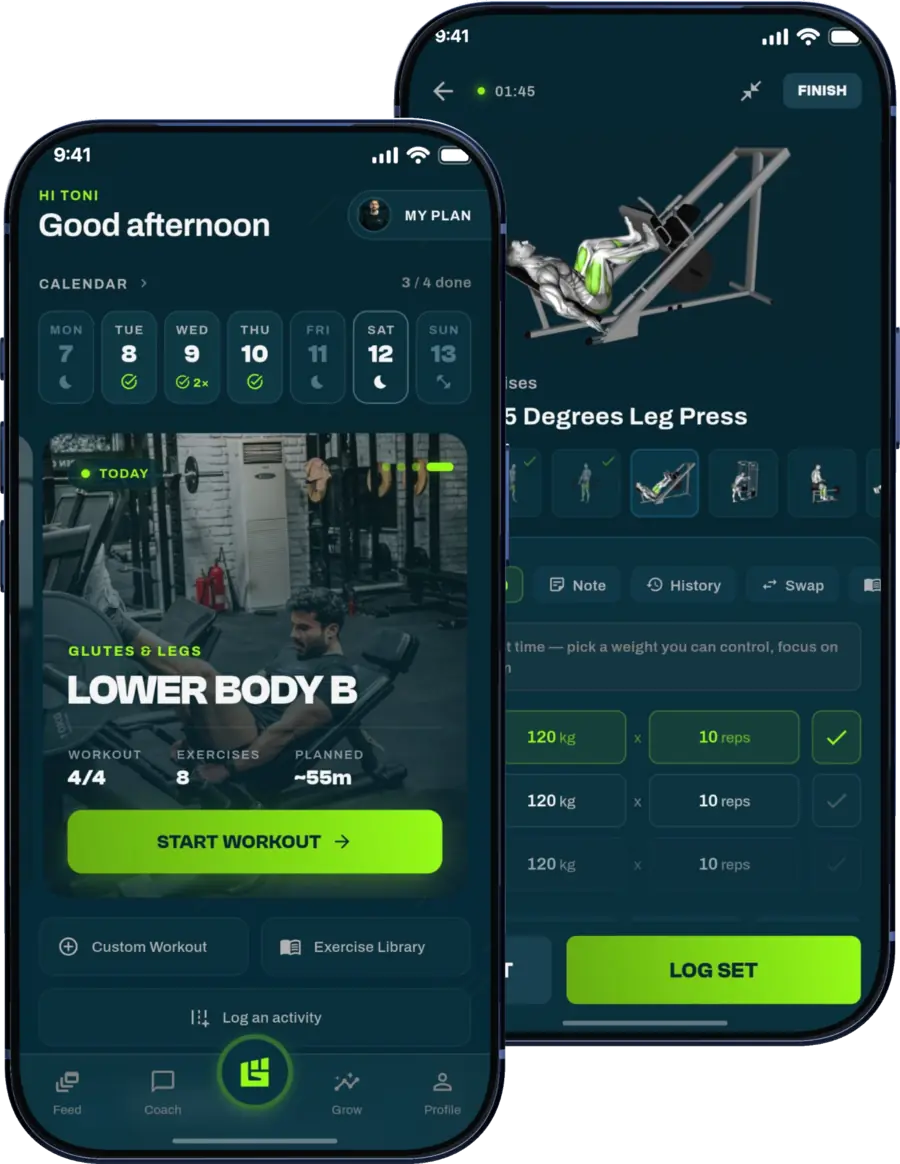
This is exactly where an app like GrabGains comes into play. It automates the whole process for you—building the routine, applying progressive overload, and making smart adjustments. It takes your goals, picks the right split, and then does the thinking for you. As you get stronger, the app tweaks your workouts so you keep making progress and never get stuck.
How GrabGains takes the guesswork out of your training split
Debating the details of PPL versus Upper/Lower is a good start, but getting into the gym and putting that theory to work is what actually builds muscle. This is where most people get stuck. What do you do when you crush a workout? How do you adjust your volume if your schedule changes mid-week? This is exactly the problem we built GrabGains to solve.
Our platform acts as your personal coach, completely removing the guesswork. Instead of forcing your life to fit a rigid template, GrabGains builds the program around you. It all starts by understanding your unique profile.
- Your Goals: Are you chasing pure hypertrophy or building functional strength?
- Your Schedule: Can you realistically hit the gym six days a week, or is four your limit?
- Your Experience: Are you a beginner who needs to lock in your form or an advanced lifter pushing your numbers?
Based on your answers, our system intelligently designs the ideal training split for your specific needs.
Programming that adapts to you
The real magic of GrabGains is its ability to adapt. Your program is not set in stone; it evolves with you. Our app tracks your performance on every single set and rep. When you’re consistently hitting your targets, it automatically applies progressive overload by increasing weight or reps, making sure you never get stuck on a plateau.
This adaptive system is built on proven training science. Research confirms that as long as total weekly volume is matched, different training splits can deliver nearly identical results. A 2021 study, for instance, found that both split routines and full-body workouts led to similar gains in strength and size over eight weeks, including an ~18% jump in bench press 1RM. The takeaway is clear: consistency and progressive volume matter most, and GrabGains automates that entire process for you.
GrabGains translates exercise science into a personalized, actionable plan. It handles the complex programming so you can focus on what you do best—lifting, recovering, and getting results.
With a library of exercises—each with video demos—and intuitive progress tracking, you have all the tools of a world-class coach right in your pocket. It’s the smartest and most effective way to apply evidence-based training and build the physique you’ve been working for.
Your questions, answered
Even after comparing PPL and Upper/Lower splits, a few common questions always come up. Here are some quick, practical answers to help you lock in your decision.
Can I run a PPL routine only 3 days a week?
Technically, yes, but it’s not a great idea. Running PPL just three days a week means each muscle group only gets hit once per week. For building muscle, that’s leaving a lot of potential growth on the table.
If you’re limited to three training days, you’ll almost always get better results from a full-body routine that stimulates muscles more frequently.
How should I choose exercises for an upper/lower split?
Keep it simple and effective. Kick off each workout with a big, heavy compound lift—think bench press on Upper Day A and squats on Lower Day A. That is your primary driver for progressive overload.
From there, add 3-5 accessory exercises to hit muscles from different angles. For upper body days, a good rule of thumb is to include one horizontal push, one vertical push, one horizontal pull, and one vertical pull. This ensures you’re not creating any imbalances.
Don't get lost in the details. A great Upper/Lower split is built on proven compound lifts, with isolation work sprinkled in to bring up weak points and round out your physique.
Is one split better for strength vs. size?
Nope. A split is just a way to organize your week. The real magic comes from how you program your sets, reps, and intensity. Both PPL and Upper/Lower can be molded for any goal.
Here’s how to steer them:
- For Strength: Focus on the 1-5 rep range with heavy weight on your main compound lifts.
- For Size (Hypertrophy): Live in the 6-15 rep range. The goal here is higher overall volume and a solid mind-muscle connection.
What if I miss a day on a 6-day PPL schedule?
Life happens, and missed workouts are inevitable. You have two solid options, and the right one just depends on what you value more: flexibility or routine.
One way is to just pick up where you left off. If you missed Leg Day on Wednesday, you do it on Thursday and bump everything else back a day. The other option is to just skip it and get back on your normal schedule. You'll miss that one workout, but your weekly rhythm stays intact.
Ready to stop guessing and start building a workout plan that actually fits you? GrabGains analyzes your goals, schedule, and experience to create the perfect PPL, Upper/Lower, or hybrid split that adapts as you get stronger. Download GrabGains on iOS or Android now and train smarter.
Get inspired and motivated