Best rep range for muscle growth
Discover how rep range hypertrophy works with science-backed principles to boost muscle growth. Clear guidance for smarter, faster gains. For years, the fitness world ran on a simple rule: if you wanted to build muscle, you had to live in the 8-12 rep range. This was the undisputed “hypertrophy zone,” the magic window for growth.
But what if I told you the real secret to building muscle is far more flexible—and a lot less rigid—than that old-school belief?

The myth of the magic hypertrophy rep range
For a long time, the idea of a single, optimal rep range for hypertrophy dominated gym talk. Lifters were taught that anything below 8 reps was strictly for strength, and anything above 12 was just for endurance. This created a set of training rules that many people still follow today, almost out of habit.
But modern research has completely turned this idea on its head. We now know that muscle growth can happen across a huge spectrum of reps—anywhere from 5 to 30—as long as one crucial condition is met: you have to train close to failure.
This simple shift in understanding moves the focus from a specific number to a much more powerful principle: effort.
Built for progress
Take the guesswork out of training
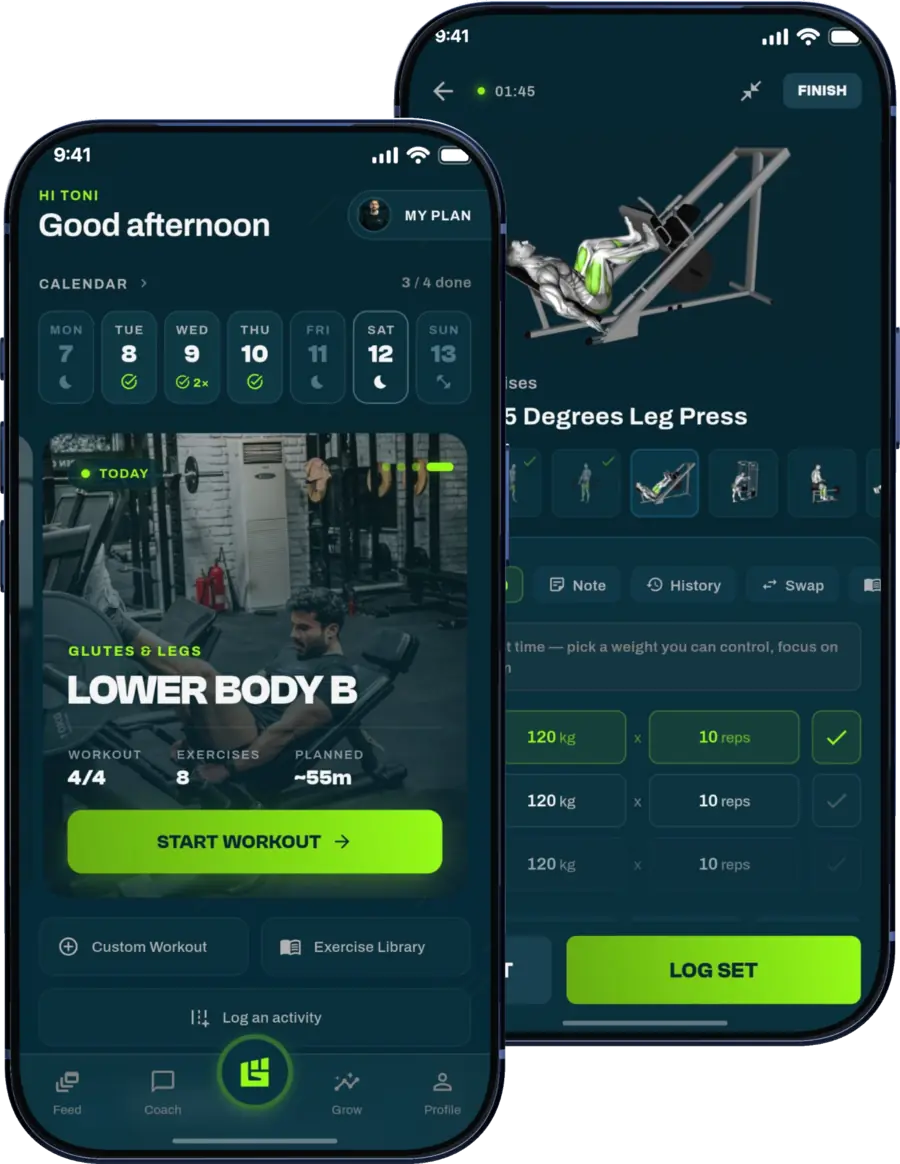
Get a personalized workout plan built around your goal, equipment and schedule. Train smarter, track every rep and keep moving forward, one workout at a time.






Effort is the real key
Think about it like cooking a steak. You can grill it on high heat for a short time, pan-sear it, or even roast it low and slow. Each method uses a different temperature and cooking time, but all three can give you a perfectly cooked result.
Different rep ranges work the same way. They’re just different tools to get to the same goal: signaling your muscles to grow.
The real driver of hypertrophy isn't the number on your notepad but how challenging those reps actually are. Pushing your muscles to their limit—whether that happens on rep 6 or rep 26—is the trigger that forces them to adapt.
Why this matters for your training
Once you stop chasing a "magic number," your training becomes much more effective and sustainable. This flexible approach allows you to:
- Vary your stimulus: Training across different rep ranges keeps your muscles guessing, helping you break through frustrating plateaus.
- Manage fatigue: On days you feel strong, you can go heavy for low reps. On days you’re not feeling 100%, you can use lighter weight for higher reps and still get a great muscle-building workout.
- Train how you like: Some people love the feeling of a heavy, low-rep grind. Others prefer the metabolic burn from a high-rep set. The good news? Both work.
The most important takeaway is this: there is no single "best" rep range for hypertrophy. Growth happens when you consistently challenge your muscles with high effort, pushing sets close to failure across a wide spectrum of repetitions.
To help you visualize how this works, here's a quick breakdown of the different rep zones and what they're best for.
Hypertrophy rep range spectrum at a glance
| Rep Range | Primary Mechanism | Typical Load (% 1RM) | Best For |
|---|---|---|---|
| 5-10 | High Mechanical Tension | 75-90% | Building foundational strength and dense muscle. |
| 10-20 | Blend of Tension & Metabolic Stress | 60-75% | The "classic" hypertrophy zone, great for overall muscle size. |
| 20-30+ | High Metabolic Stress & Cellular Swelling | 30-60% | Joint-friendly volume, improving endurance, and creating a "pump". |
Each of these ranges works. The key is to spend time training in all of them to become a more well-rounded, resilient lifter.
As we move forward, we'll dive into the science behind why this works and show you how to apply it to your own workouts. When you understand the mechanisms behind muscle growth, you can build smarter, more personalized training plans—something the GrabGains app is designed to help you do automatically.
Understanding the science of muscle growth
To really get the most out of every single rep, it helps to look under the hood and see what’s actually happening inside your muscles. Building muscle isn't just about mindlessly lifting heavy things; it’s a specific biological process. When you train, you’re sending a direct signal to your body to repair and rebuild your muscles, making them bigger and stronger than before.
This process, known as hypertrophy, happens in two main ways. Think of them as two different strategies your body uses to pack on size.
The two types of muscle growth
First up is myofibrillar hypertrophy. This is all about increasing the density of the actual contractile proteins (myofibrils) inside your muscle fibers. Picture a rope made of many small threads; this type of growth is like weaving more threads into that rope, making it fundamentally stronger and denser. This is the growth most closely tied to raw strength gains.
Then there's sarcoplasmic hypertrophy. This is about increasing the volume of the fluid, or sarcoplasm, that surrounds those muscle fibers. This fluid is packed with things like glycogen and water. Using our rope analogy again, this is like making each individual thread thicker by soaking it in water. The rope gets bigger and looks "fuller," but you haven't necessarily added more threads. This is what gives you that pumped, volumized look many lifters are after.
A smart training program doesn’t force you to choose one over the other. Instead, it creates an environment where both types of growth can happen by tapping into the three primary drivers of hypertrophy.
The three drivers of hypertrophy
So, what actually flips the switch for muscle growth? Decades of research have boiled it down to three key mechanisms that all work together. Understanding these is the secret to making any rep range for hypertrophy truly effective.
- Mechanical Tension: This is the big one—the most important driver of them all. It's the force you place on your muscles when you lift a challenging weight through a full range of motion. Imagine stretching a rubber band to its limit; that's the kind of tension that signals your muscle fibers to adapt and grow. Heavy, low-rep sets are a fantastic way to maximize this.
- Metabolic Stress: You know that deep, searing "burn" you feel during a high-rep set of leg extensions or bicep curls? That's metabolic stress. It’s the buildup of byproducts like lactate inside the muscle cell. This creates a chemical environment that signals the body to adapt, contributing heavily to sarcoplasmic hypertrophy and that incredible "pump."
- Muscle Damage: This refers to the tiny, microscopic tears that occur in your muscle fibers during intense training. It might sound bad, but it's actually a key part of the process. This damage triggers an inflammatory response that kickstarts the repair cycle, ultimately leading to stronger, more resilient muscle tissue.
No single rep range perfectly maximizes all three drivers at once. This is precisely why varying your training—using a mix of heavy, moderate, and light loads—is the most effective long-term strategy for muscle growth.
By programming different rep ranges into your workouts, you create a much more well-rounded stimulus for growth. For example, a heavy set of bench presses for 5 reps creates immense mechanical tension, while a set of cable flyes for 15 reps generates a ton of metabolic stress. Combining these different approaches, like those found in our in-depth guides to building your chest, ensures you’re not leaving any potential gains on the table.
How different rep ranges build muscle
Now that we have the science down—mechanical tension, metabolic stress, and muscle damage—it’s time to connect those ideas to what you actually do in the gym. Different rep ranges aren't just random numbers; they’re tools. Each one lets you focus on a specific driver of muscle growth, and mastering them is how you build a complete, well-rounded physique.
Think of it like being a sculptor. Sometimes you need a heavy hammer for the big, rough work. Other times, you need a fine chisel for the details. Each rep range for hypertrophy is a different tool, and knowing which one to use is what separates a good workout from a great one.
This chart shows how the two main drivers—tension and stress—work together to create the muscle damage that signals your body to repair and grow bigger.

As you can see, both the heavy loads from low-rep sets and the intense burn from high-rep sets contribute to the overall stimulus that forces your muscles to adapt.
Low reps for strength and density (1-5 reps)
When you lift heavy in the 1-5 rep range, you are creating maximum mechanical tension. This is the zone where you move the most weight possible, putting an enormous amount of force through your muscle fibers. That intense tension is a powerful signal for myofibrillar hypertrophy, which means your body responds by making your muscle fibers stronger and denser.
While this range is often thought of as just for "strength," that raw strength gain is a direct result of building structurally sound, dense muscle. It’s perfect for your big compound lifts—squats, deadlifts, and bench presses—where building raw power is the name of the game.
But be warned: training exclusively with such heavy loads is demanding. It can fry your central nervous system and put a lot of strain on your joints, which is why it’s best used strategically at the start of your workout when you’re fresh.
The hypertrophy sweet spot (6-15 reps)
The moderate rep range of 6-15 is often called the "sweet spot," and for good reason. It gives you an almost perfect blend of both mechanical tension and metabolic stress. The weight is still heavy enough to create significant tension, but the reps are high enough to cause that buildup of metabolic byproducts that gives you a satisfying "pump."
This balanced stimulus makes the 6-15 range incredibly effective for overall muscle growth. It lets you get in a solid amount of training volume without the extreme neural fatigue of heavy lifting or the searing burn of super high-rep sets.
Because it effectively targets both myofibrillar and sarcoplasmic hypertrophy, this range is the bread and butter of most muscle-building programs. It provides the best of both worlds for consistent, visible gains.
You'll probably spend a lot of your time here on assistance exercises like dumbbell presses, rows, and leg presses, especially after you've finished your heavy strength work.
High reps for pump and endurance (15-30+ reps)
Once you venture into the 15-30+ rep range, the focus shifts almost entirely to metabolic stress. The weight is lighter, so mechanical tension is lower, but the extended time under tension creates an intense chemical environment inside the muscle. Your muscles get flooded with blood, and the buildup of lactate creates that deep, unmistakable burn.
This powerful metabolic stress is fantastic for driving sarcoplasmic hypertrophy, which increases the fluid volume within your muscles and gives them a fuller, more "pumped" look. It's also great for improving muscular endurance and is generally much easier on your joints.
High-rep training works perfectly for finishing exercises, especially isolation movements like:
- Lateral raises
- Bicep curls
- Tricep pushdowns
- Leg extensions
By tacking these on at the end of a workout, you can completely exhaust the muscle fibers and chase a massive pump without risking injury with heavy weight when you're already tired. For example, many of the best routines for building bigger legs use high-rep finishers to maximize metabolic stress. If you need some ideas, you can find plenty of movements to try in our guide to leg exercises.
Ultimately, a truly effective hypertrophy program doesn't just pick one rep range; it uses all of them. By starting with heavy, low-rep work, moving to moderate-rep volume, and finishing with high-rep pump work, you create a comprehensive stimulus that leaves no stone unturned in your quest for muscle growth.
Moving beyond reps to maximize your gains
Focusing only on reps is like trying to bake a cake with just flour—you're missing several key ingredients. While the rep range for hypertrophy is an important starting point, it's just one piece of a much larger puzzle.
To really kickstart serious muscle growth, you have to look at the bigger picture and get a handle on the other variables that turn a good workout into a great one.
The power of training volume
First up, and arguably the most important ingredient, is training volume. Think of this as the total amount of work your muscles do in a session. The classic way to calculate it is sets x reps x weight.
This is the total "dose" of stimulus you're giving your muscles. You can rack up volume by doing more sets, more reps, or lifting heavier. For example, lifting 100 lbs for 3 sets of 10 reps gives you the exact same volume (3,000 lbs) as lifting 125 lbs for 3 sets of 8 reps. This is a big reason why different rep ranges can all lead to similar growth—as long as the total volume and effort are high enough, your muscles get the signal to grow.
Intensity is more than just weight
Next, we need to talk about intensity. In lifting, intensity isn't just about how much weight you have on the bar; it's about how hard you're pushing relative to your maximum ability. The most practical way to track this is by how close you get to muscular failure.
This concept is often measured using Reps in Reserve (RIR). It's a simple scale:
- RIR 3: You feel like you could have done three more good-form reps.
- RIR 2: You definitely had two more reps in you.
- RIR 1: You had just one solid rep left in the tank.
- RIR 0: You couldn't have possibly completed another rep (this is training to failure).
For most of your training, aiming for an RIR of 1-3 is the sweet spot. It ensures you’re working hard enough to trigger growth without accumulating so much fatigue that it wrecks your recovery and stalls your progress.
Pushing every set to absolute failure (RIR 0) is a rookie mistake. It creates a ton of fatigue for a tiny extra benefit, making it a tool to use strategically, not a rule to live by.
Why range of motion matters
Another variable that people often butcher is range of motion (ROM)—how far you actually move the weight. It's tempting to cut your reps short just to lift a bit heavier, but that almost always short-changes your muscle development.
A full range of motion, taking the muscle from a fully stretched to a fully contracted position, is your best bet for building complete, well-rounded muscles. Some studies find similar results between full and partial reps, but a significant amount of research shows that full ROM exercises lead to better overall muscle growth, making it the smarter default choice.
Strategic rest periods
Finally, don't sleep on your rest periods between sets. The time you rest directly impacts how well you can perform on your next set.
- Longer Rest (2-3 minutes): Perfect for your big, heavy compound lifts. This allows for greater recovery, letting you lift heavier and maximize that all-important mechanical tension.
- Shorter Rest (60-90 seconds): Great for keeping metabolic stress high. This is ideal for moderate to high-rep sets on isolation exercises where you’re chasing that muscle-building "pump."
Mastering these four elements—volume, intensity, range of motion, and rest—is what takes your training to the next level. Of course, this all assumes your nutrition is dialed in. To dig deeper into that, you can hear from a world-renowned expert on the importance of optimal protein intake and timing for muscle growth.
Building your hypertrophy-focused workout
Alright, theory is one thing, but the real gains happen when you put it all into practice in the gym. It's time to build a workout that uses the entire rep range for hypertrophy to its full potential. This isn't about picking one "magic" rep range; it's about blending different rep schemes to create a more powerful and complete stimulus for muscle growth.
The game plan is simple: hit your muscles with a variety of signals. By mixing heavy work, moderate volume, and high-rep burnouts, you'll maximize both mechanical tension and metabolic stress. You're leaving no stone unturned.
How to structure your workouts
A smart way to organize this is to work from your most demanding lifts to your least demanding. You'll start with heavy, low-rep compound movements while you're fresh, then move into moderate-rep work to build volume. Finally, you'll finish with high-rep isolation exercises to chase that deep burn and skin-splitting pump.
This approach lets you get the best of all worlds in a single session. Here are two sample workout splits—one for beginners or those tight on time, and another for more experienced lifters—to show you exactly what this looks like.
Sample 3-day full-body routine
This routine is a fantastic option if you can only get to the gym three times per week. Every session hits all the major muscle groups, giving you enough frequency to spark growth while still leaving plenty of time for recovery.
Workout A (Monday):
- Barbell Squats: 3 sets of 4-6 reps (Strength Focus)
- Dumbbell Bench Press: 3 sets of 8-12 reps (Hypertrophy Blend)
- Bent-Over Rows: 3 sets of 8-12 reps (Hypertrophy Blend)
- Lateral Raises: 2 sets of 15-20 reps (Metabolic Stress)
- Bicep Curls: 2 sets of 15-20 reps (Metabolic Stress)
Workout B (Wednesday):
- Deadlifts: 3 sets of 4-6 reps (Strength Focus)
- Overhead Press: 3 sets of 8-12 reps (Hypertrophy Blend)
- Lat Pulldowns: 3 sets of 8-12 reps (Hypertrophy Blend)
- Leg Press: 2 sets of 15-20 reps (Metabolic Stress)
- Triceps Pushdowns: 2 sets of 15-20 reps (Metabolic Stress)
Workout C (Friday):
- Barbell Bench Press: 3 sets of 4-6 reps (Strength Focus)
- Leg Press: 3 sets of 8-12 reps (Hypertrophy Blend)
- Seated Cable Rows: 3 sets of 8-12 reps (Hypertrophy Blend)
- Leg Extensions: 2 sets of 15-20 reps (Metabolic Stress)
- Hammer Curls: 2 sets of 15-20 reps (Metabolic Stress)
See the pattern? Each workout kicks off with a heavy compound lift in a low-rep range to build a strong foundation. From there, it moves into the classic hypertrophy zone before wrapping up with high-rep work to really maximize the pump.
Sample 4-day upper/lower split
For lifters with a bit more experience, an upper/lower split allows for more volume and a sharper focus on specific muscle groups. This setup hits each muscle twice a week, but with a different emphasis each day.
Here’s an example of how you could structure a week like this. If you want to build a custom plan from scratch, the GrabGains workout builder is a great tool for creating routines that line up perfectly with your goals.
Sample 4-day upper/lower hypertrophy split
This table shows how to dedicate certain days to strength-focused rep ranges (heavier weight, lower reps) and others to hypertrophy-focused ranges (moderate weight, higher reps). This gives you the best of both worlds.
| Day | Focus | Example Exercise 1 (Reps) | Example Exercise 2 (Reps) | Example Exercise 3 (Reps) |
|---|---|---|---|---|
| Monday | Upper Strength | Barbell Bench Press (4-6) | Weighted Pull-Ups (6-8) | Dumbbell Shoulder Press (8-10) |
| Tuesday | Lower Strength | Barbell Back Squats (4-6) | Romanian Deadlifts (6-8) | Barbell Hip Thrusts (8-10) |
| Thursday | Upper Hypertrophy | Incline Dumbbell Press (10-12) | Lat Pulldowns (12-15) | Cable Lateral Raises (15-20) |
| Friday | Lower Hypertrophy | Leg Press (10-12) | Leg Extensions (15-20) | Seated Leg Curls (15-20) |
These templates are your starting point for integrating a full spectrum of rep ranges. You're no longer stuck with the old-school 8-12 rep rule. Think of the entire rep range for hypertrophy as your toolkit—now you know how to pick the right tool for the job to build a stronger, more muscular physique.
Common questions about rep ranges and muscle growth
Even when you've got the science down, a few questions always seem to pop up when it's time to actually hit the gym. Let's tackle some of the most common ones that come up when people are trying to nail down their rep range for hypertrophy. This should help clear things up so you can train with more confidence.
Do I need to train to failure on every set?
There's a common myth floating around that you have to grind out every single set until you can't move the weight another inch. While training to failure is a potent tool, hammering it too often is a fast track to burnout. It generates a ton of fatigue, which gets in the way of recovery and kills your performance on later sets and even your next workout.
A much smarter way to think about it is using Reps in Reserve (RIR)—basically, how many good-form reps you could have done before failing. For most of your work, leaving 1-3 reps in the tank is the sweet spot. You get a powerful stimulus for muscle growth without the massive fatigue hangover.
Think of training to failure as a tool, not a rule. It’s best saved for the last set of a single-joint exercise, like leg extensions or bicep curls, where the overall risk and systemic fatigue are pretty low. On heavy compound lifts like squats and deadlifts? Steer clear.
How often should I change my rep ranges?
Your body is a master of adaptation. Do the exact same workout—same exercises, sets, and reps—for too long, and your progress will inevitably hit a wall. This is where periodization, or the planned variation of your training, becomes so important.
A good rule of thumb is to stick with a training program or rep scheme for a solid 4-8 weeks. That’s enough time for your body to actually adapt and get stronger through progressive overload. After that block, switching things up can provide a fresh stimulus to kickstart new growth.
That change could mean:
- Swapping from a strength block (lower reps) to a hypertrophy one (higher reps).
- Rotating your exercises to hit muscles from new angles.
- Playing with your training volume or intensity.
This kind of planned change is what keeps you growing for the long haul. Bouncing around randomly week to week is just as bad as never changing anything. Find a solid program, run it long enough to see real results, and then make a strategic change.
Is one rep range better for beginners?
When you’re just starting out, the number of options can feel like a lot to take in. While any rep range can technically work, the 8-15 rep range is usually the perfect place for beginners to start, and for good reason.
First, the weight is manageable. It’s not so heavy that you're at high risk for injury, but it's challenging enough to make your muscles grow. This lets you focus on the single most important thing at this stage: learning proper form.
Second, this moderate rep range helps you build a solid mind-muscle connection. Learning to actually feel the target muscle doing the work is a skill that pays off massively down the road. The higher reps give you more practice with each movement, helping to lock in safe and effective technique.
This range really does provide the perfect mix of safety, skill development, and muscle-building stimulus, setting you up for a lifetime of success. Once you're more advanced, you can start weaving in lower and higher rep ranges to keep the progress coming.
Building muscle is a journey of smart, consistent training. By understanding how to use the full rep range for hypertrophy, you can build workouts that are not only more effective but also more engaging. To take all the guesswork out of it, the GrabGains app uses these exact principles to create personalized routines that adapt as you do, keeping you on the fastest path to your goals. You can learn more about how GrabGains can optimize your training.
Get inspired and motivated