Rest time between sets: a science-backed guide for growth and strength
Discover the rest time between sets to optimize muscle growth, strength, and endurance with science-backed guidelines you can apply today. The ideal rest time between sets isn't one-size-fits-all. Generally, you should aim for 3-5 minutes for strength, 60-120 seconds for muscle growth, and under 60 seconds for endurance. That short pause isn't wasted time; it’s a strategic tool that directly impacts whether you build more strength, size, or stamina.


Why your rest between sets is not wasted time
Many lifters treat rest periods like an inconvenient interruption—just enough time to check their phone before jumping back into the next set. But that pause is one of the most powerful variables you can control. It determines how much intensity you can bring to the next set, whether your form holds up, and ultimately, if you hit your goals.
Think of it like a phone battery. An all-out set of heavy squats drains your energy almost completely. If you only give that battery 30 seconds to recharge, you can’t expect it to power through another demanding task at full capacity. The same idea applies to your body’s energy systems.
The recharge principle
During any intense set, your muscles burn through a high-energy molecule called adenosine triphosphate (ATP) to fuel every contraction. The moment you rack the weight, your body gets to work replenishing those ATP stores. How much time you give it for this "recharge" directly dictates the quality of your next set.
Built for progress
Take the guesswork out of training
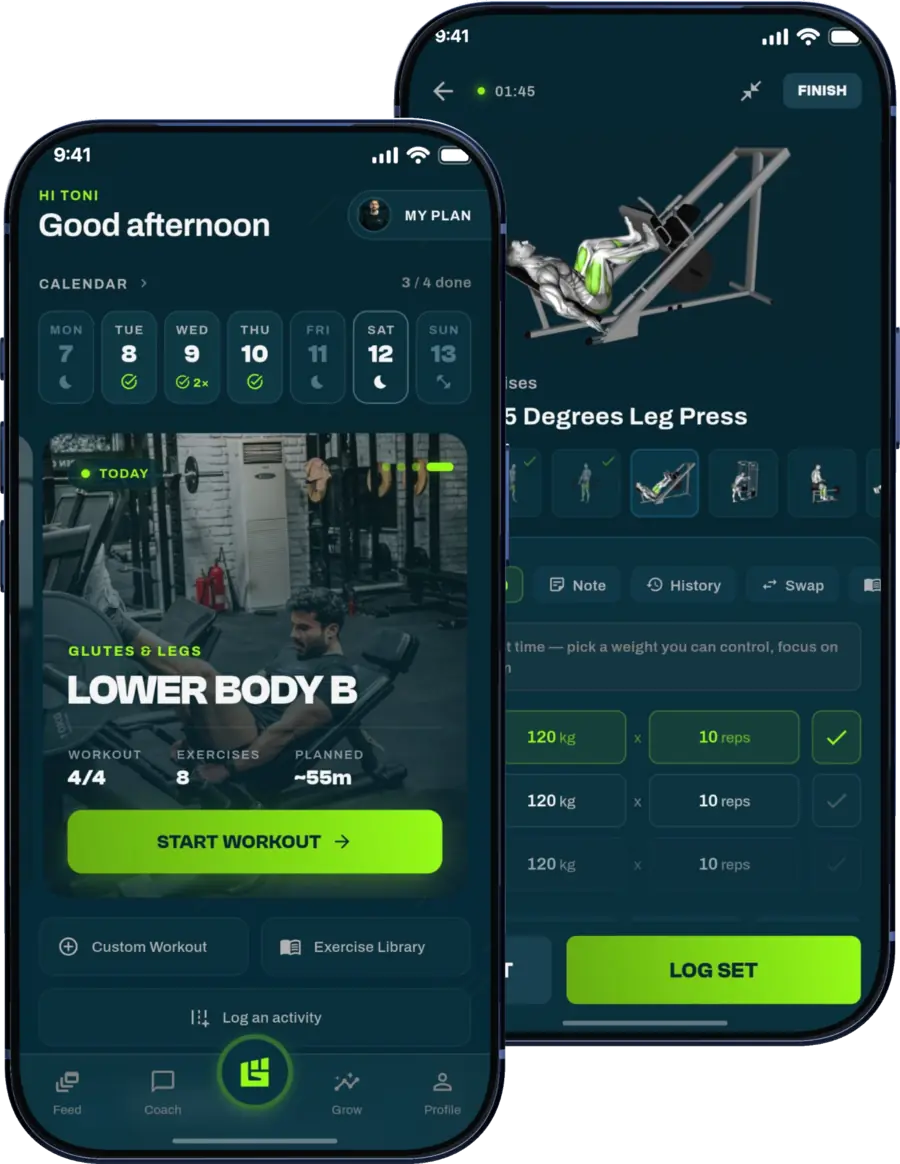
Get a personalized workout plan built around your goal, equipment and schedule. Train smarter, track every rep and keep moving forward, one workout at a time.






- Sufficient Rest: This allows for a near-complete energy top-up, letting you lift heavy with consistent performance.
- Insufficient Rest: This forces you into the next set with a half-empty tank, causing a drop in reps, weight, or both.
This infographic breaks down the general guidelines based on your training goal.

As you can see, there’s no single "best" rest time. It all comes down to what you’re trying to accomplish in the gym.
Quick guide to rest times by training goal
Use this reference table to match your rest period to your primary fitness objective for optimal results.
| Training Goal | Recommended Rest Time | Primary Outcome |
|---|---|---|
| Max Strength | 3–5 minutes | Full ATP and nervous system recovery for maximal force output. |
| Muscle Growth | 60–120 seconds | Balances recovery with metabolic stress to trigger hypertrophy. |
| Endurance | 30–60 seconds | Improves fatigue resistance and muscular stamina with minimal rest. |
Remember, these are starting points. The key is to align your rest period with your desired outcome.
If your goal is to get stronger, you absolutely need longer rests to recover your strength for the next heavy lift. If you’re chasing muscle growth, moderate rests create the perfect storm of recovery and metabolic stress needed to signal growth.
Strategic rest isn't about being lazy; it's about being smart. It ensures that every set you perform is a productive step toward your goal, not just a frantic effort to stay busy.
This is exactly why understanding and controlling your rest time is so critical. It’s the difference between just going through the motions and making real, measurable progress. Modern training apps like GrabGains even automate this, adjusting your rest timers based on your goal and performance to ensure every second of your workout is optimized. By mastering this simple concept, you unlock a new level of efficiency in your training.
The science of how rest fuels your performance
To get the most out of your rest periods, you need to look under the hood at what’s happening inside your body. That pause isn’t just about catching your breath; it’s a high-tech biological process that directly fuels your next lift. Seeing rest as an active training tool, not a passive break, is the key to unlocking better performance.
Think of your muscles as having a special kind of "cash" for immediate, powerful movements like a heavy squat or bench press. This high-energy currency is called adenosine triphosphate (ATP). During an intense set, you spend this cash fast, and by the last rep, your account is nearly empty. Your rest period is when the body works furiously to refill it.
The ATP recharge cycle
For explosive, short-duration efforts, your body relies on the ATP-PCr system. As soon as you finish a set and start resting, this system kicks into high gear to rebuild the ATP you just spent. This process isn’t instant—it follows a predictable timeline:
- After 30 seconds of rest, you’ve restored about 50% of your ATP.
- After 60 seconds, you’re back to around 75-80%.
- It takes a full 3 to 5 minutes to get back to nearly 100% replenishment.
This is exactly why rushing your rest on a heavy set is a recipe for failure. If you jump back in after only a minute, you're starting with a partially depleted energy tank. That guarantees you’ll either lift less weight or grind out fewer reps.
Clearing out metabolic byproducts
While your body is refilling its energy stores, it’s also doing some critical cleanup. Intense exercise produces metabolic byproducts, like hydrogen ions, which build up in your muscles. This buildup is what causes that "burning" sensation and contributes to fatigue, making it harder for your muscles to contract with full force.
Think of metabolic waste as traffic congestion on a busy highway. Rest periods act as the traffic control, clearing the roads so your muscle signals can travel efficiently and powerfully for the next set.
Giving yourself enough time to rest allows your circulatory system to flush out these performance-killing substances. This helps reduce fatigue, maintain proper form, and ensures you can sustain a high level of effort throughout your workout. Rushing this process leads to sloppy form and a sharp decline in performance on subsequent sets, especially for demanding movements like complex back exercises.
The metabolic stress from cutting rest short is significant. Research shows that shorter rest intervals can cause a sharp spike in markers of muscle damage. A study in Frontiers in Physiology found that lifters using 1-minute rests had dramatically higher levels of creatine kinase—a sign of muscle damage—compared to those who rested for 3 minutes. You can dive deeper into how rest impacts muscular stress by reading the full research on this topic.
While optimizing rest between sets is key, don't overlook the bigger picture. Understanding what restorative sleep is and how to get it can dramatically enhance your body's ability to recover, adapt, and come back stronger.
Rest times for maximum muscle growth
When the goal is building muscle—or hypertrophy—the old gym wisdom was all about short rests to chase "the pump." While that feeling of muscle fullness is motivating, modern science points to a smarter path for actual growth. Building serious muscle comes down to a balance of two key factors: mechanical tension and metabolic stress.
Think of mechanical tension as the force your muscles generate when lifting heavy weights through their full range of motion. Metabolic stress is that burning sensation you get from higher-rep sets, caused by a buildup of byproducts in the muscle. The classic short-rest approach cranks up metabolic stress, but often at the cost of tension.
If you jump back into a set too soon, you simply won't be recovered enough to lift with the same intensity. That means you either have to drop the weight or cut your reps short. Both actions reduce your total mechanical tension, which is the primary driver of muscle growth.
The hypertrophy sweet spot
So, what’s the optimal rest time between sets for building muscle? For most people, the sweet spot is between 60 and 120 seconds. This range offers the best of both worlds.
It gives you enough time to recover so you can maintain high-quality performance on your next set, but it doesn't let the metabolic stress completely disappear. Imagine you're building a brick wall. Each quality repetition is a perfectly laid brick. Rushing the job with short rests leads to sloppy, misplaced bricks and a much weaker wall.
Taking that extra 30 to 60 seconds of rest isn’t a sign of weakness; it’s a strategic choice. It allows you to complete more total volume—more high-quality reps with challenging weight—which is the most reliable stimulus for muscle growth.
This approach ensures you can consistently challenge your muscles from start to finish. For example, if you're doing tough chest exercises like a dumbbell bench press, a 90-second rest lets you push hard on every set, not just the first one.
What the evidence shows
This isn't just gym-floor theory; it's backed by solid research. The old-school belief that short rests are king for hypertrophy has been challenged by newer studies that look at total training volume and intensity.
A recent systematic review and meta-analysis confirmed that for building muscle, intermediate rest periods of 60-120 seconds are superior. This large-scale review, which pooled data from nine different studies, found these moderate rests led to significantly greater muscle growth compared to both very short (under 60 seconds) and very long (over 180 seconds) rest intervals. Allowing for more complete recovery simply enables greater training volume.
This evidence reinforces the idea that your main goal is to prioritize performance from set to set. You’re not just trying to get tired; you’re trying to accumulate effective, muscle-building work.
Adjusting rest based on the exercise
Of course, not all exercises are created equal. The ideal rest time also depends on the specific movement you're performing.
- Big Compound Lifts: For demanding exercises like squats, lunges, or rows that work multiple large muscle groups, lean toward the longer end of the spectrum, around 120 seconds. These lifts are systemically taxing and require more recovery.
- Isolation Movements: For smaller, single-joint exercises like bicep curls, tricep pushdowns, or lateral raises, you can often get away with shorter rests, closer to 60-75 seconds. These movements don't create as much overall fatigue.
By tailoring your rest time to both your goal and the exercise at hand, you create the perfect environment for consistent muscle growth. It’s a simple tweak that can make a huge difference in your results over time.
How to rest for building raw strength
When your goal switches from packing on muscle to forging pure strength, your entire approach to rest has to change. For lifters chasing raw power, longer rest periods aren’t just a nice idea—they are non-negotiable. The gold standard for real strength development is taking a full 3 to 5 minutes between heavy sets.
This extended break isn’t about being lazy; it’s about physiology. Lifting near your max is incredibly demanding, not just on your muscles but on your central nervous system (CNS). Your CNS is the command center that recruits muscle fibers to generate force. Pushing it to its absolute limit with heavy iron requires a full system reboot between efforts.
Think about a world-class sprinter. They don’t run a 100-meter dash, jog back to the start, and immediately go again. They take a long break to ensure their body can generate maximum explosive power on the next attempt. The exact same logic applies to your heavy squats, deadlifts, and bench presses.
Why longer rests are critical for strength
The main reason for taking a long breather is to let your ATP-PCr energy system—the one that fuels short, explosive lifts—completely replenish. As we covered before, this process takes at least three minutes. If you jump into another heavy set before that system is fully recharged, you simply won't have the fuel to perform at your peak.
This leads to an immediate drop in performance. You'll either fail the lift or complete fewer reps. Over the course of a workout, that adds up to significantly less high-intensity volume, which is the primary driver for getting stronger.
On top of that, these longer rests give your CNS the time it needs to recover. This ensures that on your next set, you can:
- Generate Maximum Force: Your brain can send the strongest possible signals to your muscles.
- Maintain Perfect Technique: CNS fatigue is a major reason why form breaks down. Bad form not only kills your strength gains but also skyrockets your risk of injury, especially on heavy leg exercises.
- Sustain High Performance: You can lift heavy with crisp form across all your working sets, not just the first one.
The science backing 3 to 5 minute rests
This isn't just "bro-science" passed down through generations of lifters; it's a cornerstone of evidence-based programming. A landmark review analyzing 35 different studies confirmed that when it comes to building maximal strength, resting 3-5 minutes between sets is superior. This extended rest allows lifters to perform more reps across multiple sets with heavy loads, which directly leads to greater gains in absolute strength and power. You can dive deeper into the complete strength training review to see how this research shapes modern training.
Rest is the invisible set. For strength athletes, what happens between lifts is just as important as the lift itself. It's the moment your body prepares to overcome the next challenge.
When you're focused on strength, you need to know what you're capable of lifting. Using a one-rep max calculator is a great way to measure and track your progress, making sure your training loads are always dialed in for your goals.
Practical application in your workouts
Putting these longer rests into practice is simple. When you're doing your main, heavy compound lifts for the day—those in the 1 to 5 rep range—you have to commit to taking the full 3 to 5 minutes.
It might feel like you’re wasting time, but the opposite is true. That patience is what lets you add another 5 pounds to the bar next week. During these breaks, you can mentally rehearse your next set, focus on your breathing, or do some light mobility work. Resisting the urge to cut your rest short is a discipline that separates good lifters from great ones.
Advanced ways to time your rest periods
While a stopwatch is a solid way to keep your rest periods consistent, truly dialed-in training goes beyond just watching the clock. The next level up is something called autoregulation—the art of listening to your body to guide your workout. This approach lets you adjust rest times on the fly based on how you feel, leading to better, more productive training sessions.
Instead of being a slave to a rigid timer, you become an adaptive lifter, making smart decisions in real time. This is where simple tools like Rate of Perceived Exertion (RPE) and Reps in Reserve (RIR) come into play.
Using RPE and RIR to guide rest
RPE and RIR are tools for rating how hard a set felt. They are intuitive scales that help you put a number on your effort, so you can make smarter choices about when to hit your next set.
- Rate of Perceived Exertion (RPE): This is a simple 1-to-10 scale rating the overall difficulty of your set. A 1 is like lifting a feather, while a 10 is an all-out effort where you couldn't have possibly done another rep.
- Reps in Reserve (RIR): This is a more direct way of thinking about it. It just asks: "How many more good-form reps could I have done before failing?" If you could have squeezed out two more, your RIR is 2.
These two ideas are basically mirror images of each other. An RPE of 8 is the same as having an RIR of 2—you had two reps left in the tank.
Think of RPE and RIR as your body's built-in feedback system. It tells you exactly how much gas you burned on the last set, so you know how long you need to refuel before the next one.
By paying attention to these cues, you can start fine-tuning your rest periods from set to set.
How to adjust rest based on effort
Using autoregulation to time your rest is a dynamic process. If a set felt surprisingly easy, you don’t need as long to recover. If it was an absolute grind, you’ll need more time.
Here’s a simple framework to get started:
- If your set was easy (RIR 3-4 / RPE 6-7): You recovered quickly and didn’t push too hard. You can probably shorten your standard rest period by 15-30 seconds.
- If your set was moderately hard (RIR 1-2 / RPE 8-9): This is the sweet spot for most training. Stick to your planned rest time for that exercise, whether that's 90 seconds for hypertrophy or 3 minutes for strength.
- If your set was a maximal effort (RIR 0-1 / RPE 9.5-10): You pushed right up to your limit. This is draining on both your muscles and nervous system, so you should extend your rest period by 30-60 seconds or more to ensure a full recovery.
Let's say you’re doing shoulder exercises like dumbbell presses. If the set felt much easier than you expected, there’s no need to sit around for the full 90 seconds. You might be ready to go in just 60, allowing you to get more quality work done in less time.
This method empowers you to adapt to daily fluctuations in energy, sleep, and stress, making sure every workout is as productive as it can be. You stop guessing and start responding to what your body is actually telling you. This turns your training from a rigid script into a smart, responsive system.
How to automate your perfect rest time
Timing your rest with a stopwatch or just going by feel can work. But what if you could put the whole process on autopilot and know every second of recovery is dialed in for your exact goal? This is where smart training technology bridges the gap between science and the gym floor, completely removing the guesswork from your rest time between sets.
Modern fitness apps are more than just glorified timers. They act like a personal coach in your pocket, using your performance data to make smart decisions about your workout as it happens. This means your rest periods stop being static and start becoming dynamic, adapting to how you're lifting, set by set.
How smart apps personalize your rest
Think of a smart training app like a GPS for your workout. It knows your destination (your goal), tracks your speed (your performance), and adjusts the route (your rest period) to get you there as efficiently as possible. It does this by constantly analyzing key data points from your session.
These platforms create a feedback loop to fine-tune your recovery. Here’s how it usually works:
- Your Stated Goal: The app starts with a baseline rest period that’s scientifically aligned with your primary objective, whether that’s strength, hypertrophy, or endurance.
- Performance Data: It logs the weight you lift and the reps you hit for every single set.
- Your Feedback: After a tough set, you might rate how hard it felt, often using a system similar to RPE.
This constant flow of information helps the app understand how you’re responding to the workout and make instant adjustments to your rest.
Dynamic adjustments in action
The real magic here is the ability to adapt on the fly. It transforms your workout from a rigid, pre-written plan into a responsive system that accounts for your daily energy levels and performance in real time.
An intelligent training app doesn't just time your rest; it prescribes it. It uses your performance data to ensure you're always in the optimal recovery zone to maximize the results of your next set.
Let’s say you’re on a hypertrophy program where the app sets a default rest of 90 seconds. Here’s how it might adjust based on how you’re doing:
- Scenario 1: You’re crushing it. You hit your set of bench presses with more reps than last week. The system sees this improvement and might trim your next rest to 75 seconds to increase metabolic stress and amplify the muscle-building signal.
- Scenario 2: You’re struggling. You barely grind out your target reps on a heavy squat set. The app picks up on this struggle and automatically extends your rest to 120 seconds or more, giving you the extra recovery you need to maintain performance and good form on the next set.
This kind of personalization ensures every rest period serves a purpose. It stops you from resting too little when you need more recovery and from resting too long when you could be working more efficiently.
Ultimately, automating your rest time between sets frees you up to focus on what really matters—lifting with intensity and perfect form. By letting technology handle the clock, you can be confident your recovery is working just as hard as you are to help you reach your goals faster.
Common questions about workout rest times
Even with the science down, practical questions always seem to come up mid-workout. Let's clear up a few of the most common ones so you can apply these ideas with confidence.
Should all exercises have the same rest time?
Definitely not. The rest you need is tied directly to how demanding an exercise is.
A heavy set of back squats is like a full-system reboot for your body—it taxes your muscles, nervous system, and energy stores all at once. An isolation move like a bicep curl is more like closing a single app. It’s not on the same level.
- Compound Exercises: For big, multi-joint movements like squats, deadlifts, and bench presses, you should always rest longer. If you’re training for strength, that means 3-5 minutes. For hypertrophy, give yourself at least 90-120 seconds.
- Isolation Exercises: For smaller, single-joint movements like leg extensions or tricep pushdowns, you can get away with much shorter breaks. A 60-90 second rest is usually plenty to recover for the next set.
Matching your rest to the exercise makes sure you give your body the recovery it actually needs without wasting time.
What if I am too busy for long rests?
Life gets hectic, and sometimes a 60-minute workout has to shrink to 30. You don’t have to throw your whole plan out the window. You can use time-efficient methods like supersets.
A superset involves performing two exercises back-to-back with almost no rest in between.
The key to a good superset is pairing non-competing muscle groups. This lets one muscle recover while the other one works, which can cut your total rest time in half without a huge hit to performance.
For example, you could pair a dumbbell bench press (a push exercise) with a bent-over row (a pull exercise). Do both moves back-to-back, then rest for about 90 seconds. It’s a fantastic strategy for getting quality work done in a short amount of time.
Does fitness level change my rest needs?
Absolutely. Your training experience plays a huge role in how much rest you need. A beginner’s body responds differently to training stress than a seasoned lifter’s does.
Newer lifters are often working with lighter weights relative to their ultimate strength potential. Their nervous system is still learning to be efficient, and their muscles can often recover faster between sets.
But as you get more advanced, you start lifting much heavier loads, placing a far greater demand on your central nervous system and ATP stores.
An advanced lifter pushing their absolute limits on a heavy squat will need a full 3-5 minutes to neurologically and metabolically recover. A beginner doing the same exercise with a lighter weight might feel ready to go after just two minutes. The stronger you get, the more critical proper rest becomes.
Ready to stop guessing and start training smarter? The GrabGains app takes all the guesswork out of your workout, including your rest periods. Its adaptive system automatically adjusts your rest time between sets based on your goal, the exercise, and your real-time performance, ensuring every second is optimized for results. Download GrabGains on iOS or Android now and discover what truly personalized training feels like.
Get inspired and motivated