Sore but no progress: why your workouts aren't working
Feeling sore but no progress? Uncover the real reasons you're stuck and learn proven strategies to break through your fitness plateau for good. You feel the burn after every gym session. But when you look in the mirror or check your workout log, it feels like nothing’s changing. This feeling of being sore but seeing no progress is one of the most common and frustrating roadblocks in fitness, and it’s a major reason why people quit.
The simple truth is that muscle soreness is just a sign you’ve challenged your muscles—it’s not a reliable signal that you’re actually building them.
Why you feel sore but see no progress
It’s the ultimate fitness paradox. You put in the work, you endure the post-workout aches, but the scale doesn’t move, the weights don’t go up, and your physique looks the same. This disconnect happens when your effort isn't lined up with the core principles of muscle growth.
Real progress isn’t just about feeling tired. It’s the direct result of combining three things: a smart training stimulus, enough fuel for repair, and plenty of time to recover.
This frustrating cycle is a huge reason people give up. According to one market analysis of fitness app retention, a shocking 77% of daily users stop using an app within just three days, and that number drops to a mere 8-12% after 30 days. When the physical discomfort of soreness is the only reward you're getting, it’s easy to lose motivation.
Built for progress
Take the guesswork out of training
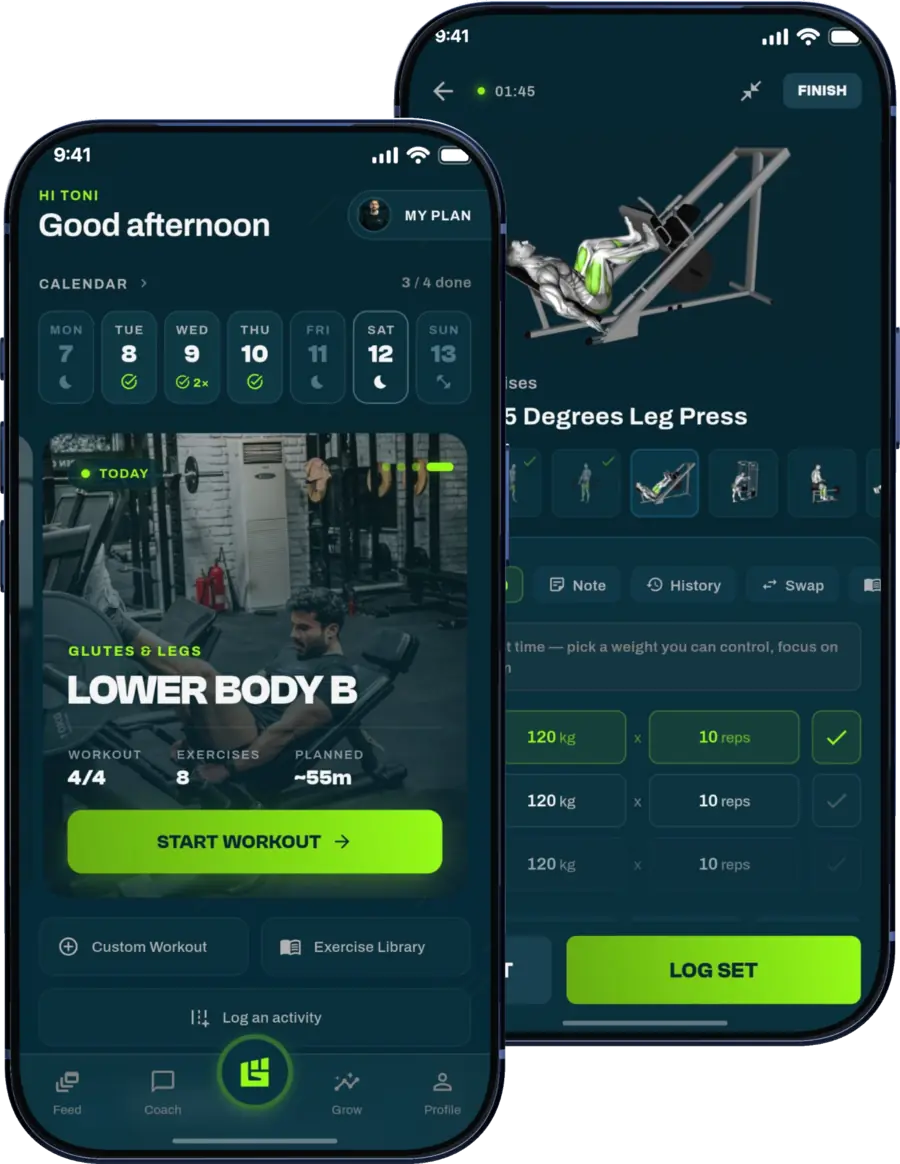
Get a personalized workout plan built around your goal, equipment and schedule. Train smarter, track every rep and keep moving forward, one workout at a time.






The myth of soreness
That ache you feel a day or two after a tough workout has a name: Delayed Onset Muscle Soreness (DOMS). It’s caused by microscopic tears in your muscle fibers, which is a sign you’ve pushed them outside their comfort zone.
But chasing soreness is like judging a chef by how messy their kitchen is—it tells you nothing about the quality of the meal. Your body is incredibly adaptive. As you get fitter, the same workouts that once left you hobbling will eventually cause less and less soreness.
This decision tree gives you a clear path for figuring out what your soreness really means.

The main takeaway here is simple: soreness is only a good sign if it comes with measurable improvements over time. Otherwise, it’s just noise.
To help clarify this, it's important to separate the feeling of soreness from the reality of progress. They are not the same thing.
Soreness vs progress: key differences
This table clarifies the critical distinctions between feeling sore and actually making measurable progress, helping you shift your focus to what truly matters.
| Indicator | What It Really Means | Is It a Goal? |
|---|---|---|
| Soreness (DOMS) | A sign of muscle damage from new or intense stress. It's your body's short-term inflammatory response. | No. It's a temporary side effect, not a target to aim for. |
| Progress | A measurable increase in performance: lifting more weight, doing more reps, or improving form over weeks and months. | Yes. This is the primary objective of any effective training program. |
Focusing on progress metrics—not just how you feel—is the key to breaking through a plateau and achieving long-term results.
Common reasons for stagnation
If soreness is your only "reward," it’s time to play detective and figure out what’s missing from the equation. The real culprits are often hiding in plain sight.
For example, many people are held back by issues they don't even know they have, like the seven common signs of nutrient deficiency, which can completely derail your hard work. Other frequent causes include:
- A stagnant program: You're stuck in a rut, lifting the exact same weights for the same reps, week after week.
- Poor nutrition: You're not eating enough protein to rebuild muscle tissue or enough total calories to fuel growth.
- Inadequate recovery: You're not getting enough quality sleep, which is when your body does most of the heavy lifting for repair and growth.
Training hard vs. training smart
There’s a big difference between training hard and training smart. Many lifters fall into the trap of chasing soreness, believing that a brutal workout is always a productive one. But if your only goal is to leave the gym feeling wiped out, you’re missing the point. This is a fast track to feeling sore but seeing no progress.
The secret to turning that sweat and effort into actual results comes down to one fundamental law of strength training: progressive overload. It’s the single most important rule for building muscle and strength.
Think of it like this: your muscles are masters of adaptation. If you don’t give them a reason to grow—a challenge slightly harder than last time—they won’t. They'll just maintain their current state, no matter how much you ache the next day.
Progressive overload simply means you must gradually increase the demands you place on your muscles over time. Without it, you’re just spinning your wheels in the gym.
How stagnant routines kill progress
A stale routine is the number one enemy of gains. If you’ve been lifting the same weight for the same reps for months on end, you’ve hit a plateau. Your body has already mastered that challenge and has no incentive to adapt further.
Stagnation can sneak into your training in a few common ways:
- The same old numbers: You look at your workout log from three months ago, and it’s identical to last week’s session. No extra weight on the bar, no extra reps.
- "Muscle confusion" chaos: You randomly swap exercises every single workout, thinking you’re "shocking" the muscle. In reality, you never give your body the chance to get better at any one movement, which prevents true overload.
- Program hopping: You jump from one training plan to the next every few weeks, long before it has a chance to work. Real, lasting adaptations take consistent effort over time.
This lack of structured progress is a huge reason why people quit. A study found that high workout completion rates were tied to a 43% increase in long-term user value for fitness apps, which shows how critical consistency is. When people feel like their hard work isn’t paying off, they lose the motivation to stick with it.
Auditing your effort for real gains
To break the cycle of being sore with nothing to show for it, you need to audit your training log. It's time to figure out if your effort is productive or just creating pointless fatigue. Is every drop of sweat actually building you toward your goal?
Start by tracking your main lifts and aiming for small, measurable wins each week. Progress doesn't always mean adding more plates to the bar. Smart progression can also look like this:
- Adding reps: Hitting more repetitions with the same weight you used last time.
- Adding sets: Performing one more set of a key exercise.
- Improving form: Mastering the movement with better control and a deeper range of motion.
- Reducing rest time: Cutting down your rest periods between sets to increase work density.
By focusing on these concrete improvements, you shift from simply working out to actively training. This deliberate, smarter approach is what ensures your hard work finally translates into real, sustainable progress.
The hidden progress killers in your kitchen and bedroom
Feeling beat up after every workout but the mirror and the barbell aren't showing any change? It’s a frustrating place to be, and the fix probably isn’t another set of reps. If you’re constantly sore but not getting stronger, it's time to look at what you’re doing outside the gym.
Think of your workout as placing an order for a stronger body. You’re telling your muscles they need to adapt and grow. But the actual building materials and construction crew? They come from your kitchen and your bedroom. All that hard work can go to waste if you’re not backing it up with the right fuel and recovery.
You don't build muscle in the gym; you break it down. The real growth happens when you're resting and eating, turning that post-workout damage into stronger, more resilient tissue.
This is the part of the equation so many people miss. They put all their focus on the hour they spend lifting, forgetting it's just one piece of a three-part puzzle. Without the right food and sleep, you’re just digging a hole you can’t climb out of, leaving you stuck in a cycle of soreness with no real gains.
How nutrition fuels your progress
Food is literally the raw material for muscle repair. After you train, your muscle fibers are full of micro-tears, and they need specific nutrients to patch themselves up and come back stronger. Mess this up, and your progress will grind to a halt.
When it comes to your food, you need to nail three things:
- Protein for repair: Protein is made of amino acids, which are the non-negotiable building blocks for muscle. If you’re not getting enough, your body simply can't repair the damage from your workouts. You’ll stay sore, but you won’t get stronger.
- Carbohydrates for energy: Carbs are your body's high-octane fuel. They replenish the glycogen your muscles burned during your workout. Skimping on carbs means you’ll show up to your next session running on fumes, and your recovery will suffer, too.
- Calories for growth: Building new muscle tissue takes energy. Plain and simple. To get bigger and stronger, you need to be in a slight calorie surplus. If you’re not eating enough total food, your body won't have the spare resources to invest in new muscle, no matter how much protein you pound.
Get these right, and food stops being just something you eat and starts being a powerful tool for getting results.
The underrated power of sleep
If nutrition provides the building materials, sleep is when the construction crew actually gets to work. It’s during deep sleep that your body kicks its repair processes into high gear and releases key growth-promoting hormones, like human growth hormone (HGH).
Research has shown that skimping on sleep tanks the levels of these crucial hormones while cranking up muscle-wasting hormones like cortisol. Just a few bad nights can seriously undermine your body's ability to recover and adapt. A consistent 7-9 hours of quality sleep isn't a luxury for people who train hard—it's a non-negotiable requirement. This is when all that soreness finally transforms into new strength. Without it, you’re just spinning your wheels.
How to actually measure fitness progress
If you're only using the scale to measure success, you're missing about 90% of the picture. That number is notoriously unreliable—it jumps up and down daily thanks to water weight, food, and hormones. Staring at it is a guaranteed way to feel like you're stuck in that frustrating loop of being sore but no progress.
To see what’s really happening, you have to look beyond the scale. The real wins are found in the metrics that prove you're getting stronger, fitter, and healthier.
True progress isn't a single number; it's a collection of positive trends over time. When you learn what to look for, you'll find evidence of your hard work everywhere.
Tracking multiple data points keeps you motivated by highlighting small victories you’d otherwise miss. More importantly, it gives you the hard data needed to make smart, targeted adjustments to your training and diet.
Meaningful ways to track your journey
It's time to stop obsessing over the scale and start collecting evidence that actually matters. These methods paint a far more accurate—and motivating—picture of your journey, proving your effort is paying off.
You don't need a hundred different metrics. Just a few key ones will tell the whole story:
- Performance gains: Did you squat 2.5 pounds more this week? Did you manage one extra rep on your last set of push-ups? This is the most direct proof of increasing strength.
- Body measurements: Once a month, grab a flexible measuring tape and track the circumference of your waist, hips, chest, and arms. Muscle is denser than fat, so you can lose inches even if the scale stays stubborn.
- Progress photos: Every 4-6 weeks, take photos from the front, side, and back. Use the same lighting, pose, and outfit. Nothing reveals changes in body recomposition—losing fat while building muscle—like a visual comparison.
- How your clothes fit: Are those jeans feeling a bit looser around the waist but tighter on the glutes? This is a classic sign of successful body recomposition that the scale will completely ignore.
Creating your progress dashboard
To see the big picture, you need to organize your data. Think of it like a personal fitness dashboard that shows your long-term trends instead of just daily blips. A simple notebook or spreadsheet is all you need.
This table breaks down how to approach each method for the clearest results.
Effective progress tracking methods
| Tracking Method | What It Measures | Frequency |
|---|---|---|
| Performance Log | Strength and endurance increases | Every workout |
| Body Measurements | Changes in body size and shape | Monthly |
| Progress Photos | Visual changes in body composition | Every 4-6 weeks |
| Scale Weight | Overall body mass changes | Weekly (average) |
By tracking these metrics together, you shift your focus from short-term soreness to long-term success. This is how you prove to yourself that your dedication is creating real, lasting change.
Turning your plateau into progress with GrabGains
Knowing why you're sore but not getting stronger is half the battle. The other half is actually fixing it. Consistently applying the right changes can feel like a full-time job, and that's where most people get stuck.
This is where smart technology can step in—not as a gimmick, but as a tool to handle the tedious work for you. Think of GrabGains less as an app and more as an intelligent training partner. It’s built to ensure the effort you put in actually leads to measurable progress.
Making progressive overload automatic
One of the biggest hurdles is applying progressive overload correctly. It's easy to get stuck lifting the same weights week after week, but it’s just as easy to jump ahead too quickly and stall out or get injured. The app's adaptive algorithm takes the guesswork out of this entire process.
Here’s how it works:
- It tracks your performance: Every rep and set you log is another data point.
- It analyzes your data: The system sees when you’re getting stronger and are ready for the next step.
- It adjusts your plan: Based on how you performed, it automatically nudges up the weight, reps, or sets for your next session.
This keeps you working in that sweet spot where you’re challenging your muscles just enough to grow, but not so much that you’re risking overtraining. You’ll never fall back into a comfortable but stagnant routine again.
Perfecting form with an extensive library
Bad form is a progress killer. When you perform an exercise incorrectly, you not only open the door to injury, but you might not even be working the muscle you think you are. That’s a perfect recipe for feeling sore in all the wrong places without seeing any real gains.
The app’s library includes high-quality exercise demonstrations. Each video gives you clear, step-by-step instructions from fitness professionals, making sure every movement is done safely and effectively. This is non-negotiable for breaking the cycle of being sore with nothing to show for it.
With clear guidance, you stop wondering if you’re doing it right and start building the mind-muscle connection needed for real growth.
Proving your progress with smart analytics
When the scale isn’t moving and the only feedback you get is soreness, it’s incredibly easy to lose motivation. GrabGains fixes this with smart analytics that track the metrics that actually matter. You get clear, visual proof of your progress that goes way beyond body weight.
The analytics dashboard shows you trends over time, highlighting key indicators like:
- Increased lifting volume: See your total weight lifted per session grow week after week.
- Strength gains on key lifts: Watch your one-rep max estimates climb for exercises like squats, deadlifts, and the bench press.
- Improved rep performance: Track your ability to hit more reps with a given weight.
Seeing these numbers trend up is the concrete evidence that keeps you going. It confirms your soreness is finally translating into real-world strength and your hard work is paying off, helping you push past sticking points and stay locked in on your goals.
A few common questions about hitting a plateau
When you feel like you're putting in the work but not getting the rewards, it’s natural to have questions. The frustration of being sore without seeing any real progress is a common sticking point.
Let’s clear up some of the most frequent concerns with straightforward, actionable answers.
How long should I wait before changing my routine?
When progress slows, the first impulse is often to scrap your entire program and search for something new. But hold on. Consistency is the foundation of all real, lasting strength and muscle gains.
A good program needs time to do its job. Give your current routine at least 4-6 weeks of honest, consistent effort before you even think about making a major change. Your body doesn't adapt overnight. During this period, focus on tiny wins—adding a single rep, improving your form, or feeling more in control of the weight.
If after a solid month of consistent training your performance log shows zero improvement—no extra reps, no added weight, no better form—that’s your signal. It's time to look closer at your progressive overload strategy, not just ditch the whole program.
Often, a small, surgical tweak is all it takes. Instead of starting from scratch, try one of these adjustments:
- Slightly increase the weight on your main compound lifts.
- Focus on adding just one more rep to each set before you jump up in weight.
- Cut your rest time between sets by 15-30 seconds to increase the workout's density.
This patient, methodical approach helps you avoid "program hopping"—a surefire way to spin your wheels and stall your gains for good.
If I'm not sore does it mean my workout was a waste?
This is one of the most stubborn myths in the gym. The short answer is: absolutely not. Soreness, or Delayed Onset Muscle Soreness (DOMS), is a terrible gauge of a productive workout.
DOMS is most intense when your body encounters something new—a new exercise, a big jump in volume, or a different training style. It's just an inflammatory response to an unfamiliar stressor.
As your body adapts to that stress, the soreness naturally fades. This is a good sign! It means you're getting fitter and more resilient. Chasing crippling soreness after every session is a mindset that leads straight to overtraining and burnout, not progress.
The real measure of a successful workout is performance. Ask yourself these questions instead:
- Did I progress? Did you lift a bit more weight or manage more reps than last time?
- Did I maintain intensity? Did you stick to your plan with good form, even when it got tough?
- Am I ready for my next session? Or are you constantly drained and dreading your workouts?
Focus on these performance metrics. They are the undeniable proof that your workout did its job, no matter how much (or how little) you ache the next day.
Can I be gaining muscle if the scale isn't moving?
Yes, and it’s an incredibly common—and positive—sign of what’s known as body recomposition. This is what happens when you lose body fat and gain muscle at the same time.
Muscle is far denser than fat. A pound of muscle takes up significantly less space than a pound of fat. So, if you trade one for the other, the number on the scale can stay exactly the same.
What won't stay the same is your appearance. Your clothes will start fitting differently—your waist might feel looser while your glutes and thighs feel tighter in your jeans. You'll look and feel leaner in the mirror.
This is exactly why relying only on the scale is one of the biggest mistakes you can make. It tells a very small, and often misleading, part of the story. To get the full picture, you need to use more meaningful tools:
- Progress photos: The single most powerful tool for seeing visual changes over time.
- Body measurements: A simple tape measure will prove you're losing inches in some places and gaining them in others.
- Performance metrics: Your workout log is the objective proof that you're getting stronger.
When you feel stuck because the scale won't budge, these are the tools that will show you the real progress you're making and keep you motivated for the journey ahead.
Ready to stop guessing and start progressing? GrabGains takes the principles from this article and puts them into action. Our adaptive platform automatically applies progressive overload, provides clear exercise demos to perfect your form, and tracks the metrics that prove your hard work is paying off. Sign up now and turn your effort into results.
Get inspired and motivated