A lifter's guide to strength curve training
Unlock smarter gains with strength curve training. Learn to match resistance to your body's mechanics for faster, more effective muscle growth and strength. Strength curve training is a smarter way to lift. It’s a method that matches the resistance of an exercise to your body's natural strength as you move. This makes your lifts more effective by challenging your muscles even when they are strongest, not just at their weakest point.


Why your lifts feel harder at different points
Ever notice how the bottom of a squat feels like an absolute battle, but once you get past the halfway point, standing up feels almost easy? Or how the first few inches of a pull-up take everything you’ve got, but the top portion is a relative breeze?
This isn’t random. It’s a fundamental principle of biomechanics known as the strength curve.
Think of your muscles like a high-tension rubber band. The more you stretch it, the more force it can generate. Your muscles work in a similar way, producing different amounts of force depending on their length and the leverage your joints give you at various points in a lift. A standard barbell or dumbbell provides constant weight, which means it only truly challenges you at your weakest point in the movement.
Built for progress
Take the guesswork out of training
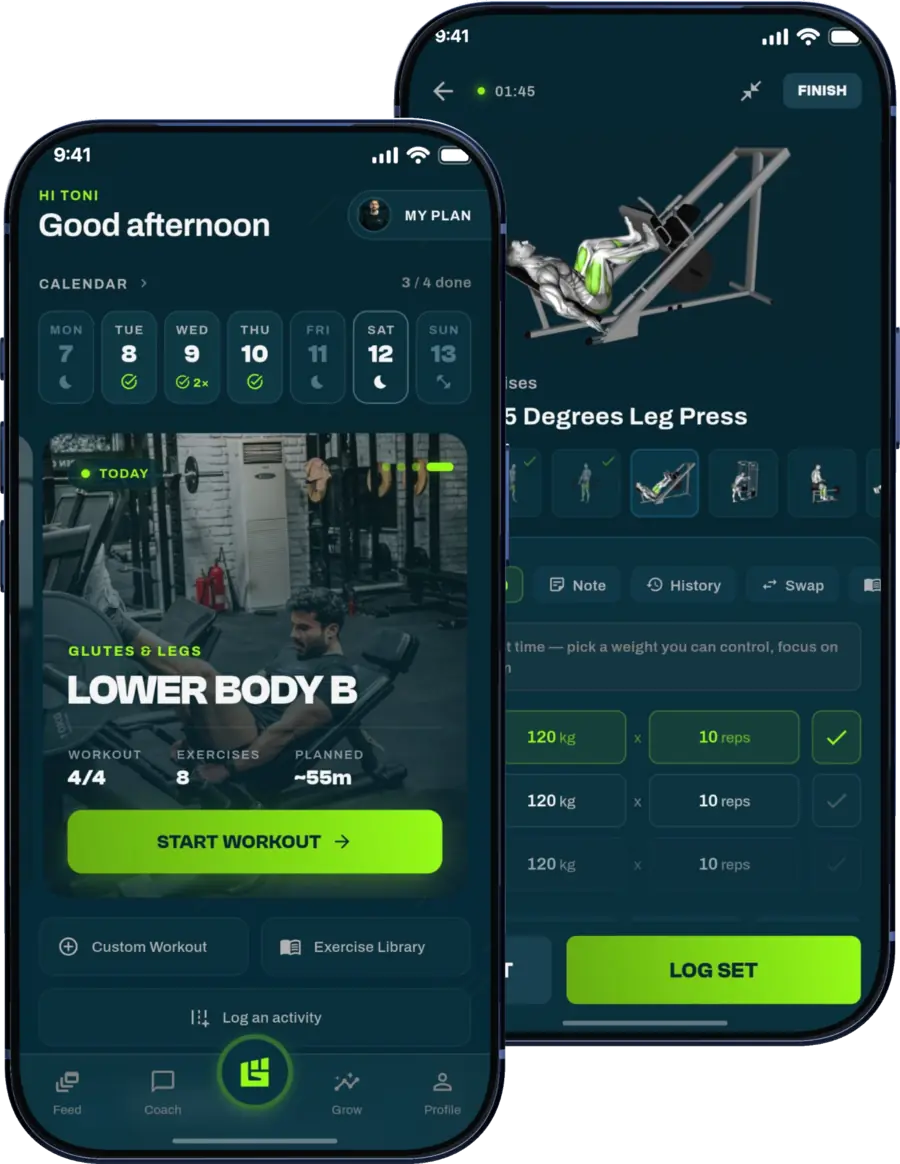
Get a personalized workout plan built around your goal, equipment and schedule. Train smarter, track every rep and keep moving forward, one workout at a time.






Understanding your natural strength
This gap between a constant weight and your body's changing strength is a huge roadblock in your training. It means your muscles aren't being fully stimulated through their entire range of motion. Strength curve training fixes this by changing the resistance to match what your body can actually handle.
The big idea is to make the easy parts of a lift harder. When you add accommodating resistance like bands or chains, you force your muscles to work intensely from start to finish. This leads to much greater strength and muscle growth.
This concept isn't some new-age fitness trend. Its roots trace back to the early 20th century with physiologist A.V. Hill, whose work on the force-velocity relationship showed that muscles produce maximum force when moving slowly. A major 2021 review of historical studies confirmed that training which respects these biomechanical principles leads to significant gains for lifters. You can dive deeper into the history of strength science on Fitentium.
The three main strength curves
Every exercise has a unique strength curve, and learning to spot them is the first step toward better workouts. They generally fall into one of three categories.
Here's a quick breakdown to help you get started:
| Curve Type | Hardest Point of Lift | Example Exercise |
|---|---|---|
| Ascending | At the beginning (the bottom) | Squat, Bench Press |
| Descending | At the end (the top/contraction) | Pull-up, Row |
| Bell-Shaped | In the middle of the movement | Bicep Curl, Lateral Raise |
As you can see, different movements challenge you at different times.
By identifying which curve an exercise follows, you can start using the right tools and techniques to challenge your muscles from every angle, not just the sticking point. This is where the real progress begins.
Understanding the three core strength curves
To really get the hang of strength curve training, you need to feel how each curve works in your own body. Forget the science-lab definitions for a second. Think of these curves as a map showing you where you’re strongest and weakest in any given lift.
Let's break down the three main types with real-world examples you'll recognize from the gym floor.
This diagram gives you a simple visual guide to the three strength curves we're about to cover.

As the infographic shows, the difficulty shifts depending on the curve. This helps you visualize whether the start, middle, or end of a lift is the biggest struggle.
Ascending strength curve
An ascending strength curve describes movements that are hardest at the bottom and get progressively easier toward the top. This happens because your body gains a mechanical advantage as you move through the range of motion.
Think about a bench press. Getting the bar off your chest is the hardest part, right? But locking out your elbows at the top feels much more powerful.
This occurs because as your joints extend (like your elbows and shoulders in a press), your muscles are in a better position to generate force. The lift feels easier at the top because that’s where you are naturally strongest.
Common exercises with an ascending strength curve include:
- Squats (all variations)
- Bench Press (all variations)
- Overhead Press
- Leg Press
- Push-ups
If you want to explore more movements that follow this pattern, you can check out our complete guide to chest exercises, where many of the big lifts have an ascending curve.
Descending strength curve
On the flip side, the descending strength curve applies to exercises that feel hardest at the end, or peak contraction, and easiest at the start. Here, you have great leverage at the beginning of the movement, but it gets worse as you approach the finish line.
The classic example is a pull-up. That initial pull from a dead hang feels manageable. It's getting your chin over the bar that presents the real challenge. Your leverage is at its worst at the very top, making that final squeeze incredibly difficult.
Exercises with a descending strength curve include:
- Pull-ups and Chin-ups
- All forms of Rows (barbell, dumbbell, cable)
- Hamstring Curls
- Lat Pulldowns
Bell-shaped strength curve
Finally, we have the bell-shaped strength curve, sometimes called a parabolic curve. This describes movements that are easiest at the very start and very end but hardest smack-dab in the middle. Your strength peaks somewhere around the midpoint of the rep.
A bicep curl is the perfect example. The first few inches are easy, and holding the weight at the top with your bicep fully squeezed is also fairly simple. The real work—the gut-check moment—happens when your forearm is parallel to the floor. That’s the 'peak' of the bell curve where your bicep is under maximum tension.
Exercises with a bell-shaped strength curve include:
- Bicep Curls
- Tricep Extensions (skull crushers)
- Lateral Raises
- Leg Extensions
Knowing which curve an exercise follows is the key to smarter programming. It allows you to strategically add resistance to challenge your muscles where they're strongest and most capable, not just where they're already struggling.
Matching resistance tools to your lifts
Knowing the theory behind strength curves is one thing. Putting it into practice is where you actually build strength and muscle. This is where you become your own lifting architect, learning to manipulate resistance to make every single rep count.
The goal is simple: challenge your muscles through their entire range of motion, not just where they’re weakest. That’s where accommodating resistance comes in. By adding tools like bands and chains, you can make the “easy” parts of a lift harder, forcing your muscles to work at a higher capacity from start to finish. This is the core of smart strength curve training.

Using bands and chains for ascending curves
For big lifts with an ascending strength curve—like squats and bench presses—the movement gets easier as you approach lockout. To counter this, we need to add resistance that increases right along with your mechanical advantage.
Resistance bands and chains are perfect for this job. As you push or stand up, the bands stretch or more chain links lift off the floor, making the bar feel heavier at the top. This matches the lift's difficulty to your body's natural strength, creating consistent, grinding tension all the way through.
This method forces your muscles to accelerate through the entire lift, a powerful stimulus for both strength and power. It trains your body to explode out of the bottom without ever letting you coast through the top.
Setting them up is pretty straightforward:
- Bands: Loop them around the ends of the barbell and anchor them to the bottom of the power rack or a pair of heavy dumbbells on the floor.
- Chains: Drape them over the barbell sleeves so most of the links are piled on the floor when you're at the bottom of the lift.
This technique is fantastic for building lockout strength and blowing past plateaus on your major compound lifts.
Overloading bell-shaped and descending curves
So what about exercises that are hardest in the middle or at the end? For bell-shaped curves like bicep curls, you can use bands to add tension at the peak of the contraction. For instance, stand on a band and hold the ends while you curl dumbbells. The resistance will be greatest when your forearm is parallel to the floor—exactly where you're strongest.
For descending curves like rows, you could use bands in reverse, setting them up to pull the weight away from you. But for these movements, another tool is often a better fit.
The role of specialized machines
Walk into any modern gym, and you'll find machines engineered with strength curves in mind. Many of them use a cam—an egg-shaped pulley—to automatically change the resistance profile throughout the movement.
This is especially helpful for isolating muscles with descending or bell-shaped curves.
- Leg Extension Machines: The cam cranks up the resistance as you straighten your leg, maxing it out at full extension to hammer the quads. If you want to build a complete lower body, check out our guide on programming the best leg exercises.
- Hamstring Curl Machines: These are designed to feel heaviest as your heel gets closer to your glutes, perfectly matching the muscle's strength curve.
These machines offer a simple, built-in way to apply these principles without the hassle of setting up bands or chains. They are an excellent tool for targeting specific muscles and ensuring you're working them hard through their full contractile range.
Here’s a quick rundown of your options for modifying resistance.
Tools for modifying resistance profiles
| Tool | How It Works | Best For Curve Type | Primary Benefit |
|---|---|---|---|
| Resistance Bands | Elastic tension increases as the band is stretched. | Ascending, Bell-Shaped | Building explosive power and overcoming sticking points. |
| Chains | Weight increases as more links lift off the floor. | Ascending | Developing lockout strength and smooth acceleration. |
| Cams (Machines) | An offset pulley varies the lever arm to alter resistance. | Descending, Bell-Shaped | Isolating muscles with consistent tension through the full ROM. |
Each of these tools gives you a different way to challenge your muscles. The key is to pick the right one for the job based on the exercise and your specific training goal.
How to program your strength curve training
Alright, you get the theory behind strength curves and resistance tools. Now for the fun part: putting it all into a plan that actually works.
A smart program isn't just a random list of exercises. It’s a blueprint that weaves these concepts together, making sure every rep gets you closer to your goals without running you into the ground. This is how you build a foundation for consistent, long-term progress.
The secret is to balance your raw strength work with targeted movements that use accommodating resistance. This one-two punch lets you build a powerful base while systematically hunting down and eliminating your weak points.
Building your training week
Your program's structure all comes down to periodization—the art of planning your training in cycles. This isn't some new-age fad; its roots trace back to the 1930s with innovators like Mark Berry. His systems rotated heavy, light, and speed work, and they produced incredible strength gains of 20-30%.
Modern science confirms what old-school lifters knew all along. Spreading your volume across different phases of the strength curve and training more frequently leads to better results and can slash overtraining risk by up to 40%.
Of course, none of this works without a solid grasp of progressive resistance training. It's the bedrock of any intelligent strength program.
A simple and brutally effective way to organize your week is to dedicate days to different types of effort:
- Max Effort Days: Go heavy. This is where you work up to a top-end set on a main lift with straight weight, like a 1-3 rep max on your squat. It builds raw, absolute strength right where you're weakest.
- Dynamic Effort Days: Think speed and power. You'll use lighter weight (50-60% of 1RM) combined with bands or chains. The goal is to move the bar as fast as humanly possible.
- Repetition Effort Days: Time to build muscle and fix weaknesses. Use accommodating resistance or specialized machines for accessory work in higher rep ranges (8-15 reps) to drive hypertrophy.
Sample workout for strength
This template is for an athlete whose number one goal is a bigger one-rep max on the main lifts. It blends max-effort grinds with explosive speed work.
Day 1: Max Effort Lower Body
- Back Squat: Work up to a heavy 1-3 rep max.
- Good Mornings: 3 sets of 6-8 reps.
- Glute-Ham Raises: 4 sets of 8-10 reps.
- Ab Rollouts: 3 sets to failure.
Day 2: Max Effort Upper Body
- Bench Press: Work up to a heavy 1-3 rep max.
- Banded Pushdowns: 4 sets of 12-15 reps.
- Chest-Supported Rows: 4 sets of 10-12 reps.
- Face Pulls: 3 sets of 15-20 reps.
Day 3: Dynamic Effort Lower Body
- Box Squat w/ Bands: 8 sets of 2 reps @ 50% 1RM + band tension.
- Speed Deadlifts w/ Chains: 6 sets of 1 rep @ 60% 1RM + chain weight.
- Reverse Hypers: 3 sets of 12-15 reps.
Sample workout for hypertrophy
This routine is all about muscle growth. It uses accommodating resistance to crank up the time under tension and metabolic stress.
For hypertrophy, the goal isn't just lifting a weight; it's about creating maximum tension in the target muscle. Bands and machines are excellent tools for this, as they keep the muscle working hard even through the strongest parts of its range of motion.
Day 1: Push Day
- Bench Press w/ Chains: 4 sets of 6-8 reps.
- Incline Dumbbell Press: 3 sets of 8-12 reps.
- Machine Shoulder Press: 3 sets of 10-15 reps.
- Banded Tricep Pushdowns: 4 sets of 12-15 reps (squeeze at bottom).
Day 2: Pull Day
- Banded Rack Pulls: 4 sets of 5-8 reps.
- Lat Pulldowns (Machine w/ Cam): 3 sets of 10-12 reps.
- Seated Cable Rows: 3 sets of 10-12 reps.
- Banded Bicep Curls: 4 sets of 12-15 reps (focus on peak contraction).
Trying to track all these variables in a spreadsheet can feel like a full-time job. Thankfully, modern platforms like GrabGains can automate this kind of sophisticated programming for you. They build adaptive plans that bake these principles right in, making high-level training accessible to anyone.
Common mistakes in strength curve training
Applying strength curve principles can be a game-changer for your progress, but like any advanced technique, it’s easy to get wrong. Falling into these common traps can stall your gains, mess with your form, and even increase your risk of injury. Let's walk through the most frequent mistakes and how to sidestep them.
The most common error is simply piling on too much band or chain tension. It’s easy to get overzealous and add so much accommodating resistance that it completely warps the exercise. When the tension is way too high, your form will inevitably crumble at the top of the lift, turning what should be a strength-builder into a shaky, unstable mess.
Instead of guessing, start conservatively. A solid rule of thumb is to have the bands or chains add about 15-20% of the total weight at the lockout. Your number one priority should always be nailing perfect technique on every single rep.
Forgetting the core lift
Another huge mistake is getting mesmerized by the novelty of bands and chains and forgetting what matters most: the main lift itself. Some lifters get so wrapped up in their banded accessory work that they neglect the hard, foundational work on their raw squats, presses, and deadlifts.
Bands and chains are supplemental tools. They are meant to patch up specific weak points, not replace the need to build raw, foundational strength.
Your primary lifts are what build the house. Accommodating resistance is what reinforces the frame. Prioritize your heavy, unaccommodated work first, and then use bands and chains to strategically enhance it.
Misapplying resistance to the wrong curve
It’s also common to see the right tool used for the wrong job. For example, adding bands to a pull-up (a descending curve) makes the easiest part (the bottom) even harder while offering zero help at the top where you're actually struggling. This kind of mismatch completely defeats the purpose of the exercise.
To fix this, always make sure the resistance profile matches the strength curve you're working with.
- Ascending Curves (e.g., Squat): Use bands or chains to add resistance where you're strongest—at the top.
- Descending Curves (e.g., Row): Use machines with cams or reverse bands that reduce the load at the strongest point (the top). For a great list of exercises, our guide to building a stronger back has you covered.
- Bell-Shaped Curves (e.g., Bicep Curl): Use bands or cables to maximize tension right in the middle of the movement where you're strongest.
By avoiding these all-too-common errors, you can ensure your strength curve training is both safe and effective, leading to fewer plateaus and more consistent progress in the long run.
Your top strength curve questions, answered
Alright, let's wrap this up by tackling some of the most common questions that pop up when people first dive into strength curve training. Think of this as the practical, no-nonsense FAQ to clear up any confusion and get you started on the right foot.
Let’s get straight to it.
Is strength curve training for beginners?
Absolutely. While the name might sound a bit intimidating, the core ideas are incredibly useful for beginners, as long as you scale it down. The trick is to start with very light resistance to get a feel for the movement and how the tension changes.
For instance, a beginner learning to squat can use a light resistance band. This is a fantastic way to teach them how to drive powerfully all the way through the movement, instead of just fighting their way out of the bottom and then relaxing at the top. It builds great habits right from day one.
How much band or chain weight should I add?
This is easily the most frequent question, and the answer is always the same: start conservatively. One of the biggest mistakes you can make is slapping on too much accommodating resistance too soon. It’s a surefire way to wreck your form and stall your progress.
A solid rule of thumb is to aim for the band or chain tension to add about 15-20% of your one-rep max at the top of the lift (the lockout).
For example, if your max bench press is 200 pounds, you’d want the bands to add between 30 and 40 pounds of tension at lockout. You would then subtract that amount from the barbell weight to keep the total effort manageable.
Always, always prioritize perfect form over adding more tension. The goal here is to make the lift harder where you're already strong, not to make it impossible to complete with good technique.
Can I do this without special equipment?
Yes, you definitely can. You don't need a gym full of bands, chains, and fancy machines to apply the principles of strength curve training. The main idea is just to manipulate leverage and resistance, and you can get creative with nothing more than free weights or even your own body weight.
Here are a few ideas to get you thinking:
- Bodyweight Squats: Instead of just repping them out, pause at different points in the movement—at the bottom, halfway up, and just shy of lockout. Hold each for 3-5 seconds to build time under tension where you're strongest.
- Push-ups: Try elevating your feet on a box. This small change shifts your body weight, making the top half of the push-up (where you're naturally strongest) significantly more challenging. It’s a simple way to mimic an ascending curve.
- Bicep Curls: Ditch the standard curl for a "drag curl." As you lift the weight, pull your elbows back, keeping the barbell right up against your body. This maximizes the tension on the bicep right in the middle of the movement.
Once you understand the why behind an exercise, you can find all sorts of simple ways to challenge your muscles more effectively, no matter what equipment you have on hand.
Ready to stop guessing and start training smarter? GrabGains builds your entire workout plan based on proven principles like strength curve training. Our platform creates adaptive routines that match your goals, helping you break through plateaus and build strength faster. Download GrabGains on iOS or Android today to get your personalized plan.
Get inspired and motivated