Strength vs hypertrophy: which training style is right for you?
Learn strength vs hypertrophy: science-backed guidance on training variables and routines to build strength, size, or both. At its heart, the difference between strength and hypertrophy training is simple: one prioritizes performance, while the other prioritizes aesthetics. Strength training is about lifting the absolute heaviest weight you can, while hypertrophy training is about building the biggest muscles you can.
Though they often go hand-in-hand, the specific training signals that drive each adaptation are surprisingly different.


Strength vs hypertrophy: what sets them apart
Every time you step into the gym, you’re sending your body a signal to adapt. The real question in the strength vs. hypertrophy debate isn’t about which is “better,” but which signal you want to send most effectively.
Think of strength training as teaching your nervous system a skill. By lifting very heavy weights for low reps, you're training your brain to fire more muscle fibers at once, and with greater force. It’s a neurological upgrade focused on maximizing pure force output.
Hypertrophy training, on the other hand, is about creating metabolic stress and physical damage within the muscle itself. Using moderate weights for higher reps floods the muscle with blood, creates micro-tears, and pushes it toward cellular fatigue. This sends a powerful signal for the muscle cells to grow larger and more resilient.
Built for progress
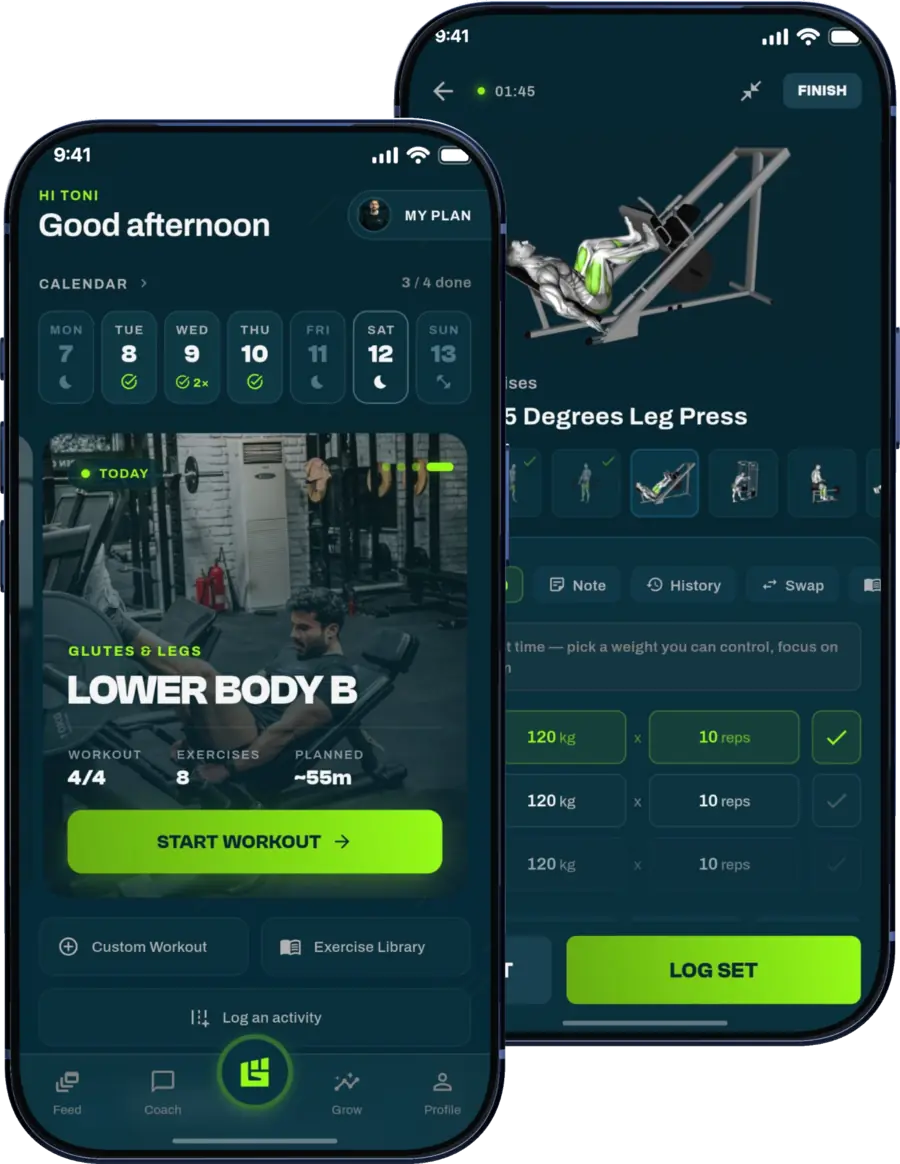
Take the guesswork out of training
Get a personalized workout plan built around your goal, equipment and schedule. Train smarter, track every rep and keep moving forward, one workout at a time.






Key goals and adaptations
Getting bigger usually makes you stronger, and lifting heavy certainly builds some muscle. But the primary driver for each goal is distinct. Strength is a clear performance metric: how much can you lift for one rep? Hypertrophy is a physiological change: how much has your muscle’s cross-sectional area actually grown?
This fundamental difference is what should guide your entire workout structure. A program designed to hit a new deadlift personal record will look completely different from one designed to add an inch to your arms.
To make it clear, let’s break down how these two approaches differ at their core.
Core differences between strength and hypertrophy focus
| Training Factor | Strength Training Focus | Hypertrophy Training Focus |
|---|---|---|
| Primary Goal | Increase maximal force production (lift heavier) | Increase muscle size (get bigger) |
| Main Adaptation | Neuromuscular efficiency and motor unit recruitment | Myofibrillar and sarcoplasmic hypertrophy (cell growth) |
| Rep Ranges | Low (1-5 reps) | Moderate to high (6-15+ reps) |
| Load (% of 1RM) | High (85%+) | Moderate (65-85%) |
| Primary Driver | High mechanical tension | Mechanical tension, muscle damage, and metabolic stress |
Understanding these core distinctions is the first step toward programming with intent. It allows you to align your daily efforts with your long-term vision, ensuring every set and rep gets you closer to where you want to be.
The science of building strength and muscle mass
To truly get the most out of your training, you need to know what’s happening under the hood. While strength and hypertrophy training both build muscle and make you stronger, they work in fundamentally different ways. One is about practicing a skill, and the other is about triggering a biological process.
When you train for strength, the biggest changes happen in your central nervous system (CNS). Lifting seriously heavy weight—anything above 85% of your one-rep max—is like skill practice for producing force. Your brain gets dramatically better at recruiting motor units, which are the bundles of muscle fibers fired by a single nerve.
This improved neural drive lets you tap into more of your muscle's raw potential. You’re essentially teaching your body to fire on all cylinders at once. It’s a neurological upgrade that makes you better at expressing force, even if the muscle itself hasn’t grown that much bigger.
The three drivers of hypertrophy
Muscle growth, or hypertrophy, is less about neurological skill and more about creating specific signals inside the muscle cells. It all boils down to three main drivers:
- Mechanical Tension: This is the force your muscles experience when you lift a weight. It’s the single most important factor for growth, as that tension directly signals the muscle cells to get bigger and more resilient.
- Muscle Damage: These are the micro-tears that happen in muscle fibers during tough workouts, especially on the eccentric (lowering) part of a lift. This damage kicks off an inflammatory response, signaling the body to repair the fibers and build them back bigger and stronger.
- Metabolic Stress: Ever feel that "pump" during a high-rep set? That’s metabolic stress. It’s the buildup of byproducts like lactate from intense muscle contractions, which causes the cell to swell and is thought to trigger even more growth.
While strength training relies almost entirely on mechanical tension, a good hypertrophy program creates a powerful cocktail of all three.
The key takeaway is this: Strength is a function of neuromuscular efficiency, while hypertrophy is a cellular response to stress and damage. One teaches your body to use what it has, while the other forces it to build more.
Load, effort, and the surprising overlap
This brings us to a huge point in the strength vs. hypertrophy debate: how much does the weight on the bar actually matter for getting bigger? The answer might surprise you. While heavy loads are non-negotiable for maximizing strength, muscle growth can happen across a much wider spectrum of weights, as long as your effort is high.
A major 2017 meta-analysis highlighted this perfectly. It compared low-load, high-rep training to traditional high-load, low-rep lifting. While the high-load groups saw far better gains in their one-rep max, the amount of muscle growth was virtually identical between both groups.
This means you can absolutely build muscle with lighter weights, provided you take your sets close to failure. The load itself is less important than the stimulus it creates. As you get more advanced, you can even explore techniques like using stretched partials for hypertrophy to find new ways to create that stimulus. By understanding these principles, you can program your workouts with intention, knowing exactly which adaptation you’re chasing with every single set.
Key training variables: load, volume, and rest
Knowing the science is one thing; putting it to work in the gym is another. The real difference between strength and hypertrophy training comes down to how you handle three variables: load (the weight), volume (how much you lift), and rest (how long you recover between sets).
Dialing these in is how you tell your body exactly what you want it to do: get stronger or get bigger.
When your goal is pure strength, everything is organized around maximizing force. This means lifting heavy—really heavy—at 85% or more of your one-rep max (1RM).
Because the weight is so demanding, your reps will naturally stay low, somewhere between 1-5 reps per set. The focus here is all on quality, not quantity. To lift at your absolute peak on every single set, your central nervous system needs a full reset. That's why you need long rest periods of 3-5 minutes. This ensures you can generate maximum power again and again without fatigue getting in the way.
The hypertrophy formula
For hypertrophy, the game changes. Instead of chasing peak force, your goal is to create as much mechanical tension, muscle damage, and metabolic stress as possible. This is done best with moderate loads, usually in the 65-85% 1RM range, which lets you hit a higher rep count.
The classic "hypertrophy zone" is 6-12 reps per set. This sweet spot provides enough tension to signal growth while also accumulating enough volume to create that "pump" and metabolic stress.
To push this effect even further, rest periods are kept short, typically between 60 and 90 seconds. This incomplete recovery keeps the muscle under tension and maximizes cell swelling, one of the key triggers for growth.
Key Insight: Strength training is a game of peak performance and full recovery between efforts. Hypertrophy training is a game of accumulated stress and managed fatigue to force cellular adaptation.
Visualizing the drivers of muscle growth
To build muscle, you have to send the right signals. This infographic breaks down the three core mechanisms that tell your muscles it's time to grow.

These three drivers—tension, damage, and stress—are the pillars of any good hypertrophy program. They show exactly why both volume and intensity are so important for building size.
Load and effort: the real story
The old debate of heavy vs. light weight is at the heart of the strength vs. hypertrophy discussion. While heavy loads are non-negotiable for maximal strength, research keeps showing that muscle growth is more about effort.
As long as you train close to muscular failure, you can build muscle with a surprisingly wide range of loads.
A landmark study from 2022 showed this perfectly. Researchers had trained men work one leg with a high-load protocol and the other with a high-volume, lower-load protocol for six weeks. The results were telling. The high-load leg saw a much bigger strength increase—a 30 kg gain versus 25 kg for the high-volume leg. But when it came to muscle growth, it was nearly identical in both legs. This proves that taking sets close to failure, not just the weight on the bar, is what drives hypertrophy.
When you're building out your own plan, understanding the overarching principles of exercise prescription helps you put all this together. It’s not just about lifting; it's about lifting with a clear purpose. By tuning your load, reps, and rest, you take direct control over how your body adapts, making sure every workout moves you closer to your goal.
How training volume drives your results
Everyone talks about how much weight is on the bar, but the real secret to shaping your long-term progress is training volume. It’s the unsung hero of the gym.
Put simply, volume is the total work you're doing. The best way to track it is by counting the number of hard sets performed per muscle group per week.
Think of it this way: the load on the bar tells your muscles how to adapt—get stronger or get bigger. But it's the volume that tells them how much to adapt. Nailing this is what separates consistent gains from a frustrating plateau.
Finding the hypertrophy sweet spot
When you’re training for muscle size, the rule is pretty straightforward: more volume generally equals more growth, up to a point. Every hard set you complete sends another signal to your muscles to grow.
For most people, that sweet spot for maximizing muscle size falls somewhere between 10 to 20 hard sets per muscle group per week. Within this range, there’s a clear dose-response relationship. Add more sets, get more growth.
But it’s not an endless curve. Pushing way beyond 20-25 sets per week usually brings diminishing returns. This is what we call "junk volume"—work that just racks up fatigue without adding any real muscle.
The goal is to find your Maximal Adaptive Volume (MAV)—the most volume you can perform, recover from, and adapt positively to. This number is unique to you and will change based on your experience, nutrition, sleep, and stress levels.
The different curve for strength gains
When it comes to building pure, maximal strength, the volume story changes. You still need enough reps to practice the skill of lifting heavy, but the dose-response curve flattens out much faster. In a strength block, too much volume can actually backfire.
Why? Because lifting at near-maximal intensity is incredibly taxing on your central nervous system (CNS). Too many heavy sets lead to deep neural fatigue, which messes with your ability to recruit motor units and generate force. Instead of getting stronger, you just feel slow and drained.
This is why strength programs prioritize the quality of your lifts over the sheer quantity. You do just enough high-quality, heavy sets to trigger an adaptation, then you stop. This gives your nervous system time to fully recover for the next heavy day.
Where strength and hypertrophy volume diverge
This difference in how our bodies respond to volume creates a clear trade-off. When training for hypertrophy, you’re often testing the limits of how much work you can handle. For strength, you’re trying to find the minimum effective dose to get stronger without creating unnecessary fatigue.
A fascinating data-driven analysis from a strength expert helps visualize this perfectly. When weekly sets were plotted against results, hypertrophy showed a steady upward climb, with muscle gains continuing to increase well past 10 sets per week. But for strength, the gains peaked at a moderate volume and then leveled off as neural fatigue took over.
This really gets to the core difference:
- Hypertrophy: Volume is a primary driver of the outcome.
- Strength: Volume is a tool to support the primary driver—high-intensity load.
Ultimately, managing your weekly sets is one of the most powerful tools in your training toolbox. It allows you to dial in your program to match your goal, ensuring every rep pushes you closer to the specific result you’re chasing, whether that’s bigger muscles or a bigger lift.
Sample training splits for strength, hypertrophy, and powerbuilding

Knowing the theory is one thing, but having a solid plan is what gets you results. To put these principles into action, we've outlined three sample training splits. Each one is built for a specific goal: pure strength, maximum muscle growth, or a hybrid of both.
Think of these as proven blueprints. You can follow them exactly or tweak them to fit your schedule and how well you recover. They give you a clear path forward, no matter which side of the strength vs. hypertrophy debate you land on.
The 4-day strength-focused split
This program is all about moving the heaviest weight possible. It’s structured around the big three lifts—squat, bench press, and deadlift—with a fourth day for overhead pressing and accessory work. The goal is to drive up your one-rep max with heavy, low-rep sets and long rest periods.
We keep the total volume moderate here. This ensures your central nervous system stays fresh for every heavy session, which is crucial for maximal force production.
Weekly Schedule:
- Day 1: Heavy Squats & Lower Body Accessories
- Day 2: Heavy Bench Press & Upper Body Accessories
- Day 3: Rest
- Day 4: Heavy Deadlifts & Back Accessories
- Day 5: Overhead Press & Shoulder/Arm Accessories
- Day 6 & 7: Rest
Each workout kicks off with the main lift, where you’ll work up to a top set in the 1-5 rep range. After that, you’ll hit your accessory exercises for slightly higher reps (6-10) to build supporting muscle and patch up weak points without causing too much fatigue.
The 5-day hypertrophy push-pull-legs split
If building muscle is your top priority, this 5-day Push/Pull/Legs (PPL) split is engineered to maximize training volume and frequency. You'll hit each major muscle group roughly twice a week, which provides a consistent stimulus for growth.
The focus shifts to moderate loads, higher reps, and shorter rest periods to create the metabolic stress needed for hypertrophy. This structure allows for a high number of weekly sets per muscle—a key ingredient for getting bigger.
Weekly Schedule:
- Day 1: Push (Chest, Shoulders, Triceps)
- Day 2: Pull (Back, Biceps)
- Day 3: Legs (Quads, Hamstrings, Calves)
- Day 4: Rest
- Day 5: Push (Shoulder & Chest Focus)
- Day 6: Pull & Legs (Back & Hamstring Focus)
- Day 7: Rest
Most lifts in this split will fall in the 8-15 rep range, with rest periods of just 60-90 seconds. The goal is to chase the pump and accumulate fatigue, signaling your muscles to adapt by growing larger.
The powerbuilding hybrid split
Why pick one goal when you can train for both? Powerbuilding is a smart hybrid approach that blends the best of strength and hypertrophy training into a single, effective program.
This split starts each workout with heavy, low-rep compound lifts to build raw strength. After that, you'll switch gears to higher-volume, bodybuilding-style accessory work to drive muscle growth.
A powerbuilding routine is the ultimate application of the strength vs. hypertrophy continuum. It lets you periodize your focus within a single workout—dedicating the first part to neurological strength and the second to metabolic hypertrophy.
Here’s a popular 4-day powerbuilding structure:
| Day | Primary Lift (Strength Focus) | Accessory Work (Hypertrophy Focus) |
|---|---|---|
| Day 1 | Heavy Squat (3-5 reps) | Leg Press, Lunges, Leg Curls (8-12 reps) |
| Day 2 | Heavy Bench Press (3-5 reps) | Incline DB Press, Dips, Cable Flys (10-15 reps) |
| Day 3 | Rest | Rest |
| Day 4 | Heavy Deadlift (1-5 reps) | Barbell Rows, Lat Pulldowns, Face Pulls (8-12 reps) |
| Day 5 | Overhead Press (5-8 reps) | Lateral Raises, Tricep Pushdowns, Bicep Curls (10-15 reps) |
These sample programs offer a great starting point for any goal. For a plan that’s even more dialed-in, a personalized workout builder can create a dynamic routine that adapts based on your progress, performance data, and recovery needs. This ensures your training always aligns with where you are now and where you want to go.
Strength vs. hypertrophy: your questions answered
When you're deciding how to structure your training, a lot of questions come up. Let's tackle some of the most common ones with straightforward, practical answers.
Can you build strength and muscle at the same time?
Yes, absolutely. You can't really do one without the other. Getting stronger will always add some muscle, and building muscle will always make you stronger. They go hand-in-hand.
That said, if you want to seriously pursue both, a dedicated "powerbuilding" program or a periodized plan is your best bet. These approaches intelligently blend heavy, low-rep compound lifts with higher-volume accessory work to give you the best of both worlds.
Which goal is better for beginners?
For almost everyone new to lifting, hypertrophy should be the first goal. Training in the 8-15 rep range is perfect for mastering proper form, building a solid foundation of muscle, and strengthening your tendons and ligaments without the high injury risk that comes with maximal lifting.
Starting with hypertrophy builds the foundation. A larger muscle has a higher potential for strength, so building size first can set you up for greater strength gains down the road.
This initial phase lets your body adapt to the stress of resistance training. After a few months of consistent work, you'll be in a much better position to start adding strength-focused blocks and chasing heavy one-rep maxes.
How often should you switch between training goals?
There’s no magic number here—it really depends on your long-term plan and how your body is responding. A common and highly effective strategy is to alternate your focus in training "blocks" of 4-8 weeks.
For instance, you could run a 6-week hypertrophy block to pack on some size, then transition into a 6-week strength block to teach that new muscle how to produce more force. This kind of periodization is a great way to break through plateaus and keep your training from getting stale.
How does nutrition change for strength vs. hypertrophy?
Your nutrition will be similar for both goals, but the priority shifts slightly. No matter what, you'll need plenty of protein (around 1.6-2.2g per kilogram of body weight) to repair and build muscle tissue.
For hypertrophy, a consistent caloric surplus is non-negotiable. Building new muscle tissue demands extra energy, so eating slightly more calories than you burn is essential for maximizing growth.
For strength, you can get away with eating at maintenance calories. While you still need enough fuel for performance and recovery, the main goal is neurological adaptation—getting your nervous system better at firing your muscles—which isn't as dependent on a big energy surplus.
Ready to stop guessing and start building a plan that truly works for you? GrabGains creates personalized workout routines that adapt to your progress, whether your goal is strength, hypertrophy, or a mix of both. Stop following generic templates and get a plan that evolves with you. Download GrabGains on iOS or Android today and start training smarter.
Get inspired and motivated