The science of training to failure: a guide to maximizing muscle growth
Explore the train to failure science. Discover when pushing to your limits builds muscle and how to do it safely for real strength gains. Should you train to failure? The science gives a nuanced answer. For muscle growth (hypertrophy), getting very close to failure is a powerful stimulus, especially for experienced lifters. For pure strength, the benefits are less clear, with similar results often seen from stopping a few reps short—but with far less fatigue.


Decoding the science of training to failure
In the world of lifting, "training to failure" is a term you hear everywhere. It's often romanticized as the ultimate sign of a tough workout—the moment you push on a set until you physically cannot complete another rep with good form.
But is this all-out approach the secret to unlocking your best results, or is it just a fast track to burnout? The real train to failure science suggests it's a strategic tool, not an ironclad rule you have to follow every single session.
The core idea behind it is that pushing your muscles to their absolute limit forces the recruitment of every available muscle fiber. This maximum-effort signal tells your body it needs to adapt by growing bigger and stronger. Sounds great, right? Well, this level of intensity comes at a high cost.
Built for progress
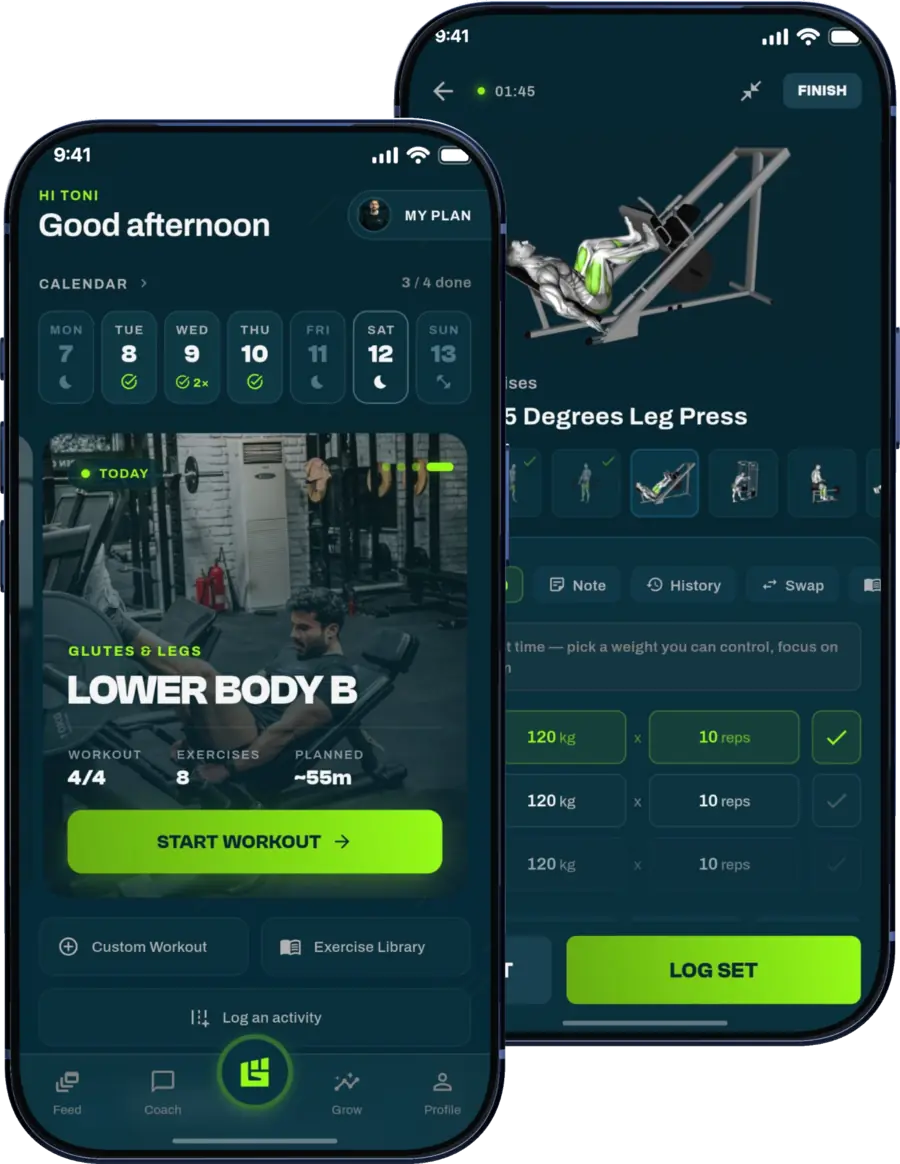
Take the guesswork out of training
Get a personalized workout plan built around your goal, equipment and schedule. Train smarter, track every rep and keep moving forward, one workout at a time.






The trade-off: stimulus vs. fatigue
Training to failure generates a massive amount of fatigue, both in your central nervous system and as local muscle damage. And while some muscle damage is a necessary trigger for growth, going overboard can crush your recovery and sabotage your next workout. This is where the real debate begins.
A smart training plan isn't just about creating a growth stimulus in one workout. It’s about managing fatigue so you can consistently apply that stimulus over weeks and months. That's the real foundation of long-term progress.
To get more precise than just going "all out," the concept of Reps in Reserve (RIR) was developed. It’s a simple but powerful way to gauge how close you actually are to failure on any given set.
- 0 RIR: This is true momentary failure—you could not have done another rep.
- 1-2 RIR: You had 1-2 good reps left in the tank. For muscle growth, this is often considered the "sweet spot."
- 3+ RIR: You stopped the set with 3 or more reps left, prioritizing form and recovery over maximal intensity.
Understanding how to use RIR lets you be much more strategic. You can push to true failure on certain exercises while leaving a few reps in reserve on others, creating a balanced and sustainable program. A personalized plan from a platform like GrabGains can help apply these principles, ensuring your training intensity is perfectly matched to your specific goals, whether that's building muscle, increasing strength, or improving overall fitness.
How your muscles actually respond to intense effort
To really get why training to failure can be such a game-changer, we need to peek under the hood and see what’s happening inside the muscle. When you lift weights, you’re sending a direct signal to your body: “Adapt or get left behind.” This whole process is driven by three key mechanisms.
Think of it like a construction project. You need an architect’s plan, a sense of urgency, and a little demolition before you can rebuild something bigger and better.
Mechanical tension: the architect’s blueprint
Mechanical tension is the raw, physical force your muscle fibers experience as they stretch and contract against a heavy load. It’s the single most important signal telling your muscles they need to grow. Every challenging rep creates this tension, basically handing your muscle cells the blueprint for a bigger, stronger structure.
This is the non-negotiable part of muscle growth. Without enough tension, the other two mechanisms don't have much to work with. It's why lifting super-light weights for hundreds of reps won’t pack on serious size—the tension is just too low.
Metabolic stress: the urgent deadline
You know that deep “burn” or skin-splitting “pump” you feel during a killer set? That’s metabolic stress. It’s caused by a buildup of byproducts like lactate and hydrogen ions when your muscles start running low on oxygen and energy.
Picture this as the foreman on the construction site screaming about an impossible deadline. This acidic, low-oxygen environment kicks off a cascade of hormonal and cellular responses that shout for adaptation. It's a powerful secondary driver of growth.
The "pump" isn't just for show. It's a clear sign of intense metabolic stress, which triggers unique muscle-building pathways that perfectly complement the effects of mechanical tension.
Training to failure is the ultimate way to max out this metabolic stress. As you grind through those last few reps, you completely drain local energy stores and flood the muscle with these byproducts, sending an unmistakable signal to get bigger.
Muscle damage: the demolition crew
Finally, there’s muscle damage. This refers to the microscopic tears that happen in your muscle fibers during intense training. This isn't an injury; it’s more like a controlled demolition that sets the stage for a repair and remodeling process.
Your body’s response is to not just patch up these tiny tears but to reinforce them, making them bigger and more resilient for the next time. This is exactly why you feel sore after a tough workout. It’s a crucial part of the process, but it also comes with a real recovery cost.
How failure cranks up the volume on growth
Training to failure doesn't just tap into one of these mechanisms; it amplifies all three, especially metabolic stress and muscle damage. Here’s a quick breakdown of how it works:
- Maximal Fiber Recruitment: As a set gets brutally hard and you near failure, your brain is forced to call in every last muscle fiber it can find. This includes the high-threshold motor units that only show up for the most demanding efforts—and activating them is essential for maximizing growth.
- Intense Metabolic Buildup: Those final, shaky reps are where metabolic stress goes through the roof. Pushing until you physically can't move the weight ensures you’ve created the most potent chemical soup possible for triggering hypertrophy.
- Significant Muscle Damage: The last few reps combine extreme mechanical tension with metabolic fatigue, leading to substantial micro-tears that kickstart that all-important repair and growth cycle.
But all this intensity comes at a price. The massive neural and muscular fatigue from going to failure can easily sabotage your next workout if you don't manage it. This is why it’s so important to have a solid recovery plan, which can include looking into the best supplements for muscle recovery to help speed things up. The "train to failure science" is clear: it’s a powerful tool, but it has to be used strategically—not as a blanket rule for every set of every workout, like the ones you might find in our back exercises guide.
Analyzing the research on failure for growth and strength
The gym floor is full of opinions, but what does the hard evidence actually say? To really get to the bottom of the train to failure science, we have to look past the anecdotes and dive into what controlled studies and large-scale analyses have uncovered. The scientific community has been picking this question apart for years, and the answer is a lot more nuanced than a simple "yes" or "no."
For decades, the default assumption was that failure was essential for growth. But modern research paints a more complex picture. It turns out the sweet spot for gains might actually be just shy of that absolute limit.
Strength gains vs. muscle growth
When researchers compare training to failure against stopping a few reps short, a clear pattern emerges depending on your goal. For pure strength—your ability to move the most weight possible for one rep (1RM)—the evidence is surprisingly consistent.
Pushing to failure doesn't seem to give you an edge for getting stronger. As long as the total amount of work is matched, lifters who leave a couple of reps in the tank see the same strength gains as those who grind out every last rep. The stimulus for strength is more about lifting heavy loads with high intent, not necessarily taking every set to muscular collapse.
But the story changes when we start talking about muscle growth (hypertrophy).
The closer you get to failure, the more potent the signal for your muscles to grow becomes. While stopping way short of your limit is less effective, those last few reps right before failure seem to be the most productive for hypertrophy.
This is where the debate gets interesting, and where things like training experience start to matter a whole lot.
The decisive research for experienced lifters
A real turning point in this conversation came from a meta-analysis that pooled the results of multiple studies. Back in 2021, a pivotal meta-analysis in the Journal of Sport and Health Science shook things up by digging deep into whether pushing to complete failure is truly necessary for building strength and size. Researchers gathered data from 15 high-quality studies on young adults, crunching the numbers to compare training to failure versus stopping short.
The big headline? For strength gains, there was no meaningful difference, with an effect size (ES) of -0.09. Whether you grind out that last rep or leave a couple in the tank, your 1RM improves about the same. For muscle growth, the overall effect size was a tiny 0.22, which also wasn't statistically different.
But here’s where it gets interesting for seasoned lifters—the kind of people using apps like GrabGains to optimize every detail. In the subgroup of resistance-trained individuals, training to failure produced a significant edge for muscle growth with an ES of 0.15. This suggests that experienced lifters might just be able to squeeze out a little extra growth by going all the way. You can explore the full study for a deeper dive into the findings.
That 0.15 effect size might sound small, but it translates to a real-world advantage. For a dedicated lifter who's chasing every ounce of muscle, that's an edge worth paying attention to. It hints that once your body is well-adapted to training, you might need the extreme stimulus of failure to keep the gains coming.
Why volume management is the real king
Maybe the most important takeaway from the research is all about workout volume. That same meta-analysis found something crucial: when the total training volume wasn't equal between the groups, the non-failure group actually saw better strength gains.
What does that look like in the real world? Let’s break it down:
- Failure Training: Is incredibly fatiguing. Hammering out three sets to failure might leave you so drained that you can't get any more quality work done.
- Non-Failure Training: Is less taxing. Stopping 1-2 reps short lets you recover faster between sets, which means you can often complete more total sets and reps (higher volume) in the same workout.
Think about it with a set of bench presses. If you go to absolute failure on your first set, your performance on the next two sets is going to tank. But if you stop just shy, you can maintain your strength and knock out more high-quality reps across all your sets.
This proves a fundamental principle: smart programming beats mindless intensity every time. The ability to rack up more productive work over the long haul is a much more powerful driver of progress than just annihilating yourself in a single set. This is where personalized tools really shine, helping you manage intensity and volume intelligently so you’re not stealing from tomorrow's gains just for today's effort.
Finding the sweet spot with proximity to failure
The whole debate around training to failure isn't really a "yes or no" question. The real detail that matters is how close you get. Modern train to failure science shows a clear relationship, especially for muscle growth: the closer you get to your absolute limit, the more powerful the muscle-building signal becomes.
This is why stopping a set five or six reps short of what you're truly capable of just doesn't pack the same punch as leaving only one or two reps in the tank. Those last few grinding reps are where your body is forced to recruit every last muscle fiber it has, creating the intense stimulus needed for growth.
The power of the 1-3 RIR range
This brings us to a practical sweet spot for most lifters: training within the 1-3 Reps in Reserve (RIR) range. Think of this zone as the best of both worlds. You get almost all the muscle-building benefits of going to true failure, but without the crushing recovery demands and higher injury risk.
This approach is a game-changer for anyone who needs to manage their fatigue. If you're an athlete who has to perform the next day or just a busy person juggling life with the gym, constantly pushing to your absolute limit can backfire. It generates so much systemic and neural fatigue that it can sabotage your next workout, meaning you get less quality work done over the long run.
By training hard in the 1-3 RIR zone, you rack up high-quality, stimulating reps without digging yourself into a recovery hole. This is the secret to making consistent, sustainable progress.
Recent science has really hammered this idea home. A 2023 meta-analysis from researchers at Florida Atlantic University, published in Sports Medicine, gave a clear verdict. While strength gains were surprisingly similar whether lifters stopped far from failure or went all the way, muscle growth told a different story. The closer you train to failure, the bigger the gains in muscle size, with sets ending near zero reps in reserve driving the best growth. It's solid proof that for building muscle, those last few reps truly matter. You can read more about the study's findings on proximity to failure.
This infographic gives you a quick visual summary of how training proximity to failure affects different goals for various experience levels.

As you can see, experienced lifters get a clear muscle-growth advantage by pushing closer to failure, while strength gains stay high even when stopping just short.
Why this matters for your workouts
Understanding this sweet spot lets you be much smarter with your programming. Instead of just chasing failure on every single set, you can apply that intensity where it counts most.
For big, taxing compound movements like squats and deadlifts, staying in the 2-3 RIR range is usually best to keep your form sharp and manage fatigue.
But for isolation exercises like bicep curls or shoulder raises, pushing closer to failure (0-1 RIR) on your final set can provide that extra growth stimulus without derailing your recovery. Our guide on effective shoulder exercises can help you put this idea into practice. This intelligent approach helps you maximize growth where it's safest and most effective, all while keeping your training sustainable.
Who should train to failure and when
Turning the science of training to failure into a real-world game plan is where the magic happens. The decision to push to your absolute limit isn't a simple yes or no; it depends on your experience, your goals, and even the exercise you’re doing.
A smart training strategy uses failure as a precision tool, not a blunt instrument you swing around on every set.
For beginners, the advice is straightforward: avoid training to failure entirely. Your first six to twelve months should be all about building a solid foundation. The goal is to master perfect form, learn how to feel the right muscles working, and give your tendons and ligaments time to adapt. Pushing to failure too soon almost always leads to bad habits and a much higher risk of injury.
A smarter approach for intermediate and advanced lifters
Once you have a year or more of consistent, structured training under your belt, you can start weaving failure into your workouts. For intermediate and advanced lifters chasing maximum muscle growth, this is where that extra intensity can really pay off. But you have to be smart about it.
The key is to save it for moments where the reward outweighs the risk. Here’s how to do it right:
- Focus on Isolation Exercises: Failure is safest on single-joint, machine-based, or dumbbell isolation movements. Think bicep curls, leg extensions, and lateral raises. On these, form breakdown is less risky, letting you push the target muscle to its true limit without much danger.
- Use It on the Final Set: Instead of going all-out on every set, use failure as a finisher. Do your first one or two sets in the 1-2 RIR range, then take only the final set of that exercise to true muscular failure.
- Skip It on Heavy Compound Lifts: For heavy squats, deadlifts, and bench presses, training to failure is a high-risk, low-reward gamble. The potential for your technique to crumble is huge, and that's a fast track to serious injury. Stopping with 1-3 reps in reserve on these big lifts is the smarter play for long-term progress. Our guide on proper leg exercise execution dives deeper into why form is non-negotiable on these big movers.
Periodizing your intensity for long-term growth
Your body is an adaptive machine, but it can’t run at 100% intensity all the time. Just like you periodize your volume, you should also periodize how close you train to failure. This means cycling through periods of high intensity followed by periods of lower intensity to let your body recover and come back stronger.
A great way to do this is with training blocks.
Think of your training in 3-4 week waves. You can spend one block pushing hard and getting close to failure, followed by a deload or a block where you pull back the intensity to allow your body to fully recover and grow.
This approach isn't just theory; the research backs it up. A 2020 study in the Journal of Human Kinetics looked at experienced lifters and found that training to failure wasn't necessary for impressive gains.
Over 10 weeks, lifters who stopped 1-2 reps short saw nearly identical quadriceps growth (12.4%) as those who went to failure (13.7%), even though they did 13.6% fewer total reps. The takeaway is that consistent, near-failure effort is incredibly effective and far more sustainable. You can see the study’s findings on training intensity for yourself.
This is where intelligent, personalized training really shines. An adaptive platform can automate this process, adjusting your reps in reserve based on your performance. It ensures you’re pushing hard when it counts and pulling back to recover when you need to—training smarter, not just harder, to build a more muscular and resilient physique over the long haul.
Putting your training plan into action
So, after digging into the science, the research, and the nitty-gritty details, what’s the real takeaway from all this train to failure science? It's that smart training isn't about chasing that last, grinding rep on every single set. It’s about knowing when to push that hard and when to hold back, based on your goals, your experience, and how well you can recover.

But let's be honest, that can feel like a lot to juggle. Trying to manage Reps in Reserve (RIR), pick the right exercises, and periodize your training takes a ton of mental energy and constant adjustments. Thankfully, modern tools are now built to handle that complexity for you, taking the guesswork out of the equation.
Using technology for smarter training
This is where an adaptive platform like GrabGains comes in. It’s designed to take all this science and apply it directly to your workout plan, automating those tough decisions so you can focus on lifting.
- For Hypertrophy: The system knows when to program workouts that get you right up to the edge of failure (0-1 RIR). Think the final set of a machine chest press, where you can safely max out your effort.
- For Strength and Recovery: On heavy compound lifts or days you need to manage your energy, the system dials it back to a more sustainable range (2-3 RIR). This ensures you're still making progress without digging yourself into a recovery hole.
This kind of intelligent programming means every set has a clear purpose. Instead of blindly following a static plan, your workouts actually adapt based on how you're performing. That’s the key to finding the sweet spot between the powerful stimulus of near-failure training and the non-negotiable need for recovery.
Smart training is about working harder when you can and smarter when you must. Technology helps you know the difference, ensuring consistent progress without burnout.
Of course, to get the most out of this kind of intense training, you have to nail your recovery. Implementing effective strategies for reducing muscle fatigue is a huge piece of the puzzle and can make or break your long-term gains.
The future of personalized fitness
The real magic of an adaptive system is that it learns. It tracks your performance over time—reps, sets, weight, even your session feedback—to figure out when you're ready for more intensity and, just as importantly, when it's time to back off with a deload.
This data-driven approach pulls the emotion out of the equation. No more wondering if you’re pushing too hard or not hard enough. The system makes objective calls for you, keeping your training productive week after week.
This is how you apply the science of training to failure for real, sustainable results. By blending proven principles with smart technology, you can train with a level of precision that used to be reserved for elite athletes. If you want more ideas on how to apply these principles, check out our guide to chest exercises.
Common questions about training to failure
Once you get past the science, a lot of practical questions pop up. Let's tackle the most common ones so you can feel confident about how (and when) to apply this in the gym.
How often should I train to failure?
Think of it this way: training to failure is a tool, not a rule. And like any powerful tool, you want to use it sparingly.
For most people focused on building muscle, a good starting point is to take only the final set of one or two isolation exercises to true failure per workout. This gives you that extra growth signal without the system-wide fatigue that can wreck your next training day.
Is training to failure safe?
It all comes down to exercise choice. Pushing to failure on a bicep curl or a leg extension is pretty low-risk. If your form starts to wobble, you just stop. No big deal.
On the other hand, taking a heavy barbell squat or deadlift to failure is a recipe for disaster. When your form breaks under a heavy bar, the risk of serious injury skyrockets. For those big compound lifts, always leave a rep or two in the tank and live to train another day.
Your non-negotiable rule should always be this: the moment your technique falters is the moment the set ends. That's technical failure, and it's your absolute stopping point.
Should beginners train to failure?
In a word, no. If you’re new to lifting, your job isn't to annihilate your muscles—it's to master the movements.
The first few months are all about building good habits: learning proper form, developing a mind-muscle connection, and letting your body adapt. Pushing to failure too early just ingrains bad technique and cranks up injury risk. Instead, beginners should stick to a consistent 2-3 Reps in Reserve (RIR), making sure every single rep is clean.
What’s the difference between muscular and technical failure?
This is a critical distinction that keeps you safe and makes your training effective. It's simple, but most people get it wrong.
- Muscular Failure: This is the goal post. It's when you physically can't complete another rep with perfect form because the target muscle is just tapped out.
- Technical Failure: This is the red flag. It’s the point where your form breaks down and you start using momentum, other muscles, or sloppy movement to cheat the weight up.
You should only aim for muscular failure on a few, carefully chosen exercises. You should always stop at the first sign of technical failure on every single lift you do.
Ready to stop guessing and start applying the science of training intensity the right way? GrabGains builds personalized workout plans that manage your effort for you, pushing you toward failure when it matters and backing off for recovery. Download GrabGains on iOS or Android today and start training smarter.
Get inspired and motivated