Optimal training frequency for muscle growth
Unlock your muscle-building potential with the right training frequency hypertrophy. This guide reveals how often to train for science-backed, optimal gains. When it comes to the best training frequency for hypertrophy, the evidence points to one approach: hitting each muscle group at least twice per week. This consistently builds more muscle than the old-school, once-a-week "bro split," as long as your total weekly training volume stays the same.
It’s all about being smart with your schedule to maximize the muscle growth signal.


How often should you train for maximum muscle growth?
For years, the gym floor debate raged: is it better to completely annihilate a muscle once a week or stimulate it more often with less intensity each time? The science has settled this, showing that higher frequency is a powerful tool for unlocking more consistent gains.
Instead of one massive, exhausting workout, you split your volume across multiple sessions. This allows for higher-quality sets and much better recovery between them.
This changes the conversation from how much you lift to how strategically you plan your training. Think of it as giving your muscles frequent nudges to grow throughout the week, rather than one big shout followed by six days of silence. The goal is to keep the muscle-building engine running smoothly all week long.
Built for progress
Take the guesswork out of training
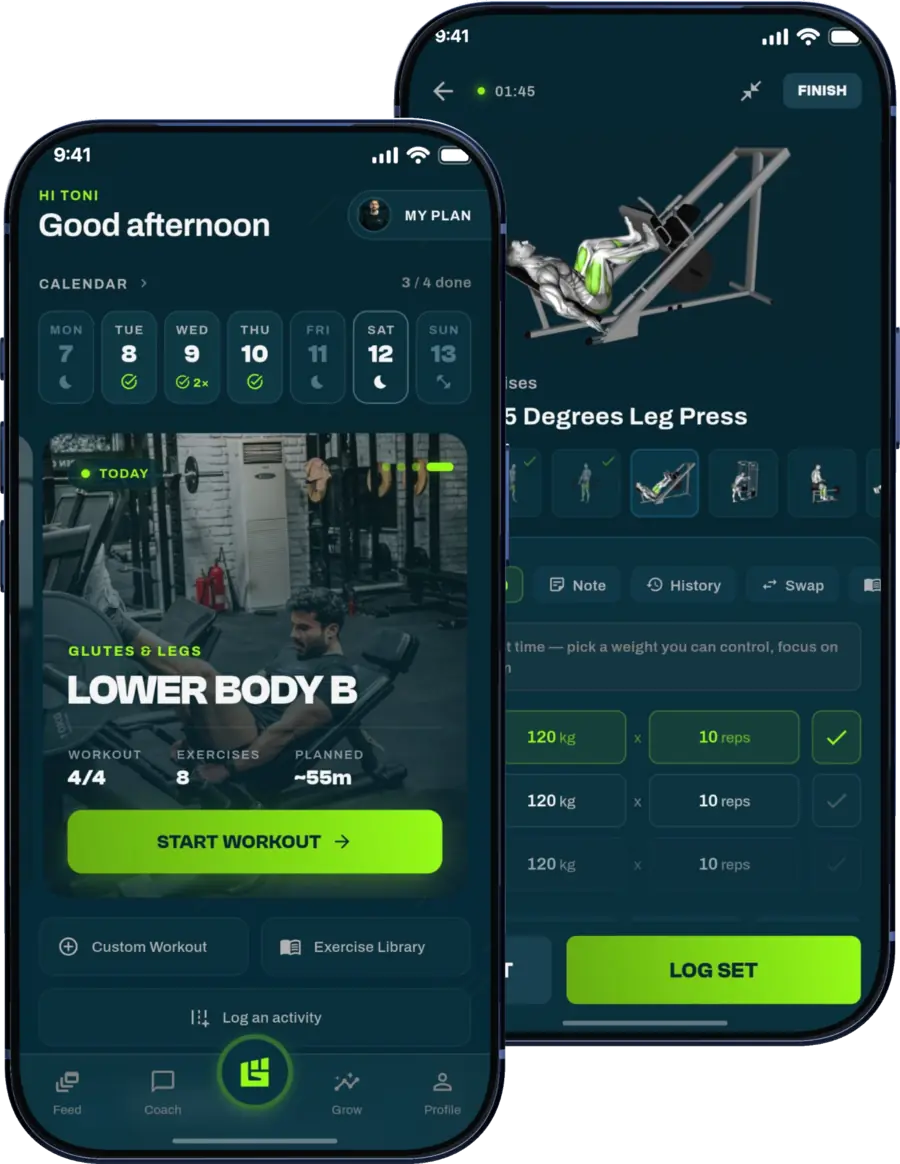
Get a personalized workout plan built around your goal, equipment and schedule. Train smarter, track every rep and keep moving forward, one workout at a time.






The science behind training twice a week
This isn't just gym wisdom; it’s backed by solid research. Key studies have put different training frequencies head-to-head, and the results are eye-opening for anyone serious about building muscle.
A landmark 2016 meta-analysis found that training a muscle group twice per week was significantly better for growth than hitting it just once. When the total weekly sets were matched, the higher-frequency group saw roughly 63% greater muscle growth. That’s a huge difference and a compelling, evidence-based reason to move on from the once-a-week model if your main goal is hypertrophy.
What this means for your workout plan
This doesn’t mean you need to live in the gym seven days a week. It’s about structuring your plan so that each major muscle group—chest, back, legs, shoulders, and arms—gets direct work on at least two different days.
This is easy to set up with some of the most effective and popular training splits:
- Full-Body Routines: Hitting your entire body three times per week.
- Upper/Lower Splits: Training your upper body twice and your lower body twice per week.
- Push/Pull/Legs (PPL): This split lets you hit each muscle group twice over a six-day training cycle.
Getting your split right is simple with smart planning. And while training frequency is crucial, you can't out-train a bad diet. To make sure you’re fueling all that hard work, check out this guide on muscle gaining supplements.
Why more frequent training sparks more growth
To understand why training frequency matters so much, think of building muscle like tending a garden. To make your plants grow, you have to water them. That watering is the stimulus—the signal that kicks off growth—but its effects don’t stick around forever.
Every time you train a muscle, you’re flipping a switch that tells your body to start building new tissue. This biological process is called Muscle Protein Synthesis (MPS), and it’s the engine that drives every ounce of muscle you gain. A good workout cranks up MPS, putting your body in a prime muscle-building state.
But here’s the catch: this elevated state is on a timer. After a tough session, the MPS signal stays strong for about 24 to 48 hours. After that, it drops back to baseline, and that prime window for growth closes. This is exactly where the old-school "bro split" starts to fall apart.
The problem with training a muscle once a week
Imagine watering your garden only on Sunday. For a day or two, the soil is damp and the plants are thriving. But by Wednesday, the ground is bone dry, and the plants are just waiting around for the next watering. For most of the week, their growth potential is sitting on pause.
Training a muscle just once a week works the same way. If you blast your chest on Monday, MPS is running high on Monday and Tuesday. But for the rest of the week—Wednesday, Thursday, Friday, Saturday, and Sunday—that growth signal is off. You're leaving five whole days of potential gains on the table.
This rhythm of stimulus and response is the core of effective training. Leaving a muscle unstimulated for five or six days is like leaving a factory idle; the machinery is there, but nothing is being produced.
This is why a higher training frequency for hypertrophy is so powerful. It’s not about cramming more total work in, but about timing your "watering" sessions more strategically to keep the growth process humming all week long.
Keeping the growth signal switched on
By hitting each muscle group at least twice a week, you create overlapping waves of Muscle Protein Synthesis. Instead of one big spike followed by a long, flat line, you get a consistently elevated muscle-building environment.
Here’s what that looks like in practice:
- Session 1 (Monday): You train your chest, spiking MPS for the next 48 hours.
- Session 2 (Thursday): Right as the growth signal from Monday’s workout starts to fade, you train your chest again. This re-stimulates MPS and kicks off another 48-hour growth window.
This simple shift turns your entire week into an opportunity for growth. You’re no longer wasting days just waiting for your next session to roll around.
Better stimulus quality and recovery
Spreading your training volume out also makes each workout better. Instead of trying to survive 16 sets for your back in one grueling, marathon session, you can split it into two focused workouts of eight sets each.
This means you can approach each set with more energy and sharper technique, leading to a much higher-quality stimulus. The result is a more potent signal for growth from every single session and a much more sustainable way to train for the long haul.
Balancing frequency, volume, and intensity
Think of training frequency, volume, and intensity as the three legs of a stool. If one is too long or too short, the whole thing gets wobbly and unstable. Nailing the balance between these three variables is what separates a decent program from a truly great one.
Frequency isn't just about dragging yourself to the gym more often; it's a strategic tool. It's how you cleverly manage your total weekly workload, spreading out volume and intensity to maximize performance and keep fatigue in check. The result? Every set you do becomes more productive.
Trading marathon sessions for quality work
The old-school "bro split" often calls for marathon sessions where you absolutely hammer one muscle group into oblivion. It might feel productive because you're sore for days, but the quality of your work takes a nosedive as the workout drags on.
This is where the idea of "junk volume" comes in. We’re talking about those sloppy, exhausting sets you barely grind out at the end of a long session. Your muscles are shot, your form is probably breaking down, and you’re just going through the motions. These sets pile on fatigue but offer next to nothing for muscle growth.
The goal isn't just to accumulate sets; it's to perform high-quality, stimulating sets. Frequency is the tool that makes this possible.
By splitting a single massive workout into two smaller, more manageable ones, you can attack every set with more power, focus, and precision. This guarantees that each rep is a meaningful step toward building more muscle.
How frequency enhances volume and intensity
Let's say your weekly goal for your chest is 16 total sets. You've got a couple of ways you could structure this:
- Low-Frequency Approach: One brutal session where you perform all 16 sets. The first 8-10 sets probably feel strong, but the last 6-8 will be a real grind. You'll be fatigued, and their effectiveness tanks.
- High-Frequency Approach: Two focused sessions of 8 sets each. In both workouts, you’re fresh enough to lift heavy and maintain crisp form for every single rep.
In the second scenario, the total weekly volume is identical, but the quality of that volume is significantly higher. Over time, this improved quality delivers a much better growth stimulus. You're able to lift with greater intensity on more of your sets, which is a key driver of hypertrophy. A well-designed program, like those you can map out with a good workout builder, helps you organize this balance without the guesswork.
Finding a sustainable balance
This balanced approach also makes your training far more sustainable. Instead of crawling out of the gym feeling completely wiped out, you leave feeling challenged but energized. This simple shift helps prevent burnout and keeps overuse injuries at bay.
Of course, managing this delicate interplay requires more than just smart programming. You need to dial in your recovery. To effectively handle higher frequency, volume, and intensity, recovery strategies are non-negotiable. Exploring methods like using a sauna for muscle recovery can help, but don't forget the fundamentals: proper sleep, nutrition, and stress management are the bedrock of your progress.
Ultimately, the best training frequency for hypertrophy is the one that lets you consistently perform high-quality work without running yourself into the ground. When you start seeing frequency as a tool to improve the quality of your volume and intensity, you unlock a smarter, more sustainable path to building the physique you want.
Finding your personal training frequency sweet spot
Alright, let's move from the science to the real world—your gym plan. The “optimal” training frequency isn't some magic number you can find online. It’s a moving target, completely dependent on your body, your schedule, and your life outside the gym.
One of the biggest mistakes lifters make is copying an elite bodybuilder's routine, which almost always leads to burnout, not growth. The real goal is to build a smart, sustainable plan that works for you. Three key factors will tell you exactly where your personal frequency sweet spot lies.
Your training age and experience
How long you’ve been lifting consistently is probably the single most important variable. A beginner’s body is a sponge for new stimulus, while an advanced lifter has to fight for every ounce of muscle.
- Beginners (0-1 year): When you're new, your muscles are incredibly responsive. You don't need to hammer them with tons of volume to grow. A full-body routine performed three times per week is often the gold standard. This approach gives you repeated practice on the main lifts and keeps the muscle-building signal firing all week long, fueling those rapid "newbie gains."
- Intermediates (1-3 years): Once the newbie gains slow down, you need more total work to keep the progress coming. This is where a higher frequency becomes a huge advantage. It lets you spread out your volume so your workouts don't turn into grueling, 2-hour slogs. Training each muscle group twice per week with something like an upper/lower split is a fantastic sweet spot for most intermediates.
- Advanced Lifters (3+ years): For the seasoned lifter, progress is slow and hard-won. To keep growing, you often need very high weekly volumes. Hitting each muscle 3-4 times per week becomes a practical tool to get all that work in without crushing your recovery on any single day.
Recovery capacity: the make-or-break factor
Your ability to recover is the engine that drives your results. You can have the most dialed-in program on paper, but if you can’t recover from it, you won't grow. It’s that simple.
Your body doesn't know the difference between stress from a heavy squat session and stress from a crazy week at work. It all draws from the same recovery bank account.
Several huge lifestyle factors dictate your recovery capacity:
- Sleep: Getting 7-9 hours of quality sleep is non-negotiable. This is primetime for muscle repair and growth hormone release.
- Nutrition: You can't build a house without bricks. A solid calorie surplus and enough protein are the raw materials your body needs to rebuild bigger and stronger.
- Stress: High levels of life stress jack up cortisol, a hormone that actively works against muscle growth.
If your sleep is a mess, your diet is all over the place, or you're chronically stressed, your ability to handle a high training frequency plummets. You are far better off crushing a lower-frequency program than barely surviving an ambitious one.
Lifestyle and scheduling constraints
Last but not least, your plan has to actually fit into your life. The best program in the world is useless if you can't stick to it consistently. It doesn’t matter if a six-day-a-week split is "optimal" if you can realistically only get to the gym three days.
Let’s say you have a demanding job and your only available days are Monday, Wednesday, and Friday. A full-body routine is the perfect solution. It lets you hit every major muscle group multiple times, respecting the core principles of effective training frequency for hypertrophy while fitting perfectly into your schedule.
When you honestly assess these three pillars—experience, recovery, and schedule—you can finally move beyond generic templates. You start building a truly personal strategy. This process is made a whole lot easier with adaptive programming tools. To see how technology can build a plan around your unique needs, discover how the GrabGains app creates personalized workouts that evolve with you.
Building your week with popular training splits
Alright, we’ve covered the principles. Now, let’s get practical. Knowing you need to hit each muscle a couple of times a week is one thing; actually arranging your workouts to make that happen without living in the gym is another.
Let's look at three of the most popular and effective training splits. These aren't just abstract ideas—they're proven, plug-and-play templates you can use to structure your week, no matter your schedule or experience level. Think of them as blueprints for building your ideal physique.
The 3-day full body split
The full-body split is a classic for a reason. It's brutally efficient and incredibly effective, making it a perfect fit for beginners or anyone tight on time.
By training your entire body every session, you guarantee each major muscle group gets stimulated three times per week. This creates a constant signal for growth. It’s the ultimate "bang for your buck" routine. Because you're hitting muscles so often, you don't need a ton of volume in any single workout. Just a few well-chosen compound lifts are enough to trigger a powerful muscle-building response.
The 4-day upper/lower split
As you get stronger, you'll find you need more total weekly volume to keep the gains coming. The upper/lower split is the logical next step. It lets you dedicate entire sessions to either your upper or lower body, which means you can add more quality sets for each muscle without your workouts dragging on forever.
This split is the sweet spot for most intermediate lifters. You're still training every muscle group twice a week—maintaining that optimal frequency for hypertrophy—but with the added benefit of more focused volume and better recovery between sessions. It’s a balanced, sustainable approach that has built countless impressive physiques.
This diagram shows how different factors stack up to determine your ideal frequency.

As you can see, your training age is the foundation. But your recovery capacity and lifestyle are just as critical in deciding what you can realistically stick to.
The 5-day push/pull/legs (PPL) split
For lifters who can commit to five training days a week and want to maximize muscle growth, the Push/Pull/Legs (PPL) split is king. This setup organizes workouts by movement pattern: pushing (chest, shoulders, triceps), pulling (back, biceps), and of course, legs.
When you run PPL on a rotating schedule (like Push, Pull, Legs, Rest, Push, Pull, Rest...), every muscle group gets hit roughly twice per week. This structure allows for a very high volume of quality work, making it a favorite among advanced lifters and physique athletes. The research backs this up, too.
A huge meta-analysis found that training muscles more than once a week led to 28% faster lower body growth and a staggering 40% faster upper body growth compared to hitting them just once. This shows just how powerful a higher frequency split can be. For more on this, check out the full breakdown at Stronger by Science.
Comparison of popular training splits
So, which split is right for you? To help you decide, here’s a simple breakdown of how these three popular structures compare. Be honest about your schedule, experience, and goals to make the best choice.
| Training Split | Weekly Schedule | Frequency Per Muscle | Best For |
|---|---|---|---|
| Full Body | Mon, Wed, Fri | 3x per week | Beginners, time-crunched individuals, or those focused on strength and functional fitness. |
| Upper/Lower | Mon, Tue, Thu, Fri | 2x per week | Intermediate lifters who need more volume to progress and want a balanced approach to strength and size. |
| Push/Pull/Legs | Mon, Tue, Wed, Fri, Sat | ~2x per week | Advanced trainees aiming to maximize volume and muscle growth who can commit to 5+ gym days. |
At the end of the day, no matter which split you pick, consistency and progressive overload are what truly matter. Each of these templates gives you a solid framework to apply the principles of training frequency effectively. If you're running an upper/lower or PPL split and need ideas for your lower body days, our guide on leg exercises has you covered with a huge library of movements.
Common questions about training frequency
Even with a solid plan, a few questions always pop up when you're dialing in your training. Let's tackle some of the most common ones to clear up the confusion so you can move forward with confidence.
Is training a muscle only once a week a waste of time?
It’s definitely not a "waste," because any training is better than none—especially if you're new to lifting. That said, it’s not the fastest way to grow. The research is clear on this: when weekly volume is matched, hitting a muscle at least twice a week gets you far better results.
The problem with the old-school "bro split" is all the downtime. The muscle-building signal you send with a workout, called Muscle Protein Synthesis, fires up and then returns to baseline after about 48 hours. Training a muscle once a week leaves it sitting idle for the next five days. That's a huge missed opportunity for growth.
Can I train the same muscle every day for faster results?
This is almost always a bad idea for building muscle. Growth doesn't happen in the gym; it happens when you're recovering. Smashing the same muscles day after day prevents them from ever repairing and getting stronger, which is a fast track to overtraining, joint pain, and watching your numbers go down.
Instead of speeding things up, this approach actually sabotages your progress. The sweet spot for balancing stimulus and recovery is hitting a muscle 2-4 times per week. For some great exercise ideas to slot into your split, check out our in-depth guide to chest exercises.
Does frequency matter if my total weekly volume is low?
It does, but it becomes much more important as your volume goes up. If you’re only doing 6-8 total sets for a muscle each week, you can probably knock those out in one solid session without any real drop-off in quality.
But as you get more advanced, you'll need more volume to keep making progress—often 15-20 sets per week, or even more. Trying to cram that much work into a single workout is just a recipe for "junk volume," where fatigue tanks your form and your later sets do more harm than good.
Higher frequency becomes the key to managing higher volumes effectively. It allows you to split the work, ensuring every set is performed with the focus and intensity needed to trigger real growth.
Think of frequency as the tool that lets you do more productive work over the long haul. It's what allows you to maintain quality as the quantity of your training inevitably rises.
Ready to stop guessing and start building a smarter workout plan? GrabGains creates an adaptive training program that optimizes your frequency, volume, and exercise selection based on your real-time progress. Download GrabGains on iOS or Android today and discover what a truly personalized plan can do for you.
Get inspired and motivated