Dumbbell Incline Biceps Curl vs Dumbbell Biceps Curl
These two dumbbell curl variations train the same primary muscle group, but they do not stress the biceps in the same way. The main difference is shoulder position: the incline version places the upper arm behind the torso, while the standard curl is usually performed with the arm at the sides. That changes the starting length of the biceps, the amount of momentum available, and which exercise is easier to load and repeat consistently.
Veröffentlicht: 2026-07-23
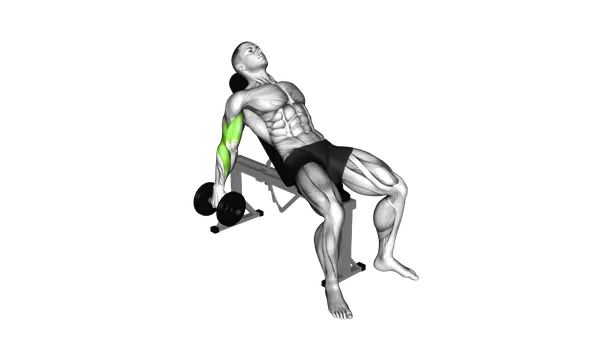
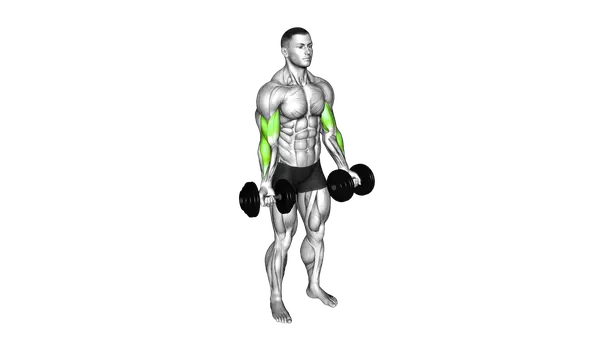
Setup and mechanics
The Dumbbell Biceps Curl is the simpler setup. You stand or sit upright with a dumbbell in each hand and curl through a controlled range of motion with the arms near the sides. It is a beginner-level isolation exercise and is easy to perform at home.
The Dumbbell Incline Biceps Curl requires an incline bench and places the shoulders in extension, with the upper arms slightly behind the torso. That position increases the stretch on the biceps at the bottom and reduces the ability to use body English. It is still home-friendly, but the setup is more demanding and the exercise is classified as intermediate.
Muscle emphasis and lengthened-position work
Both exercises primarily train the biceps and secondarily involve the forearms. The incline version changes the line of pull by starting from a more lengthened biceps position, which tends to make the bottom half of the curl more demanding.
That difference matters because training the elbow flexors in the initial range of motion, where the muscle is longer, has been shown to produce greater muscle adaptations than emphasizing the final range in the arm curl [1]. The incline curl is therefore the more specific choice when the goal is to challenge the biceps under stretch and limit compensation.
Loading, progression, and exercise difficulty
The standard Dumbbell Biceps Curl is usually easier to load progressively. Most people can handle more weight, add reps more predictably, and maintain a stable groove because the body position is straightforward. That makes it a practical base exercise for building general biceps size and strength.
The incline curl usually requires lighter dumbbells because the stretched start position increases difficulty and exposes technical breakdown sooner. Progression often comes from smaller load jumps, stricter tempo, pauses at the bottom, or tighter control of elbow position rather than from large increases in weight.
Joint stress and common limitations
The standard curl is generally more forgiving at the shoulder because the arm starts closer to neutral. Its main limitation is that it is easier to cheat with torso sway, shoulder flexion, or elbow drift, especially as the load rises. Those adjustments can reduce direct biceps tension and turn the movement into a less strict curl.
The incline curl usually improves strictness, but the deeper shoulder extension can be less comfortable for people with limited shoulder mobility or irritation at the front of the shoulder. The bottom position also places higher demand on the biceps tendon and the stretched tissues around the elbow and shoulder. If that position causes discomfort, the standard curl is usually the better-tolerated option.
When each exercise is the better choice
Use the Dumbbell Biceps Curl when you want a simple, repeatable exercise that is easy to learn, easy to recover from, and easy to progress. It fits well as the main curl variation for beginners and for lifters who want balanced biceps and forearm involvement without a specialized setup.
Use the Dumbbell Incline Biceps Curl when strict form and lengthened-position tension are the priority. It is especially useful after a heavier curl variation, or as the main choice when standard curls are being performed with too much momentum. It is less about maximum load and more about controlling the full curl from a stretched start.
Das Fazit
Pick the Dumbbell Biceps Curl if you want the more accessible, beginner-friendly option and the easiest path for steady loading. Pick the Dumbbell Incline Biceps Curl if you want stricter execution and more emphasis on the biceps in the stretched, initial range of motion, which may support greater hypertrophy stimulus [1]. For many programs, the standard curl works best as the primary strength-building variation, while the incline curl works best as a secondary or more targeted hypertrophy exercise. If shoulder extension is uncomfortable, default to the standard curl.
Was ist dein Fitnessziel?
Wähle eines aus und die App baut dein Programm darum herum, um deine Ausrüstung und um die Tage, an denen du trainieren kannst.
Auf einen Blick
Dumbbell Incline Biceps Curl
Dumbbell Biceps Curl
Häufige Fragen
Is the incline curl better for biceps growth than the standard dumbbell curl?
It can be, depending on the goal. The incline curl places the biceps under more tension in a lengthened starting position, and training the initial range of motion in the arm curl has been shown to promote greater muscle adaptations than the final range [1]. The standard curl is still effective, but it is less specialized toward that stretched-position demand.
Which exercise should beginners start with?
Beginners should usually start with the Dumbbell Biceps Curl. It has a simpler setup, a lower technical demand, and makes it easier to learn controlled elbow flexion before adding the stricter shoulder position used in the incline variation.
Can both exercises be used in the same workout?
Yes. A common approach is to perform the standard Dumbbell Biceps Curl first for heavier, more stable sets, then use the Dumbbell Incline Biceps Curl for stricter, lighter work that emphasizes the stretched position. This combines straightforward loading with more targeted biceps isolation.
Wissenschaftliche Quellen
Pedrosa GF, Simões MG, Figueiredo MOC et al. · Sports (Basel, Switzerland) (2023)
Die Quellen sind begutachtete wissenschaftliche Publikationen von PubMed.