Back
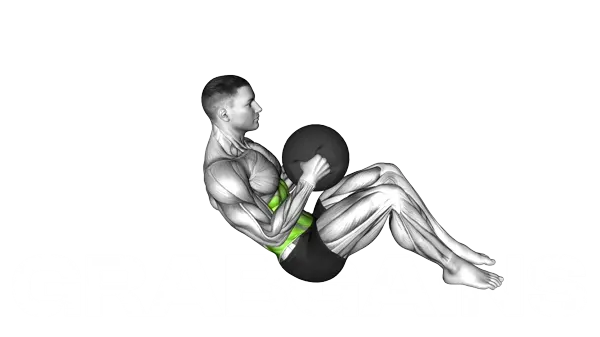
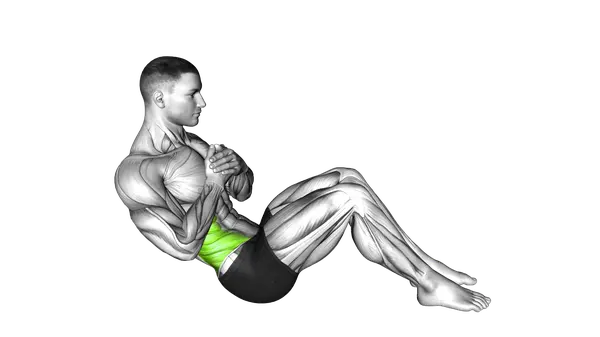
Russian Twist (Medicine Ball)
Add to Workout

Russian Twist (Medicine Ball)

Build

How to Perform

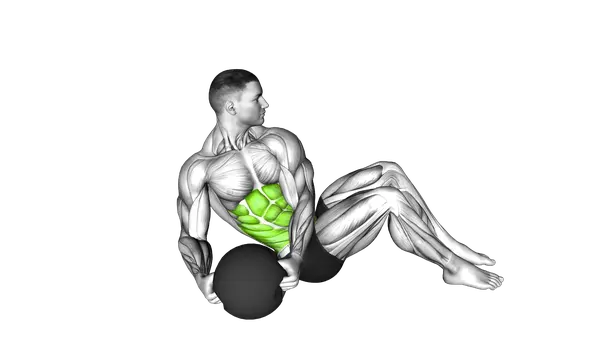
  1. Sit on the floor with your knees bent and feet flat, holding the medicine ball close to your chest with both hands.
  2. Lean back slightly to create a 45-degree angle between your torso and the floor, engaging your core muscles to maintain this position.
  3. Lift your feet a few inches off the ground while keeping your knees bent, creating a V-shape with your body as you balance on your sit bones.
  4. Extend your arms forward with a slight bend in the elbows, holding the medicine ball approximately 6-8 inches away from your chest.
  5. Exhale as you rotate your torso to the right, bringing the medicine ball toward the floor beside your hip while keeping your feet elevated and spine long.
  6. Inhale as you return to center, maintaining tension in your abdominal muscles and keeping your chest lifted throughout the movement.
  7. Exhale and rotate to the left side in the same controlled manner, ensuring your shoulders remain pulled back and down away from your ears.
  8. Continue alternating sides in a smooth, controlled motion, focusing on rotating from your midsection rather than simply moving your arms.

Important information

  • Keep your back straight throughout the exercise; avoid rounding your shoulders or collapsing through your chest.
  • Adjust the difficulty by changing your foot position—keep both feet on the ground for beginners or extend your legs fully for advanced practitioners.
  • Focus on rotating through your torso rather than just moving the ball with your arms to maximize core engagement.
  • Start with a lighter medicine ball (2-4 lbs) and progress to heavier weights only after mastering proper form.

Exercise Details

Primary Muscles

Abs Obliques

Muscle Groups

Ab exercises

Mechanic

Isolation

Risk Areas

Abs

Built for progress

Take the guesswork out of training

Create personalized AI-powered workout plans that evolve with you. Train smarter, track every rep and keep moving forward, one workout at a time.

Be among the first to join!
GrabGains workout plans

The Russian Twist with a medicine ball delivers an exceptional core challenge that targets both your abs and obliques simultaneously. This intermediate-level movement has gained popularity across multiple training disciplines including HIIT, CrossFit, and bodybuilding programs due to its effectiveness at developing rotational strength and stability.

Working beyond the standard abdominal exercises, the Russian twist engages the deeper core musculature, particularly the transverse abdominis and obliques, which are crucial for functional movement patterns in everyday life and athletic performance. The addition of a medicine ball adds resistance that intensifies the exercise, creating greater muscle activation through each rotation.

What makes this exercise particularly valuable is its ability to train the core in a multi-planar fashion. While many core exercises focus primarily on sagittal plane movements (forward and backward), the Russian twist incorporates rotational strength through the transverse plane, which is essential for sports that require twisting motions like golf, tennis, baseball, and martial arts.

The beauty of the Russian twist lies in its scalability. As your core strength develops, you can progress by using heavier medicine balls, increasing your range of motion, or elevating your feet off the ground to create greater instability. This adaptability makes it suitable for continued progression within your fitness journey, regardless of whether you're using it as part of a HIIT circuit, CrossFit WOD, or traditional bodybuilding routine.

For optimal core development, the Russian twist with a medicine ball complements exercises like planks, deadlifts, and squats by adding that crucial rotational component to your training regimen. When performed consistently with proper form, this exercise contributes significantly to core strength, spinal stability, and improved athletic performance across multiple domains, while also helping to sculpt those coveted oblique muscles that contribute to a well-defined midsection.

FAQ - Russian Twist (Medicine Ball)

What muscles does the Russian Twist with a medicine ball target?

The Russian Twist primarily targets your obliques and rectus abdominis (six-pack muscles), while also engaging your transverse abdominis (deep core), hip flexors, and lower back muscles. The rotational movement specifically challenges the obliques, making it excellent for developing a strong, functional core.

How can I modify the Russian Twist if I'm a beginner?

Beginners should start with feet flat on the floor, use a lighter medicine ball (2-4 lbs), and perform slower, controlled rotations with a smaller range of motion. As you build strength, progress by lifting your feet, increasing the medicine ball weight, or extending your arms further from your body.

What are the most common form mistakes to avoid?

The most common mistakes include rounding your lower back, rotating your hips instead of keeping them square, rushing through the movement, and not hinging properly at the hips. Focus on maintaining a neutral spine, moving with control, and keeping your standing knee slightly soft rather than locked.

How often should I include Russian Twists in my workout routine?

Incorporate Russian Twists 2-3 times weekly as part of your core training, allowing at least 48 hours between sessions for muscle recovery. Start with 2-3 sets of 10-15 rotations per side, gradually increasing volume as your core strength improves.

Is the Russian Twist safe for people with back problems?

Russian Twists may not be suitable for those with acute lower back pain or certain spinal conditions. If you have back issues, consult a healthcare provider first, and consider modifications like keeping both feet on the floor, reducing range of motion, or substituting with plank rotations until core strength improves.

Alternative Exercises

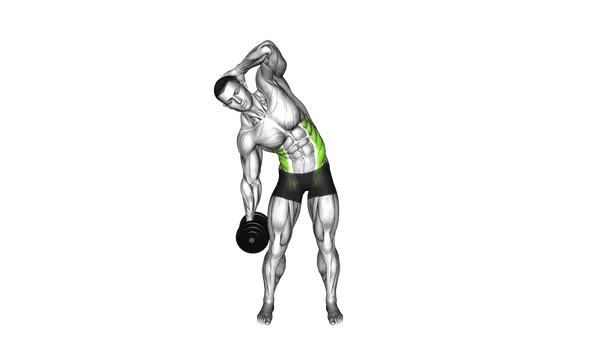
Dumbbell Side Bend

Dumbbell Side Bend

The Dumbbell Side Bend stands as a fundamental core exercise that specifically targets the obliques—those muscles running along the sides of your abdomen. This beginner-friendly movement helps develop a stronger, more stable midsection while adding definition to your waistline. Unlike many core exercises that focus primarily on the front abdominal wall, side bends directly engage the often-neglected lateral core muscles. When incorporated into bodybuilding routines, this exercise contributes to a more complete physique development, helping create that coveted V-taper by emphasizing the oblique muscles. The movement allows for progressive overload through increased weight, making it adaptable as your strength improves. Many fitness enthusiasts appreciate how side bends create a noticeable burn in areas that traditional crunches or sit-ups might miss. The beauty of the Dumbbell Side Bend lies in its versatility. It serves multiple purposes within a fitness program, functioning effectively as part of a comprehensive warm-up to activate the core before more demanding exercises. During recovery phases, lighter weight side bends can promote blood flow to the midsection without excessive strain. The exercise requires minimal space and equipment, making it accessible for home workouts or crowded gym environments. Beyond aesthetic benefits, strengthening your obliques through side bends enhances rotational stability and helps protect your spine during everyday movements. Strong obliques contribute significantly to improved posture and reduced risk of lower back issues. The core engagement required helps develop the neuromuscular connections necessary for more advanced fitness endeavors. Regular inclusion of Dumbbell Side Bends in your routine can help create a more balanced core development approach. While six-pack abs might get all the attention, the complete core package includes well-developed obliques that provide both functional strength and visual appeal. This time-tested exercise continues to be a staple in fitness programs across experience levels for good reason—it delivers results when performed consistently within a well-rounded routine.

Core
Bodybuilding
Recovery
+1
Dumbbell
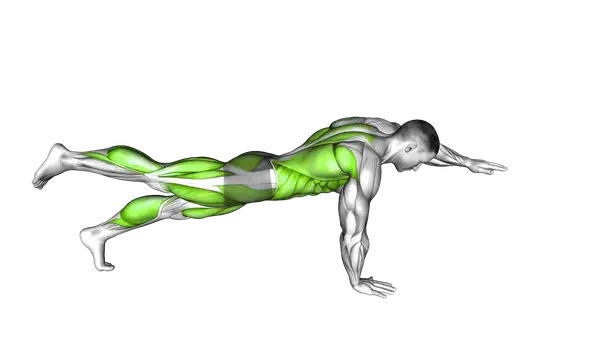
Push-up plank with alternating arm and leg lifts

Push-up plank with alternating arm and leg lifts

The push-up plank with alternating arm and leg lifts represents one of the most comprehensive core challenges in the fitness world, simultaneously engaging multiple muscle groups while testing your stability and coordination. This advanced movement elevates traditional planking by incorporating dynamic limb movements that force your core to work overtime, particularly targeting your abs and glutes while secondary muscles act as crucial stabilizers. When you incorporate this exercise into your routine, you're essentially performing multiple exercises at once: combining the anti-rotational benefits of planks with the destabilizing effect of limb movement, creating an intense core engagement that static exercises simply can't match. The constant fight against rotation as you lift opposing limbs forces your deep transverse abdominis and obliques to fire continuously, while your glutes activate powerfully to maintain proper hip position throughout the movement. This versatile exercise finds its home across multiple training modalities. HIIT enthusiasts appreciate how it elevates heart rate while building functional strength, CrossFit athletes value its scalability and core-strengthening benefits, and bodybuilders recognize its ability to develop detailed abdominal definition and enhance overall core aesthetics. The beauty lies in its adaptability: the intensity can be modified through tempo changes, hold durations, or by adding resistance bands. What makes this movement truly exceptional is how it enhances core function beyond mere appearance. Your core serves as your body's power center, transferring force between upper and lower body while protecting your spine. By strengthening these connections through complex movements like the push-up plank with alternating limb lifts, you're building a resilient foundation that translates to improved performance across all physical activities, from daily movements to specialized athletic endeavors. For those willing to embrace the challenge, this exercise delivers remarkable returns: not just in core strength and definition, but in total-body stability, improved posture, and enhanced movement efficiency that will serve you well in any fitness pursuit you choose to undertake.

Core
HIIT
Crossfit
+1
Bodyweight exercises
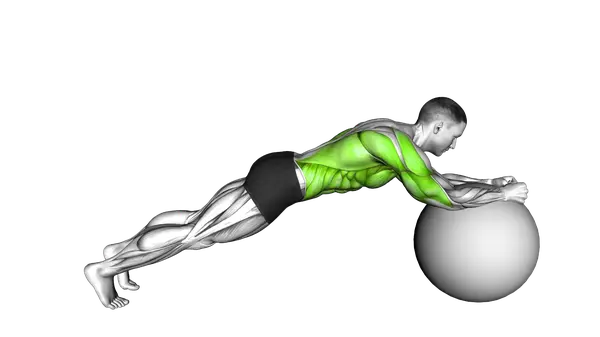
Stability Ball Body Saw

Stability Ball Body Saw

The Stability Ball Body Saw stands as a remarkable core-strengthening exercise that challenges your abdominal muscles and front deltoids simultaneously, making it a perfect addition to any intermediate fitness enthusiast's routine. This dynamic movement builds upon the traditional plank by incorporating an element of instability and controlled motion that intensifies the engagement of your core musculature. When properly executed, the Body Saw creates continuous tension throughout your midsection, particularly targeting the rectus abdominis, transverse abdominis, and obliques while your front deltoids work overtime to maintain proper shoulder positioning. The beauty of this exercise lies in its simplicity combined with its effectiveness: you don't need complex equipment or extensive space, just a quality stability ball and determination. Popular in HIIT circuits, Crossfit workouts, and bodybuilding regimens, the Stability Ball Body Saw offers versatility for various training styles. In high-intensity interval training, it serves as an excellent metabolic conditioning element that elevates heart rate while building core strength. Crossfit athletes appreciate its functional carry-over to other movements requiring midline stability, while bodybuilders value its ability to sculpt and define the abdominal wall without adding bulky muscle mass. The exercise's primary benefit comes from the anti-extension component that forces your core to resist arching your lower back as your body moves. This anti-extension training proves particularly valuable for improving posture, enhancing athletic performance, and reducing the risk of lower back injuries in daily activities and sports movements. For those looking to progress their core training beyond basic planks, the Stability Ball Body Saw represents a significant step up in difficulty and effectiveness. The constant muscle tension created throughout the movement pattern stimulates greater muscle fiber recruitment than static holds alone, resulting in more comprehensive core development. As with any progressive core exercise, consistency with this movement will yield noticeable improvements in overall stability, strength, and athletic capability.

Core
HIIT
Crossfit
+1
Stability ball
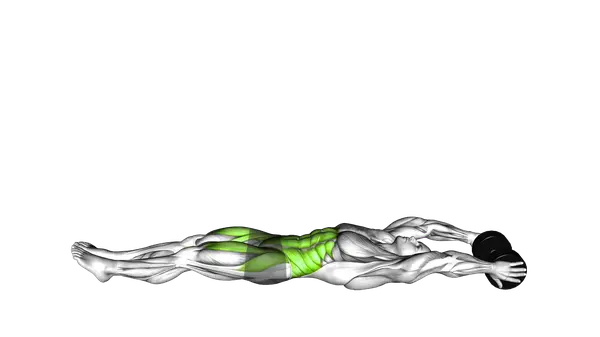
Dumbbell V-Up

Dumbbell V-Up

The Dumbbell V-Up elevates the classic V-Up exercise by adding external resistance, creating a challenging core movement that effectively targets your abdominal muscles and hip flexors simultaneously. This intermediate-level exercise has become a staple in both HIIT circuits and bodybuilding routines for those looking to develop visible core definition and functional strength. Unlike basic core exercises, the Dumbbell V-Up incorporates weight to increase the demand on your rectus abdominis (the "six-pack" muscles) while also engaging the deeper transverse abdominis for stability. The added resistance from the dumbbell forces your core to work harder against gravity, making each repetition more effective at building strength and muscle tone across your midsection. What makes this exercise particularly valuable is how it trains the coordination between your upper and lower body. Your hip flexors activate powerfully to raise your legs while your abs contract to lift your upper body, creating that distinctive "V" position at the top of the movement. This simultaneous action improves the mind-muscle connection and develops balanced core strength that translates to better performance in everyday activities and sports. For those focused on aesthetics in bodybuilding, the Dumbbell V-Up helps create that coveted abdominal definition by targeting the full length of the rectus abdominis. When incorporated into HIIT workouts, it elevates your heart rate while building core endurance, effectively burning calories while strengthening your midsection, a true multitasking exercise. Many fitness enthusiasts appreciate the Dumbbell V-Up because it can be scaled by adjusting the weight, making it adaptable to different fitness levels despite being classified as intermediate. The exercise delivers an intense abdominal contraction at the top position that you can genuinely feel working, providing that satisfying feedback that signals muscle development is occurring with each challenging repetition.

Core
HIIT
Bodybuilding
Dumbbell