The ultimate 4 day split for maximum muscle and strength
Unlock your potential with this science-backed 4 day split workout plan. Discover proven routines and practical tips to build muscle and strength efficiently. So, what exactly is a 4-day split? It’s a training schedule that divides your workouts into four sessions per week, typically splitting them between your upper and lower body. This simple setup allows you to train each muscle group twice weekly with plenty of rest in between, making it one of the most effective routines for building both muscle and strength.


Why a 4-day split is your secret weapon for results
When it comes to building a better physique, the goal isn't just clocking more hours in the gym—it's about making every minute count. While five or six-day routines might look impressive on paper, a 4-day split often delivers better results by striking the perfect balance between training intensity and recovery. This isn't just gym folklore; it's a proven formula for sustainable progress.
Think about it: cramming six workouts into an already packed week often leads to one thing—exhaustion. Your performance drops, your motivation fades, and you start dreading your gym sessions. A well-designed four-day plan flips that script entirely. It transforms your training into focused, high-energy sessions that drive real growth without burning you out.
Hitting muscles twice a week: the growth trigger
One of the biggest advantages of the classic 4-day split—the upper/lower routine—is its training frequency. You stimulate every major muscle group twice a week. A typical schedule might look like this:
Built for progress
Take the guesswork out of training
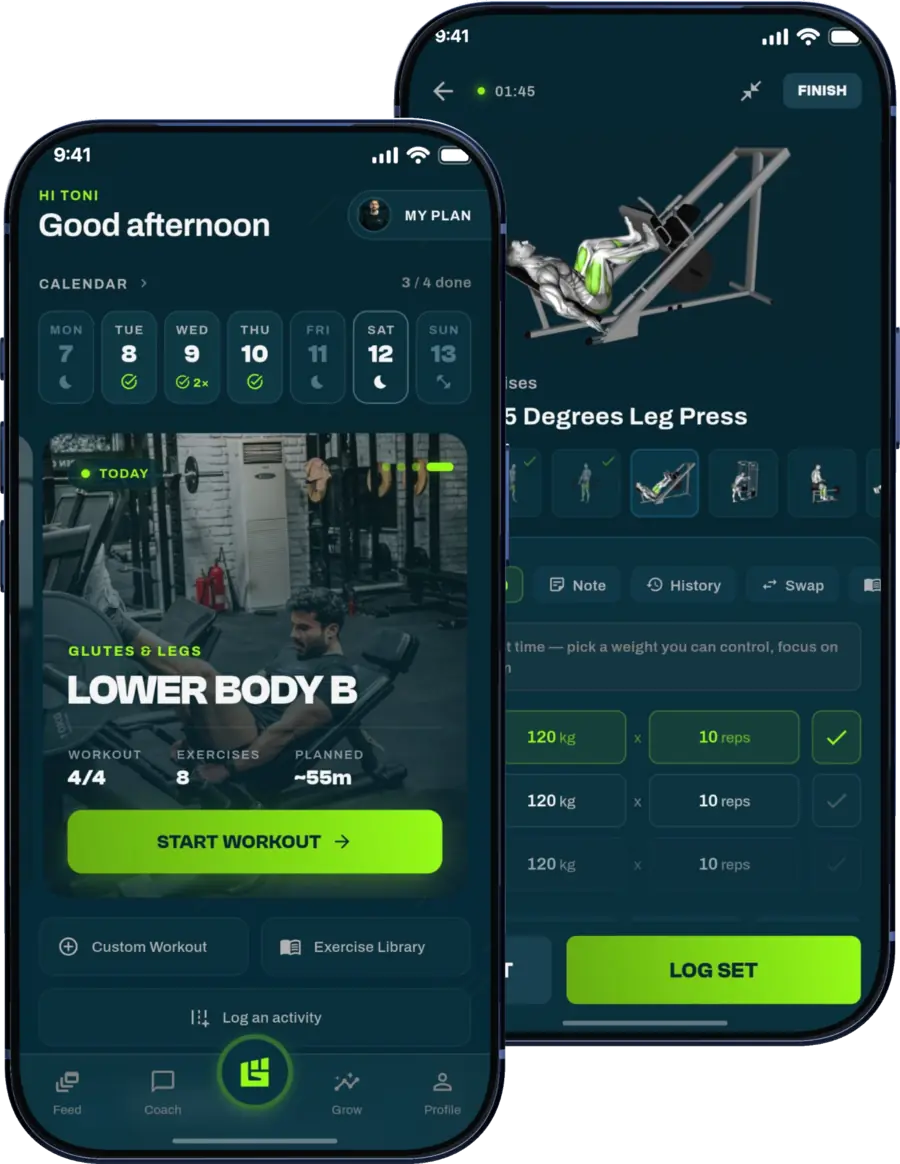
Get a personalized workout plan built around your goal, equipment and schedule. Train smarter, track every rep and keep moving forward, one workout at a time.






- Monday: Upper Body
- Tuesday: Lower Body
- Thursday: Upper Body
- Friday: Lower Body
This timing is ideal. After a solid workout, muscle protein synthesis (the process where your body repairs and builds muscle) remains elevated for roughly 48-72 hours. A four-day structure lets you hit that muscle again right as it’s finished recovering, maximizing your growth potential throughout the week.
Comparing popular workout splits
To put things in perspective, let’s see how a 4-day split stacks up against other common routines. Different splits cater to different goals and lifestyles, but the 4-day routine often comes out on top for its blend of efficiency and results.
Here’s a quick look at how the 4-day split compares to other common routines for efficiency, frequency, and recovery.
| Training Split | Weekly Frequency Per Muscle | Time Commitment | Best For |
|---|---|---|---|
| 4-Day Upper/Lower | 2x per week | Moderate (4 days) | Balanced muscle growth, strength, and recovery. |
| 3-Day Full Body | 3x per week | Low (3 days) | Beginners, strength focus, limited time. |
| 5-Day Body Part Split | 1x per week | High (5 days) | Advanced bodybuilders, targeting specific muscles. |
| 6-Day Push-Pull-Legs | 2x per week | Very High (6 days) | High-volume training, advanced lifters with excellent recovery. |
As you can see, the 4-day split offers an excellent middle ground, providing double the muscle stimulation of a traditional body part split without demanding the near-daily commitment of a six-day routine.
Work smarter, not harder: efficiency is king
For anyone juggling a busy life, efficiency is everything. The 4-day upper/lower split is a powerhouse for this exact reason. In fact, a detailed breakdown ranking popular workout routines gave this split a hypertrophy score of 8.4 out of 10. That’s a significant jump over the classic 3-day push-pull-legs routine, which scored a 6.7, primarily because the 4-day split allows for more quality training volume each week.
By focusing your energy on four quality sessions instead of spreading it thin across six, you can lift heavier and with better form. This intensity is the real driver of long-term muscle and strength gains.
This means you get a stronger muscle-building signal in less time. Instead of just going through the motions on day five or six, every workout in a 4-day split is a high-impact session designed for results. It’s a smarter way to train that respects both your goals and your schedule. And with tools like the workout builder, you can structure these sessions perfectly for your own progress.
Building your perfect 4 day split routine
Alright, let's move from theory to action—this is where the real gains happen. Building a solid 4 day split isn’t about grabbing a random template you found online. It's about crafting a plan that fits your body, your schedule, and your goals.
Two of the most battle-tested approaches are the classic Upper/Lower split and the versatile Push/Pull hybrid. Each has its own strengths, and figuring out which one works best for you is the first step. Let's break them down.
The classic upper and lower split
There's a reason the Upper/Lower split is so popular: it’s simple, logical, and incredibly effective. You train your entire upper body (chest, back, shoulders, arms) on two days and your lower body (quads, hamstrings, glutes, calves) on the other two.
The beauty of this setup is that it guarantees you train every muscle group twice a week with ample recovery built right in. You can also get creative with how you structure the week. For example, you could have one day focused on strength and another on hypertrophy.
- Day 1: Upper Body Strength (heavy compound lifts, low reps)
- Day 2: Lower Body Strength (heavy squats and deadlifts)
- Day 3: Rest
- Day 4: Upper Body Hypertrophy (more volume, moderate weight, isolation work)
- Day 5: Lower Body Hypertrophy (leg presses, lunges, and curls to build size)
This is a classic example of undulating periodization. In simple terms, you're building raw strength and muscle size simultaneously, making your training incredibly efficient.
The push and pull hybrid split
Another excellent option is a hybrid split that blends Push/Pull logic with an Upper/Lower framework. Think of it as an "Upper Push/Lower" and "Upper Pull/Lower" setup. This is a great way to give more focused attention to specific movement patterns while still training everything twice a week.
Here’s one way you could structure it:
- Day 1: Upper Body Push (chest, shoulders, and triceps)
- Day 2: Lower Body & Core
- Day 3: Rest
- Day 4: Upper Body Pull (back and biceps)
- Day 5: Lower Body & Core
This split is fantastic if you find your pressing power fades by the end of a full upper body day. It lets you go all-in on pushing movements one day, knowing those muscles get a complete break on your pulling day. If you want to dive deeper into the best pressing movements, our guide on chest exercises is the perfect place to start.
Putting a little thought into your plan upfront saves you from spinning your wheels in the gym. More focus equals better results.
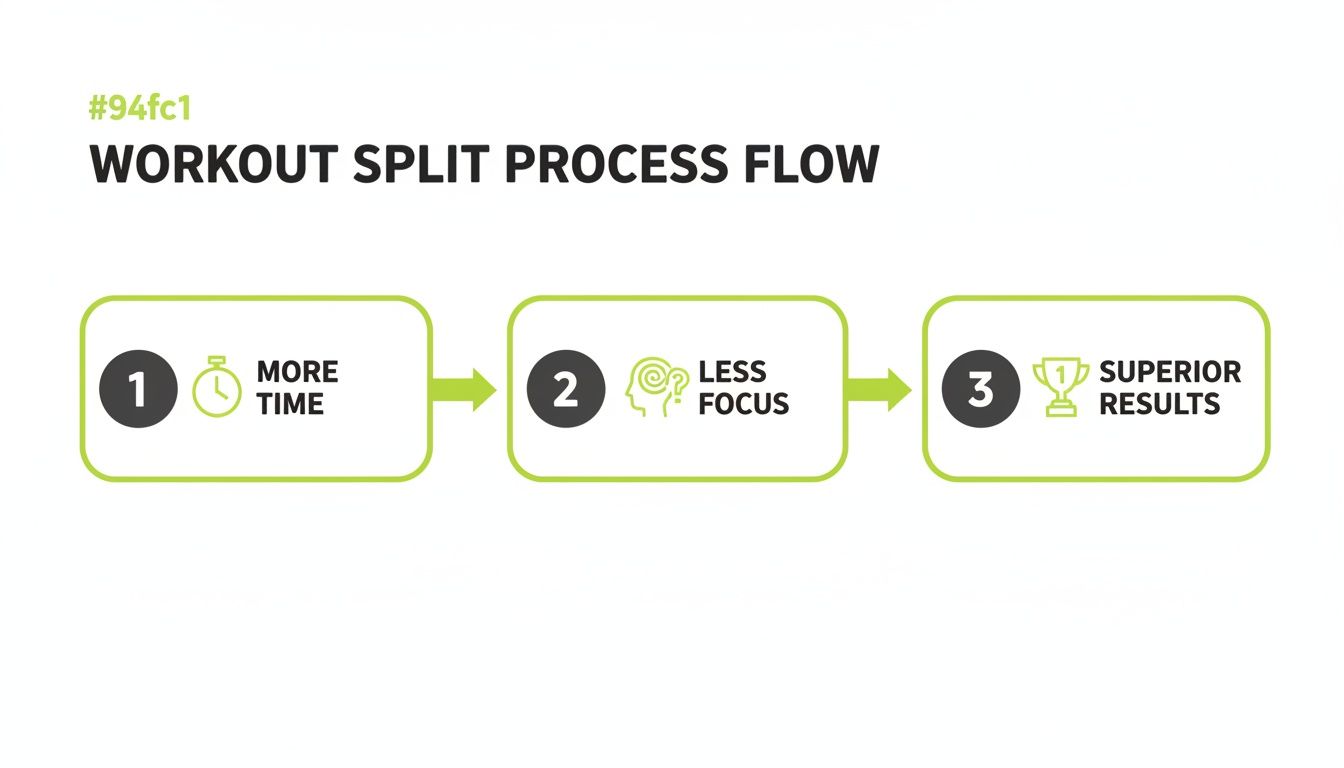
This process flow reinforces a simple truth: a good plan is the bridge between showing up and actually getting somewhere.
Selecting your core exercises
No matter which split you choose, your success will be built on a foundation of big, compound movements. These multi-joint lifts are the heavy hitters for strength and muscle because they recruit the most muscle fibers and allow you to move the most weight.
Your routine should be built around 3-5 core compound lifts that form the backbone of your workouts. Accessory exercises are important, but they should complement these foundational movements, not replace them.
Ensure your primary exercises are variations of these fundamental patterns:
- Horizontal Press: Bench Press, Dumbbell Press, Weighted Push-ups
- Vertical Press: Overhead Press, Arnold Press
- Horizontal Pull: Barbell Row, Dumbbell Row, Seated Cable Row
- Vertical Pull: Pull-ups, Chin-ups, Lat Pulldowns
- Squat: Back Squat, Front Squat, Goblet Squat
- Hinge: Deadlift, Romanian Deadlift, Good Mornings
These lifts should always come first in your workout. Do them when you're fresh so you can give them your maximum effort.
Defining your sets and reps for your goal
The final piece of the puzzle is dialing in your sets and reps to match your goals. While there is overlap, certain ranges are better suited for specific outcomes.
- For Pure Strength: The goal here is to lift heavy. You're training your central nervous system to become more efficient at recruiting muscle fibers for maximum force.
- Sets: 3-5
- Reps: 1-6
- Rest: 2-5 minutes between sets. You need that long rest to be ready to go all-out again.
- For Muscle Hypertrophy (Size): This is the sweet spot for building muscle. This rep range creates the perfect blend of mechanical tension and metabolic stress that forces muscles to grow.
- Sets: 3-4
- Reps: 6-12
- Rest: 60-90 seconds. Just enough time to catch your breath but not long enough to let the tension completely fade.
A smart approach is to use both. Perform your main compound lifts in the lower, strength-focused range, then complete your accessory exercises in the higher hypertrophy range. You get the best of both worlds—building a body that's as strong as it looks.
Actionable 4-day split workouts you can use today
Alright, let's put theory into practice with some workout plans you can take straight to the gym. Below are three different 4-day split routines, each built for a specific training goal. These aren't just random lists of exercises; they're complete blueprints with sets, reps, and rest periods all mapped out.
Whether your goal is building maximum muscle, raw strength, or all-around functional fitness, one of these templates is a perfect place to start.
Plan 1: The maximum muscle hypertrophy split
This split is all about one thing: building muscle size. We're focusing on creating metabolic stress and mechanical tension with controlled reps, moderate-to-heavy weight, and shorter rest periods to keep the muscles under tension. The goal is a solid pump to stimulate as much growth as possible.
With every accessory movement, concentrate on the mind-muscle connection. You should feel the target muscle doing the work on every single rep.
Day 1: Upper Body Hypertrophy This workout targets your chest, back, shoulders, and arms with a focus on volume in the 8-15 rep range.
| Exercise | Sets | Reps | Rest |
|---|---|---|---|
| Incline Dumbbell Press | 4 | 8-12 | 75s |
| Barbell Bent-Over Row | 4 | 8-12 | 75s |
| Seated Dumbbell Shoulder Press | 3 | 10-15 | 60s |
| Lat Pulldown | 3 | 10-15 | 60s |
| Cable Chest Fly | 3 | 12-15 | 45s |
| Dumbbell Bicep Curl | 3 | 12-15 | 45s |
| Tricep Pushdown | 3 | 12-15 | 45s |
Day 2: Lower Body Hypertrophy Time to build some serious leg muscle. This session targets quads, hamstrings, glutes, and calves with a mix of compound lifts and higher-rep isolation work.
| Exercise | Sets | Reps | Rest |
|---|---|---|---|
| Barbell Back Squat | 4 | 8-12 | 90s |
| Romanian Deadlift | 4 | 8-12 | 90s |
| Leg Press | 3 | 10-15 | 75s |
| Lying Leg Curl | 3 | 12-15 | 60s |
| Goblet Squat | 3 | 15-20 | 60s |
| Seated Calf Raise | 4 | 15-20 | 45s |
Plan 2: The pure strength and power split
If your goal is to get as strong as humanly possible, this is your program. The entire split is built around heavy compound lifts in low rep ranges. Your mission here is simple: move maximum weight with perfect form.
For this plan, rest is non-negotiable. You must take the full 3-5 minutes between your main lifts. This allows your central nervous system to recover so you can give maximum effort on every single set.
Accessory work is included to support your main lifts and build a solid foundation, but the heavy compound movements are always the priority.
Day 3: Upper Body Strength Here's a sample workout for one of your upper body days. Notice the emphasis is on the big, multi-joint lifts like the bench press and weighted pull-ups.
Example Upper Body Strength Workout
| Exercise | Sets | Reps | Rest |
|---|---|---|---|
| Flat Barbell Bench Press | 5 | 3-5 | 3-5m |
| Weighted Pull-Up | 5 | 3-5 | 3-5m |
| Standing Overhead Press | 4 | 5-8 | 2-3m |
| Pendlay Row | 4 | 5-8 | 2-3m |
| Close-Grip Bench Press | 3 | 6-10 | 90s |
| Barbell Curl | 3 | 6-10 | 90s |
The accessories are done in a slightly higher rep range to build supporting muscle without taxing your recovery too much.
Day 4: Lower Body Strength This day is anchored by the deadlift and front squat—two massive strength builders. The accessories here help strengthen your posterior chain and core to support those heavy lifts.
| Exercise | Sets | Reps | Rest |
|---|---|---|---|
| Barbell Deadlift | 5 | 3-5 | 3-5m |
| Front Squat | 4 | 3-5 | 3-5m |
| Good Morning | 3 | 6-10 | 2m |
| Barbell Lunge | 3 | 6-10 per leg | 90s |
| Hanging Leg Raise | 3 | 8-12 | 60s |
| Standing Calf Raise | 4 | 8-12 | 60s |
Plan 3: The functional fitness hybrid split
This 4-day split is for anyone who wants it all: strength, muscle, and athleticism. It blends traditional strength training with elements of metabolic conditioning to build a body that performs as well as it looks.
You'll notice this plan includes explosive movements and challenging finishers designed to boost your heart rate and push your work capacity. It’s perfect if you're training for general physical preparedness or just want a more dynamic and engaging workout. For more ideas on powerful upper body movements, you can learn more about building strong and stable shoulders in our guide.
Day 1: Upper Body Functional Strength
- Main Lifts:
- Push Press: 4 sets of 6-8 reps (90s rest)
- Single-Arm Dumbbell Row: 4 sets of 8-10 reps per side (75s rest)
- Accessory Superset: (Perform A & B back-to-back with no rest, then rest 60s)
- A. Incline Dumbbell Press: 3 sets of 10-12 reps
- B. Face Pulls: 3 sets of 15-20 reps
- Finisher: (Complete 3 rounds for time)
- 15 Kettlebell Swings
- 10 Burpees
Day 2: Lower Body Power & Conditioning
- Main Lifts:
- Trap Bar Deadlift: 5 sets of 5 reps (2m rest)
- Bulgarian Split Squat: 3 sets of 8-10 reps per leg (90s rest)
- Accessory Superset: (Perform A & B back-to-back with no rest, then rest 60s)
- A. Dumbbell Romanian Deadlift: 3 sets of 12-15 reps
- B. Plank: 3 sets of 60-second holds
- Finisher: (Complete 5 rounds for time)
- 10 Goblet Squats
- 200-meter row or sprint
Mastering recovery to prevent overtraining
Training hard is only half the battle. The real magic—the growth, strength gains, and long-term progress—happens between your workouts. A 4 day split is so effective because it builds recovery right into its structure, protecting you from the dreaded plateau of overtraining.
Think of it this way: working out creates microscopic tears in your muscle fibers. Recovery is the process of rebuilding them stronger than before. If you don't give your body enough time to repair, you’re just breaking yourself down without letting it adapt. This is where many eager lifters go wrong, thinking more is always better.

The science behind smart recovery
The beauty of a 4 day split is how it respects your body's biological clock for muscle repair. When you train a muscle group, muscle protein synthesis (MPS)—the scientific term for the muscle-building process—spikes and stays elevated for about 24 to 48 hours. After that window, it starts returning to normal.
A classic upper/lower split gives each muscle group a full 72 hours of rest before you train it again. For example, if you trained your lower body on Tuesday, it has until Friday to fully recover and rebuild. This schedule lines up perfectly with the MPS cycle, letting you train muscles when they’re fully repaired and primed for another growth stimulus.
This balance is why the 4 day split is so sustainable. By balancing training volume with proper rest, this split can reduce the risk of overtraining by as much as 40% compared to more demanding 5 or 6-day programs. You can discover more insights about these findings on builtwithscience.com and see how different splits stack up.
Recognizing the early signs of overtraining
Listening to your body is a skill, and it's one of the most important ones you can develop in the gym. Overtraining doesn't just happen overnight; it creeps in when the balance between training stress and recovery is consistently off.
Keep an eye out for these early warning signs:
- Persistent Muscle Soreness: Feeling sore for a day or two is normal. Feeling constantly achy and beat up is not.
- Stagnant or Decreasing Performance: If your lifts are stuck or, worse, going down for weeks, your body is telling you it needs a break.
- Irritability and Mood Swings: Overtraining affects your hormones, which can leave you feeling unusually moody or agitated.
- Poor Sleep Quality: You might feel exhausted but find it hard to fall asleep or stay asleep through the night.
- Getting Sick More Often: A rundown system has a weaker immune response, making you more susceptible to colds and other illnesses.
If you start noticing these symptoms, it’s a clear signal to ease up.
Actionable tips for optimal recovery
Recovery isn't just about sitting on the couch. Being proactive about it can dramatically accelerate your results.
Your training stimulates growth, but your nutrition, sleep, and active recovery are what actually build the muscle. Neglecting any of these is like trying to build a house without bricks.
Here are a few high-impact strategies to incorporate into your routine:
- Prioritize Sleep: Aim for 7-9 hours of quality sleep per night. This is when your body releases growth hormone and performs the bulk of its repair work.
- Fuel Your Body: Your muscles need protein to rebuild and carbohydrates to replenish energy stores. Don't starve your body of the raw materials it needs to grow.
- Stay Hydrated: Water is essential for nearly every metabolic function, including nutrient transport and waste removal. Dehydration can severely hinder your recovery.
- Incorporate Active Recovery: On your rest days, don't just be a couch potato. Light activity like walking, stretching, or foam rolling increases blood flow to sore muscles, which can speed up the healing process.
By mastering recovery, you turn your 4 day split from a simple workout plan into a powerful system for continuous improvement. If you're building out your lower body days, check out our full library of leg exercises that promote strength and stability.
How to evolve your 4 day split for continuous gains
Sooner or later, every lifter hits a plateau. It's a rite of passage. That initial surge of progress slows down, and suddenly, the numbers on the bar just stop moving.
But hitting a wall isn't a dead end. Think of it as a signal from your body: it has adapted to the current challenge and is now ready for something new. The key to long-term success with your 4 day split is knowing how to evolve it intelligently.
The secret ingredient here is progressive overload, which is simply the principle of making your workouts harder over time. While adding more weight is the most common method, it’s far from the only one. Smart progression is about more than just brute force; it's about making calculated tweaks that keep your body guessing.
Smart progression beyond adding weight
When you feel stuck, don't just fixate on putting another plate on the bar. You have several other tools in your arsenal to dial up the intensity and spark new growth.
- Increase Your Reps: If you completed 3 sets of 8 on your bench press, aim for 3 sets of 9 next week with the same weight. Once you can comfortably hit 3 sets of 12, then it's time to increase the weight and drop back down to 8 reps.
- Add Another Set: This is a simple way to increase your total training volume, a key driver of muscle growth. If you normally do 3 sets of squats, try adding a fourth set and see how it feels.
- Decrease Rest Times: Shaving just 15-30 seconds off your rest periods increases workout density and metabolic stress. This forces your muscles to work more efficiently under fatigue.
- Improve Your Form: Sometimes, the best way to progress isn't about the numbers at all. It's about performing the same weight and reps with flawless control, a deeper range of motion, and a stronger mind-muscle connection.
The 4 day split has become incredibly popular for its efficiency. After 2020, as gym memberships in the US grew by 15% to 184 million, the average workout time dropped to just 45 minutes. This routine delivers up to 85% of the benefits of a top-tier program in roughly 30% less time, making it perfect for busy schedules.
Breaking through a stubborn plateau
Let's walk through a real-world scenario: your bench press has been stuck at the same weight for a month. You’ve tried adding reps and sets, but nothing is working. It’s time to get strategic.
First, consider a deload week. This doesn't mean you stop going to the gym. Instead, you'll dial back the intensity by cutting your weights by 40-50% for one week. This gives your joints and central nervous system a much-needed break, and you'll often come back stronger.
A plateau is your body's way of saying it has mastered the current challenge. Your job is to give it a new one it hasn’t seen before.
Next, try a strategic exercise swap. If your flat barbell bench has stalled, make the incline dumbbell press your primary chest movement for the next 4-6 week training block. This introduces a new stimulus, recruits different stabilizing muscles, and can strengthen weak points that were holding you back. For more ideas on effective swaps, you can explore our library of exercises for a strong back and see how different movements target the muscles.
The power of tracking your workouts
You can't manage what you don't measure. The single most important habit for making continuous gains is tracking every workout.
By logging your exercises, weights, sets, and reps, you gather the data needed to make smart decisions. Without a training log, you're just guessing. You might feel like you're pushing harder, but are you really? A log provides the objective truth.
When you see your numbers laid out, it becomes obvious where you're making progress and where you're stuck. This data is your roadmap. It tells you when it’s time to add weight, push for more reps, or perhaps even pull back for a deload. Tools like the GrabGains app automate this entire process, turning your workout history into clear, actionable insights that guide your next session. This is how you turn a static 4 day split into a dynamic system that evolves with you.
Your questions about the 4 day split answered
Even the most solid plan runs into real-world challenges. A good 4 day split is designed to be flexible, but knowing how to adapt it on the fly is what separates temporary effort from long-term results. Let's tackle a few common questions.
What if I can only train on consecutive days?
Life happens. Sometimes the perfect schedule isn't possible, and you have to train four days in a row. While a rest day between big sessions is ideal, you can absolutely make a consecutive-day schedule work with smart planning.
If you're stuck with a Monday-to-Thursday block, a great strategy is to alternate between heavier strength days and lighter hypertrophy days.
- Monday: Upper Body Strength (heavy, low reps)
- Tuesday: Lower Body Strength (heavy, low reps)
- Wednesday: Upper Body Hypertrophy (lighter, high reps)
- Thursday: Lower Body Hypertrophy (lighter, high reps)
This way, your most demanding lifts are done when you're freshest at the start of the week, saving the higher-rep, less taxing work for when fatigue starts to set in.
Can I still do cardio with a 4 day split?
Of course. In fact, you should. The trick is to program it so it helps, not hurts, your recovery and lifting performance. For most people, the easiest way to do this is to place cardio on your rest days.
Think of cardio as a tool to enhance your recovery and work capacity, not a session that leaves you too drained for your next lift.
A 20-30 minute session of low-intensity steady-state (LISS) cardio, like walking on an incline or light cycling, is perfect for a rest day. It gets the blood flowing and can even help with muscle soreness. If you must do it on a lifting day, save it for after your weight training so it doesn't drain energy from your heavy compound lifts.
How do I substitute an exercise if a machine is taken?
It’s the classic gym dilemma. The gym is packed, and someone is taking selfies on the leg press you need. Don't just skip the exercise—swap it for something that trains the same muscle group with a similar movement pattern.
Here are a few smart substitutions you can make in a pinch:
| If this is taken... | Try this instead... | Why it works |
|---|---|---|
| Barbell Bench Press | Dumbbell Bench Press | Works the same muscles but adds a stability challenge. |
| Leg Press | Barbell Hack Squat or Goblet Squat | Both are quad-dominant movements that mimic the pressing motion. |
| Lat Pulldown | Assisted Pull-ups or Barbell Rows | All are excellent vertical or horizontal pulling exercises for your back. |
Knowing a few alternatives for your go-to lifts means a crowded gym never has to ruin your workout. A great plan is one that can bend without breaking.
Ready to stop guessing and start building a 4 day split that actually fits your life? The GrabGains app creates personalized workout plans that evolve with you. It tracks your progress, suggests smart exercise swaps, and makes sure you're always moving toward your goals, no matter what your schedule throws at you. Download GrabGains on iOS or Android today and start training smarter.
Get inspired and motivated