Master your 4 day workout split structure
Build your ideal 4 day workout split structure. Explore upper/lower, PPL, & body-part splits for strength, hypertrophy, or endurance gains. You’re probably here because your training week feels pulled in two directions.
A high-frequency plan looks productive on paper, but it asks for more gym time than your schedule can support. A lower-frequency plan is easier to follow, yet it can feel like you’re not practicing the lifts often enough or giving each muscle enough quality work. That is exactly where a 4 day workout split structure tends to shine.
It gives you enough sessions to train with intent, enough room to recover, and enough flexibility to shape the week around muscle growth, strength, or hybrid performance. For most lifters, that balance matters more than chasing the most complicated split in the room.


Why a 4-Day split is the sweet spot for progress
A good training plan has to survive real life.
Four training days fit around work, family, travel, and the normal unpredictability of the week better than a six-day setup. At the same time, four sessions give you more focused practice and more total work than a minimalist plan that leaves too much on the table.
The biggest reason this works is simple. You can organize the week so each major muscle group gets trained often enough to keep progress moving, while still leaving recovery days in place. That combination is hard to beat if your goal is to build muscle, get stronger, and avoid the cycle of going all-in for two weeks and then burning out.
Built for progress
Take the guesswork out of training
Get a personalized workout plan built around your goal, equipment and schedule. Train smarter, track every rep and keep moving forward, one workout at a time.






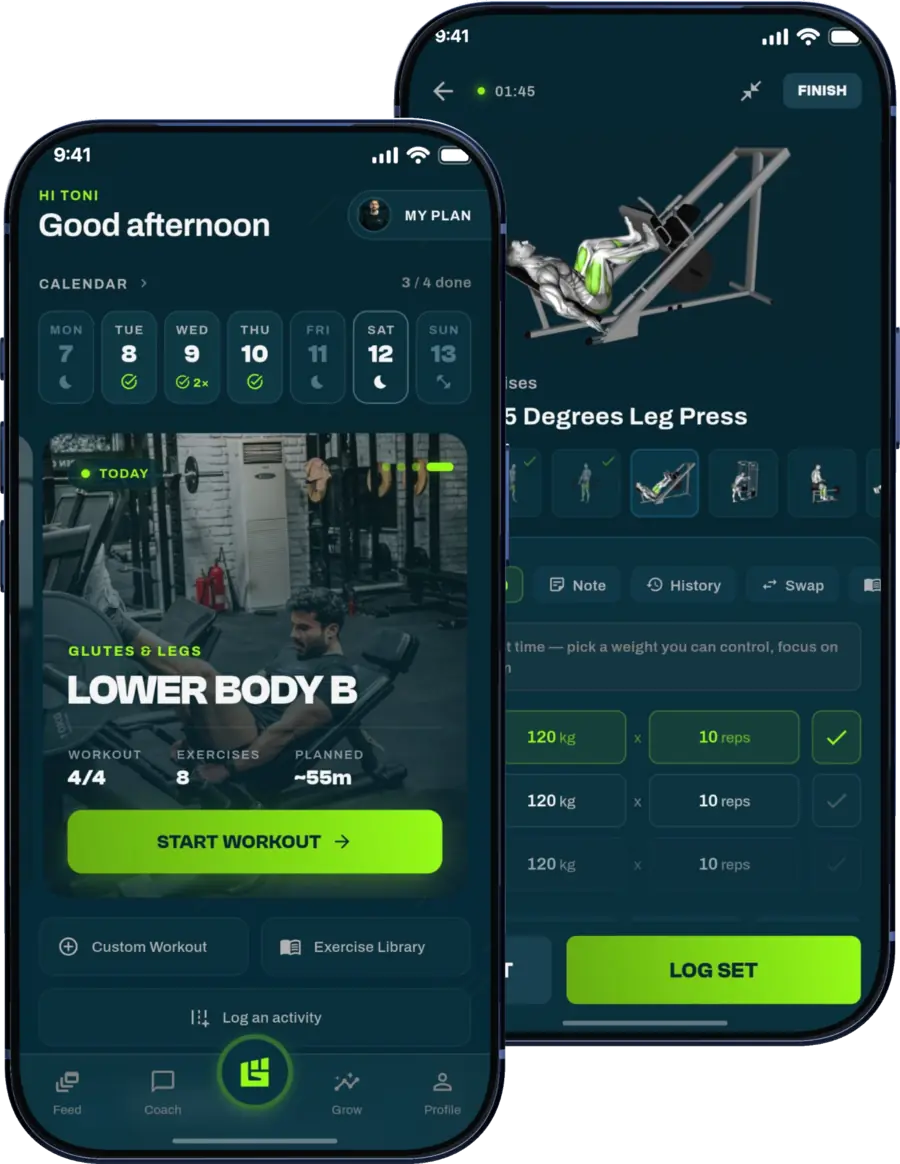
A well-run 4 day workout split structure also improves exercise quality. Instead of cramming your entire body into every session, or smashing one body part once a week and waiting too long to train it again, you can spread the work across the week in a way that keeps performance higher.
This means:
- More productive sets: You’re fresher when you start key lifts.
- Better technique: Repeating movement patterns during the week sharpens execution.
- Less schedule friction: Missing one session does not wreck the whole plan.
- More sustainable momentum: You can keep training hard without feeling chained to the gym.
Busy lifters do best when the plan asks for discipline, not perfection. Four days is enough structure to create momentum and enough breathing room to keep going.
A plan only works if you can repeat it for months. The sweet spot is not the split that looks hardest. It is the split you can execute well, recover from, and progress on.
Foundational principles of an effective workout structure
Before choosing exercises, get the structure right. Most successful programs are built on the same few principles. The difference between progress and frustration comes down to how well those principles are applied.

Frequency drives repeat exposure
A strong 4 day workout split structure gives each muscle enough repeated stimulus during the week to keep adaptation moving.
Training each muscle group 1.5 to 2 times per week in a 4-day split supports hypertrophy and strength well, and this frequency is also associated with better adherence, with 80% user retention versus 60% for more intensive 5+ day programs according to the data summarized by Setgraph’s 4-day workout split overview.
That matters because the perfect split on paper is useless if you stop following it.
In practice, this means you should avoid structures that leave a muscle untouched for too long unless you have a very specific reason. Many lifters do better when they revisit the same muscle or movement pattern later in the week with a slightly different emphasis.
Volume determines how much work gets done
Weekly volume means how much hard work you do for a muscle across the week. In plain terms, it is the total number of challenging sets that count.
Too little volume and progress stalls because the signal is weak. Too much volume and performance drops because fatigue starts to outrun adaptation.
A useful middle ground in many 4-day plans is to spread work across the week rather than dumping everything into one workout. That keeps session quality higher and improves recovery between sessions.
Think of volume in layers:
- Primary work from your big lifts.
- Secondary work from variations and accessories.
- Support work that fills gaps and keeps joints healthy.
If your chest, back, or legs are wrecked for days after one monster session, your split is probably too concentrated. If you finish every workout feeling like you barely trained, it is probably too light.
Progressive overload gives the body a reason to adapt
Without progressive overload, a split is just organized exercise.
Your body changes because you gradually ask it to do more. That can mean more load, more reps, more total sets, cleaner technique with the same load, or better control through the same rep range.
Lifters often make one of two mistakes:
- They change too much. New exercises every week, random rep schemes, no stable benchmark.
- They change nothing. Same weights, same reps, same effort, month after month.
A better approach is steady progression with repeatable lifts. Keep your main patterns in place long enough to improve them. Change accessories when needed, not because you are bored.
If you cannot tell whether you are improving, you are guessing. Track load, reps, and exercise choices every week.
Recovery is built into the structure
The gym does not build muscle or strength by itself. Training creates the demand. Recovery lets the body answer it.
That is why rest days are not filler. They are part of the plan. Spacing similar sessions across the week helps you come back stronger instead of dragging fatigue from one workout to the next.
Good recovery has a few obvious pillars:
- Sleep: The fastest way to sabotage a strong plan is poor sleep.
- Food: Fuel enough to support the goal.
- Stress management: High life stress changes how much training you can productively handle.
- Session design: Hard days should feel intentional, not chaotic.
A smart split respects both stimulus and recovery. If either side is missing, progress slows down.
Choosing Your 4-Day Split The Most Popular Structures
Pick the structure that matches your goal, not the one that sounds the most hardcore. A 4 day workout split structure can work in several forms, but each one carries different trade-offs.

The most common options are Upper/Lower, Push/Pull/Legs adaptations, and Body Part splits. Some coaches also use a Full Body twice-per-week style with two additional focused days, but the three structures above are still the main decision point for many lifters.
Upper lower split
This is considered the cleanest option.
An upper/lower structure divides the week into two upper-body sessions and two lower-body sessions. It is simple, balanced, and easy to recover from if you place rest days well. The classic setup is Monday upper, Tuesday lower, Thursday upper, Friday lower.
The major strength of this split is efficiency. According to Zing Coach’s 4-day split guide, a 4-day upper/lower split delivers approximately 85% of the muscle gains of more demanding 5-6 day splits while requiring 30% less time in the gym. The same source also notes that training muscles at least twice weekly can produce up to 40% greater muscle growth than once-weekly splits.
That combination explains why so many intermediate lifters stay with upper/lower for years.
Best for: busy professionals, beginners, intermediates, and anyone who wants a reliable default.
What works well:
- Balanced fatigue across the week
- Easy exercise rotation
- Clear recovery windows
- Strong fit for both hypertrophy and strength
What goes wrong:
- Upper days can become too crowded if you try to train everything hard
- Lower days can turn into a grind if you stack too many heavy compounds
- Lifters sometimes neglect arms, calves, or rear delts because they focus only on the big lifts
Push pull legs 4-day adaptation
This version is more pattern-based. Instead of splitting by body region, you split by movement type.
A four-day adaptation looks like Push, Pull, Legs, and then a second Push or an Upper/Lower hybrid day depending on what you need most. Some lifters use it to bias chest and shoulders. Others use the fourth day to round out what the first three missed.
This structure is useful if you like organizing training around movement logic. Push days collect pressing and triceps work. Pull days collect rows, pulldowns, hinges, and biceps. Leg days focus on squats, hinges, unilateral work, and calves.
The appeal is focus. You get more room to attack a movement family without the day feeling scattered.
Best for: intermediate lifters, physique-focused trainees, and people who like clearly themed sessions.
Primary benefits:
- Sessions feel purposeful and organized
- Easy to emphasize weak points
- Good fit for lifters who enjoy exercise variety
Drawbacks to watch:
- Fatigue management gets trickier if pull and leg days both hammer the lower back
- Some muscles may get indirect work that is hard to quantify unless you track carefully
- The extra specialization can tempt people into adding junk volume
Body part split 4-day adaptation
This is the classic focused approach. You assign separate days to different muscle groups, such as chest and triceps, back and biceps, legs, then shoulders and arms.
This can work well for lifters who want maximum attention on one area at a time. It is also psychologically satisfying. You walk into the gym knowing exactly what the day is about.
The trade-off is frequency. If the split is not designed carefully, some muscles may only get one direct stimulus each week. That can still work, especially for experienced bodybuilders managing lots of volume per session, but it is less efficient for general muscle gain and strength than more balanced structures.
Best for: advanced physique trainees and people who prefer high focus on individual muscle groups.
Good reasons to choose it:
- High concentration on lagging areas
- Easier mind-muscle connection for isolation work
- Sessions can feel less mentally cluttered
Reasons many lifters should not start here:
- Lower training frequency for major muscles
- Easy to overspend energy on one day and undertrain the rest of the week
- Less forgiving if you miss a workout
Quick comparison table
| Split Type | Muscle Frequency | Best For | Primary Pro | Primary Con |
|---|---|---|---|---|
| Upper/Lower | Usually each major area is trained twice weekly | Busy lifters, beginners, intermediates | Balanced recovery and simplicity | Upper and lower days can become long if poorly planned |
| Push/Pull/Legs 4-day adaptation | Varies by setup, often close to twice weekly for priority muscles | Intermediate lifters and physique-focused trainees | Clear movement organization | Lower-back fatigue and overlap can sneak up |
| Body Part Split 4-day adaptation | Often lower direct frequency per muscle unless designed carefully | Advanced physique trainees | Maximum focus on specific muscles | Less efficient for broad progress if frequency is too low |
How to choose without overthinking it
If you are stuck, use this filter:
- Choose upper/lower if you want the highest return for the least friction.
- Choose PPL adaptation if you enjoy movement-based organization and want extra focus on certain patterns.
- Choose body part split only if you already know you benefit from concentrated work on individual muscle groups.
Many individuals do not need the most specialized option. They need the option they can run hard, recover from, and keep improving on.
When a lifter asks me which split is “best,” the underlying question is usually which split they can execute consistently with good effort and clear progression. That answer is often simpler than they expect.
Building Your Workouts Exercise Selection and Programming
Once your split is chosen, the next job is building each training day so it drives adaptation. Many plans fall apart at this point. The weekly layout looks fine, but the workouts inside it are random.

A useful workout has order. It starts with the highest-value work, then adds enough accessory training to build muscle, shore up weak links, and keep the program balanced.
Start with one primary lift
Each session should revolve around a main movement pattern.
On upper days, that might be a bench press, overhead press, row, or weighted pull-up. On lower days, it is a squat, deadlift variation, or hip hinge. Put the movement that matters most for your goal first, while you are fresh.
That first lift sets the tone for the session because it carries the highest load, the greatest technical demand, or both.
A simple rule works well:
- Strength focus: prioritize lower rep work on the main lift
- Hypertrophy focus: still keep a main lift, but use controlled moderate rep work
- Hybrid focus: choose a lift that builds force without wrecking your energy for the rest of the session
Add accessory lifts with purpose
Accessories are not filler. They solve problems the main lift cannot solve by itself.
After your primary movement, add a small number of exercises that do one of the following:
- Build muscle in supporting areas
- Address imbalances
- Add volume with lower systemic fatigue
- Improve joint stability or positional strength
A good upper day combines a horizontal press, a row, a vertical press or pull, then a few arm or delt accessories. A good lower day covers a squat pattern, a hinge, a unilateral movement, and a calf or core slot.
The key is restraint. If every accessory is treated like a max-effort event, recovery suffers fast.
Match sets and reps to the goal
Your rep ranges should reflect what the exercise is doing.
Heavy compounds respond well to lower or moderate reps because they are technically demanding and load multiple muscle groups at once. Isolation work fits better in moderate to higher reps where you can train the target muscle hard with less joint stress.
The exact numbers do not need to be perfect. The intent does.
Use this framework:
- Main lift first: lower to moderate reps, strong focus on execution.
- Secondary compounds next: moderate reps and stable technique.
- Isolation work last: moderate to higher reps with controlled effort.
The reason this works is practical. You protect performance where it matters most, then accumulate targeted work without wasting energy early.
A sample upper lower template
Day 1 upper
- Bench press
- Chest-supported row
- Overhead press
- Lat pulldown or pull-up
- Lateral raise
- Triceps extension
- Biceps curl
Day 2 lower
- Back squat
- Romanian deadlift
- Split squat or leg press
- Hamstring curl
- Calf raise
- Core movement
Day 3 upper
- Incline press
- One-arm row or cable row
- Pull-up or pulldown variation
- Dumbbell shoulder press
- Rear delt fly
- Triceps movement
- Biceps movement
Day 4 lower
- Deadlift variation or front squat
- Hip thrust or hinge variation
- Lunge or step-up
- Leg curl or leg extension
- Calf raise
- Core movement
This template works because it repeats major patterns while changing the angle or emphasis enough to avoid beating the same groove into the ground.
Progression has to be visible
A plan without tracking turns into guesswork. The data from Setgraph’s 4-day workout split guide notes that a 4-day Push/Pull/Legs variant can yield 1.5x the strength gains of a 3-day full-body routine over 8 weeks, but 50% of lifters stagnate due to poor progression tracking. The same source states that structured bi-weekly overload can support a 10-20% 1RM increase in 12 weeks.
That tells you what matters. The split helps, but the progression system is what keeps the split productive.
If you want support organizing that progression, Fully customized workouts can help automate exercise selection, scheduling, and performance-based adjustments inside one system.
Keep your main lifts stable long enough to measure them. Rotate accessories when needed, not before the core work has a chance to produce results.
Adapting your split for specific training goals
The same weekly framework can produce different results depending on how you aim it. That is why copying someone else’s split works less well than customizing your own.

For hypertrophy
If your goal is muscle growth, your split should make it easy to accumulate quality volume without turning every session into a marathon.
That means:
- keeping compound lifts in the plan
- adding enough accessories to fully train the target muscles
- using exercise variation to hit muscles from multiple angles
- avoiding so much fatigue on the first lift that the rest of the workout becomes sloppy
A hypertrophy-focused 4 day workout split structure benefits from upper/lower or a PPL adaptation because both make it easier to distribute volume across the week.
The common mistake is confusing more exercises with better programming. You do not need endless movement variety. You need repeated high-quality work and enough recovery to come back strong.
For strength
Pure strength work asks for a different emphasis.
You still need muscle, but your week should revolve around improving performance on the lifts that matter most. That means placing your priority lifts first, controlling fatigue from accessories, and keeping enough specificity in the plan that skill improves along with force production.
For strength, I want each training day to answer one question: what lift or pattern is this session trying to move forward?
When that answer is clear, programming becomes easier. Accessories support the main lift instead of competing with it.
For functional endurance and HYROX-style training
Many split guides come up short in this area.
A lot of 4-day programs do a solid job with muscle and strength, then ignore the athlete who needs engine, durability, and movement under fatigue. The gap is obvious for HYROX-style training, where strength and conditioning have to coexist instead of taking turns.
According to Hevy’s 4-day workout split guide, this is a major blind spot in typical 4-day split content. The same source states that integrating HYROX-specific functional training can improve VO2 max by 12% and strength retention by 18% over pure splits, and it ties that need to a 35% projected surge in HYROX participation in 2025.
That kind of athlete needs more than chest day, back day, and hope.
A better hybrid setup looks like this:
- one upper day centered on pressing and pulling strength
- one lower day built around squat and hinge patterns
- one upper or total-body day with moderate volume
- one hybrid day using carries, sled work, wall-ball style conditioning, burpee patterns, rowing, ski erg work, or short circuit blocks
The goal is not to turn every session into conditioning. The goal is to teach the body to hold onto strength while performing repeated efforts.
If you want extra context on mixed-method training demands, this guide on understanding specific training methodologies like CrossFit is useful because it frames how strength, skill, and conditioning can coexist without sabotaging each other.
The right split evolves
Your split should not stay frozen while your goal changes.
A muscle-building phase may need more accessory work and less conditioning. A strength phase may cut back on fluff and tighten exercise selection. A HYROX build may replace some isolation work with functional intervals and carries.
The structure stays. The emphasis shifts.
Long-Term progress tracking progression and recovery
Short-term enthusiasm is easy. Long-term progress is what separates a useful program from a temporary kick.
Lifters often plateau for predictable reasons. They stop adding meaningful overload, they never reduce fatigue, or they ignore recovery until performance starts sliding. A strong 4 day workout split structure fixes all three if you run it with intent.
How to progress without guessing
Use a small progression target on your main lifts. Add load when reps are solid. Add reps when load should stay put. Add sets sparingly, because more work is only useful if you can recover from it.
You do not need dramatic jumps. You need repeatable ones.
A simple progression checklist works:
- Watch performance trends: Are reps cleaner, faster, or more stable?
- Log every main lift: Memory is unreliable.
- Keep accessories honest: They should support progress, not bury you in fatigue.
Use deloads before your body forces one
A deload is not losing momentum. It is managing fatigue before fatigue starts managing you.
If joints ache, motivation drops, and bar speed looks flat for multiple sessions, reduce training stress for a short period. That can mean less volume, lower intensity, or both. The point is to preserve your ability to train hard over the long run.
Recovery has to be active, not accidental
Sleep, food quality, hydration, and stress control all shape how well your plan works. Many individuals recognize this. Fewer act like it is part of programming.
If recovery is a weak point, even basic support strategies can help. For example, athletes who are reviewing sleep and muscle recovery inputs may find this guide on Magnesium Glycinate for Athletes useful alongside their broader recovery habits.
The lifter who trains slightly below reckless intensity for months will usually outperform the lifter who trains recklessly for two weeks and then disappears.
Frequently Asked Questions about 4-Day Splits
How long should my workouts take
Aim for 60 to 75 minutes per session. That is enough time for a warm-up, one or two main lifts, accessories, and a short cool-down.
If your sessions keep running longer, the problem is poor exercise selection or too much rest between non-demanding movements. Tighten the plan before assuming you need more time.
Can I do a 4-day split at home with limited equipment
Yes.
The principles stay the same even if your setup is basic. An upper/lower split works well at home because you can organize sessions around movement patterns instead of machine access. Push-up variations, dumbbell rows, presses, goblet squats, lunges, hinges, bridges, and band work can all fit a solid structure.
The goal is still the same. Train the major patterns consistently, progress them over time, and keep the week balanced.
What should I do if I miss a day
Do not try to cram two full workouts into one.
Pick up where you left off and shift the week forward. If you miss Thursday, do that session Friday and move the next one to Saturday if needed. Protect the sequence of the split instead of panicking and turning the week into a mess.
This works because consistency is built over months, not judged by one disrupted day.
If you want a 4 day workout split structure that adjusts to your schedule, goals, and performance, GrabGains offers AI-based planning, exercise guidance, and progress tracking in one place. It can be a practical option if you want less guesswork and a clearer path from workout to workout.
Get inspired and motivated