Bench press stuck? Proven fixes to smash your plateau
Is your bench press stuck? Discover why you've hit a wall and learn actionable strategies, technique fixes, and programs to finally break your plateau. When your bench press stalls, it almost always comes down to one of three things: a weak point in the lift, a flaw in your technique, or a problem with your programming. The fastest way to figure out what's wrong is to identify exactly where the bar gets stuck.
Once you know that, you can use targeted exercises and programming tweaks to smash right through that plateau.


Diagnosing why your bench press is stuck
Feeling that bar grind to a halt is one of the most frustrating feelings in the gym. But you're not alone. The first step to breaking through a plateau isn't more reps or a new pre-workout—it's understanding the real reason you're stuck.
Let's cut through the noise and figure out the "why" behind your stalled progress.
Analyses of failed lifts show that a staggering 70-80% of bench press failures happen somewhere between the chest and lockout. That's the dreaded sticking point where momentum dies, and the lift fails.
Built for progress
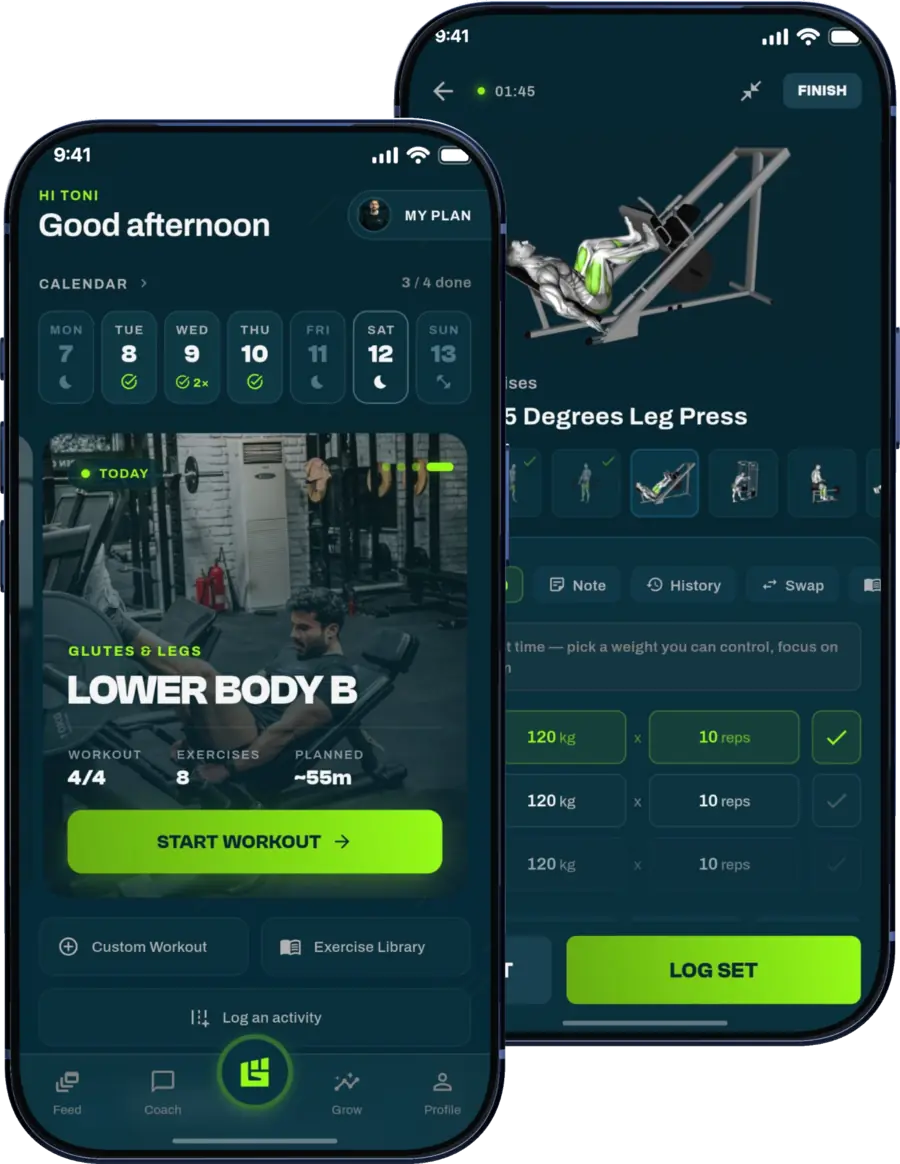
Take the guesswork out of training
Get a personalized workout plan built around your goal, equipment and schedule. Train smarter, track every rep and keep moving forward, one workout at a time.






Identifying your sticking point
Where the barbell stops moving tells a story about your specific weaknesses. Most lifters fail in one of three distinct phases. Figuring out which one is yours is the key to unlocking new strength.
This decision tree gives you a quick visual guide to what's likely holding you back based on where you fail the lift.

Here's a closer look at what each sticking point means:
- Failure Off the Chest: If the bar feels glued to your chest, you're lacking explosive power. This is almost always a sign of underdeveloped pectoral muscles or weak front delts. You need to build more raw strength from the bottom position.
- Failure Mid-Lift: This is easily the most common sticking point. The bar gets a few inches off your chest but dies halfway up. This tells you that your triceps are the weak link and can't take over once your pecs have done their initial job.
- Failure at Lockout: You get the bar most of the way up but just can't extend your elbows to finish the lift. This points directly to a lack of triceps strength or poor lockout stability. Sometimes, it can also be linked to underdeveloped stabilizer muscles in your shoulders.
Key Takeaway: Your sticking point isn't random; it’s a direct signal of which muscle group needs more attention. Stop guessing and start targeting the real issue.
Common bench press sticking points and quick fixes
This table gives you a quick reference for diagnosing your sticking point and the best exercises to start fixing it. Find where you fail, see the likely cause, and get the primary corrective exercise to add to your routine.
| Sticking Point Location | Likely Weak Muscle Group | Primary Corrective Exercise |
|---|---|---|
| Off the Chest | Pectorals, Front Deltoids | Pause Bench Press |
| Mid-Lift | Triceps | Close-Grip Bench Press |
| At Lockout | Triceps, Shoulder Stabilizers | Board Press / Pin Press |
Use these exercises as targeted accessories to bring up your weak points. By focusing your efforts where they matter most, you'll start seeing progress much faster than just repeating the same program.
Before you dive into a new program, though, it's crucial to make sure no underlying physical limitations are holding you back. Sometimes, a plateau isn't just about strength—it can be traced back to issues with your shoulder health and strength. Addressing those foundational elements can be the fastest way to a bigger, safer bench press.
Refining your technique for immediate strength gains
Sometimes, the fastest way to add weight to your bench isn't about getting stronger—it's about lifting smarter. A flawed technique is a massive power leak, and fixing it can unlock immediate strength gains.
We're going to move past the basics. This is about the small tweaks that make a big difference when your progress stalls. By turning your form from a weakness into an asset, you build the foundation you need to get unstuck and keep growing.
Create an unshakable foundation
Your entire lift is won or lost in the setup. A loose, unstable base means you're leaking force before the bar even leaves the rack. The goal here is to create so much tension throughout your body that you become a solid platform to press from.
Think of it like trying to fire a cannon from a canoe—all the power dissipates. You need solid ground. For the bench press, that starts with your back and feet.
Before you even think about unracking the weight, dial in these two things:
- Scapular Retraction: Actively pull your shoulder blades together and down. Imagine you're trying to tuck them into the back pockets of your jeans. This creates a tight, stable shelf for your upper back on the bench.
- The Arch: A slight, natural arch in your lower back is your friend. It helps protect your shoulders by shortening the range of motion and putting you in a much stronger position. Your butt and upper back must stay glued to the bench at all times.
Your setup should feel tight, solid, and almost uncomfortable. You're building potential energy to explode into the bar. If you feel loose and relaxed before you unrack the weight, you’re not tight enough.
This full-body tightness is non-negotiable. It guarantees that every ounce of force you generate goes directly into driving the bar up, not into wiggling around on the bench.
Generate power from the ground up
Too many lifters treat the bench press as just a chest and arms exercise. The truth is, elite lifters know a monster bench is built from the ground up. This is where leg drive becomes a game-changer.
Leg drive is how you transfer force from the floor, through your body, and into the barbell. It’s what gives you that "pop" off the chest, which is exactly where most people get stuck.
Here’s how to use it:
- Plant your feet firmly on the floor. Whether you prefer them flat or on your toes, pick the position that lets you create the most tension.
- Think about "screwing" your feet into the floor. You should feel your glutes and hamstrings fire up.
- As you start pressing the bar off your chest, drive your feet hard into the floor—as if you're trying to slide yourself backward on the bench.
This isn't about lifting your butt off the pad. It's about channeling that force through your tight torso and directly into the bar, giving you a massive boost right when you need it most.
Master the bar path and elbow position
The most efficient way to press the bar is not in a straight line. A clean bar path saves energy and keeps your shoulders in a safe, powerful position. The bar should travel in a slight arc, starting over your mid-to-lower chest and finishing over your shoulders at lockout.
Your elbow position is key to making this happen. A classic mistake is flaring your elbows out to 90 degrees. This puts a ton of stress on the shoulder joint and drains your strength.
Instead, tuck your elbows to a 45 to 75-degree angle relative to your torso. This angle brings your lats into the lift for more stability and keeps your shoulders in a much stronger and healthier position. As you press, your elbows should track directly under the bar.
Finally, keep your wrists strong and straight. Don't let them bend back into a "broken" position. This is a huge power leak and a recipe for injury. Imagine you're trying to punch the ceiling—your knuckles should point straight up, with the bar sitting low in your palm, stacked right over your forearm.
Smarter programming to break through your plateau
 If your technique is solid but the numbers on the bar aren’t moving, your program is the next place to look. Just showing up and grinding out the same 3 sets of 8 every week is a recipe for stagnation. Your body is an adaptation machine—it only gets stronger when you give it a new reason to.
It's time to stop training randomly and start programming with intent. This means getting strategic with your training variables to create a fresh stimulus for growth.
Manipulate volume and intensity with periodization
Periodization is just a structured way of planning your training. Instead of winging it, you'll cycle through different phases of volume (how much you lift) and intensity (how heavy you lift) over time. This systematic approach keeps your body from hitting a wall.
This is how you force progress instead of just hoping for it. There are a couple of proven models that work well.
- Linear Periodization: This is the classic, old-school approach. You start with higher volume and lower intensity, then gradually flip that around over a few weeks. Think starting a block with 4 sets of 10 and ending with heavy sets of 3 as you prep for a new max.
- Undulating Periodization: This model mixes things up more frequently, often within the same week. You might have one heavy, low-rep day for strength and another lighter, high-rep day for muscle growth. This constant variation is incredibly effective for getting a stuck bench moving again.
For most intermediate lifters, an undulating model is a fantastic choice. The heavy day builds raw strength, while the volume day packs on muscle and drills your technique—the perfect combo for a bigger bench.
Use autoregulation to optimize every workout
Ever walk into the gym and your warm-ups feel like a one-rep max? Or have a day where the bar feels weightless? That’s your daily readiness talking. Autoregulation is how you listen to your body and adjust your training on the fly.
The two most common tools for this are RPE and RIR.
- RPE (Rate of Perceived Exertion): A simple 1-10 scale rating how hard a set felt. An RPE 10 means you had zero reps left. An RPE 8 means you could have done two more.
- RIR (Reps in Reserve): Basically the inverse of RPE. You just state how many reps you had left in the tank. A 2 RIR is the exact same as an RPE 8.
Using autoregulation lets you push hard on good days and ease off on bad days. This ensures every workout is productive but keeps you from burning out.
Pro Tip: Aim for most of your work sets to be in the RPE 7-9 range (or 1-3 RIR). This is the sweet spot for stimulating growth without wrecking your form or recovery.
Weak points are a near-universal problem. For both strength athletes and HYROX competitors, data shows why 80% of intermediate lifters plateau around the 1.5x bodyweight mark—it almost always comes down to weak triceps or poor strength through the shoulder transition. With millions of people hitting the gym, that’s a huge number struggling past common sticking points like a 225 lbs bench press. You can discover more bench press data and insights on how to train around these issues.
Smartly incorporate bench press variations
You can’t just hammer away at the standard bench press and expect to break a plateau. Variations are your secret weapon for attacking specific weak points and building strength exactly where you need it.
Instead of just doing more sets, strategically swap in a variation that targets your problem area.
Common Variations and Their Purpose:
- Tempo Bench Press: Use a slow negative (think a 3-4 second descent) to build control and maximize muscle tension. This is a game-changer for cleaning up your bar path and building power off the chest.
- Pause Bench Press: Pause the bar on your chest for 1-3 seconds before you press. This kills the stretch reflex, forcing your pecs to generate raw power from a dead stop.
- Cluster Sets: Break one traditional set into several "mini-sets" with short rests. Instead of one set of 6, you might do 3 "clusters" of 2 reps with 20 seconds rest in between. This trick lets you use heavier weight for more total reps, building some serious strength.
By weaving these strategies into your program, you create a plan that consistently challenges your body in new ways. This is the key to forcing adaptation and finally watching the numbers on the bar start climbing again.
Targeted accessory lifts to build a bigger bench
Your bench press is a chain, and it's only as strong as its weakest link. If your programming is on point and your technique is clean, but the weight still isn’t moving, it’s time to find that weak link and fix it.
This isn't about just doing more benching. It's about surgically targeting the specific muscles that are failing you mid-lift. Every bit of effort you put into these accessories should directly translate to a bigger, stronger press.
Fortify your lockout with triceps work
Does the bar die in the top half of the lift? Do you fight to get your elbows fully extended? If so, your triceps are the undeniable weak link. They’re responsible for that final, powerful push to finish the rep.
To build triceps that can lock out any heavy attempt, you need to move beyond basic cable pushdowns. Get these heavy-hitters into your routine:
- Close-Grip Bench Press: This is the king of triceps-builders for good reason. Bring your grip into about shoulder-width, and you'll immediately shift the load from your chest to your triceps. Keep your elbows tucked and aim for 3-4 sets of 6-10 reps.
- JM Press: A brutal hybrid of a close-grip bench and a skull crusher. Lower the bar toward your upper chest or neck, letting your elbows hinge forward, and then press back up. This directly trains the triceps in a pattern that mimics the bench press lockout. Start light to nail the form, doing 2-3 sets of 8-12 reps.
- Dips (Chest-Up Variation): To really hammer the triceps, keep your torso as upright as possible when you dip. This takes the emphasis off the chest and puts it squarely on your triceps and shoulders. Once you can hit sets of 10-15 reps with bodyweight, start adding weight.
These movements overload the triceps with heavy weight, building the raw strength you need to smash through lockout plateaus.
Develop explosive power off the chest
Is the bar practically glued to your chest the moment you try to press it? That’s a dead giveaway that you lack starting strength from your pecs and front delts. You need to build explosive power right from a dead stop.
The key is to overload the very bottom of the lift, forcing those muscles to get stronger right where they’re weakest.
Key Takeaway: Your main lift trains the entire movement, but accessory work allows you to surgically repair specific weak points. Choose exercises that directly challenge the part of the lift where you fail.
Understanding which upper body exercises build pure strength is critical. For instance, comparing the benefits of Push Ups or Bench Press shows that while both are useful, overloading the movement is essential for breaking strength plateaus.
Overload Lifts for Bottom-End Strength:
- Board Press (1-2 boards): Placing a board on your chest shortens the range of motion. This lets you handle heavier weight, overloading your triceps and building confidence with loads you can’t yet press for a full rep.
- Spoto Press: Think of this as a regular bench press with a built-in lesson in control. Lower the bar, stop it an inch or two above your chest, and hold it for a 1-2 second count before exploding up. This kills momentum and builds incredible power out of the hole.
Create unshakable stability with back work
A huge bench press is always built on a strong, stable back. Your lats, traps, and rear delts form the solid shelf you press from. If that foundation is weak, your setup will feel loose, and you'll leak power all over the place.
You can't shoot a cannon from a canoe. A thick, tight upper back is the solid ground your bench needs to launch heavy weight.
Essential Back-Builders for a Bigger Bench:
- Barbell Rows: This is the perfect counterpart to the bench press. Rowing heavy builds the upper back thickness needed for a rock-solid platform. Focus on pulling the bar to your stomach with control for 3-4 sets of 6-10 reps.
- Face Pulls: Honestly, this should be non-negotiable for anyone who presses. Face pulls strengthen the rear delts and external rotators, keeping your shoulders healthy and stable by counteracting all that pressing volume. Do them for high reps (12-20) for 2-4 sets at the end of your workouts.
- Pull-Ups: The ultimate back developer. Strong lats are crucial for controlling the bar on the way down and staying tight on the bench. If you can’t do pull-ups yet, start with lat pulldowns or assisted variations.
Stop throwing random exercises at your bench problem. Instead, pick the right tools for the job. Integrate these targeted lifts into your routine to fix your specific weaknesses, and watch your bench finally start moving up again.
Your 8-week 'unstuck' bench press program for 2026
Alright, enough talk. We’ve covered the theory behind why your bench press gets stuck. Now it’s time to put that knowledge into practice with a complete, 8-week program designed to break through that wall.
Think of this as your game plan for getting unstuck. We've laid out everything to build you toward a new personal best in week 8, using smart programming and the exact accessory lifts you need to fix your weak points.
Program overview and philosophy
This 8-week plan is built around undulating periodization. In simple terms, you'll have two different bench press days each week. One day is all about heavy, low-rep strength work, while the other is focused on building muscle and perfecting your technique with more volume.
This one-two punch is incredibly effective. The heavy day pushes your top-end strength, while the volume day builds the muscle mass you need to support new strength gains and lets you drill perfect form rep after rep. We'll use RPE (Rate of Perceived Exertion) to guide your intensity, making sure every workout is productive without running you into the ground.
Your Goal: For the next eight weeks, your mission is simple: get stronger and add weight to the bar on the key lifts below. Consistent, focused progressive overload is what will finally push you past your plateau.
Here's a high-level look at how the program is structured. We'll start with a foundation of volume, gradually ramp up the intensity, and finish with a peak week to test for a new one-rep max.
Sample 8-week program overview
| Weeks | Primary Focus | Volume | Intensity |
|---|---|---|---|
| 1–2 | Volume & Technique | High | Moderate |
| 3–4 | Strength Introduction | Medium | High |
| 5–6 | Strength Intensification | Low | Very High |
| 7–8 | Peaking & Max Test | Low | Max Effort |
This structure ensures you build a solid base before pushing for new personal records, reducing the risk of burnout and maximizing your chances of success in week 8.
The strength and hypertrophy templates
We've laid out two different templates below. Pick the one that fits your main goal. The "Strength Focus" plan is for anyone chasing a new one-rep max. The "Hypertrophy Focus" plan is for lifters who care more about building a bigger chest, shoulders, and triceps.
Make sure you do a proper warm-up before every session.
Template 1: Strength focus (powerlifting) This template prioritizes heavy compound lifts to teach your body how to produce maximum force.
- Day 1 (Heavy Day)
- Competition Bench Press: 4 sets of 3-5 reps @ RPE 8
- Close-Grip Bench Press: 3 sets of 6-8 reps
- Barbell Rows: 4 sets of 6-8 reps
- Face Pulls: 3 sets of 15-20 reps
- Day 2 (Volume/Variation Day)
- Pause Bench Press: 3 sets of 5-6 reps @ RPE 7-8
- Dumbbell Incline Press: 3 sets of 8-12 reps
- Pull-Ups (or Lat Pulldowns): 4 sets of 8-10 reps
- Dips (or JM Press): 3 sets of 10-12 reps
Template 2: Hypertrophy focus (bodybuilding) This template uses higher rep ranges and more isolation work to drive muscle growth.
- Day 1 (Strength & Size Day)
- Competition Bench Press: 3 sets of 6-8 reps @ RPE 8-9
- Spoto Press: 3 sets of 8-10 reps
- Dumbbell Rows: 4 sets of 10-12 reps per arm
- Dumbbell Lateral Raises: 3 sets of 12-15 reps
- Day 2 (Volume & Pump Day)
- Dumbbell Bench Press: 4 sets of 10-12 reps
- Incline Dumbbell Flyes: 3 sets of 12-15 reps
- Seated Cable Rows: 4 sets of 12-15 reps
- Tricep Pushdowns: 3 sets of 12-15 reps
How to progress and track your lifts
Getting stuck is a common frustration. In fact, major fitness surveys show that around 65% of lifters feel like they're dealing with a chronic bench plateau, costing them months of potential gains. This program is your way out. Using an app like GrabGains can help you stay on track by building adaptive routines that update based on your performance, and its tracking tools make it easy to see your progress. You can explore how AI-driven workout planners can help optimize your training.
Here’s how to make progress from one week to the next: Your main driver is progressive overload. Each week, your goal is to add a small amount of weight to the bar or do one more rep than last time, all while staying inside the target RPE.
- Log everything: Grab a notebook or use an app to track your exercises, weight, sets, and reps for every workout. This isn't optional—it's how you guarantee you're moving forward.
- Week 8 Peak: In the final week, you'll dial back the volume, rest up, and take a shot at a new one-rep max on the bench press. This is what we've been building toward.
Frequently asked questions about bench press plateaus
When you're grinding away trying to break a plateau, it's natural for questions to pop up. Let's tackle some of the most common ones so you can get back to hitting new PRs with confidence.
How do I know if my bench is stuck due to technique or strength?
The easiest way to diagnose this is to film your working sets from the side. You're looking for where things break down.
If you see an inconsistent bar path, your elbows flaring out way too early, or your butt lifting off the bench, you’re looking at a technique issue. These are power leaks. On the other hand, if your form is crisp and identical on every rep but the bar just hits a brick wall at the same point every time, that’s a strength issue at that specific point in the lift.
A good rule of thumb: if your form breaks down before you fail, drill your technique. If your form is perfect until the moment you fail, it’s time to build strength in that weak point.
Should I deload if my bench press is stuck?
Yes, a well-timed deload is one of the smartest things you can do. Pushing near your limit week after week creates a massive amount of neural and muscular fatigue that you don't always feel until it’s too late. Eventually, your performance just tanks.
Think of a deload as a strategic pit stop, not a sign of giving up.
For one week, cut your training volume and intensity by roughly 50%. This gives your body and central nervous system the break they desperately need to recover and adapt. You’ll come back to your next training block feeling stronger and ready to smash past your old sticking points.
How often should I bench press to get unstuck?
For most people, benching twice a week is the sweet spot for breaking through a plateau. It’s enough stimulus to drive new strength and muscle growth without running your shoulders and elbows into the ground.
A simple and effective setup looks like this:
- One Heavy Day: Focus on building raw strength with lower reps, like 3-5 per set. This is where you push the intensity and move heavy weight.
- One Volume or Variation Day: Focus on building muscle and drilling technique with higher reps (6-12 per set), or use a bench variation like a Pause Bench or Close-Grip Bench to attack a weak point.
Benching just once a week often isn't enough to force an adaptation, while pressing three or more times a week can be a recipe for overuse injuries unless you’re very careful with your programming.
Is nutrition and sleep really that important for breaking a bench plateau?
They’re not just important—they're non-negotiable. You stimulate growth in the gym, but you build strength when you eat and sleep. If you ignore either, you’re just spinning your wheels.
You can’t out-train a bad diet or poor sleep. Your body builds muscle from the fuel you provide and during the hours you rest—neglecting either one is like trying to build a house without bricks or mortar.
Your body needs fuel to repair and build muscle. Aim for about 0.8-1 gram of protein per pound of bodyweight to make sure you have the necessary building blocks. Trying to get stronger while in a calorie deficit is nearly impossible.
Sleep is just as critical. Those 7-9 hours of quality sleep are when your body releases growth hormone and does most of its repair work. Skimp on sleep, and you can expect your recovery, hormones, and gym performance to plummet.
Ready to stop guessing and start progressing? The GrabGains AI workout planner builds adaptive routines that target your specific weaknesses and update based on your performance. With smart tracking and a library of 350+ exercises, you'll have a clear path to smashing your bench press plateau. Pre-register today and be the first to train smarter.
Get inspired and motivated