Best Split for muscle growth: An evidence-based Guide (2026)
Find the best split for muscle growth. We compare Full-Body, Upper/Lower, and PPL with sample plans to help you choose the right training split for your goals. A split is just a way to organize hard training across a week. Muscle growth comes from doing enough productive work, recovering from it, and repeating that process long enough for adaptation to show up. If your split looks perfect on paper but falls apart every time work gets busy, travel hits, or recovery drops, it isn’t the best split for muscle growth for you.
Lifters ask the wrong question. They ask, “What’s the best split?” A better question is, “What split lets me train hard, recover well, and stay consistent in my real life?” That shift is more important than many realize.


Why the best split is the one you can stick to
A split only works if you can repeat it for months, not just for one motivated week.
That’s why I push back on rigid recommendations. A lifter who can train three days every week with focus will likely outperform the lifter who keeps failing to complete a six-day plan. The second plan may look more “advanced,” but missed sessions destroy the logic of the split.
Consistency beats the fantasy version of your schedule
A lot of lifters choose based on aspiration. They pick the plan that fits the body they want, not the schedule they have.
Built for progress
Take the guesswork out of training
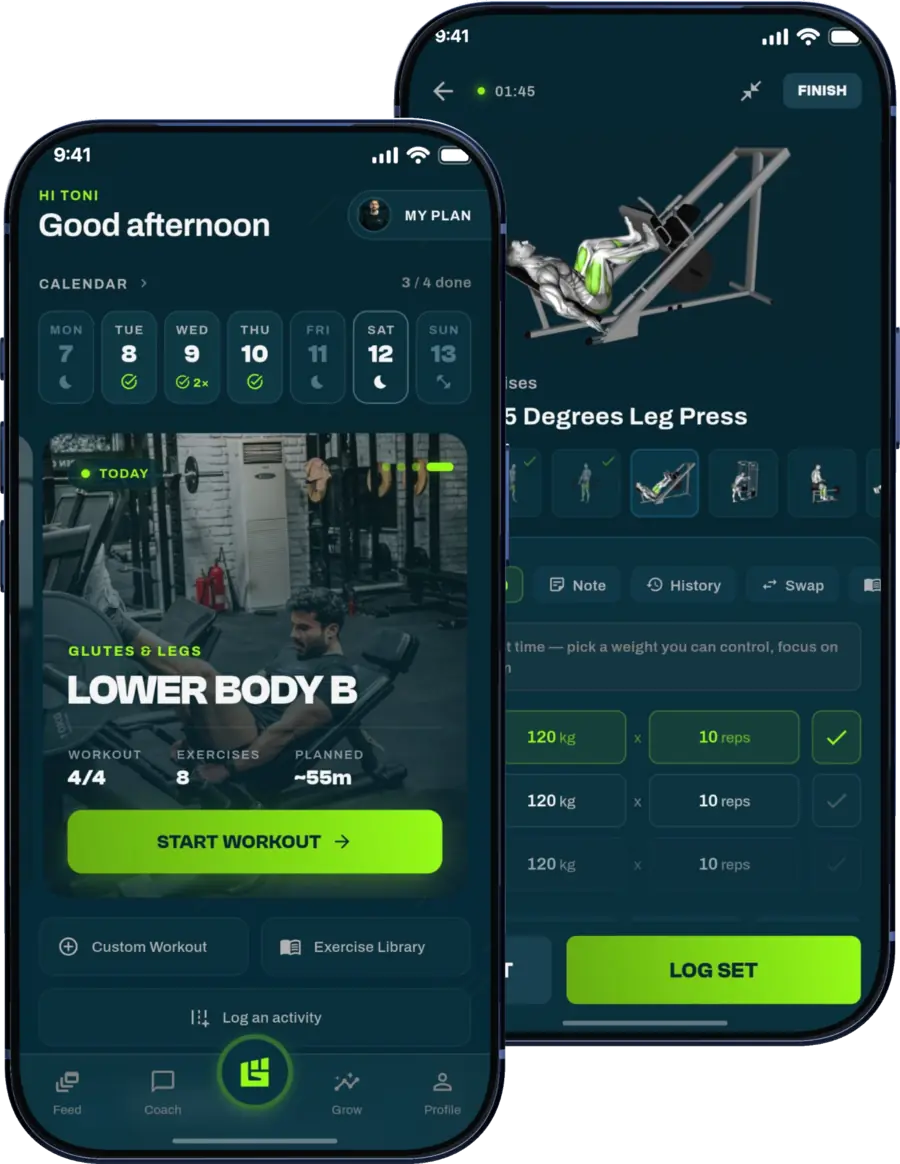
Get a personalized workout plan built around your goal, equipment and schedule. Train smarter, track every rep and keep moving forward, one workout at a time.






This commonly leads to one of three problems:
- Too many training days: You miss sessions, then try to cram them in later.
- Too much volume per workout: Session quality drops because fatigue piles up before the important work is done.
- Poor exercise rotation: You keep restarting the week instead of progressing it.
The best split for muscle growth has to fit around your work, sleep, stress, and training age. A beginner with limited lifting skill needs frequent practice on basic lifts. An intermediate lifter benefits from more room for volume. An advanced lifter may need tighter control of fatigue and exercise selection.
The comparison is between systems you can sustain
Many people end up choosing between three broad setups:
| Split | Weekly schedule | Best fit | Main trade-off |
|---|---|---|---|
| Full-body | Involves fewer training days | Beginners, busy professionals, anyone who needs efficiency | Less room to hammer one muscle in a single session |
| Upper/lower | Involves a moderate weekly schedule | Intermediate lifters who want balance | Requires more weekly availability than full-body |
| Push-pull-legs | Involves more frequent training | Lifters who want more specialization and session focus | Harder to sustain with a chaotic schedule |
That’s also why adaptive planning matters more than static planning. If your availability changes week to week, your training structure should change with it. A Personalized strength training app can help lifters match the split to the week they have instead of forcing every week into the same mold.
Coach’s rule: Pick the split you can complete when life is normal and when life is messy.
Understanding the drivers of muscle growth
Muscle growth does not come from the split itself. It comes from the kind of training the split makes possible week after week.

A useful split gives you enough exposure to the right exercises, enough room to recover, and enough consistency to progress. If one setup looks great on paper but falls apart when work gets busy or sleep drops, it is the wrong setup for that phase of training.
Mechanical tension is the main signal
The body builds muscle in response to high-tension reps. That means taking sets hard enough, controlling the eccentric, and using exercises you can load and repeat with good form.
Big compound lifts make this easier because they train a lot of muscle at once and give you clear progression targets. Isolation work still matters. It fills gaps, brings up weak areas, and adds volume where compounds stop being efficient.
Volume only counts if you can recover from it
For hypertrophy, the practical target is enough hard sets to force adaptation without burying performance.
That is where split choice starts to matter. A split is really a way to organize weekly volume. If chest, back, quads, and delts all get enough quality work and you can come back stronger next session, the split is doing its job. If fatigue kills performance by midweek, the structure needs work.
Nutrition is part of that recovery equation. Lifters who under-eat commonly blame the split when the underlying issue is poor fuel intake. Plant-based lifters who need more structure can use a vegan bodybuilding meal plan for building muscle to line up food intake with training demands.
Frequency is a tool, not a trophy
Frequency matters because it changes how your weekly work gets distributed.
A lifter trying to do all chest volume on one day usually sees set quality drop fast after the first few hard efforts. Spread that same work across two or three sessions and the reps are often stronger, technique is cleaner, and progression is easier to track. That is why many effective splits hit muscles more than once per week, even though the exact pattern can vary.
The right frequency depends on the lifter in front of you. Beginners benefit from more frequent practice on a smaller exercise menu. Intermediate and advanced lifters may need more variation in session stress so they can keep volume high without beating up joints or stalling loads.
Exercise quality and effort decide whether the split works
A well-designed split still fails if the exercise selection is sloppy or the effort is inconsistent.
Use three filters:
- Can you train the target muscles with stable, repeatable exercises
- Can you push working sets hard enough to create a growth stimulus
- Can you recover well enough to improve performance over time
That last point is why the best split keeps changing. A four-day upper/lower plan might fit a stable work month, while a three-day full-body setup makes more sense during high stress. Tools like GrabGains help automate that adjustment by matching training structure to your schedule, recovery, and recent progress instead of locking you into one fixed template.
The split is the container. Growth comes from productive training that fits your current capacity.
Full-body splits for maximum frequency
Full-body training is frequently dismissed as a beginner-only option. That’s a mistake.
For muscle growth, full-body splits are one of the most efficient ways to train because they let you practice major lifts often and spread work across the week without turning any single session into a marathon.
Why full-body works so well
A full-body split trains the main movement patterns every session. You often include a squat or leg pattern, a press, a pull, and a hinge or accessory pattern in each workout.
That setup does two useful things.
First, it raises training frequency. Second, it keeps individual session volume under control. You’re not trying to do every chest exercise you know in one day. You’re giving the muscle repeated quality exposure.
A 2019 study on trained lifters found that a 5-day full-body split produced significantly greater muscle growth across almost every measured muscle than a bro split that trained each muscle once weekly, according to this summary from Jeff Nippard’s discussion of the research. That finding fits what many coaches see in practice. Trained lifters respond well when quality volume is spread across more touchpoints instead of buried inside one massive body-part day.
Who should use it
Full-body is often a strong fit for:
- Beginners: More chances to practice squats, presses, rows, and hinges.
- Busy professionals: Fewer weekly sessions, but each one covers the bases.
- Lifters returning after time off: Easier to rebuild skill and tolerance.
- Anyone with an unstable schedule: Missing one day doesn’t erase an entire muscle group from the week.
A practical 3-day full-body template
Here’s a simple structure that works well.
| Day | Main focus | Example lifts |
|---|---|---|
| Day 1 | Squat and horizontal press | Back squat, bench press, row, leg curl, lateral raise |
| Day 2 | Hinge and vertical press | Romanian deadlift, overhead press, pull-up or pulldown, split squat, curl |
| Day 3 | Squat variation and upper pull | Front squat or leg press, incline press, chest-supported row, hip thrust, triceps work |
Keep the session centered on compounds. Add isolation work where it solves a problem, not where it floats the workout.
Where full-body can fall short
The downside is session focus. If your goal is to bring up a lagging body part, full-body can feel cramped. You have to be disciplined with exercise order and avoid turning every day into a checklist of everything.
It gets harder to run when you want a lot of specialization. Advanced lifters often need more room to push targeted volume for specific muscles.
Practical rule: If you can only guarantee a few training days each week, full-body is usually the safest way to keep growth moving.
Upper/lower splits for balanced volume and recovery
Upper/lower is the split I recommend for many when a lifter is past the beginner stage but doesn’t want the scheduling burden of push-pull-legs.
It gives you more room per session than full-body, but it still keeps frequency high enough to support steady hypertrophy. For a lot of intermediates, that’s the sweet spot.
Why upper/lower fits so many lifters
The structure is simple. You alternate upper-body and lower-body sessions across the week. That immediately solves one common programming problem. You can train hard without asking the same muscles to do everything in the same workout.
That gives you more space for useful accessory work, better exercise variety, and cleaner session sequencing. Heavy presses don’t need to compete with squats and hinging in the same hour. Lower-body work gets attention without being rushed.
A randomized controlled trial in 67 untrained males found that split and full-body routines produced equivalent gains in muscle strength and thickness when weekly volume and intensity were matched, according to the full paper at PMC8372753. In that study, both groups improved similarly, including 1RM squat increases of 24.5kg and 28.2% in the split group and 25.7kg and 28.6% in the full-body group, with comparable changes in muscle thickness. The practical lesson is clear. The split itself isn’t magic. It’s a way to organize effective volume.
Why a 4-day upper/lower split works
A four-day setup usually gives each muscle group two productive exposures per week without overcomplicating recovery.
That schedule tends to work well because you can:
- Push hard on major lifts: Sessions are focused enough to train with intent.
- Add accessories where needed: Arms, delts, hamstrings, calves, and upper back all get room.
- Recover between exposures: Muscles get time before the next hard session.
Sample 4-day upper/lower structure
A practical template looks like this:
| Day | Session | Example emphasis |
|---|---|---|
| Monday | Upper 1 | Bench press, row, incline press, pulldown, lateral raise, triceps |
| Tuesday | Lower 1 | Back squat, Romanian deadlift, leg press, calf raise |
| Thursday | Upper 2 | Overhead press, pull-up, dumbbell bench, chest-supported row, curls |
| Friday | Lower 2 | Deadlift variation, front squat or hack squat, leg curl, split squat |
This split works especially well for intermediate lifters who need more than full-body but don’t want to live in the gym.
The main trade-off
Upper/lower still needs a predictable week. If you regularly lose one or two training days, the split can become uneven. Missing a lower day repeatedly is a common problem. That’s why lifters with highly inconsistent schedules may do better with full-body as their default.
Still, for many people, upper/lower gives the cleanest balance of volume, recovery, and sustainability.
Push-pull-legs for high volume and specialization
Push-pull-legs is not the default "best" split. It is the best fit for a specific job.
PPL works well when a lifter needs more exercise slots, more weekly sets, and more room to bias certain muscle groups without turning every session into a two-hour grind. That often makes it a better match for intermediate and advanced lifters than for beginners. It works best when the training week is stable enough to support frequent sessions.
Why PPL works
The structure is simple. Push days cover chest, shoulders, and triceps. Pull days cover back, rear delts, and biceps. Leg days handle quads, glutes, hamstrings, and calves.
That setup keeps each session focused and generally manages local fatigue better than cramming everything into one workout. A hard chest and shoulder session does not need to compete with heavy rowing, squatting, and arm work on the same day. The lifter can do more quality work for the target muscles before performance drops.
PPL gives coaches and self-directed lifters more room to specialize. If delts lag, add more lateral raise and overhead press volume on push days. If upper back needs attention, pull days can carry more rows, pulldowns, and rear delt work without disrupting the rest of the week.
Frequency is part of the appeal. As noted earlier, muscle groups respond well to being trained more than once per week when total volume is set up well. A standard 6-day PPL rotation makes that easy because each pattern comes back around every few days.
Who usually does well with it
PPL tends to suit three groups:
- Intermediate lifters who have outgrown simpler templates: They often need more weekly work than a basic full-body or upper/lower setup comfortably allows.
- Advanced lifters chasing weak-point development: They benefit from more exercise variety and more controlled volume distribution.
- Lifters who can train 5 to 6 days most weeks: The split falls apart quickly if attendance is inconsistent.
A practical 6-day PPL structure
A common setup looks like this:
- Monday, Push: Bench press, incline dumbbell press, overhead press, lateral raise, triceps extension
- Tuesday, Pull: Barbell row, pulldown or pull-up, chest-supported row, rear delt raise, curl
- Wednesday, Legs: Back squat, Romanian deadlift, leg press, leg curl, calf raise
- Friday, Push: Machine or dumbbell press variation, overhead press variation, chest fly, lateral raise, triceps work
- Saturday, Pull: Pull-up or pulldown variation, row variation, upper-back work, rear delts, biceps
- Sunday, Legs: Front squat or hack squat, hinge variation, lunge or split squat, hamstrings, calves
Thursday can be a rest day. Some lifters do better with a rolling rotation instead of tying PPL to fixed weekdays.
That distinction matters. A calendar-based 6-day split looks great on paper, but a rotation-based split often survives real life better. If work or family cuts one session, the next workout in the sequence still happens instead of forcing the whole week out of alignment.
The main trade-off
PPL asks for more than enthusiasm. It asks for repeatable recovery, decent sleep, enough food, and enough schedule control to show up consistently.
Miss one session and the week can get messy fast. Miss two and lower body work can get pushed aside first. I see this all the time with busy professionals who like the idea of specialization but do not have six reliable training windows. In that case, PPL is not too advanced intellectually. It is just a poor fit for the current week.
That is why split selection should stay adaptive. A lifter might run PPL during a stable phase, shift to upper/lower during a busier block, then return to PPL when recovery and schedule improve. GrabGains follows that same logic by adjusting training structure around availability, recovery, and actual progress instead of treating one split like a permanent identity.
A high-volume split only works when your week can support high-volume training.
How to choose the best split for you
The right answer depends less on what’s popular and more on what your week, recovery, and training history can support.

Many guides still treat split selection like a fixed identity. You pick one and stick with it no matter what. That’s where a lot of lifters get stuck. The world doesn’t hold still. Work deadlines show up. Sleep gets worse. Travel breaks the week in half. Motivation shifts.
An overlooked point in the discussion around training structure is that fixed plans don’t adapt well to changing schedules. As noted in Bony to Beastly, many guides ignore the variability of busy professionals, even though volume-matched full-body and split approaches can produce equivalent hypertrophy. That is why split selection should be adaptive, not ideological.
Start with your available days, not your ideal days
Many lifters should choose their split by asking a blunt question first.
How many days can you reliably train most weeks?
Not your best week. Not your vacation week. Your normal week.
Use this framework:
| Reliable training days | Strong starting point | Why it works |
|---|---|---|
| Fewer days available | Full-body | Covers all major muscle groups each session |
| Moderate weekly availability | Upper/lower | Balances focus and recovery |
| High weekly availability | Push-pull-legs | Creates room for specialization and more targeted work |
If your answer changes from week to week, that matters. You don’t need a fixed split. You need a training system that can compress or expand without losing direction.
Match the split to your training age
Beginners need repetition more than variety. They benefit from practicing foundational lifts often and building technical consistency.
Intermediate lifters generally need more total work and more room for accessories. That’s where upper/lower becomes useful.
Advanced lifters usually need sharper fatigue management and more individualization. Sometimes that means PPL. Sometimes it means a modified upper/lower. Sometimes it means rotating between structures based on block goals.
Use recovery feedback, not ego
A split should fit your recovery capacity.
If your joints stay irritated, your performance stalls, and you drag through every session, the issue may not be motivation. The split may be asking more than your current lifestyle supports.
Look for these signs:
- Performance is sliding: Loads and reps stop moving even when effort stays high.
- Session quality is uneven: You feel good for one day, then flat for the next two.
- Missed workouts are becoming normal: The split no longer matches your life.
- Aches keep accumulating: Fatigue is outpacing recovery.
Let the split evolve with the week
This is the part many articles miss.
You don’t need one perfect split forever. You need a default structure and a fallback structure.
For example:
- If you planned a 4-day upper/lower week but lose a day, condense it into three total sessions built around compounds.
- If you normally run PPL but work gets chaotic, switch to full-body until consistency returns.
- If recovery is poor, reduce overlap and clean up exercise selection before adding more training days.
That adaptive approach is what makes programming work outside of textbooks. Some lifters handle this with a coach. Others use structured logging and adjust manually. Tools can help too. GrabGains builds routines around goals, tracks performance over time, and updates programming based on user feedback and schedule changes, which is useful for lifters who need their split to adjust instead of staying frozen.
A simple decision checklist
If you want a faster answer, use this:
- Choose full-body if your schedule is unpredictable, you’re newer to lifting, or you want maximum efficiency.
- Choose upper/lower if you can train on a steady weekly rhythm and want more room for volume.
- Choose PPL if training is a major priority, you recover well, and you can consistently support frequent sessions.
- Switch the split when life changes enough that the current structure stops being repeatable.
- Judge the plan by progress, not by how advanced it looks.
The best split for muscle growth is the one that keeps productive work moving forward under real conditions.
Making any split work progressive overload and recovery
A split organizes training. It does not create progress by itself.
What drives results is progressive overload. You ask the body to do a little more over time, then you recover enough to adapt.
What progressive overload looks like
Lifters tend to overcomplicate this. In practice, overload usually means one of a few things:
- More load: You lift slightly more weight with solid form.
- More reps: You get an extra rep at the same weight.
- More useful sets: You add work only when recovery supports it.
- Better execution: Cleaner tempo, stronger control, and more consistent range of motion.
That’s how a basic split beats a flashy one. It gives you repeatable lifts, clear targets, and enough consistency to build on prior sessions.
Recovery decides whether overload sticks
Muscle doesn’t grow during the set. It grows after the work, when sleep, food, and stress management support the process.
If recovery is poor, every split starts to look broken.
Pay attention to the basics:
- Sleep quality: Poor sleep blunts training output fast.
- Nutrition consistency: Random eating makes progress random too.
- Hydration and cramps: If cramping disrupts training or recovery, this guide on how to prevent muscle cramps is a useful practical read.
- Stress load: Hard training on top of hard life stress changes what you can recover from.
Hard training works only when recovery can cash the check.
Frequently asked questions about training splits
Why is the bro split often a poor fit for natural lifters
The biggest issue is low frequency. Training a muscle hard once per week can work, but many natural lifters do better when quality volume is spread across more than one session. That tends to improve execution, progression, and weekly stimulus.
How often should you change your split
Change your split when it stops fitting your life or when progress stalls for reasons the current setup can’t solve. Don’t change it because you’re bored after two weeks. Many plateaus come from poor progression, weak recovery, or inconsistent attendance, not from the split itself.
Can hybrid splits work
Yes. Hybrid setups work well, especially for busy lifters. You might run upper/lower as the default and use a full-body fallback week when your schedule tightens. You might keep a PPL structure but rotate in full-body sessions during travel weeks.
Is more training days always better for muscle growth
No. More days help if they improve the quality and distribution of your training. If extra days create missed workouts, poor recovery, or lower effort, they make the plan worse.
What should beginners start with
Many beginners do best with full-body training because it gives frequent practice on the main lifts and keeps the program simple. Once they need more volume and can recover from it consistently, upper/lower tends to become the next logical step.
If you want a plan that adjusts when your week changes, GrabGains is built for that. It creates personalized routines, tracks your training, and updates your programming based on your performance so your split can evolve with your schedule instead of fighting it.
Get inspired and motivated