The ultimate compound exercise workout plan
Build strength & muscle efficiently with this complete compound exercise workout plan. Includes programming principles, sample routines, and tracking. Most compound training advice is backwards. It tells people to collect exercises like trading cards, chase soreness, and spend half the session on movements that barely move the needle. Effort isn’t the problem for most lifters. The problem is wasted effort.
A good compound exercise workout plan fixes that by forcing priorities. You train the lifts that give the biggest return first, you load them with intent, and you progress them long enough to matter. That works for beginners who need structure, busy professionals who need efficiency, and HYROX athletes who can’t afford a plan that builds muscle in isolation but ignores work capacity.
If your plan doesn’t tell you what to prioritize, how hard to push, when to add load, and when to back off, it’s not a plan. It’s a random list of exercises. Random training creates random results.


The Foundation of Smart Training Why Compounds Reign Supreme
Many individuals fail in the gym because they confuse activity with progress. They leave drenched, tired, and convinced that a longer workout must be a better one. It usually isn’t. The body responds to stress that is organized well, repeated consistently, and progressed over time.
That’s why compound lifts should sit at the center of almost every serious program. Squats, presses, rows, deadlift patterns, lunges, and pull-ups train multiple joints and large amounts of muscle at once. You get more mechanical tension, more coordination, and more useful carryover to sport and daily life than you’ll ever get from stringing together endless curls, kickbacks, and machine fluff.
Built for progress
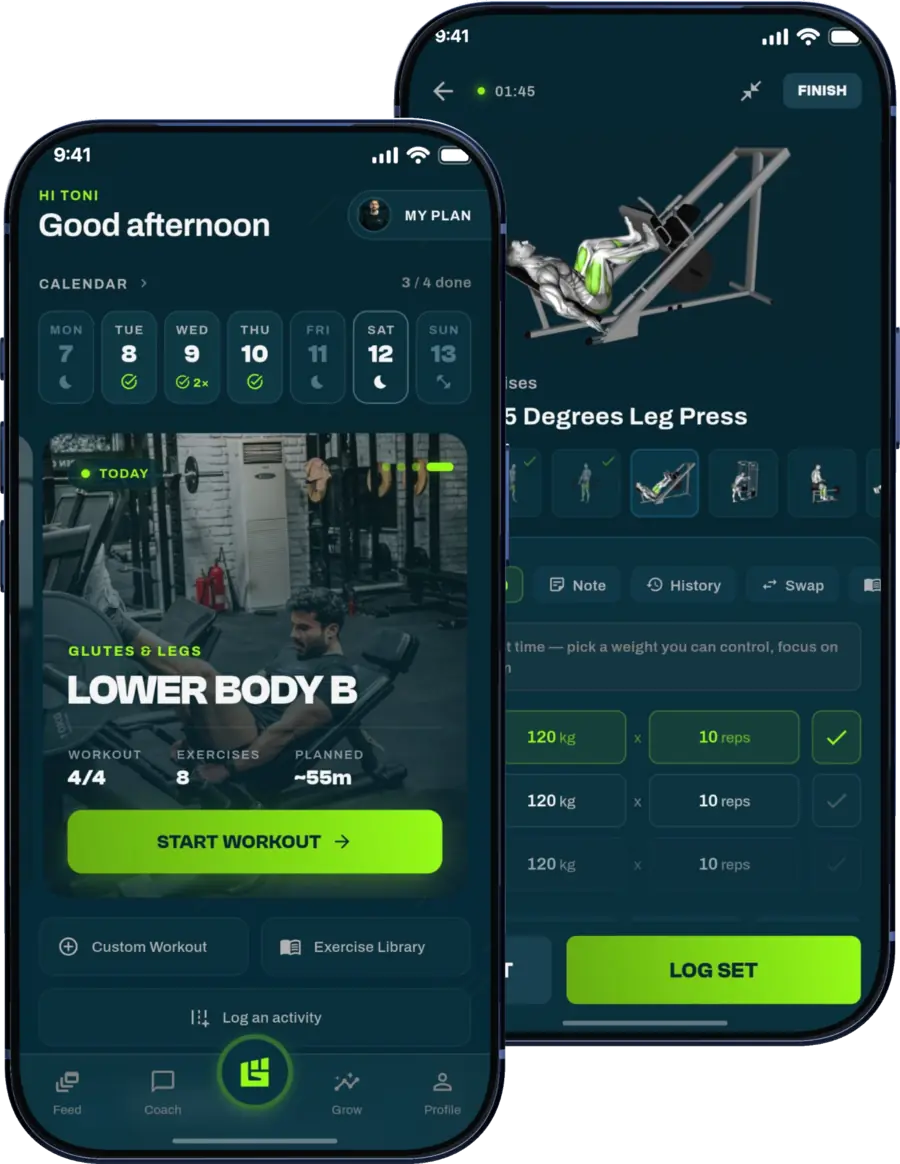
Take the guesswork out of training
Get a personalized workout plan built around your goal, equipment and schedule. Train smarter, track every rep and keep moving forward, one workout at a time.






Why efficiency matters more than variety
A strong plan doesn’t ask, “How many exercises can I fit in?” It asks, “Which exercises earn their place?” Compound movements win that test because one lift can train strength, muscle, bracing, coordination, and in many cases a meaningful conditioning effect.
That matters even more if your schedule is tight. A parent training before work, a traveler using a hotel gym, or an office worker trying to get in and out in under an hour doesn’t need more options. They need better decisions.
Practical rule: If a movement trains a lot of muscle, allows progressive loading, and improves a skill you’ll use elsewhere, it belongs near the front of the session.
For lower-body programming in particular, it helps to think in movement categories instead of body-part clichés. A guide on lower body compound exercises is useful for sorting squat patterns, hinge patterns, and unilateral work without turning leg day into a mess of redundant exercises.
Compounds do more than build muscle
The lazy argument says compound lifts are only for strength. That misses the point. They also train the engine while they build the frame.
A 2017 study in Frontiers in Physiology found that a compound exercise group improved VO2 max by 12.5% over 8 weeks, compared with 5.1% in an isolation exercise group, while also posting stronger gains in key lifts like the bench press and squat (Frontiers in Physiology study). That’s the kind of result busy people should care about. Better strength and better cardiovascular fitness from the same training block.
What doesn’t work
Three things consistently waste time:
- Isolation-first sessions that drain energy before the lifts that matter
- Program hopping before skill and strength can build
- Volume without purpose where every exercise gets equal status, even though they don’t produce equal results
You can still use isolation work. It has a place. It just shouldn’t be the spine of your program unless you’re addressing a very specific weak point. Build the session around compounds first. Everything else is support work.
Designing Your Workout Architecture
A plan works when the structure matches the goal. That sounds obvious, but contradictory signals often guide training efforts. They say they want strength, then use random rep ranges. They say they want muscle, then change exercises every week. They say they want HYROX performance, then follow a bodybuilding split that never trains sustained output.
A useful compound exercise workout plan starts with one question. What outcome matters most right now?

Start with the goal, not the exercise list
Your primary goal changes the whole build:
- Strength Use fewer lifts, keep the main compounds stable, and give them your freshest effort. You’re chasing load, clean technique, and repeated exposure to the same patterns.
- Hypertrophy Keep compounds first, but use a bit more total work and more variation in rep ranges. Muscle growth responds well when the big lifts do the heavy lifting and the assistance work fills in what they miss.
- Functional endurance or HYROX-style prep Choose compounds that carry over to repeated efforts, posture under fatigue, and total-body output. Exercise selection matters more here than people think.
If your life situation changes recovery capacity, the plan has to respect that too. Someone returning to training after surgery, pregnancy, or a long layoff doesn’t need motivational nonsense. They need a progression they can recover from. For readers navigating that stage, this overview on exercise after cesarean is a useful reminder that training progression has to match healing, not ego.
The four variables that control results
Programming gets much easier when you understand the levers.
Volume
Volume is how much work you do. In practical terms, that means the total number of hard sets and reps you perform. Think of it as the amount of stress you’re asking the body to adapt to.
Too little, and nothing changes. Too much, and performance falls off before adaptation can happen.
Intensity
Intensity is how heavy the work is relative to your current ability. You can estimate this with a percentage of your 1RM or by using RPE. If you don’t know your current numbers, use a calculator or training log rather than guessing.
Frequency
Frequency is how often you train a movement or muscle group each week. More isn’t automatically better. Better is better. Most lifters do well when they repeat core movement patterns often enough to practice them but leave enough room to recover.
Exercise selection
Often, plans are flawed in this area. A good exercise earns its place because it fits your goal, your equipment, your skill level, and your current limitations. A bad exercise may be fine in theory but wrong for you right now.
The best plan isn’t the one with the most variety. It’s the one you can recover from, progress on, and repeat long enough to matter.
A practical default that works for most people
If you want a reliable base, use a 4-day upper/lower split. One effective template is to start lower days with squats at 4 sets of 6 to 8 reps at 75% of 1RM. According to the verified protocol summary, this style of setup can produce 1.5 to 2 times faster strength transfer to sports than isolation-heavy routines, while 30 to 40% of trainees run into overtraining without proper rest days, which can double injury risk. Those figures come from the same verified programming summary tied to the earlier research source.
That last point matters. A hard plan is not the same as a smart one. If you’re dragging through sessions, your joints ache, and your numbers stall, adding more work usually makes the problem worse.
Choosing the right split for your schedule
Here’s the honest breakdown.
- Three days per week Best for beginners, busy professionals, and people who need a simpler recovery rhythm. Full-body or hybrid full-body works well here.
- Four days per week The sweet spot for many lifters. Enough frequency to progress, enough room to separate priorities, and manageable for people with jobs and families.
- Five or more days Useful for advanced lifters with high work capacity, but often unnecessary. More days create more opportunities to accumulate junk fatigue.
A platform with Fully customized workouts can help organize those variables if you want structure around goal selection, exercise choice, and performance tracking from day one. The tool matters less than the logic, but the logic has to be there.
Use a simple build sequence
When I write programs, the order is boring on purpose:
- Pick the main lift first Squat, hinge, press, or pull pattern based on the day’s priority.
- Add a second compound that doesn’t fight the first Pair a squat with a press, or a hinge with a vertical pull, instead of stacking fatigue on the same tissues without a reason.
- Use assistance work to support the main lifts Rows, split squats, incline presses, or carries should solve a problem, not just fill time.
- Finish with optional isolation only if needed Arms, calves, delts, or trunk work go last.
That’s architecture. Everything else is decoration.
Sample 4–12 Week Compound Workout Routines
Templates beat random exercise lists because they tell you what to repeat and what to progress. Below are three practical models. They aren’t magic. They work because each one has a clear priority and enough structure to drive adaptation.
Workout Plan Focus Comparison
| Variable | Strength Focus Plan | Hypertrophy Focus Plan | Endurance Focus Plan |
|---|---|---|---|
| Primary goal | Maximize force production on core lifts | Build muscle with compound-first volume | Build strength, work capacity, and movement durability |
| Weekly structure | 4 days upper/lower | 4 days upper/lower | 3 days full-body hybrid |
| Main lift emphasis | Low to moderate reps, longer rest | Moderate reps, controlled tempo | Moderate reps, density and sequencing matter |
| Assistance work | Limited and targeted | More supporting volume after compounds | Chosen for carryover and fatigue tolerance |
| Best fit | Lifters chasing stronger numbers | Lifters chasing size with structure | HYROX-style and functional fitness athletes |
Four-day strength-focused plan
This plan is for the lifter who wants to get stronger at the big patterns and keep the menu tight.
Day 1 lower strength
- Back squat, 4 x 6 to 8
- Romanian deadlift, 3 x 6 to 8
- Walking lunge, 3 x 8 each side
- Weighted carry or plank variation, 3 rounds
Day 2 upper strength
- Bench press, 4 x 6 to 8
- Barbell row, 4 x 6 to 8
- Overhead press, 3 x 6 to 8
- Pull-up or assisted pull-up, 3 hard sets
Day 3 lower strength
- Deadlift variation, 3 x 5
- Front squat, 3 x 6 to 8
- Step-up, 3 x 8 each side
- Hamstring curl or hip hinge accessory, 2 to 3 sets
Day 4 upper strength
- Incline press, 4 x 6 to 8
- Chest-supported row, 4 x 8
- Dips or close-grip press, 3 sets
- Face pull or rear-delt row, 2 to 3 sets
Use longer rests on the first two movements of each session. Progress by adding reps within the range before adding load. If form degrades, the set doesn’t count as progression.
Coach’s note: Strength plans fail when lifters treat every set like a max attempt. Leave a little room, own the reps, then add load over time.
Home substitutions:
Back squat becomes goblet squat. Bench press becomes weighted push-up or dumbbell floor press. Barbell row becomes one-arm dumbbell row. Deadlift variation becomes heavy kettlebell or dumbbell Romanian deadlift.
Four-day hypertrophy-focused plan
This version keeps compounds first but allows more total work. You’re still training hard, but the target is muscular tension and repeated quality efforts, not just bigger top-end numbers.
Day 1 lower hypertrophy
- Back squat, 4 x 8
- Romanian deadlift, 4 x 8 to 10
- Bulgarian split squat, 3 x 10 each side
- Calf raise or leg curl, 2 to 3 sets
Day 2 upper hypertrophy
- Incline dumbbell press, 4 x 8 to 10
- Pull-up or pulldown pattern, 4 x 8 to 10
- Seated press, 3 x 10
- Chest-supported row, 3 x 10 to 12
- Optional curls or triceps work, 2 sets
Day 3 lower hypertrophy
- Front squat or leg press pattern, 4 x 8 to 10
- Hip thrust, 4 x 8 to 10
- Reverse lunge, 3 x 10 each side
- Trunk work, 3 rounds
Day 4 upper hypertrophy
- Bench press, 4 x 8
- Bent-over row, 4 x 8 to 10
- Dumbbell shoulder press, 3 x 10
- Push-up variation, 2 hard sets
- Lateral raise or rear-delt work, 2 to 3 sets
Control the eccentric, don’t rush transitions, and avoid turning accessory work into a cardio contest. You’re trying to load muscle through full ranges, not just survive the session.
Three-day functional endurance and HYROX-style plan
Hybrid athletes can’t afford body-part thinking. The exercise choice has to support strength and repeated output. That’s why bent-over rows are such a smart inclusion here. The verified guidance notes that for hybrid goals like HYROX, bent-over rows support back hypertrophy, core stability, and the work capacity needed for sled-pull demands better than a generic split that separates those qualities.
Day 1 squat and push capacity
- Front squat, 4 x 6
- Push press or dumbbell push press, 4 x 6
- Walking lunge, 3 x 10 each side
- Rowing or ski-erg interval block
- Carry finisher
Day 2 hinge and pull capacity
- Deadlift variation, 3 x 5
- Bent-over row, 4 x 8
- Pull-up or inverted row, 3 hard sets
- Step-up, 3 x 10 each side
- Short work-capacity circuit
Day 3 mixed full-body density
- Thruster or squat-to-press variation, 3 to 4 rounds
- Romanian deadlift, 3 x 8
- Push-up variation, 3 hard sets
- Row variation, 3 x 10
- Sled substitute, carry, or incline treadmill push effort
This plan works best when you keep the first compound lift honest, then build density later in the session. Don’t turn the whole workout into gasping chaos. Hybrid training still needs hierarchy.
How to run these plans for 4 to 12 weeks
Use one main pattern of progression:
- Weeks 1 to 4 Learn the setup, lock in technique, and build consistency.
- Weeks 5 to 8 Push progression on the primary lifts and keep accessories stable.
- Weeks 9 to 12 Either continue if numbers are moving, or rotate a close variation if motivation, joints, or technique need a reset.
If a lift stalls, don’t scrap the plan immediately. First check sleep, stress, food intake, and whether you’ve been honest about rest periods and effort.
Essential Protocols Before and After You Lift
The warm-up and the cooldown aren’t optional extras for organized people. They’re part of the training session. Lifters skip them because they want to get to the “real work,” then wonder why the first few sets feel terrible and the next day feels worse.
The warm-up that actually prepares you
A proper warm-up should raise temperature, open the ranges you need, and switch on the muscles that keep you in position. It should not leave you tired.
Use this sequence before most compound sessions:
- General movement first Walk briskly, bike lightly, or row for a few minutes until you feel warm.
- Mobility where the session demands it For lower body days, open ankles, hips, and thoracic rotation. For upper body days, get the shoulders moving and the upper back active.
- Activation with purpose Glute bridges, dead bugs, band pull-aparts, or scapular push-ups work well if they prepare the positions you need under load.
- Ramp-up sets Take the first main lift through several lighter sets before your work sets begin.
Don’t judge a warm-up by how sweaty it makes you. Judge it by whether your first work set feels crisp and stable.
Nutrition timing matters here too, especially if you train early or after work. If you tend to walk into sessions under-fueled, a simple guide on best foods to eat before gym can help you sort out practical pre-workout meal ideas without overcomplicating it.
What to do after the last set
The session isn’t over when the bar is racked. Recovery starts immediately, and the basics still matter most.
Cool down in a simple sequence
- Bring breathing down Walk for a few minutes instead of jumping straight into the car.
- Stretch what took the load Hit the hips, chest, lats, and calves if they feel restricted. Keep it easy. The goal is to downshift, not force range.
- Rehydrate and eat You don’t need ritual. You need fluids and a meal that supports recovery.
What doesn’t help much
A lot of post-workout habits are just distraction. If you skip sleep, ignore hydration, and train hard again before you’re recovered, no recovery gadget will save you.
The basics still win:
- Consistent sleep During consistent sleep, the adaptation you trained for is built.
- Repeatable food habits Eat like someone who intends to perform again tomorrow.
- Reasonable spacing between hard sessions Recovery is programming, not laziness.
Tracking Progress and Adapting Your Plan
A static program stops working the moment your body changes and the plan doesn’t. Good training is a feedback loop. You perform, you record what happened, you adjust the next exposure. That’s how coaches think, and it’s how lifters should think too.
What to track every session
You don’t need a complicated dashboard. You need enough data to make decisions.
Write down:
- Exercise selection The exact variation matters. A front squat and a back squat are not the same lift.
- Sets and reps This tells you whether workload is increasing or if you’re just repeating yourself.
- Load used No memory-based training. Log the weight.
- RPE or effort Two sets of eight can be completely different if one had room left and the other was a grind.
- Notes on form and recovery Brief notes like “lost position on last rep” or “slept badly” tell you more than people think.
Use double progression before chasing maxes
Most lifters would progress faster if they stopped testing and started building. Double progression is simple and reliable. You keep the load stable until you hit the top of the rep range across your prescribed sets with solid form. Then you increase the load and start again at the lower end of the range.
Example:
- Week 1, squat 4 x 6
- Week 2, squat 4 x 7
- Week 3, squat 4 x 8
- Week 4, add weight and return to 4 x 6
That approach keeps technique cleaner and decision-making easier.
If you can’t prove progression on paper, you’re probably relying on motivation instead of a system.
How to know when to push and when to deload
A lot of plateaus aren’t true plateaus. They’re fatigue disguised as lack of progress. Before changing the entire routine, look for patterns.
Signs you should push
- Bar speed feels good
- Reps are clean
- Recovery between sessions is normal
- Motivation is steady
Signs you should back off
- Warm-up weights feel heavy
- Technique breaks earlier than usual
- Sleep, soreness, and irritability are trending in the wrong direction
- Performance drops across multiple sessions, not just one bad day
When that happens, reduce demand for a short stretch. Keep the movements, but lower the load, trim a set or two, or shorten the hard work. A deload should restore momentum, not make you feel like you quit training.
Rotate only when the evidence says to
Exercise variation is useful, but random variation is just disguised impatience. Keep a lift in place long enough to learn it, load it, and assess it. Rotate when one of these is true:
- The lift is beating up a joint
- Technique has gone stale
- Motivation is falling hard
- A close variation would serve the same goal with less wear
That might mean front squats instead of back squats for a block, or dumbbell presses instead of barbell work if your shoulders need a break.
Turn data into decisions
The best plans behave like living systems. A notebook can do this. A spreadsheet can do this. An app can do this. The method is the same.
- Record the session accurately.
- Compare it to the last exposure.
- Adjust one variable at a time.
- Repeat until progress slows for a real reason.
That’s what adaptation looks like in practice. Not motivation quotes. Not random “muscle confusion.” Just clear feedback and disciplined adjustment.
Frequently Asked Questions About Compound Training
Do I need isolation exercises at all
Yes, sometimes. No, not as the foundation.
Compounds should handle the bulk of your training because they give the highest return on time and load. Isolation work is useful when a smaller muscle group is limiting a bigger lift, when you want extra volume without more full-body fatigue, or when you’re trying to bring up a lagging area such as calves, side delts, or arm size.
Can beginners use a compound exercise workout plan
They should. Beginners need repetition on the basics more than they need variety. Start with a squat pattern, a hinge, a push, and a pull. Learn how to brace, control tempo, and finish reps in good position.
The mistake beginners make is adding complexity too early. Mastering a few movements beats dabbling in many.
Can I do this with bodyweight only
Yes, if you respect progression. Bodyweight squats, split squats, push-ups, inverted rows, hip hinges, step-ups, and pull-up variations can all form the spine of a good program. The challenge is making them harder over time by varying the body's position, range, tempo, pauses, or total workload.
A bodyweight plan still needs structure. Random circuits done hard aren’t the same as progressive training.
Will compounds build my arms and calves too
They’ll help, but they may not fully satisfy someone chasing specific size goals. Rows, pull-ups, presses, carries, and lunges train a lot of tissue indirectly. For many people, that’s enough for a solid base. If you want more arm or calf development, add a little direct work after the main session.
That’s the right order. Base first, detail second.
How often should I change exercises
Less often than you think. If you change a movement every week, you never get good enough at it to drive meaningful progress. Keep the main compounds stable for a block, then assess.
Change exercises because the plan calls for it, because recovery demands it, or because a close variation better fits your current goal. Don’t change them because you got bored after two sessions.
If you want a system that builds and updates your training around your goal, schedule, and performance, take a look at GrabGains. It organizes workout planning, exercise guidance, and progress tracking in one place so your program can adapt instead of going stale.
Get inspired and motivated