
The whole full-body vs. split routine debate comes down to one simple trade-off: full-body routines give you higher training frequency, hitting every muscle 2-3 times per week, while split routines pack in more per-session volume by hammering just one or two muscle groups.
When total weekly volume is matched, most people get nearly identical muscle and strength gains from either approach. The right plan is always the one you can stick to week in and week out.
Deconstructing the full body vs split debate
Choosing between a full-body or split routine is one of the oldest arguments in fitness, and it causes way more confusion than it should. New lifters get paralyzed, worried they’ll pick the “wrong” path and sabotage their gains.
Built for progress
Take the guesswork out of training
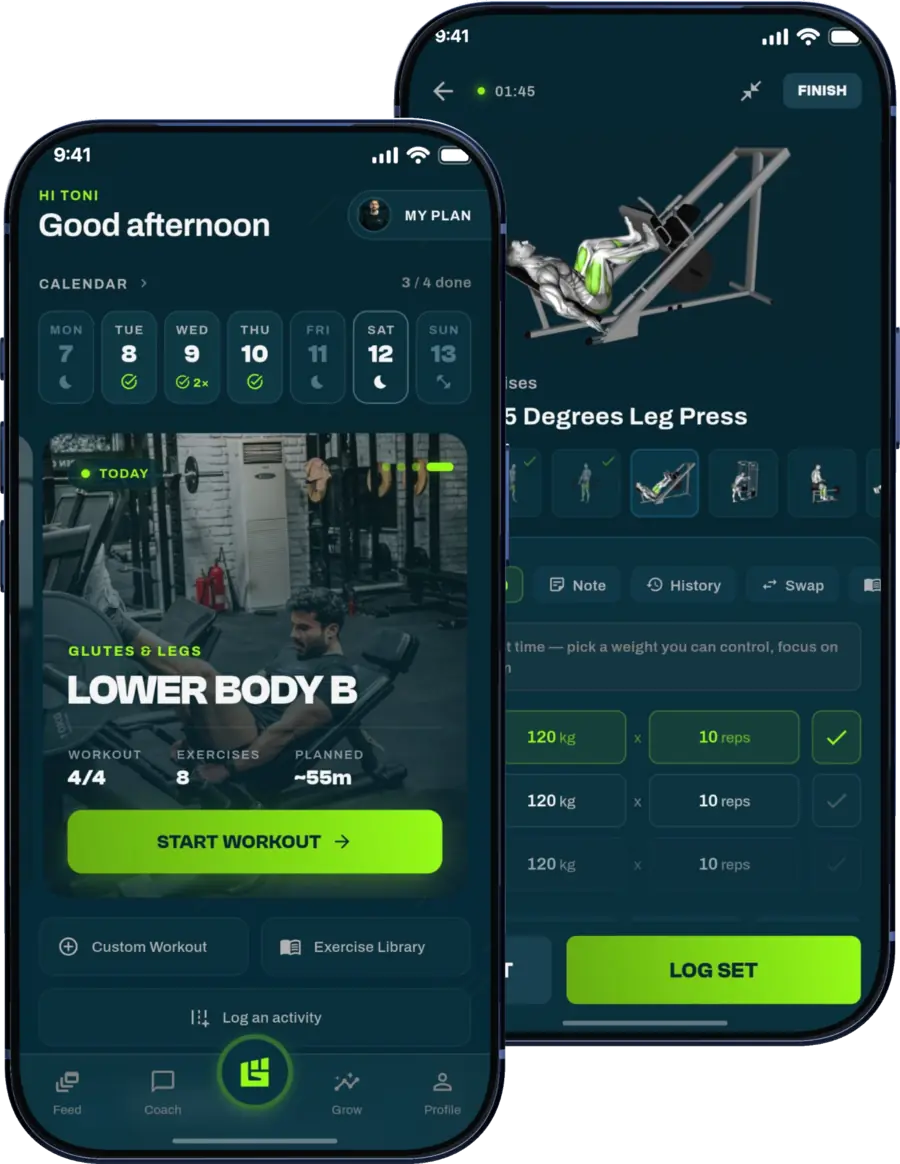
Get a personalized workout plan built around your goal, equipment and schedule. Train smarter, track every rep and keep moving forward, one workout at a time.






But the truth is much simpler. The best program is the one that fits your schedule, your goals, and your experience level.
This guide cuts through the noise. We'll break down the mechanics of each training style, moving beyond the generic pros and cons to see how each one really impacts the drivers of muscle growth:
- Training Frequency: How often you stimulate each muscle group.
- Training Volume: The total work you do (sets x reps x weight).
- Recovery: How your body repairs and adapts between workouts.
- Time Commitment: How many days you actually need to be in the gym.

Full body vs split at a glance
To make the choice easier, here’s a quick side-by-side comparison of how these two popular training styles stack up.
| Characteristic | Full Body Routines | Split Routines |
|---|---|---|
| Training Frequency | High (2-3 times per week per muscle) | Low (1-2 times per week per muscle) |
| Per-Session Volume | Low (fewer sets per muscle group) | High (more sets per muscle group) |
| Time Efficiency | Excellent (fewer gym days needed) | Lower (requires 4-6 days per week) |
| Best For Beginners | Yes, great for learning compound lifts | Can be complex for new lifters |
| Recovery Demand | High systemic fatigue, lower local soreness | Low systemic fatigue, higher local soreness |
| Primary Advantage | Efficiently builds a strong foundation | Allows maximum focus on specific muscles |
Understanding these core differences helps you make an informed decision instead of just following a random plan you found online. You can build a routine that actually works for you.
And once you’ve picked a path, platforms like GrabGains can create a personalized, adaptive plan that gets the most out of whichever style you choose.
Understanding the science of muscle growth
To settle the full body vs. split debate, you first have to get what actually makes muscles grow. The process, known as muscle hypertrophy, isn't just about heaving heavy things around; it’s a biological response to the specific stress you put on your body during a workout.
At its core, muscle growth kicks off when you send the right signals. Think of them as messages telling your body, "I need to get stronger to handle this again."
The three drivers of hypertrophy
The big one is mechanical tension. This is the force your muscles are under when you lift weights. That tension disrupts the muscle fibers, signaling that they need to repair and adapt. When you’re grinding out that last heavy squat rep, you’re creating serious mechanical tension.
Next up is muscle damage. This refers to the tiny, microscopic tears that happen in muscle fibers during hard exercise, especially in the eccentric (or lowering) part of a lift. This damage triggers an inflammatory response that leads to repair and growth, making the muscle bigger and more resilient.
Finally, there’s metabolic stress. This is the "pump" or burn you feel during high-rep sets. It’s caused by the buildup of metabolic byproducts like lactate, which can signal growth through a few different cellular pathways.
While all three play a part, mechanical tension—driven by lifting progressively heavier weights—is widely seen as the most important factor for long-term muscle and strength gains.
The overriding principle: total weekly volume
So, where do full-body and split routines fit in? They’re just different ways to organize the one variable that matters most: total weekly volume. This is the master key to growth, calculated as sets x reps x weight.
No matter how you slice up your week, your main job is to hit each muscle group with enough high-quality volume. This is the non-negotiable foundation of any good training program.
A big 2024 meta-analysis confirmed this, pulling together 14 randomized trials with 392 participants. It found that full-body and split routines deliver identical muscle growth and strength gains when weekly volume is matched. The research showed no real advantage for either approach, proving that how you get your volume in is less important than making sure you get enough of it.
Regardless of your routine, mastering progressive overload is the only way to keep the gains coming. You have to consistently challenge your body by increasing weight, reps, or sets over time. Without it, your body adapts, and progress flatlines.
Ultimately, the full body vs. split debate isn't about which routine is fundamentally better. It’s about which one helps you best manage and increase your total weekly volume, based on your schedule, recovery, and goals.
Full body workouts for maximum efficiency
Full body workouts are the very definition of efficiency. The premise is simple but powerful: you train every major muscle group in a single session. Instead of dedicating entire days to specific body parts, you’ll focus on big compound movements that hit your chest, back, shoulders, arms, and legs all at once. This kind of training is usually done two or three times a week on non-consecutive days, like a Monday, Wednesday, Friday schedule.

The biggest advantage here is the higher training frequency. Every muscle gets stimulated multiple times per week, which is fantastic for reinforcing movement patterns and building foundational strength—especially if you're new to lifting. It's also incredibly time-efficient. You can get a killer workout in just three days, leaving the rest of your week open for recovery or other activities.
The trade-off between frequency and volume
Of course, this efficiency comes with a trade-off. Because you're training your entire body, you simply can't rack up a massive amount of volume for any single muscle group in one session. Trying to cram in five chest exercises after you've already hit squats and rows is a recipe for exhaustion and sloppy form.
This means that while the frequency is high, the per-session volume for each muscle stays relatively low. A typical full-body day might look something like this:
- 3 sets of squats for your legs
- 3 sets of bench press for your chest
- 3 sets of rows for your back
This is definitely enough to trigger growth, but it's a world away from a split routine where you might perform 12-15 sets for your chest alone. For more advanced lifters, this can make it tough to get the targeted volume needed to smash through muscle-specific plateaus.
Managing fatigue and maximizing results
Another key factor is central nervous system (CNS) fatigue. Hitting large muscle groups with heavy compound exercises like squats, deadlifts, and overhead presses all in one workout is demanding on your entire system. This systemic fatigue can be much harder to bounce back from than the localized muscle soreness you get from split routines.
The core principle of a full body routine is to stimulate, not annihilate. The goal is to do just enough work to trigger a growth response, then get out of the gym and recover so you can do it all again in 48 hours.
And this approach works. A landmark 2022 randomized controlled trial followed untrained women over 12 weeks. When the total weekly volume was matched, the full-body group saw a 20.3% jump in upper-body power and a 1.9% increase in muscle mass—statistically the same as the split-routine group. This proves that when the total work is equal, full body training delivers potent results. You can read the full research about these findings on PMC.
Ultimately, full body workouts are a fantastic tool for building a solid base of strength and muscle, especially for anyone short on time. By focusing on the big compound lifts and a few key accessory movements, you can build a balanced and highly productive training schedule.
Split routines for focused muscle building
While full body routines are champions of efficiency, split routines are all about specialization. The idea is simple: you divide your workouts to hammer specific muscle groups on different days. This lets you pour all of your energy into just a few muscles per session—a proven strategy for driving serious growth.
The biggest advantage here is the potential for significantly higher training volume. Instead of hitting three sets for your chest and moving on, a dedicated chest day might involve a variety of chest exercises for a total of 12-20 sets. That kind of intense, targeted stimulus is exactly why bodybuilders and advanced lifters live by split routines to maximize hypertrophy.
Popular split routine structures
Split routines are incredibly flexible, letting you organize your week however you see fit. A few common setups have stood the test of time because they nail the balance between volume, frequency, and recovery.
Here are a few of the most popular ways to set it up:
- Upper/Lower Split: This is a fantastic 4-day-a-week plan. You train your entire upper body (chest, back, shoulders, arms) on two non-consecutive days, and your entire lower body (quads, hamstrings, glutes, calves) on the other two. Simple, effective, and it hits every muscle twice a week.
- Push/Pull/Legs (PPL) Split: PPL can be run anywhere from 3 to 6 days a week, making it highly versatile. "Push" day hits your chest, shoulders, and triceps. "Pull" day works your back and biceps. And "Legs"... well, that one’s self-explanatory. It’s an efficient way to group muscles by their function.
- The "Bro Split": This is the classic 5-day bodybuilding split where each day is dedicated to one major muscle group (Monday is chest day, Tuesday is back day, and so on). While it allows for insane per-session volume, its biggest flaw is training each muscle only once a week—a frequency that’s likely less than optimal for most people.
The recovery and time commitment factor
The main trade-off with a split routine is the time commitment. To give every muscle group the attention it needs, you’re looking at being in the gym 4-6 days per week. For busy professionals or anyone tight on time, that schedule can be a tough sell.
A huge benefit of split training is localized recovery. After you obliterate your chest on Monday, those specific muscles get a full week to repair and grow while you’re busy training other body parts.
But managing that recovery is absolutely critical. Even though individual muscles get plenty of rest, training almost every day puts a heavy demand on your entire system. Without disciplined sleep and nutrition, you risk systemic burnout. The high volume can also lead to some serious delayed onset muscle soreness (DOMS), which might mess with your performance if you don't manage it well.
The full body vs split debate really boils down to this balance. A split routine is an incredible tool if you have the time and want to apply maximum volume to each muscle. Just remember that it demands a smart, structured approach to recovery to keep you in the game for the long haul.
Choosing the right workout for your goals
Now that we've covered the science, let's get practical. The "full body vs. split" debate isn't about finding one superior routine—it's about matching the right tool to the right job. Your goals, how long you've been training, and what your life looks like are the only things that matter here.
A beginner's main job is to build a solid foundation. That means nailing your form on the big compound lifts and developing neuromuscular coordination, which is just a fancy way of saying you're teaching your brain and muscles to fire together efficiently.
Beginners and busy professionals
For anyone new to lifting, a full body routine is almost always the best place to start. Hitting exercises like squats, bench presses, and rows multiple times a week hammers home the movement patterns. This high frequency helps you lock in good technique way faster than a split where you might only squat once every seven days.
It’s the same story for busy professionals with chaotic schedules. Missing one workout in a 5-day split can derail your whole week. But with a 3-day full body plan, you can shuffle days around without torpedoing your progress. You get the stimulus you need, even when life gets in the way.
The beauty of a full body program is its simplicity and effectiveness. It delivers the majority of the results with a minimal time commitment, making it a sustainable choice for most people starting their fitness journey or juggling a demanding career.
Advanced athletes and hypertrophy goals
Once you're an advanced lifter chasing maximum muscle size (hypertrophy), the conversation changes. These athletes have already built their base and now need more specialization to keep growing. This is where split routines truly shine.
By dedicating an entire session to just one or two muscle groups, you can hammer them with a massive amount of targeted training volume. A split routine lets you attack your chest, back, or legs from every conceivable angle, creating the metabolic stress and muscle damage that sparks next-level growth. Think about it: a proper leg day might include heavy squats, leg presses, lunges, and hamstring curls—a workload that's just not feasible in a full body session.
Splits are also perfect for bringing up weak points. If your shoulders are lagging, a Push/Pull/Legs split lets you program dedicated shoulder exercises with high volume twice a week, giving them the focused attention they need to catch up.
This decision tree gives you a visual on how your goals, volume needs, and focus areas point you toward the right split.

As the flowchart shows, the more specific your goals become and the more volume you need, the more a specialized split routine just makes sense.
Fat loss and recovery considerations
When fat loss is the main goal, the choice gets a little more interesting. Any kind of resistance training will help you hold onto muscle in a calorie deficit, but full body workouts often have an edge. They tend to burn more calories per session simply because you're using so many large muscle groups, and that can lead to a bigger metabolic boost after you're done.
Full body routines can also be a game-changer for managing soreness. A fascinating 2024 study on experienced lifters found that a full-body approach was way better for fat loss and led to dramatically less muscle soreness than a split routine, even with identical weekly volume. The full-body group felt up to 7.5 times less soreness in their lower body. This is huge, because it helps increase your NEAT (non-exercise activity thermogenesis)—all the calories you burn just moving around. In contrast, the crippling soreness from split routines often made people more sedentary, which actually slowed down their fat loss.
Check out the detailed breakdown of these fat loss findings on Men's Health to see the full story.
Workout recommendation by goal and lifestyle
To make the choice even clearer, this table breaks down which routine fits best for different types of people and their goals.
| User Profile | Primary Goal | Recommended Routine | Why It Works Best |
|---|---|---|---|
| Beginner Lifter | Master form, build foundation | Full Body | High-frequency practice on compound lifts accelerates skill acquisition and builds a solid base of strength. |
| Busy Professional | Time efficiency, consistency | Full Body | Flexible 2-3 day/week schedule is easy to maintain. Missing one day doesn't disrupt the entire training cycle. |
| Bodybuilder | Maximize muscle hypertrophy | Split Routine (e.g., PPL, Body Part) | Allows for massive, targeted volume on specific muscle groups, which is essential for advanced muscle growth. |
| Strength Athlete | Maximize 1-Rep Max | Split Routine (e.g., Upper/Lower) | Enables focused, heavy lifting days for key lifts (squat, bench, deadlift) with adequate recovery between sessions. |
| Functional/HYROX Athlete | Improve overall work capacity | Full Body | Mimics the demands of the sport by training the entire body as a unit, improving endurance and functional strength. |
| Fat Loss Focus | Preserve muscle, burn calories | Full Body | Maximizes calorie burn per session, boosts post-exercise metabolism, and minimizes crippling soreness to keep daily activity high. |
At the end of the day, the best plan is the one you can stick with. A bodybuilder is going to get the most out of a high-volume split, while a time-crunched parent will thrive on a 3-day full body plan. Choosing the path of least resistance isn't lazy; it's smart training.
How to structure your ideal workout plan
Knowing the theory is one thing, but actually building a plan that gets you results is a whole different ball game. It doesn’t matter if you’ve landed on a full-body or split routine; how you structure it is what separates progress from wasted effort. A good plan isn't a random collection of exercises—it's a framework built on principles that work.
Your foundation should always be built on big, compound movements. These are the multi-joint lifts like squats, deadlifts, bench presses, and overhead presses that give you the most bang for your buck. They hit multiple muscle groups at once, driving up strength and overall muscle gain far more efficiently than anything else.
Once those heavy hitters are in place, you can sprinkle in isolation exercises to hit specific muscles. For example, after your main sets of rows or pull-ups, you might throw in some bicep curls. After benching, maybe some triceps pushdowns. This combo builds a strong, functional base while still letting you bring up individual body parts.
Determining sets and reps
Your sets and reps should be a direct reflection of what you're trying to achieve. There are no magic numbers here, but there are well-established guidelines that steer you in the right direction.
Think of it like this:
- For pure strength: Keep the reps low, somewhere in the 3-6 rep range per set. This lets you move the heaviest weight possible, which is the primary driver for getting stronger.
- For hypertrophy (muscle growth): The 6-12 rep range is your sweet spot. It’s the perfect blend of heavy-enough weight and enough time under tension to tell your muscles it's time to grow.
- For muscular endurance: Go for higher reps, usually 15+ per set. This is all about training your muscles to fight off fatigue for longer periods.
What really counts is your total weekly volume—the total number of hard sets you perform for each muscle group. For most people, 10-20 weekly sets per muscle is a solid target for growth. A split routine might cram all 15 sets for chest into one workout, whereas a full-body routine would spread them out over three sessions (think 5 sets on Monday, Wednesday, and Friday).
The engine of progress: progressive overload
Your body is incredibly efficient at adapting. If you keep throwing the same workout at it—same weight, same reps, same sets—it will eventually get comfortable and stop changing. That’s where progressive overload comes in. It’s the simple, non-negotiable principle of making things just a little bit harder over time to force new adaptations.
Progressive overload is the single most important concept in long-term training. Without it, you are not training; you are just exercising. The goal is to make each workout a little bit harder than the last.
You can apply this in a few simple ways:
- Add more weight: The most obvious one. Slap another 2.5 lbs on the bar.
- Do more reps: Hit 9 reps with a weight you could only do 8 with last week.
- Add more sets: Tack on one extra set to your main lift.
- Shorten your rest: Cut your rest time between sets to make the workout denser.
The key is to do this gradually. Don’t expect to add 20 pounds to your bench every week. Small, consistent jumps are what lead to massive long-term gains. This is why tracking your workouts is so critical; you can’t progress what you don’t measure.
Integrating rest and recovery
Last but not least, remember this: you don’t build muscle in the gym. You build it when you recover. Your training plan is only as effective as your ability to recover from it. For most, taking 1-2 rest days a week is non-negotiable for letting your body repair and grow stronger.
How you schedule this depends on your routine. A 3-day full-body plan has recovery baked right in (e.g., train Mon/Wed/Fri). A 5-day "bro split" lets individual muscles rest for nearly a full week—after you hit various back exercises on Tuesday, they get a long break until next Tuesday.
Ultimately, you have to listen to your body. If you’re constantly tired, unusually sore, or just dreading your workouts, you might need more rest. Prioritizing 7-9 hours of sleep and eating enough quality food will do more for your progress than any extra set ever could.
Frequently asked questions
Digging into the full-body vs. split debate always brings up a few common questions. Here are some straight answers to help you lock in your training strategy.
Can I combine full body and split routines?
You absolutely can. In fact, hybrid routines can be incredibly effective, especially once you're past the beginner stage. This approach lets you grab the best of both worlds—the high-frequency stimulation of full-body training and the focused volume of a split.
A common way to set this up is to hit two full-body workouts early in the week, making sure every muscle gets worked. Then, you could tack on a dedicated upper or lower body day over the weekend to hammer a weak point or just get in some extra volume where you need it most.
How often should I change my workout routine?
The core of your routine—whether you go with a full-body or split approach—can work for you for months, sometimes even years. The real secret to making long-term progress isn’t flipping your entire program upside down, but consistently applying progressive overload.
Instead of a total overhaul, think about making small, smart tweaks every 4 to 8 weeks. You can spark new growth and bust through plateaus just by changing key variables like:
- Exercise Selection: Swapping a barbell bench press for a dumbbell incline press.
- Set and Rep Schemes: Moving from 3 sets of 10 to 4 sets of 6.
- Rest Periods: Cutting rest times to make your workouts denser.
Is one better for recovery?
It’s not that simple. Each routine challenges your recovery in a different way. Splits give individual muscles a ton of rest days, which is great for repairing the damage from a high-volume session. If you blast your chest on Monday, it gets a full week off.
On the flip side, full-body workouts usually cause less crippling muscle soreness (DOMS) because the volume for any single muscle is lower per session. The catch is they can create more systemic fatigue, since you're hitting your entire body and central nervous system every time you train. No matter which you choose, listening to your body and nailing your sleep and nutrition is what really matters. For answers to more frequently asked questions about fitness, you might find other helpful resources.
Your ideal workout structure is personal. GrabGains takes the guesswork out of the equation by building a truly adaptive plan based on your goals, schedule, and performance. Stop wondering and start training smarter by downloading GrabGains on iOS or Android.
Get inspired and motivated