How to create a workout plan that actually works for you
Tired of generic routines? Learn how to create a workout plan tailored to your goals, schedule, and fitness level. This guide provides actionable steps. Crafting a workout plan boils down to four key parts: defining your goals, figuring out your starting point, picking the right exercises, and setting up a weekly schedule you can actually stick to.
Get these right, and you'll move past generic templates and start building a routine that delivers real, measurable progress.
Your blueprint for building a personalized workout plan
Starting a fitness journey without a plan is like trying to build a house without a blueprint. You might end up with something, but it probably won’t be strong, functional, or what you actually wanted.
Built for progress
Take the guesswork out of training
Get a personalized workout plan built around your goal, equipment and schedule. Train smarter, track every rep and keep moving forward, one workout at a time.






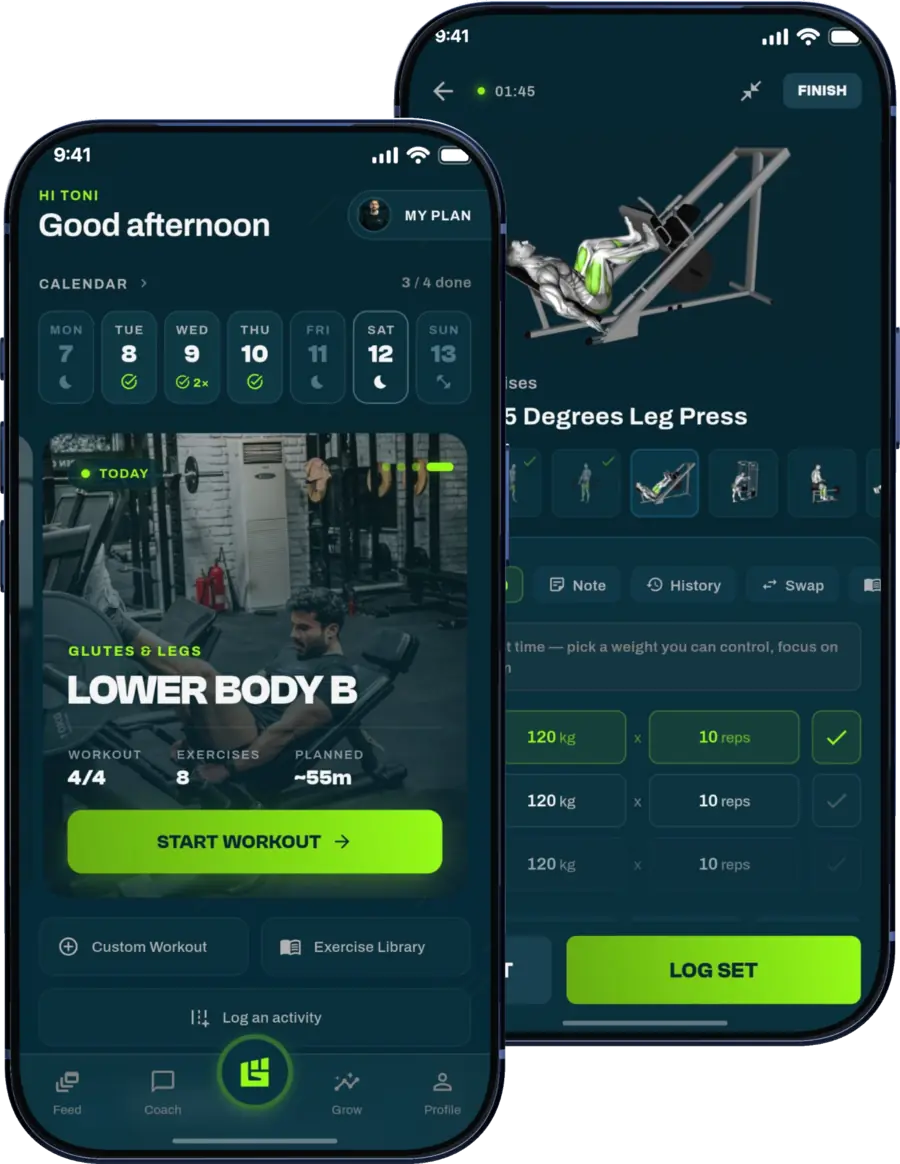
Those generic workout plans you find online often fail because they ignore the single most important variable: you. Your specific goals, your schedule, your experience level, and the equipment you have access to are what make a routine work. This guide is all about moving past that one-size-fits-all mentality. We’ll walk through how to build a workout plan from the ground up, making sure every exercise and every session has a purpose.
Why personalization isn't just a "nice-to-have"
A personalized approach is non-negotiable if you want long-term success and motivation. There's been a massive shift in what people expect from fitness. Generic plans are on their way out, with a recent report showing that 51% of consumers now prioritize personalized experiences driven by their own data.
This trend makes perfect sense. A plan that’s built for your body and your lifestyle is one you’re far more likely to stick with. This is where a thoughtful, structured approach makes all the difference. It’s the gap between just doing random exercises and making consistent, forward progress.
The four pillars of an effective workout plan
To build a plan that actually works, you need to focus on a few core components. Think of these as the support beams holding up your entire fitness structure. They ensure your routine is balanced, effective, and sustainable for the long haul.
| Pillar | Key Action | Why It Matters |
|---|---|---|
| Specificity | Align every exercise with your primary goal. | Training for a marathon is completely different from training to build maximum muscle. Your plan needs to reflect that. |
| Consistency | Build a schedule you can realistically follow week after week. | A "good enough" plan you do consistently is far better than a "perfect" plan you quit after a week. |
| Progression | Include clear rules for making your workouts harder over time. | Your body adapts. To keep seeing results, you have to continuously challenge it with more weight, reps, or intensity. |
| Recovery | Schedule rest days and prioritize sleep. | Progress happens when you rest, not just when you train. Your muscles need time to repair and grow stronger. |
By getting this foundation right, you set yourself up for success. Instead of feeling lost or overwhelmed by all the options, you'll have a clear roadmap to follow. Platforms like GrabGains are designed around these very principles, using smart technology to create adaptive plans that grow and change with you.
The goal is to build a system, not just a workout. A well-designed plan provides the structure needed to turn your effort into tangible results, keeping you engaged and moving forward.
Whether you're just starting out or you're an experienced lifter trying to break through a plateau, these principles don't change. Understanding how to create a workout plan is the first and most important step toward taking control of your fitness.
Defining your fitness goals and assessing your starting point
A workout plan without a clear goal is like a road trip without a destination—you’re just burning fuel. Before you even touch a weight, you need to lock in your "why." Vague ideas like "get in shape" or "be healthier" are impossible to measure and even harder to stay motivated for.
The fix? Get specific. The best way to do this is with SMART goals: Specific, Measurable, Achievable, Relevant, and Time-bound. This simple framework turns a fuzzy wish into a concrete target. It's the difference between "I want to be stronger" and "I will increase my squat 1RM by 20% in 12 weeks."
Translating ambition into actionable goals
Let’s look at how this works in the real world. Maybe you're training for an event or just want to hit a new personal best.
- For the functional athlete: "I want to complete my first HYROX event in under 90 minutes within the next six months." This is perfect—it's specific, timed, achievable with the right training, and clearly relevant to your passion.
- For the strength enthusiast: "My goal is to deadlift 405 pounds for a single rep by the end of the year." It’s a clean, quantifiable strength target with a non-negotiable deadline.
- For someone focused on aesthetics: "I aim to lose 10 pounds of body fat while maintaining my current muscle mass over the next 16 weeks." This goal can be tracked with body composition scans and progress photos, making it perfectly measurable.
Your goal is the blueprint for your training. A plan to build maximum muscle (hypertrophy) will look completely different from one designed for raw strength or one for improving functional endurance. Nailing this first step ensures every single exercise you do pushes you closer to your ultimate goal.
Conducting an honest self-assessment
Once you know where you're going, you need to figure out where you’re starting from. This isn't about judging yourself; it's about collecting data to build a program that's both safe and effective from day one. An honest look in the mirror keeps you from jumping into a plan that's too advanced, which almost always leads to injury or burnout.
Start by getting real about these key areas:
- Your current strength levels: You need to know your numbers. For the big lifts—squat, bench press, and deadlift—a 1RM (one-rep max) calculator is your best friend. It estimates your max strength based on a weight you can lift for several reps, which is much safer than attempting a true 1RM if you're not used to it.
- Your available time and equipment: Be brutally honest here. Can you realistically train three, four, or five days a week? Do you have access to a fully loaded commercial gym, or are you working out of your garage with a couple of dumbbells? Your plan has to fit your life, not the other way around.
- Your experience and movement quality: Have you been lifting for a decade, or are you just starting out? Can you knock out a perfect bodyweight squat, or does it feel a little shaky? Knowing your movement proficiency helps you pick exercises you can perform safely and effectively right now.
Taking the time to establish an accurate baseline isn't just a warm-up—it's the foundation of your entire plan. It ensures your starting weights are right, your volume is manageable, and your goals are actually grounded in reality. This is how you avoid the frustration that comes from following a plan that was never right for you in the first place.
Structuring your weekly workouts for optimal progress
Alright, you’ve got your goals locked in and a clear picture of where you’re starting from. Now comes the fun part: building the actual engine of your workout plan. Tossing a bunch of random exercises together won't get you very far. You need a smart, repeatable structure that builds on itself week after week.
This is all about creating a weekly flow that matches your goals, fits your life, and uses proven principles to keep you moving forward. Think of it as going from a pile of ingredients to a complete recipe.
This simple flowchart shows how a solid plan always starts with a clear goal and an honest look at where you're at right now.
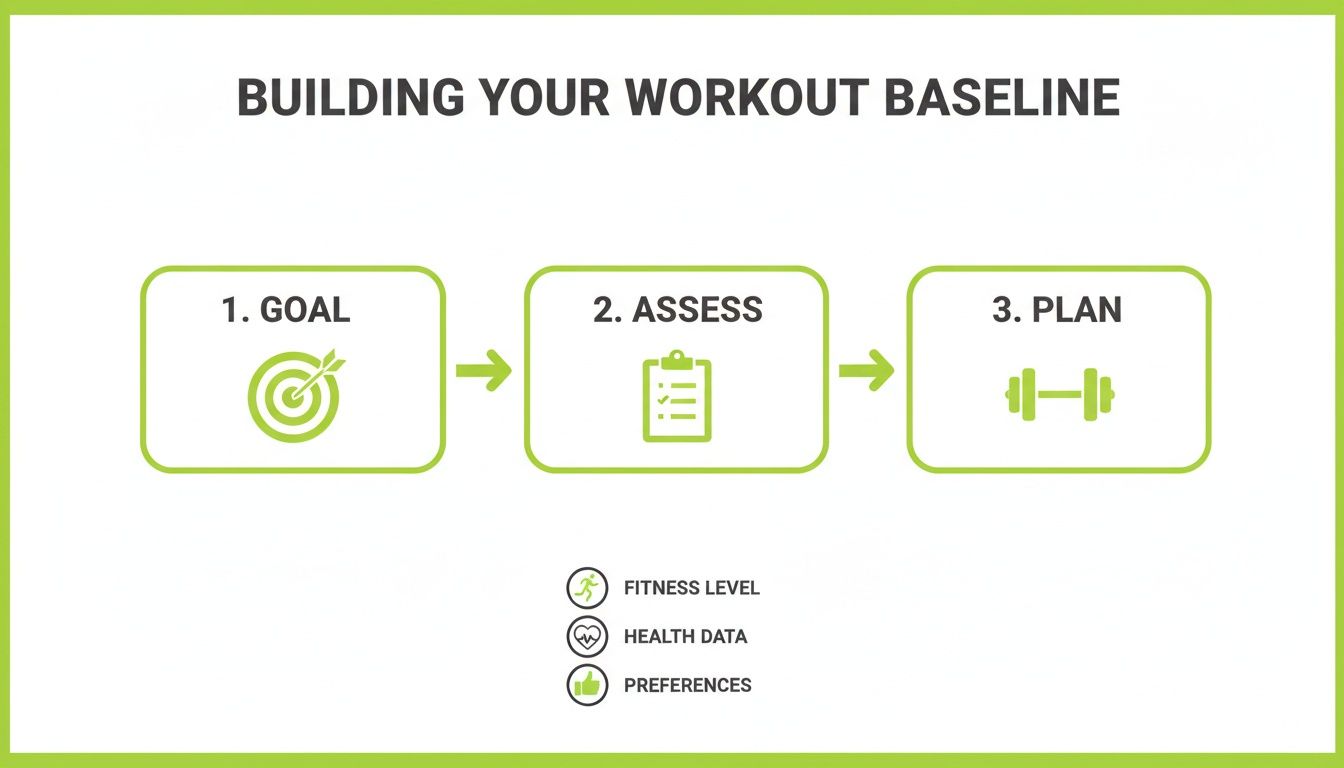
Without this foundation, you’re just guessing. With it, every workout has a purpose.
Mastering the art of periodization
One of the cornerstones of any serious workout plan is periodization. It’s just a fancy word for dividing your training into specific phases to keep making gains and avoid hitting a wall. The global fitness market is expected to grow by 8-9% annually, pushing past $200 billion, and it's largely because people are hungry for structured, evidence-based programming like this.
A simple way to do this is with a 12-week macrocycle. For instance:
- Weeks 1-4: Focus on hypertrophy (8-12 reps at 70-80% of your 1-rep max).
- Weeks 5-8: Shift to strength (4-6 reps at 85%+ of your 1RM).
- Weeks 9-12: Peak your performance, followed by a planned deload.
This kind of structured approach can boost strength by 20-30% in a single cycle for intermediate lifters and has been shown to add 5-10% more muscle mass over 8-12 weeks. Instead of doing the same thing forever, you’re constantly giving your body a new reason to adapt and get stronger.
A crucial part of this process is the deload week—something most people skip. It’s a planned week of lower volume and intensity, usually every 4th or 5th week. This gives your body a chance to fully recover, repair tissue, and come back even stronger for the next training block.
Choosing your weekly workout split
Your workout split is just how you organize your training sessions throughout the week. The best split isn't some secret formula; it's the one you can actually stick to.
Here are a few of the most popular and effective options:
- Push-Pull-Legs (PPL): A classic for a reason. You group workouts by movement pattern. Push days hit your chest, shoulders, and triceps. Pull days cover your back and biceps. And leg days... well, you get the idea. It's incredibly efficient. For a look at what goes into a great push day, check out our library of chest exercises.
- Upper/Lower: This one’s perfect if you can train four days a week. You split your training between upper body days and lower body days. This allows you to hit every muscle group twice a week with plenty of recovery time in between.
- Full Body: Ideal for beginners or anyone tight on time. You train all your major muscle groups in one session, usually three times a week on non-consecutive days (like Monday, Wednesday, and Friday).
If you can only get to the gym three days a week, a full-body routine is a fantastic choice. If you have five or six days to train, a PPL split might be a better fit to manage the workload and recovery.
The key training variables you need to control
Once you've picked a split, you need to manage three key variables. These are the dials you'll turn to make sure your workouts are actually working.
| Variable | What It Means | How to Apply It |
|---|---|---|
| Volume | The total amount of work you do, calculated as sets x reps x weight. | A solid starting point for muscle growth is 10-20 total sets per muscle group, per week. |
| Intensity | How heavy the weight is, usually measured as a percentage of your 1-Rep Max (1RM). | For raw strength, you’ll work at higher intensities (85%+ of 1RM). For size, a moderate range (70-80%) is your sweet spot. |
| Frequency | How often you train a specific muscle group each week. | Most research points to hitting a muscle group twice per week as the optimal frequency for growth. |
The single most important principle here is progressive overload. To build muscle and get stronger, you have to consistently make your workouts more challenging over time. Add more weight, do more reps, or increase your total sets. Without this, your progress will eventually grind to a halt.
Selecting exercises and building your routine
Now that you have a weekly schedule mapped out, it's time for the fun part: picking the exercises that will actually get you there. This is where the plan stops being an idea and starts becoming a workout. Choosing the right movements is what makes every rep count.
The best routines are almost always built on a foundation of compound movements. These are the big, multi-joint lifts like squats, deadlifts, bench presses, and overhead presses. They hit multiple muscle groups at once, making them incredibly efficient for building both strength and size. Think of them as the pillars of your program.
With that foundation in place, you can add isolation exercises to bring up specific muscles. These single-joint movements: think bicep curls or triceps pushdowns, are perfect for adding extra volume to a lagging body part or carving out more definition. The key is to get the balance right. Prioritize the heavy compound lifts at the start of your workout, then layer in isolation work where it makes the most sense for your goals.
Choosing the right exercises for you
The "best" exercise is simply the one you can do safely and correctly. Your current skill level and what equipment you have access to will guide your choices. An experienced lifter in a commercial gym might use a barbell for back squats, while someone training at home could get the same benefits from a dumbbell goblet squat. Both are fantastic quad builders.
This is where a solid exercise library becomes your best friend. For instance, the GrabGains platform gives you over movements, each with a video tutorial to make sure your form is on point. Having a deep well of options lets you:
- Adapt to any gym: Find an alternative whether you have a full squat rack or just a single kettlebell.
- Scale the difficulty: As you get stronger, you can move from a bodyweight lunge to a more challenging Bulgarian split squat.
- Work around limitations: If barbell overhead presses bother your shoulders, an incline dumbbell press might be a better fit. For more shoulder-friendly ideas, check out our guide to the best shoulder exercises.
Sample routines for different goals
Let's see how this looks in practice. These templates are starting points, not rigid rules. Feel free to swap exercises based on your equipment and preferences. Notice how the exercises and set/rep schemes are tailored to the specific goal.
Strength-focused full-body routine (3 days/week)
This is all about getting stronger on the big lifts. The lower rep ranges and longer rest periods are geared for maximum force production.
- Day 1:
- Barbell Squats: 4 sets of 5 reps
- Bench Press: 4 sets of 5 reps
- Bent-Over Rows: 4 sets of 6-8 reps
- Face Pulls: 3 sets of 15 reps
- Day 2:
- Deadlifts: 3 sets of 5 reps
- Overhead Press: 4 sets of 5 reps
- Pull-Ups (or Lat Pulldowns): 4 sets of 6-8 reps
- Plank: 3 sets, hold for 60 seconds
Muscle growth PPL split (3-6 days/week)
Here, the focus shifts to higher volume to drive muscle growth (hypertrophy). Reps are higher and rest periods are shorter to create more metabolic stress.
Here’s a simple way to structure a Push-Pull-Legs split. It’s a classic for a reason—it works.
| Day | Focus | Sample Exercises | Sets x Reps |
|---|---|---|---|
| Day 1 | Push | Bench Press, Incline DB Press, Shoulder Press, Triceps Pushdowns | 3-4 x 8-12 |
| Day 2 | Pull | Pull-Ups, Barbell Rows, Lat Pulldowns, Bicep Curls | 3-4 x 8-12 |
| Day 3 | Legs | Squats, Romanian Deadlifts, Leg Press, Calf Raises | 3-4 x 10-15 |
This setup ensures each muscle group gets hit hard once a week, but you can also run it twice for a 6-day split if you have the recovery capacity.
Functional fitness circuit (HYROX prep)
This template is built for work capacity, blending strength and endurance to mimic the demands of a fitness race. The idea is to move from one station to the next with minimal rest.
This type of training is less about lifting heavy and more about building the stamina to perform well even when you're tired. It’s all about work capacity.
- Perform as a circuit, resting 60-90 seconds after each full round. Complete 3-5 rounds.
- Kettlebell Goblet Squats: 15 reps
- Farmer's Walks: 50 meters
- Dumbbell Push Press: 12 reps
- Sled Push: 25 meters
- Burpee Broad Jumps: 10 reps
These examples show that with smart exercise selection and the right training variables, you can build an effective plan for any goal.
Tracking progress and adapting your plan for long-term success
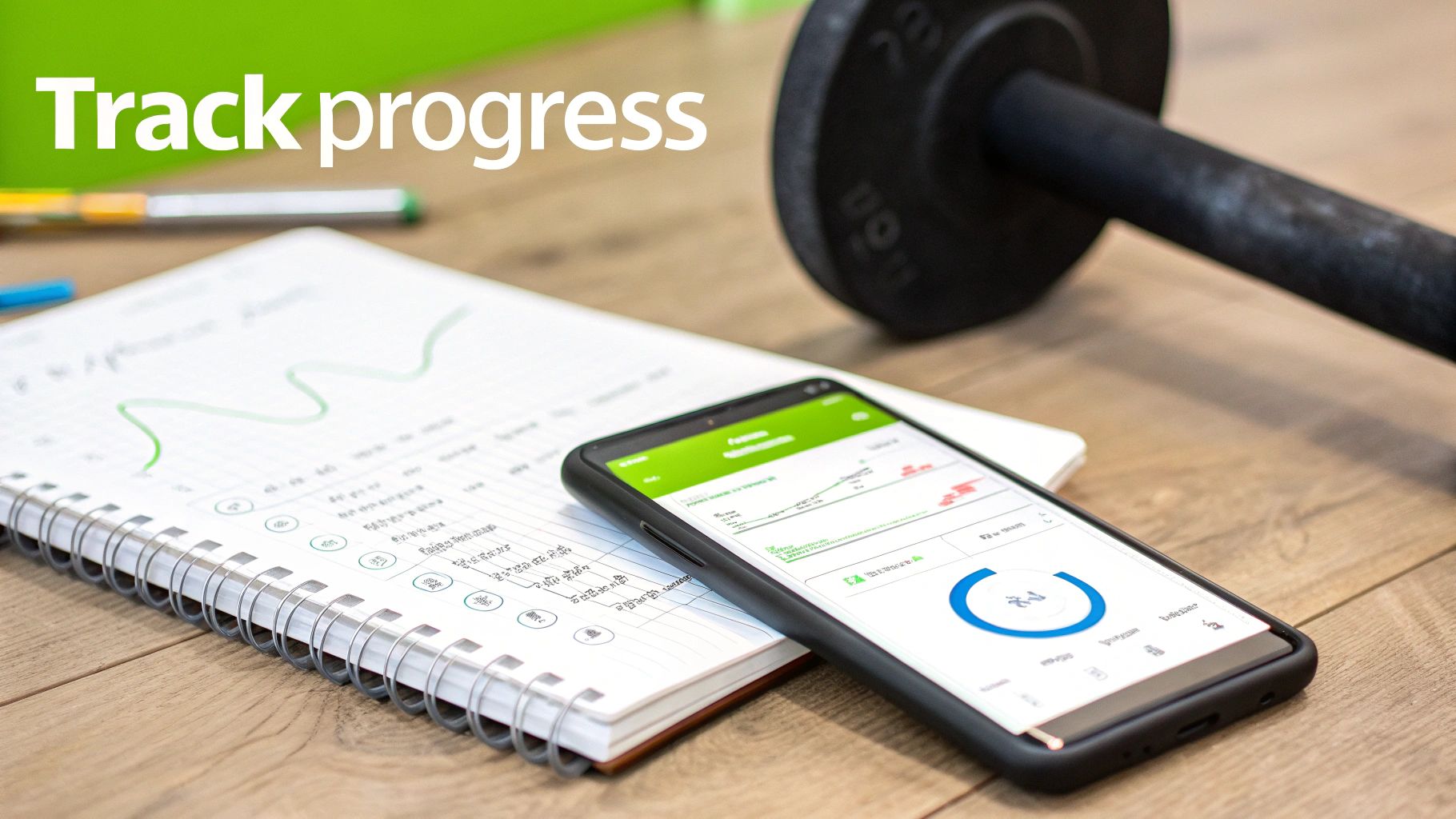
Here’s a hard truth: a workout plan is only good for as long as it works. The moment you write it down, the clock starts ticking. The real magic isn’t in the initial plan, but in how you track, tweak, and adapt it over time.
Without tracking, you’re just guessing. You have no real idea if you're getting stronger, pushing hard enough, or spinning your wheels. A static plan is a fast track to a plateau, boredom, and eventually, quitting.
What metrics actually matter
Don't get lost in a sea of data. You only need to track the numbers that directly tie back to your goals. For most people, this means focusing on gym performance first and foremost.
These are the non-negotiables to log for every single workout:
- Weight Lifted: How heavy did you go on each exercise?
- Sets Completed: Did you hit your target number of sets?
- Reps Per Set: How many reps did you get in each set?
These three metrics let you calculate your volume load (sets x reps x weight). This number is your best friend for gauging progress. If your volume load is trending up over weeks and months, you’re successfully applying progressive overload. It's that simple.
The power of visual progress
Seeing your progress is a huge motivator. Data shows that total health club visits bounced back to 6,250 million after the 2020 slump, and that growth is powered by smart tracking. It's why wearable tech and fitness apps are the #1 and #2 fitness trends right now.
Something as simple as seeing a graph of your bench press jump from 135lbs to 185lbs over 12 weeks can boost your consistency by up to 90%. You can dig deeper into how the industry uses this data in the latest global fitness report.
But it's not all about the numbers. Keep some qualitative notes, too. How’s your energy? Are you sore for days or recovering well? How’s your sleep? This subjective feedback can tip you off to overtraining before your performance starts to tank.
Knowing when and how to adapt your plan
Collecting data is step one. Knowing what to do with it is where progress is really made. Your plan has to be a living, breathing document. The goal is to stay in that sweet spot—challenged enough to grow, but not so fried that you can't recover.
Here are some clear signs it’s time to shake things up:
- You’ve Hit a Plateau: If you haven't added weight or reps to your main lifts for two or three weeks straight, it’s time for a change.
- You're Consistently Missing Reps: If you’re regularly falling short of your targets, your plan is likely too intense.
- You Feel Drained and Unmotivated: Persistent fatigue is a massive red flag. You might need to dial back the volume or schedule a deload week.
A workout plan shouldn't feel like a rigid set of rules. Think of it as a feedback loop: you perform, you track the data, you analyze the results, and you adjust. This continuous cycle is the engine of long-term progress.
Making these changes doesn't have to be complicated. If a workout felt too easy, maybe you bump up the weight by 5% next time. Stalled on your back squat? Try switching to a front squat for a few weeks to give your body a new stimulus. You can find plenty of great options in our leg exercises library.
This is exactly where a tool like GrabGains comes in. It automates this entire feedback loop for you. The app analyzes the performance you log and intelligently adjusts your next workout—tweaking volume, intensity, or exercise selection to keep you perfectly challenged. It turns your plan into a responsive tool that evolves right along with you.
Common questions about creating a workout plan
Even with a solid framework, a few questions always seem to pop up when you're piecing together a new training plan. It's totally normal to wonder if you're on the right track. This section tackles some of the most common hurdles I see people run into.
My goal here is to give you clear, straightforward answers so you can build your plan with confidence and keep moving forward.
How often should I change my workout plan?
This is a big one. The simple answer? You change your plan when it stops working. That's it.
So many lifters fall into the trap of "program hopping"—jumping from one routine to another every few weeks out of boredom. This is the fastest way to get absolutely nowhere. Your body needs consistent stimulus over time to adapt and grow stronger.
Stick with a well-designed program for at least 8-12 weeks before you even think about a major change. The real magic happens when you master the movements and consistently add weight or reps.
The only time you should make an immediate change is if a specific exercise causes pain, or if you've hit a hard plateau and haven't added a single rep or pound to a lift in 3-4 consecutive weeks. Otherwise, trust the process.
How do I know if my workout plan is working?
Your workout log is the ultimate source of truth. The clearest sign of a plan that’s working is measurable, objective progress. Are you getting stronger?
Look for these dead giveaways in your logbook:
- You're lifting more weight for the same number of reps than you were a month ago.
- You're hitting more reps with the same weight.
- Your total volume (sets x reps x weight) is trending upward over time.
Seeing changes in the mirror is great, but it's often slow and subjective. The numbers don't lie. If they're going up, the plan is working. For example, if you're consistently getting stronger on your rows and pull-downs, you know you're making progress. And if you need some new ideas to keep things fresh, you can learn more about effective back exercises to incorporate later.
What is the best workout split for a beginner?
For anyone just starting out, the best split is the one that lets you practice the main lifts as frequently as possible. That’s why a 3-day full-body routine is almost always the best place to begin.
Training your whole body three times a week (say, Monday, Wednesday, and Friday) gives you multiple chances to practice fundamental movements like squats, presses, and rows. This repetition builds motor patterns and confidence way faster than splitting the body up. It also gives you plenty of recovery time between sessions, which is crucial when your body isn't used to the stress of lifting.
Can I build muscle and lose fat at the same time?
Yes, it's possible. This process is called body recomposition, but it works best for two very specific groups:
- New Lifters: When you're new to strength training, your body is so primed for growth that it can often pull energy from fat stores to build muscle simultaneously.
- Detrained Individuals: Anyone who was previously fit but took a long break from the gym can also experience this "recomp" effect as their body quickly regains lost muscle.
For anyone with a decent amount of training experience, it’s a lot harder to pull off. It usually requires a very dialed-in nutrition plan with a small calorie deficit and a high protein intake. For most intermediate and advanced lifters, focusing on one goal at a time—either a dedicated muscle-building phase or a fat-loss phase—delivers much faster and more predictable results.
Ready to stop guessing and start building a plan that actually adapts with you? With GrabGains, our platform does the heavy lifting for you, creating personalized workout plans that evolve as you get stronger. Sign up today and let us build your blueprint for success.
Get inspired and motivated