How to know if your workout Is working: A 2026 Guide
Wondering how to know if your workout is working? Learn to track strength, performance, and recovery with our step-by-step guide to measuring real progress. You’re probably asking this because you’ve been putting in the work and still aren’t sure what counts as real progress. Maybe you leave the gym drenched and exhausted, but your lifts look the same. Maybe you feel less sore than you did when you started, and now you’re wondering if your body has “stopped responding.”
That confusion is common. Individuals often judge training by the wrong signals. They look at sweat, soreness, or whether a workout felt brutal. Those things can happen during productive training, but they don’t prove much on their own.
If you want to know how to know if your workout is working, you need a better framework. The most useful one is simple. Start with leading indicators like performance and consistency. Then confirm them with lagging indicators like body composition changes, visual changes, and daily life improvements. When those pieces line up, you know your plan is doing its job.


The Core Principle of Progress Are You Getting Stronger
A common scenario looks like this. Someone trains hard for three weeks, feels smoked after every session, then starts worrying because the soreness fades. Meanwhile, their dumbbell press has gone from 40s for 8 reps to 40s for 11. That rep increase matters more than the soreness ever did.
If your goal includes muscle gain, strength, or better body composition, the first question is simple. Are your numbers improving in a repeatable way?
That is the core principle behind progressive overload. Your body adapts when it can handle a little more work over time. In training, that usually means more weight, more reps at the same weight, more total volume, or cleaner execution with the same load. Those are leading indicators. They show progress before the mirror does.
Built for progress
Take the guesswork out of training
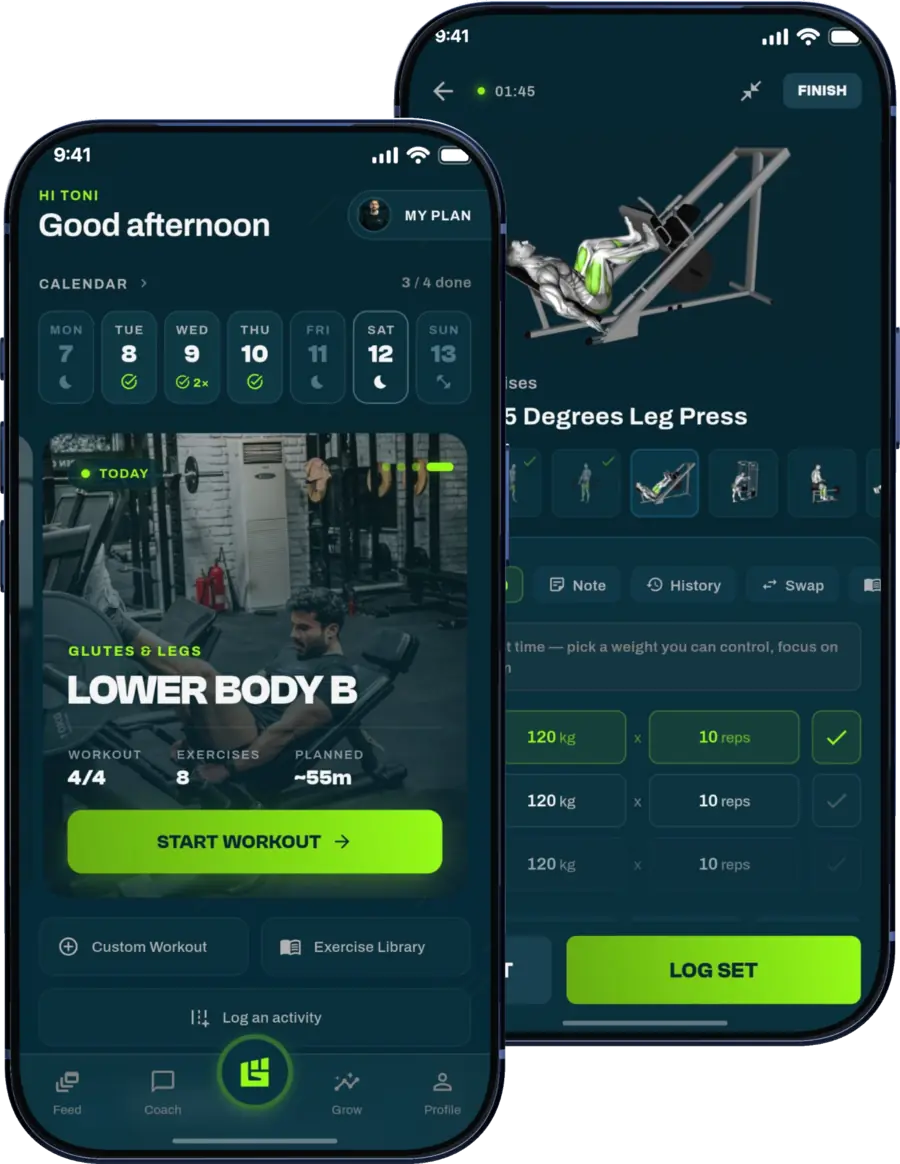
Get a personalized workout plan built around your goal, equipment and schedule. Train smarter, track every rep and keep moving forward, one workout at a time.






The important trade-off is that overload has to be productive, not sloppy. Adding five pounds while your range of motion shrinks or your form breaks down does not count as meaningful progress. Better training logs separate true improvement from ego lifting.
What progressive overload looks like in real training
Progress rarely shows up as a personal record every session. More often, it shows up as a steady trend across several weeks.
A simple example:
- Week one: you squat 100 pounds for 8 reps
- Week two or three: you squat 100 pounds for 10 reps with the same depth and control
- Next progression: you move to 105 pounds and build back to 8 reps
That is a working program. Stress went in, adaptation came back out.
Progress can also show up in less obvious ways. A set of 8 that used to feel like a grind now moves faster. Rest periods stay the same, but performance improves. Technique holds together on later sets instead of falling apart after the first hard effort. Those changes matter because they show your capacity is improving, not just your willingness to suffer.
Practical rule: If the same lifts, reps, and loads look the same month after month at the same effort level, you are probably maintaining, not progressing.
What to track every session
For primary lifts, keep the log simple enough that you will use it:
- Weight used
- Reps completed
- Sets performed
- Effort, such as RPE or reps in reserve
- Form notes, especially if a lift felt different than usual
That last point is where a lot of people lose the plot. They remember their best set and forget the context. A training app like GrabGains helps by storing the full picture. You can review whether strength is rising, whether volume is stalling, and whether better numbers came from real adaptation or from pushing every set to failure.
Good evaluation depends on trends, not isolated workouts. One strong day after extra sleep and caffeine means very little. Three to four weeks of steady improvement under similar conditions means a lot.
Strength comes before visible change
Physical changes are lagging indicators. Strength and performance usually show up first.
That matters because many people quit during the phase when the program is working but the mirror has not caught up yet. If your rows, presses, squats, or pull-ups are improving with solid form, the training is doing its job. The visible side often arrives later, especially if sleep, food intake, and stress are inconsistent.
This is why I tell clients to judge the plan in layers. Start with performance. Confirm that the lifts are moving in the right direction. Then give body composition and visual changes time to catch up. That system is more reliable than judging a workout by sweat, soreness, or whether it felt brutal enough to “count.”
Beyond the Weights Tracking Performance and Endurance
Not everyone judges a workout by a barbell. If you train for HYROX, running, circuits, or general functional fitness, the question changes from “Can I lift more?” to “Can I do more work, faster, and recover well enough to repeat it?”
That’s where performance testing matters. Your training should transfer to a task you care about. If it doesn’t, you’re just collecting fatigue.
A practical example is a HYROX athlete doing a repeat benchmark every few weeks. One person might track a running split plus sled work. Another might use a fixed circuit and measure completion time, pacing stability, and whether technique holds up under fatigue. The exact test matters less than repeating the same test under similar conditions.
Good benchmarks for non-strength goals
For endurance and functional fitness, useful markers include:
- Time to complete a repeat workout using the same structure each time
- Pace over a fixed distance such as a steady run or row
- Workout density meaning more quality work completed in the same time
- VO2max trend from your device if you use a compatible wearable
- Skill consistency under fatigue such as maintaining movement quality late in a session
The point is specificity. If you’re training for an event, your metrics should look like the event.
A workout is working when gym performance carries over to the thing you actually want to do outside the gym.
Why event athletes need objective tests
Advice around workout progress often stays vague. “You’ll feel more energized” or “your clothes may fit differently” can both be true, but neither tells a HYROX athlete whether race-day capacity is improving.
According to Jessica Welch Fitness on signs your workout is working, objective performance tests are key for HYROX and functional fitness athletes. That source reports that recent 2025 studies showed VO2max improved 8-12% in HYROX trainees using AI-adaptive plans with weekly benchmarks, versus 4% in static routines. The same source argues this exposes a major weakness in advice that relies too heavily on subjective feelings.
That doesn’t mean every workout should feel perfect. In practice, occasional bad sessions are normal. A rough interval day or a missed target pace doesn’t automatically mean your plan failed. It could mean the training stress is high enough to force adaptation. What matters is the trend across repeated benchmarks.
A simple way to judge transfer
Use this three-part check:
| Question | Good sign | Warning sign |
|---|---|---|
| Are repeat tests improving? | Times, pace, or output trend upward | Benchmarks stay flat for too long |
| Is movement quality holding up? | Technique stays solid under fatigue | Form falls apart early |
| Does training resemble the goal? | Sessions build event-specific capacity | Workouts feel random |
If your gym work is improving these markers, your training is doing its job even if the mirror hasn’t caught up yet.
Listening to Your Body Recovery Energy and Feel
A program isn’t working if it makes you strong for two weeks and wrecks you for the next four. Productive training improves performance, but it also improves your ability to recover, show up again, and function well outside the gym.
That’s why recovery and daily life carry real weight when you’re judging progress. They’re not fluff metrics. They tell you whether your body is adapting to the training stress or just surviving it.

The clearest signs show up away from the gym. You sleep better. You don’t drag through the afternoon. You stop feeling beat up all the time. Stairs, carrying groceries, getting up from the floor, and long workdays feel easier instead of harder.
What healthy adaptation feels like
Guidance summarized by Integrehab’s article on measuring your fitness routine recommends assessing workout effectiveness through recovery and functional adaptation metrics. That includes better sleep in the 7-9 hour range, stable energy, easier daily tasks, and reduced baseline soreness from 5/10 to 2/10 over 4 weeks. The same source notes that efficient recovery is often marked by DOMS resolving in under 48 hours.
Those are useful because they help you separate a hard program from a productive one.
Here’s the trade-off many people miss. A plan that leaves you crushed after every session may feel serious, but if soreness lingers, sleep tanks, and motivation drops, the plan is probably too aggressive for your current recovery capacity. On the other hand, if you’re training consistently, sleeping well, and feeling more capable week to week, that usually points to adaptation.
What to watch between workouts
Use a short check-in after sessions and on the next day:
- Energy asks whether training leaves you flat or ready for the rest of the day
- Soreness pattern tells you if discomfort is fading as your body adapts
- Sleep quality often reveals overload before your numbers do
- Readiness to train again helps you spot whether intensity and volume are sustainable
If your recovery is poor for one session, that’s life. If it stays poor, your programming, sleep, nutrition, or life stress needs attention.
Recovery is not the opposite of progress. Recovery is where progress becomes usable.
For people who need a more deliberate recovery routine, practical resources can help fill in the gaps between training sessions. A concise guide like these elite post-workout recovery tips can be useful when you need ideas for cooling down, restoring mobility, or building habits that make training sustainable.
When body signals mean back off
Not every warning sign means stop training completely. But some signs mean you should adjust.
If soreness keeps stacking up, your performance drops repeatedly, and your general energy stays low, don’t romanticize it. Lower the load, reduce volume, or add recovery space. Good training should challenge you. It shouldn’t make normal life feel harder every week.
A Practical System for Tracking and Interpreting Your Progress
Many individuals don’t need more motivation. They need a system. Without one, it’s easy to misread a normal slow week as failure, or mistake random hard effort for progress.
The easiest way to judge whether your workouts are effective is to track a few metrics on a schedule. Not everything needs to be measured daily. Some indicators matter every session. Others only make sense every few weeks.

What to track and when to track it
Here’s a practical rhythm that often proves effective:
| Timing | What to track | Why it matters |
|---|---|---|
| Every workout | Weights, reps, sets, session effort, notes on form | Shows whether performance is trending up |
| Same day after training | Recovery score, energy, soreness, readiness | Helps separate productive fatigue from poor recovery |
| Weekly | Session consistency and benchmark summary | Keeps you focused on patterns instead of one workout |
| Every few weeks | Photos, body measurements, repeat conditioning tests | Captures slower changes that daily tracking misses |
| Periodically | Bigger benchmark sessions like a 1RM estimate or event simulation | Confirms whether the plan is transferring to your goal |
This kind of schedule keeps leading and lagging indicators in the same place. You can spot whether strength is rising before visual changes show up. You can also catch problems early if consistency is dropping or recovery trends are slipping.
The minimum viable scorecard
If you want the leanest possible setup, track these five things:
- Performance on key lifts or benchmark workouts
- Attendance and adherence to the plan
- Recovery score after sessions
- Body measurements or progress photos at intervals
- One goal-specific test that reflects your real objective
That’s enough to answer the main question. Is your body handling more, adapting better, and moving toward the goal you care about?
How apps help without replacing judgment
Logging by hand works. A spreadsheet works. A notes app works. The downside is that many people stop using them once life gets busy, and then they lose the thread of their own progress.
A tool like GrabGains can simplify that process by logging sets, reps, and session feedback, then using that information to adjust training and display progress visually. That’s useful if you want one place for strength trends, consistency, calculators, and adaptive planning instead of stitching together separate tools.
If you’re also trying to improve recovery habits between sessions, practical reading can help there too. This guide on how to recover faster from workouts is a useful companion to the data side because it focuses on the behaviors that help your training show up in your numbers.
Coach’s note: Don’t change your plan just because one workout feels off. Change it when your data shows a real pattern.
How to interpret the data without overreacting
Look for trends, not isolated blips.
A single bad session can come from stress, poor sleep, or timing. A flat week can happen in the middle of a good month. What matters is whether your average direction is improving. If your lifts trend up, your benchmark pace improves, recovery remains manageable, and your consistency stays high, the program is working.
If those start moving in the wrong direction together, that’s when you adjust.
Common Pitfalls That Mask Your True Progress
Two people can follow the same plan for a month and reach the wrong conclusion for opposite reasons. One quits because the workouts no longer leave them wrecked. The other keeps grinding through a plan that feels intense even though their numbers have stalled. In both cases, the problem is the same. They are using the wrong scoreboard.
The biggest blind spot is confusing effort with progress. Hard sessions have value, but effort alone does not confirm that the program is producing adaptation. Soreness, sweat, and exhaustion are training sensations. Progress shows up in repeatable outcomes such as better lifts, more reps at the same load, improved benchmark times, steadier recovery, and consistent attendance.
The biggest mistakes I see most often
- Chasing soreness instead of progression. Delayed onset muscle soreness usually reflects novelty, exercise selection, or recovery status. It does not reliably measure muscle gain, strength gain, or conditioning improvement.
- Obsessing over the scale. Body weight can stay stable while body composition improves. That is common during phases where someone is gaining muscle and losing fat at the same time.
- Program hopping before the plan has a fair trial. If you change routines every 10 days, you never build a clean data set. That makes smart adjustments almost impossible.
- Ignoring adherence. A decent plan completed four days a week beats an ideal plan that gets skipped every time work or family life gets busy.
- Treating one bad workout like proof the plan failed. Performance fluctuates. Sleep, hydration, stress, meal timing, and the point you are at in the training week all affect a single session.
I see one more mistake often with data-minded lifters. They track everything, then react too fast. If your squat dips on a poor sleep day, that is not a programming crisis. It is noise. The useful question is whether the trend across several sessions still points up.
What to focus on instead
Use better filters for what you measure.
| Misleading focus | Better question |
|---|---|
| “Am I sore enough?” | “Am I handling more work or performing better over time?” |
| “Why hasn’t the scale changed?” | “Are my measurements, photos, strength markers, or pace improving?” |
| “Should I switch programs?” | “Have I followed this plan consistently long enough to judge it fairly?” |
A simple system is beneficial. If you log only feelings, you will make emotional decisions. If you log performance, recovery, and consistency together, you can separate a rough day from a real stall. GrabGains helps by keeping those markers in one place so you can spot whether the issue is the program, your recovery, or your follow-through.
Good training is sometimes boring to evaluate. That is a feature, not a flaw. The people who make steady progress usually stop asking whether a workout felt dramatic and start asking whether the results keep stacking up.
Frequently Asked Questions About Workout Progress
How long does it take to know if a workout plan is working
Performance changes usually show up before visual changes. If your reps, load, benchmark times, or movement quality improve, that’s an early sign the plan is working. Physical changes often lag behind those indicators, so don’t use the mirror as your only scoreboard.
Is it bad if I’m not sore after workouts
No. Lack of soreness does not mean lack of progress. Once your body adapts, you may recover faster and feel less beat up while still making solid gains. Consistent performance improvement matters more than post-workout soreness.
What should I do if I hit a plateau
First, check your logs. If progress stalled, look at recovery, sleep, adherence, and whether you’ve been pushing the same loads and reps for too long without a structured change. Then adjust one variable at a time, such as volume, load, exercise selection, or recovery habits.
When should I change my workout routine
Change it when the data says it’s no longer moving you forward, not when you’re bored. If you’re still progressing, recovering, and staying engaged, your plan may not need a full overhaul. It may only need a small adjustment.
What’s the single best way to know if your workout is working
Track whether you’re doing more over time and whether your body is recovering well enough to repeat that effort. That combination tells you more than sweat, soreness, or motivation ever will.
If you want a simpler way to answer “is this plan working?” week after week, GrabGains gives you a structured place to log performance, monitor consistency, and see your progress without guessing. It’s a practical option for lifters, beginners, and HYROX-focused athletes who want their training decisions based on real feedback instead of gym folklore.
Get inspired and motivated