Machines vs free weights: the ultimate 2026 strength guide
Unsure about machines vs free weights? This guide provides a science-backed comparison to help you choose the best tool for muscle growth and strength goals. The core difference in the machines vs free weights debate boils down to one thing: stability. Machines guide you through a fixed path for safe, isolated training, while free weights force you to create your own stability, firing up more muscles for real-world strength. Your best choice depends on whether you're chasing targeted muscle growth or functional performance.
The enduring debate: machines vs free weights
Every lifter eventually stands at a crossroads in the gym, looking at a rack of dumbbells on one side and a row of gleaming machines on the other. This isn't just a choice of equipment; it's a fundamental question about the best way to build a stronger, more capable body.
For years, the old-school thinking was simple: free weights were for "serious" lifters building "real" strength, while machines were for beginners. That black-and-white view is outdated. The truth is that the best tool often depends entirely on your goals, experience, and even how you feel on a given day.
Understanding the core differences
At its heart, the main distinction is the path of motion. This single factor changes everything—from which muscles get worked to how safely you can train. Understanding this is the first step to making the right choice for your body.
Built for progress
Take the guesswork out of training
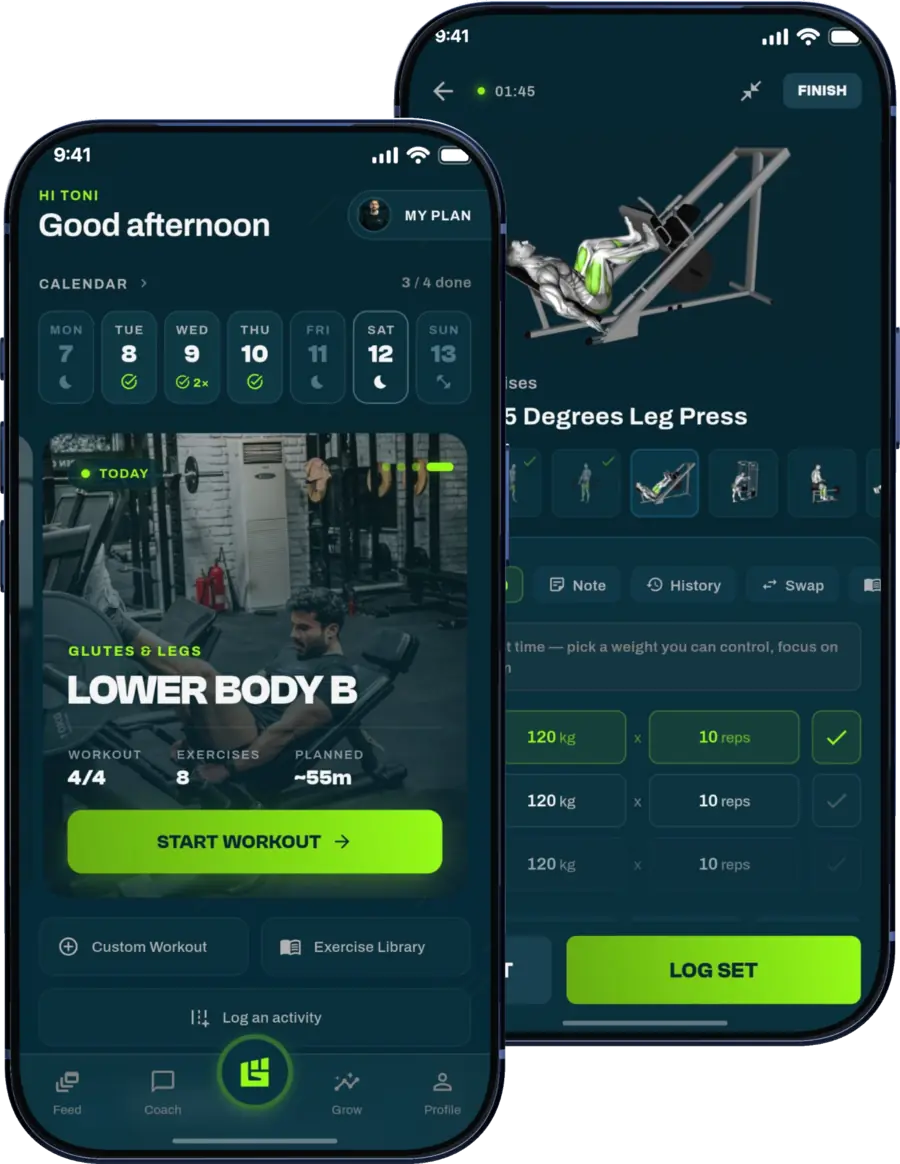
Get a personalized workout plan built around your goal, equipment and schedule. Train smarter, track every rep and keep moving forward, one workout at a time.






This guide moves beyond the old gym myths to give you a clear, evidence-based way to decide. We'll break down how each training style impacts your primary fitness goals:
- Building maximum muscle (hypertrophy)
- Developing raw strength and power
- Improving athletic and real-world performance
The table below gives you a quick look at the key characteristics that define each training style.
| Feature | Free Weights (Dumbbells, Barbells) | Machines (Selectorized, Plate-Loaded) |
|---|---|---|
| Movement Path | Unrestricted; requires user stabilization. | Fixed; guided by the equipment's design. |
| Muscle Activation | Engages primary movers and smaller stabilizer muscles. | Isolates specific primary mover muscles. |
| Learning Curve | Higher; requires learning proper form and control. | Lower; easier for beginners to learn and use safely. |
| Functional Carryover | High; mimics real-world movements and activities. | Lower; movements are less applicable to daily life. |
| Safety | Requires more skill and often a spotter for heavy lifts. | Generally safer for lifting to failure without a spotter. |
Which one actually builds more muscle?
When your main goal is building muscle, a process known as hypertrophy, the debate between machines and free weights really heats up. The fundamental rule of muscle growth is pretty simple: you have to stress your muscles enough to signal them to get bigger and stronger. This happens through two main drivers: mechanical tension and metabolic stress.
Mechanical tension is the force your muscle feels when it stretches and contracts against a heavy load—think of that deep stretch at the bottom of a dumbbell press. Metabolic stress is that unmistakable "burn" you get from the buildup of byproducts like lactate during high-rep sets, which also signals your muscles to adapt.
For years, gym wisdom was that free weights were the clear winner for packing on mass because they recruit more stabilizer muscles. But as it turns out, the real story is a lot more nuanced, and modern research shows both tools can be incredibly effective when you know how to use them.
The case for machine-based hypertrophy
The biggest advantage machines have for muscle growth is their built-in stability. By locking you into a fixed path, machines take balancing the weight out of the equation. This lets you do one thing extremely well: isolate a target muscle and push it to its absolute limit.
This laser-focused approach is perfect for a few key situations:
- Bringing up lagging body parts: If your chest is growing but your triceps are holding you back, a machine tricep extension lets you hammer that muscle group without your shoulders or core trying to help out.
- Maximizing metabolic stress: You can safely crank out high-rep sets or drop sets to failure on something like a leg press. This generates massive metabolic stress without you having to worry about your form collapsing or getting hurt.
- Consistent tension: Many modern machines use cams and pulleys designed to keep constant tension on the muscle through the entire lift. That’s harder to do with free weights, where the resistance often drops off at the top or bottom of the movement.
The stability of a machine is its superpower. It allows you to direct all your effort into contracting the target muscle, creating a powerful stimulus for growth that is difficult to replicate when you're also focused on balancing a heavy weight.
This means you can overload muscles with incredible precision, which is a game-changer for anyone trying to sculpt a specific physique or fix a weak point. That guided motion is a reliable way to get the volume you need to trigger growth.
The free weight advantage in muscle building
While machines are masters of isolation, free weights build muscle by recruiting a much larger network of muscles. When you do a barbell squat, your quads, glutes, and hamstrings are the main event, but your core, lower back, and even your upper back muscles are firing like crazy to keep you and the weight stable.
This coordinated effort doesn't just build functional strength; it also adds to your overall muscle mass. Every muscle that’s engaged is a muscle being stimulated to grow. This makes free weights super efficient for building a well-rounded, powerful physique where muscles learn to work together as a complete system.
Do machines and free weights build equal muscle?
The old-school belief that free weights are simply better for building muscle is now being seriously challenged by science. In fact, when the total training volume is the same, studies are finding that you can get similar muscle growth with either tool.
A groundbreaking 2024 study in the Journal of Bodywork and Movement Therapies looked at this directly. Researchers had people train each leg differently—one with free-weight lunges and the other with incline leg presses on a machine. The results were crystal clear: both legs grew significantly, with no real difference between the two methods. This lines up with a larger meta-analysis of 13 studies, which also found no superior method for hypertrophy. You can dive into the full study details and what they mean for your training on Men's Health.
The takeaway here is that the most important factor for muscle growth isn't the tool you choose, but how you use it. Consistent, progressive overload—whether with a dumbbell, a barbell, or a machine—is what ultimately gets you the results.
Optimizing for raw strength and power
When your goal switches from building muscle size to developing raw, maximal strength, the free weights vs. machines debate gets a lot simpler. Building strength follows one unbreakable rule: the principle of specificity.
Simply put, your body gets stronger at the exact movements you train it to perform. If you want to hit a new one-rep max (1RM) on your barbell squat, the most direct path is to train the barbell squat. Your nervous system, stabilizers, and primary movers all learn to fire in unison to master that specific movement pattern under maximum load.
The specificity principle in action
The question for strength isn't which tool is "better" overall, but which tool is better for hitting a specific strength goal. Training on machines will make you exceptionally strong on those machines. Training with free weights will make you exceptionally strong on free weight lifts.
The way your body adapts to each is fundamentally different:
- Free weights for strength: A heavy barbell back squat forces your entire body to work as a unit. Your core, hips, and upper back have to create immense tension to stabilize the load. This develops the full-body control you need to move maximal weight in an unstable environment.
- Machines for strength: A heavy leg press takes that stabilization work out of the equation. This allows you to isolate your legs and push far more weight than you could ever squat. You get incredibly strong at the leg press, but that strength doesn't transfer one-for-one to a free-standing squat.
When strength is the goal, your training must mirror your testing. A powerlifter doesn't use a Smith machine to prep for a competition squat, just as a bodybuilder might use a leg press to build their quads without the systemic fatigue that comes from heavy barbell squats.
What the research says about strength gains
This isn't just gym talk—the science backs it up. It’s a real, measurable outcome that dictates how you should program your training.
A major 2021 systematic review and meta-analysis looked at the data from multiple trials comparing both methods. The takeaway was crystal clear: strength gains are highly specific to the tool you use. When athletes were tested on free-weight lifts, the free-weight group saw much bigger gains. When they were tested on machine lifts, the machine group was stronger. On neutral tests, the results were a wash. You can dig into the complete findings from this strength training meta-analysis on PubMed.
This is a critical detail for anyone chasing new personal records. If you want a bigger barbell bench press, your main lift has to be the barbell bench press. A machine chest press is a fantastic accessory for adding volume, but it will never be a substitute for the main lift when building specific strength.
What about power output?
Power is all about moving weight fast. Think of an explosive jump or a powerful sprint. Interestingly, when it comes to developing power, research shows minimal difference between free weights and machines. Both can be used to improve your ability to generate force quickly.
For example, doing explosive reps on a leg press can build lower-body power almost as well as certain free-weight movements. The secret is the intent—you have to consciously try to move the weight as fast as possible on the way up.
However, since most athletic movements are complex and happen in multiple planes of motion, free weights often get the nod for direct transfer to sports. Of course, no matter what equipment you use, nutrition is what fuels your progress. You can learn more about how plant-based protein supports muscle growth and strength. When it comes to pure strength, though, specificity is king.
Boosting athletic and real-world performance
When your training goal isn't just about looks or lifting heavy numbers, the free weights vs. machines debate gets a lot more interesting. For athletes, weekend warriors, or anyone who wants the gym to make life easier, it all comes down to one thing: transferability. How well does your gym strength translate to jumping higher, sprinting faster, or just carrying groceries without a second thought?
This is where free weights have always had the home-field advantage. Athletic movements are almost never clean, isolated actions in a single direction. Think of a basketball player grabbing a rebound or a tennis player lunging for a return—these are messy, powerful, and demand coordination, stability, and strength all at once.
Mimicking real-world demands
Free weight exercises, by their very design, force you to control instability. A simple dumbbell lunge doesn't just work your legs. It lights up your core, hips, and ankles as they fight to keep you balanced. This is how you build integrated, full-body strength that actually shows up in the real world.
Machines, on the other hand, do the stabilizing for you. They guide you along a fixed path, which is fantastic for isolating a muscle. But that controlled environment doesn't teach your nervous system the complex patterns needed for sports or daily life. You get strong in that one specific motion, but the strength doesn't always stick around when the supports are gone.
When performance is the goal, your body must learn to be the machine. Free weights teach your muscles and nervous system to work as a single unit to produce force, stabilize joints, and control movement in three dimensions—skills that are non-negotiable on the field and in life.
The great equalizer: explosive power
While free weights are king for building sport-specific coordination, what about raw athletic output, like a vertical jump? Here, the evidence is surprisingly balanced. It turns out both free weights and machines can be powerful tools for developing explosive power if you use them correctly.
A fascinating 2023 meta-analysis in BMC Sports Science, Medicine, and Rehabilitation looked at this very question. After analyzing 13 different studies with over 1,000 participants, researchers found no significant difference in countermovement jump improvements between the machine and free-weight groups. Sure, the free-weight group got stronger on barbell lifts and the machine group got stronger on their specific machines. But when it came to applying that strength to an explosive jump, both methods worked equally well. You can dive deeper into the findings in this comprehensive review of free weights versus machines on OmahaPTI.com.
What this tells us is that the ability to generate force quickly—the bedrock of power—can be built with either tool. The secret ingredient is training with explosive intent.
Creating the ultimate performance-hybrid model
So, what’s the takeaway for an athlete or anyone focused on functional fitness? It's not about picking a side. It’s about building a smart, hybrid program that plays to the strengths of both. This "best of both worlds" approach is how you build a truly resilient and high-performing body.
Here’s what a well-designed hybrid plan could look like:
- Primary lifts with free weights: Kick off your workouts with heavy, compound free-weight movements. Think squats, deadlifts, and overhead presses. These are your foundation for building raw strength, stability, and the muscle coordination that underpins all athleticism.
- Accessory power with machines: Use machines for targeted power work or to add volume without crushing your whole system. An explosive leg press, for example, can build serious lower-body power without the stability demands of a squat, letting you focus purely on producing force.
- Isolation for weak points: Finish your session with machine-based isolation work. This is perfect for shoring up weak links or injury-prone areas, like using a hamstring curl machine to build strength around the knee joint.
This integrated model gives you the coordinated strength from free weights while also tapping into the targeted, high-intensity potential of machines. It’s a complete system for building an athlete who isn't just strong in the gym, but dominant everywhere else.
How to choose based on your goals
The real question isn't which tool is better, but which tool is right for your goal, right now. Forget generic pro/con lists. The smart way to approach this is to match the equipment to your primary objective.
This flowchart can help you map out your path, whether you're chasing athletic performance or building general strength.

As the infographic shows, your main goal sets the destination. The equipment you choose is the vehicle that gets you there efficiently. Let’s break down how to pick the right one for the job.
Which tool for your goal?
This table provides a situational comparison to help you decide whether to use machines or free weights based on your primary training objective.
| Training Goal | When to Use Free Weights | When to Use Machines | Smart Hybrid Strategy |
|---|---|---|---|
| Max Muscle Growth (Hypertrophy) | To build functional, full-body mass. The systemic stress of heavy compound lifts (squats, deadlifts) creates a powerful growth stimulus. | To isolate lagging muscles (e.g., leg extensions for quads) or safely push to failure with drop sets for maximum metabolic stress. | Start with a heavy compound free-weight lift (e.g., dumbbell press), then finish with an isolation machine (e.g., pec-deck fly) to fully exhaust the target muscle. |
| Raw Strength & Power | If your goal is a bigger squat, bench, or deadlift, these free-weight lifts must be your focus. It's non-negotiable for building sport-specific strength and coordination. | To build foundational strength without the systemic fatigue of free weights. A heavy leg press overloads the quads without taxing the lower back. | Use heavy free-weight compounds as your primary lifts, then use machines for accessory work to strengthen weak points without compromising recovery for your main lifts. |
| Athletic Performance | For 90% of your training. Movements like kettlebell swings and lunges mimic the multi-planar demands of sports and build real-world, coordinated strength. | To safely train for explosive power (e.g., explosive leg press) or to strengthen a specific weak link without the technical demands of Olympic lifts. Also great for rehab. | Build your base with multi-joint free-weight exercises, then use machines to safely add explosive power or address specific deficits identified during your sport or training. |
This comparison shows there's no single winner—just the right tool for the right situation. Now let's dive deeper into the "why" behind these choices.
If your goal is maximum muscle growth (hypertrophy)
For pure muscle size, the debate is a wash. Research consistently shows that when volume and intensity are matched, both machines and free weights deliver similar hypertrophy. Your choice comes down to strategy.
- Free weights are your go-to for building overall functional mass. A heavy barbell squat doesn't just hammer your quads; it recruits your glutes, back, and core, creating a systemic stress that can trigger a greater hormonal response for all-around growth.
- Machines shine when you need to isolate a stubborn muscle group. If your quads are lagging, no amount of squatting will target them with the same focused intensity as a leg extension machine. They're also unmatched for safely taking a muscle to true failure with drop sets or high-rep burnouts.
A classic hybrid approach for chest day: start with a heavy compound lift like the dumbbell bench press to hit multiple muscle groups, then move to a machine chest fly to completely fatigue the pecs with targeted, high-tension reps.
If your goal is raw strength and power
When your goal is adding plates to the bar, the principle of specificity is law. Your body gets stronger at the exact movements it performs.
- Free weights are non-negotiable if you want to increase your 1-rep max in the squat, deadlift, or bench press. You have to practice the lift itself. There's no substitute for developing the stabilizer strength and neural drive needed to move maximal loads through an unguided path.
- Machines are fantastic assistance tools. A heavy leg press lets you overload your leg musculature with weight you couldn't dream of squatting, strengthening the prime movers without the same demand on your core and lower back. This builds raw strength capacity you can later apply to your main lifts.
If your goal is athletic performance and functional fitness
For athletes or anyone who wants their gym strength to show up in the real world, the answer is clear. Functional fitness is about teaching your body to move as a single, coordinated unit.
- Free weights should make up 90% of your athletic development. Exercises like kettlebell swings, overhead presses, and lunges train your body to generate and control force across multiple planes of motion. This is the very definition of what sports and daily life demand.
- Machines are best used strategically. An explosive leg press can be a safe way to build lower-body power without the steep learning curve of an Olympic lift. They're also incredibly valuable in rehabilitation, allowing an athlete to train around an injury in a controlled, safe environment.
Ultimately, the smartest training plans don't force you to pick a side forever. They empower you to know when to grab a barbell, when to sit in a machine, and how to combine them to make every single session count.
Creating your ultimate hybrid workout plan
The old debate of machines vs. free weights is a waste of time. The smartest, most effective training programs don't force you to choose a side—they combine the best of both worlds.
A hybrid approach moves past the "either/or" argument and builds a routine that uses each tool for what it does best. This is how you break through plateaus and build a truly well-rounded physique.
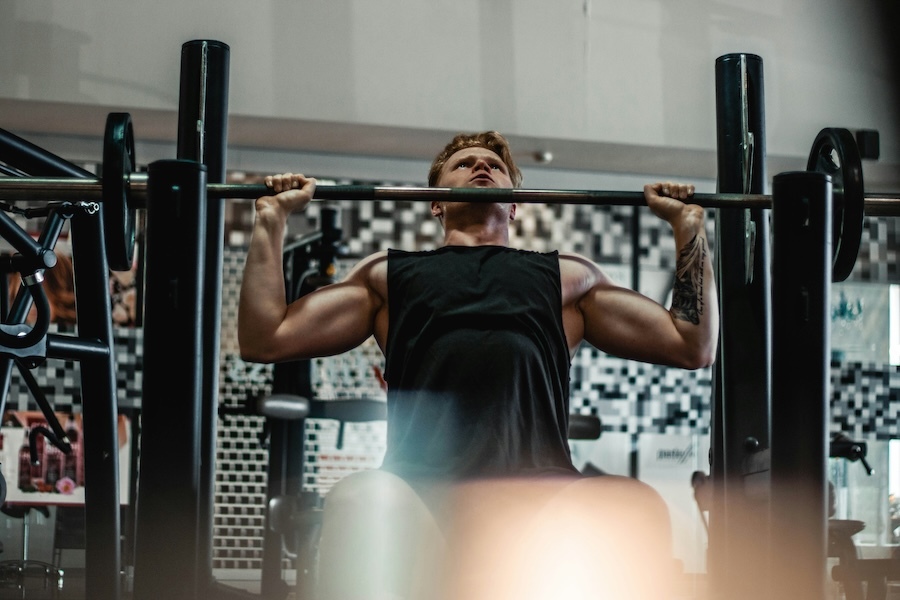
The principle is simple but powerful: start with free weights to build your foundation, and finish with machines to isolate and fatigue the muscle. You hit the big, complex lifts when you’re fresh, then use the stability of machines to safely add volume when you’re tired.
Structuring your hybrid training week
A good hybrid plan is all about smart sequencing. By ordering your exercises correctly within each workout, you get the most out of every single rep without compromising on safety.
The most proven way to structure these workouts follows a simple two-part formula:
- Start with compound free weights: Begin every session with a heavy, multi-joint free-weight exercise. Think barbell squats on leg day or a dumbbell bench press on chest day. These movements recruit the most muscle, challenge your nervous system, and build functional strength that carries over to everything else.
- Finish with isolation machines: After your main lift, move on to machines. This is where you isolate the primary muscles you just worked, adding more training volume to trigger growth. The machine's stability makes it much safer to train close to failure when your form might otherwise break down.
The magic of a hybrid model is in the synergy. Your heavy free-weight lift provides the initial strength stimulus, while the machine work comes in to finish the job, ensuring you’ve completely fatigued the muscle—a key driver for hypertrophy.
Practical examples of hybrid workouts
Let's look at how this works in practice. This approach can be applied to any muscle group you want to develop. The goal is always to get the best of both worlds for better gains.
Here are a couple of examples of how to pair your exercises:
- Leg day: Start with barbell squats (3 sets of 5-8 reps) to build overall leg and glute strength. Finish with leg extensions and hamstring curls (3 sets of 10-15 reps each) to maximize quad and hamstring growth with focused tension.
- Chest day: Begin with dumbbell bench press (3 sets of 6-10 reps) to engage the pecs, shoulders, and triceps. Follow up with pec-deck flys (3 sets of 12-15 reps) to isolate the chest and get a great pump.
This strategic combination helps you get stronger while also building a more defined, resilient physique. To take the guesswork out of building your routine, the GrabGains app can create a personalized hybrid plan based on your exact goals and progress.
Frequently asked questions
When it comes to machines vs. free weights, a few common questions always pop up. Let's clear the air and give you some straightforward answers based on what we see in the gym every day.
Are free weights more dangerous than machines?
Not inherently. The danger in strength training doesn't come from the equipment itself—it comes from using it improperly. Bad form is dangerous whether you're under a barbell or on a machine. You can just as easily injure your knees or back on a leg press with too much weight and sloppy form.
The real keys to safety are universal, no matter what you're lifting:
- Prioritize perfect technique on every single rep.
- Choose a weight you can actually control through a full range of motion.
- Leave your ego at the door and listen to your body.
With that said, machines offer a safety net that free weights don't. Their guided motion path makes it much harder to have a catastrophic form breakdown, which is why they’re a more forgiving option for beginners or for anyone training to failure without a spotter.
Can I build muscle using only machines?
Absolutely. For pure muscle growth (hypertrophy), machines are incredibly effective. Research backs this up, and so does what we see in bodybuilding gyms everywhere. Their main advantage is the stability they provide.
By taking balance and coordination out of the equation, you can completely isolate a target muscle and hit it with constant, focused tension. This makes a machine-only routine a fantastic way to build serious muscle, especially for:
- Beginners who are still learning basic movement patterns.
- Lifters working around injuries that free weights might aggravate.
- Anyone aiming for maximum muscle development in a specific area.
The fixed path lets you push your muscles to their absolute limit safely—a crucial ingredient for sparking growth.
Should I start with machines or free weights as a beginner?
For most people new to the gym, starting with machines is an excellent strategy. They act as built-in guides, teaching you the fundamental motor patterns for exercises like presses, rows, and curls in a controlled setting. This helps you build a solid base of strength and confidence without the intimidation factor of a free-weight section.
A smart approach is to begin with machines to master the movements. Once you feel strong and comfortable, you can start phasing in their free-weight counterparts. This progression allows you to gradually challenge your stability and coordination, building a more well-rounded and functional strength base over time.
Ready to stop guessing and start building the perfect hybrid workout plan for your goals? GrabGains creates personalized routines that intelligently combine machines and free weights, adapting to your progress every step of the way. Download GrabGains on iOS or Android today and get a smarter training plan delivered right to your phone.
Get inspired and motivated