Your essential muscle builder workout for serious gains
Discover a science-backed muscle builder workout plan. Learn the best routines, exercises, and nutrition tips to maximize strength and achieve serious gains. A solid muscle builder workout is all about one core principle: progressive overload. It sounds technical, but it just means you have to systematically ask your muscles to do more over time. It’s a blend of big, powerful compound exercises like squats and bench presses, plus some targeted isolation work to bring up specific areas. When you structure this into a consistent weekly routine that allows for proper recovery, and you fuel it with the right nutrition, you’ve got the most effective way to build serious muscle mass.
The blueprint for building serious muscle
Forget just showing up and doing random exercises. A real muscle builder workout is a strategic plan—a blueprint designed to force your body to adapt and grow. True success in the gym isn't about how long you're there; it's about making every single minute count with a smart, structured approach.
This means you need to understand the "why" behind every lift, every set, and every rest period.

This shift toward well-planned strength training isn't just a niche trend; it's a massive movement. In fact, 2023 saw a striking 20% increase in strength training activity compared to before the pandemic. This lines up perfectly with record-high gym memberships, especially in the U.S., where nearly a quarter of the population now has a fitness membership. People are realizing that smart training gets results.
Built for progress
Take the guesswork out of training
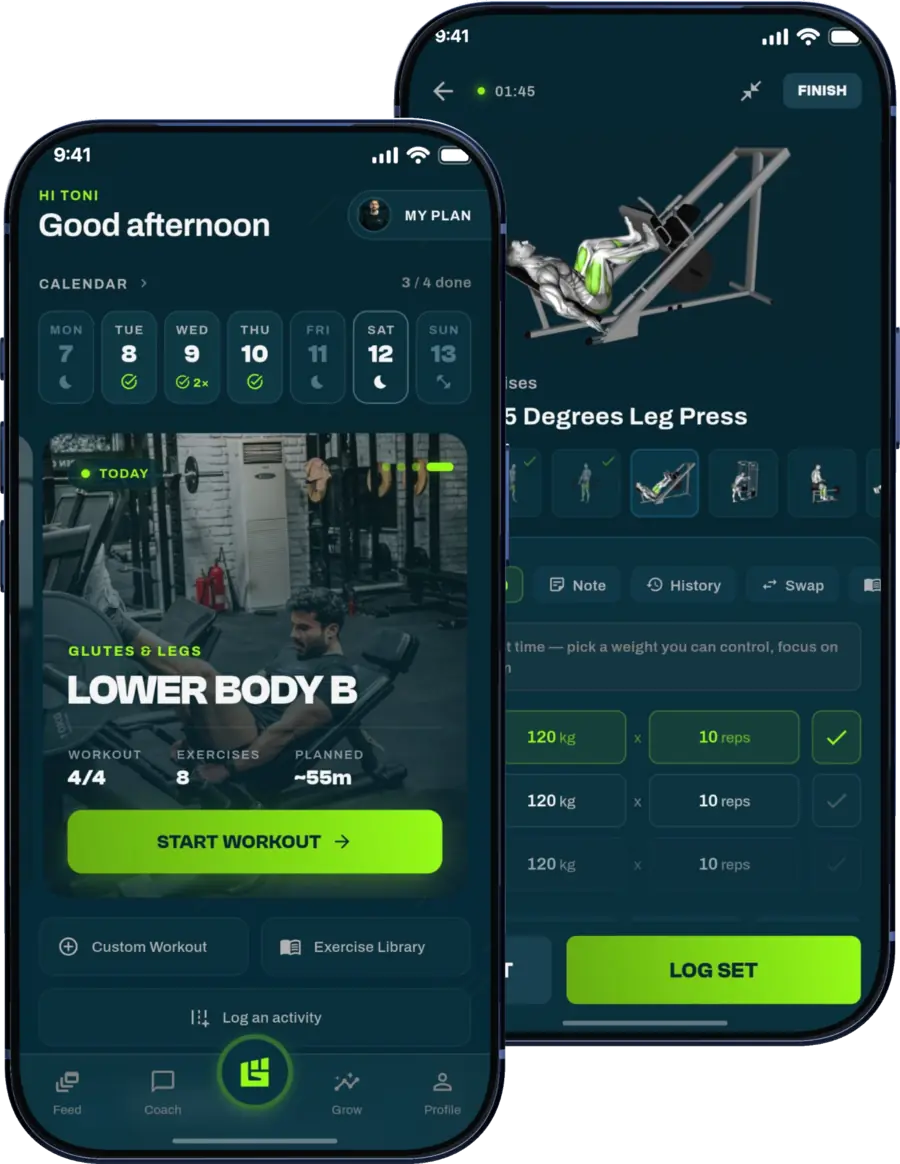
Get a personalized workout plan built around your goal, equipment and schedule. Train smarter, track every rep and keep moving forward, one workout at a time.






What makes a workout plan effective
A truly effective plan is way more than just a list of exercises. It’s a complete system built around the fundamental drivers of muscle growth, a process known as hypertrophy. If you miss these key elements, all that hard work in the gym won't deliver the results you're after.
Here are the non-negotiables:
- Progressive Overload: This is the absolute cornerstone of building muscle. You have to consistently challenge your muscles by gradually adding more weight, reps, or sets. Your body simply won't grow if it's never pushed past its current comfort zone.
- Consistency and Structure: Hitting the gym whenever you feel like it won't cut it. A properly designed weekly split ensures you hit each muscle group with the right frequency while giving them the downtime they need to repair and grow stronger.
- Proper Exercise Selection: Focusing on compound movements—those big lifts that work multiple muscle groups at once—gives you the most bang for your buck. These are the exercises that build a strong, functional foundation.
The goal is to stimulate, not annihilate. Consistently pushing yourself just a little further each week is what compounds into incredible results over time.
This is exactly why modern fitness platforms like GrabGains are so effective. They're built on these very principles, using smart technology to create adaptive workout routines. Instead of you following a generic, static plan, these tools actually adjust your workouts based on your real-time performance. This ensures every single session is perfectly optimized to drive progress and help you build the physique you want.
How to structure your weekly workout
Consistency is the engine of muscle growth, but a smart structure is the steering wheel. Without a plan, you risk hammering some muscles into the ground while neglecting others—a surefire way to stall out and hit a plateau. A well-designed weekly workout split is the backbone of your entire plan, making sure every muscle group gets the attention and recovery it needs to grow.
A good split lets you train with high intensity while keeping fatigue in check. By dividing your workouts—either by muscle group or movement pattern—you give specific muscles 48-72 hours to recover before you train them again. That recovery window is exactly when the magic happens. It’s when your body repairs and builds new muscle tissue.
Choosing your workout split
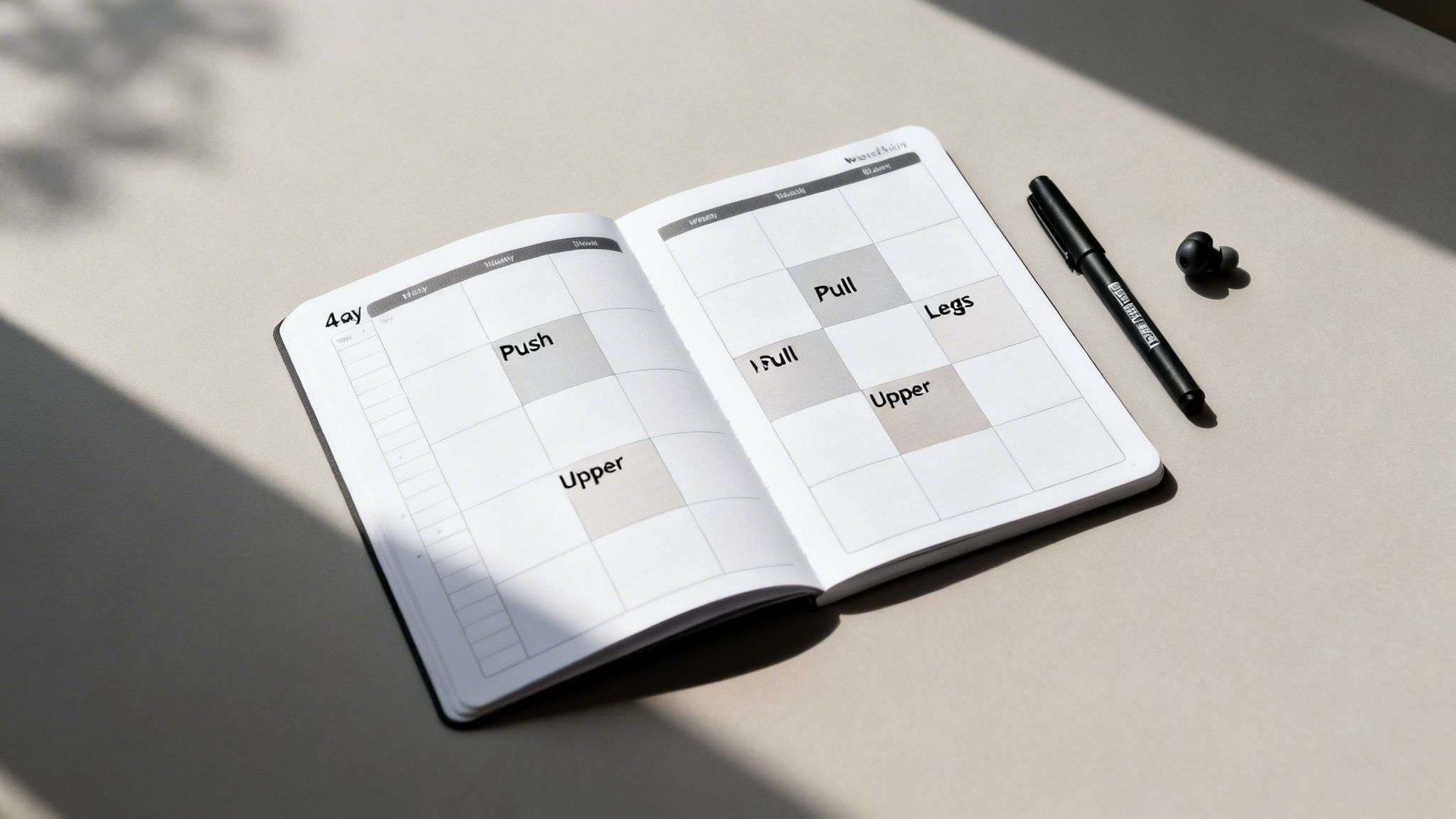
When it comes to building muscle, two splits have stood the test of time: the Upper/Lower split and the Push/Pull/Legs (PPL) split. Both are fantastic, but the right one for you really boils down to your schedule and how well you recover.
If you’re training four days a week, the Upper/Lower split is an ideal starting point. It’s beautifully simple but brutally effective.
You’ll dedicate two days to your upper body and two days to your lower body, alternating between them to give each half of your body a chance to recover. This setup ensures you hit every major muscle group twice a week, which has been shown time and time again to be a sweet spot for stimulating muscle growth.
A sample 4-day upper lower split
Here’s what that looks like in the real world. This isn't just a random schedule; it's a balanced approach designed to build a symmetrical, powerful physique. Notice how the rest days are placed strategically to help you come back strong for each session.
Sample 4-Day Upper/Lower Workout Split
| Day | Workout Focus | Primary Muscle Groups |
|---|---|---|
| Day 1 | Upper Body | Chest, Back, Shoulders, Biceps, Triceps |
| Day 2 | Lower Body | Quadriceps, Hamstrings, Glutes, Calves |
| Day 3 | Rest | Active Recovery (e.g., light walk, stretching) |
| Day 4 | Upper Body | Chest, Back, Shoulders, Biceps, Triceps |
| Day 5 | Lower Body | Quadriceps, Hamstrings, Glutes, Calves |
| Day 6 | Rest | Full Rest Day |
| Day 7 | Rest | Full Rest Day |
This rhythm prevents burnout and keeps you performing at your best in every single workout. Of course, planning this out week after week can be a grind. That's where a smart workout builder like the one in GrabGains can save you a ton of time and effort. It can automate this scheduling and even adjust your split based on performance, so you’re always moving forward.
Pro Tip: To keep things fresh and avoid plateaus, try introducing some variation on your second Upper and Lower days. For example, your first upper body day could be built around heavy, low-rep presses, while the second could use higher-rep, machine-based movements to hit the muscle fibers differently. This is a simple but powerful way to keep your training engaging and effective.
The core exercises for maximum muscle growth
When you're building a house, you pour a strong foundation long before you hang the curtains. The same goes for your body. Real, lasting muscle is built on the back of big, powerful exercises that deliver the most bang for your buck.
Not all lifts are created equal. The secret to an effective routine is prioritizing compound exercises. These are the multi-joint movements that recruit huge amounts of muscle at once—think squats, deadlifts, and bench presses. Because they engage so much of your body, they trigger a powerful hormonal response, signaling your body to get bigger and stronger.
This back-to-basics approach is a huge reason why the fitness industry, now valued at a staggering $257 billion globally, keeps growing. It's not just about cardio anymore. Recent surveys show that nearly 50% of adults with fitness goals are now focused on building muscle and strength, which means the demand for smart, effective resistance training has never been higher.
The titans of training: upper body
For a powerful and well-developed upper body, a few key exercises form the bedrock of any solid routine. Mastering these will give you the most significant return on your effort. No question.
These are the non-negotiables for your chest, back, and shoulders:
- Barbell Bench Press: The undisputed king for building a powerful chest. It hammers your pecs, front delts, and triceps, developing raw pushing strength. The key here is control on the way down and pure explosion on the way up. You can explore a full range of movements for a bigger chest in our dedicated guide.
- Bent-Over Barbell Row: You can't build a thick, dense back without pulling heavy weight. This is the tool for the job. The bent-over row hits your lats, rhomboids, traps, and biceps. Just remember to keep your back flat and pull the bar toward your lower chest, squeezing your shoulder blades together like you’re trying to crack a walnut.
- Overhead Press (OHP): Want broad, powerful shoulders? The OHP is your ticket. It’s the ultimate test of upper-body strength, primarily working the deltoids while demanding serious stability from your triceps and core. Keep that core tight and press the bar straight overhead until your arms lock out.
Building a powerful lower body and arms
Your lower body is your power base. Skipping leg day is one of the biggest mistakes you can make in the gym, period. Strong legs and glutes are the engine for everything else you do. And while those big compound lifts will definitely hit your arms, a little targeted work goes a long way.
For your legs, these two movements are fundamental:
- Barbell Back Squat: Often called the king of all exercises, and for good reason. Squats are absolutely essential for building powerful quads, glutes, and hamstrings. They also force your core to work overtime, building stability from the ground up. Get deep, keep your chest up, and own the movement.
- Deadlift: Nothing builds raw, full-body strength like the deadlift. It works pretty much every muscle you have, especially your entire posterior chain—hamstrings, glutes, and all the muscles in your back. Form is everything here. Start light, keep your spine neutral, and drive the lift with your legs, not your lower back.
Perfect form is non-negotiable if you want to get the most out of every single rep. Inside the GrabGains app, each of our exercises comes with a professional video demonstration. It’s like having a coach in your pocket, helping you master your technique to maximize muscle growth and minimize injury risk from day one.
Mastering progression to avoid plateaus
Your body is an incredibly efficient machine. It adapts to whatever you throw at it, which is great for survival but a massive pain when you’re trying to build muscle. If you walk into the gym and do the exact same workout week after week, you're practically begging for a plateau. Your progress will grind to a halt.
The secret to long-term growth is a simple concept called progressive overload. All it means is that you have to consistently and strategically make your workouts more challenging over time. Most people hear that and immediately think "add more weight," but that's just one tool in the toolbox.
Smart ways to apply progressive overload
Progressive overload is all about forcing your muscles to adapt by getting bigger and stronger. Just lifting heavier is a great start, but true mastery comes from using different methods to keep your body guessing.
Here are a few powerful ways to progress your lifts:
- Increase Repetitions: Before you jump up in weight, try adding a rep. If you hit 8 reps last week, shoot for 9 this week with the same weight. Once you can comfortably nail 10-12 reps with perfect form, then it’s time to add a little more iron to the bar.
- Improve Your Form: This is probably the most underrated form of progression. Lifting the same weight with better control, a deeper range of motion, and a stronger mind-muscle connection puts way more effective tension on the muscle you're trying to grow.
- Reduce Rest Times: If you normally rest for 90 seconds between sets, try trimming it to 75 seconds. This ramps up the metabolic stress on your muscles, a key driver for hypertrophy.
The goal isn’t just to lift a number; it’s to create a stimulus for growth. Consistently applying these small, strategic increases over a 4–8 week cycle is what forces your body to keep adapting and prevents you from stalling out.
Tracking your workouts for smarter decisions
You can't progress what you don't measure. Guessing what you lifted last week is a surefire way to spin your wheels. Honestly, tracking your workouts is the single most important habit you can build to make sure you're applying progressive overload correctly.
This visual highlights the foundational compound lifts—the big three that should be the core of any serious muscle-building program.
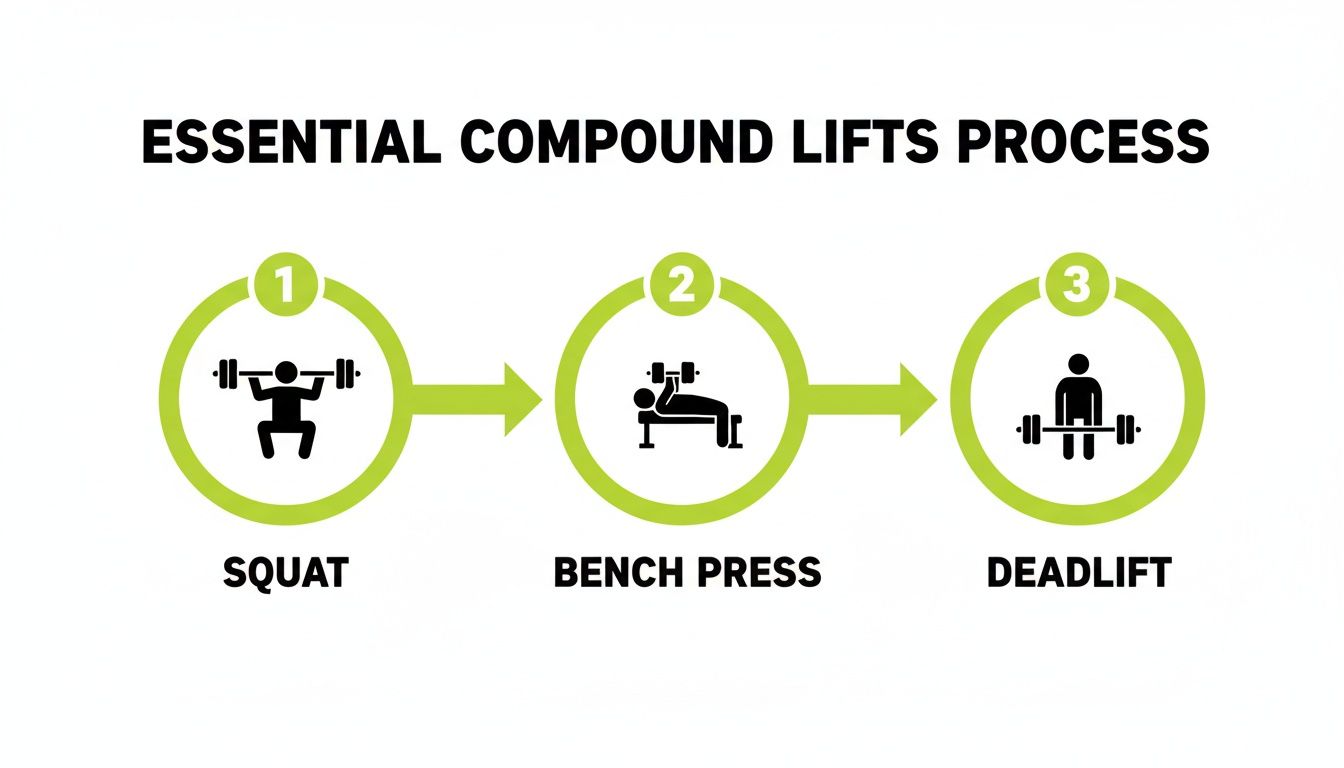
Mastering progression on these key movements will drive the majority of your gains. If you want to dive deeper into form for movements that build a powerful posterior chain, check out our complete guide to back exercises.
Your logbook—whether it’s a notebook or an app—is your roadmap. At a bare minimum, you need to track these four things:
- Exercise Name: The specific movement you performed.
- Weight Used: The load you lifted for each set.
- Reps Completed: How many reps you actually got per set.
- Sets Performed: The total number of working sets.
This data creates your feedback loop. Before every session, you can glance back at your last workout and set a clear, achievable goal for the day. This is where tools like GrabGains' smart tracking really shine. The app logs every detail for you and gives you visual analytics to see your strength gains over time. It even has a 1RM calculator to help you monitor your top-end strength and stay fired up.
Fueling your muscles and optimizing recovery
Your work in the gym is only half the battle. A truly effective muscle-building workout doesn’t end when you put the weights down; that’s actually when the real growth begins.
What you do outside the gym—how you eat, sleep, and recover—is what transforms that effort into actual muscle. Thinking you can out-train a poor diet is one of the biggest mistakes you can make. The food you eat provides the literal building blocks your body uses to repair and rebuild muscle fibers stronger than before.
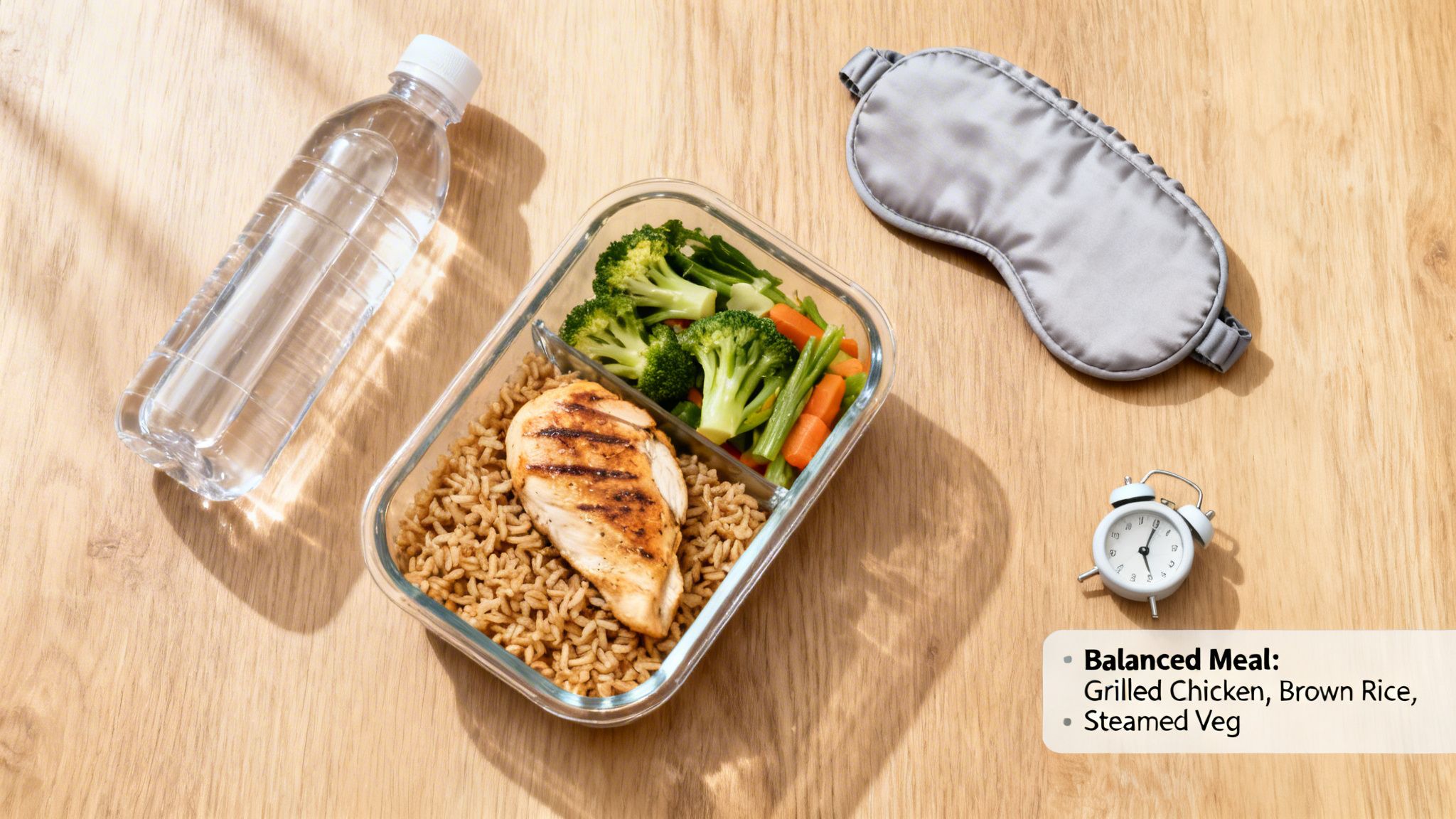
This synergy between training and lifestyle has become undeniable. The virtual fitness market, valued at $16.4 billion in 2022, is booming as more people adopt hybrid routines. Data shows a 41% rise in hybrid training between 2020-2022, leading to better muscle growth results.
Despite this, only 29.3% of U.S. adults are doing enough strength work, showing a huge gap between goals and execution. If you're curious about how digital trends are shaping physical activity on globalwellnessinstitute.org, it's worth a read.
Getting your macronutrients right
Let’s simplify nutrition. To build muscle, you need to focus on three key macronutrients: protein, carbohydrates, and fats. Each one plays a vital role.
- Protein: This is the most crucial nutrient for muscle repair and growth. Aim for 1.6 to 2.2 grams of protein per kilogram of body weight (or 0.7 to 1.0 grams per pound). Think chicken, fish, eggs, and legumes.
- Carbohydrates: Carbs are your body’s primary energy source, fueling your intense training sessions. They also replenish glycogen stores post-workout, which is critical for recovery. Stick to complex carbs like oats, brown rice, and sweet potatoes.
- Fats: Healthy fats are essential for hormone production, including hormones like testosterone that are critical for muscle growth. Good sources include avocados, nuts, seeds, and olive oil.
You don't need to get overly complicated with nutrient timing. A simple strategy that works wonders is to have a balanced meal with protein and carbs 1-2 hours before your workout, and another one within 1-2 hours after you finish.
The non-negotiables of recovery
Recovery is where your body cashes in on your hard work. Skimping on it is like making a deposit at the bank but never letting the interest compound. You’re just leaving gains on the table.
There are two things that are absolutely non-negotiable for anyone serious about building muscle.
- Prioritize Sleep: This is your body's prime time for repair and growth hormone release. Aim for 7-9 hours of quality sleep per night. Consistently falling short will sabotage your recovery and limit your results, no matter how hard you train.
- Stay Hydrated: Your muscles are about 75% water. Even slight dehydration can mess with your performance, strength, and recovery. Drink water consistently throughout the day, not just when you're thirsty at the gym.
Tools like the macro calculator inside the app can be a massive help here. It takes the guesswork out of your nutrition, giving you personalized targets that align with your specific muscle-building goals and ensuring your efforts in the kitchen fully support your work in the gym.
Common questions about building muscle
Even with a great plan, you're going to have questions. Everyone does. Let's tackle some of the most common ones that come up when people get serious about building muscle, so you have clear, straightforward answers to keep you moving forward.
How long does it take to see results?
This is the big one, isn't it? While you'll probably feel stronger within a couple of weeks as your nervous system gets more efficient, seeing actual muscle growth takes a bit longer.
Most people start noticing visible changes in muscle size within 8-12 weeks of consistent training. And "consistent" is the magic word here—that means getting your workouts in 3-4 times a week and dialing in your nutrition. It’s a marathon, not a sprint.
How much protein do I really need?
Protein is literally the raw material your body uses for muscle repair, so getting enough is non-negotiable. For anyone actively trying to build muscle, a solid, evidence-backed target is somewhere between 1.6 to 2.2 grams of protein per kilogram of body weight (or about 0.7 to 1.0 grams per pound).
Try to spread this out over four or five meals during the day. This gives your body a steady supply of amino acids, which helps optimize muscle protein synthesis—the actual process that builds new muscle tissue.
Don’t just get hung up on the total number. Hitting your protein goal every single day is what really gives your body the consistent building blocks it needs to recover and grow from those tough workouts.
Should I train to failure on every set?
Training to failure—pushing until you physically can't squeeze out another rep—is a powerful tool, but it's one you should use sparingly. It generates a ton of fatigue, which can mess with your recovery and tank your performance on later sets and even your next workout.
A much smarter strategy is to train 1-2 reps shy of failure on most of your sets, especially for the big compound lifts like squats and deadlifts. Save that all-out effort for the very last set of a smaller isolation move, like a bicep curl. This way, you get the stimulus for growth without burning your whole system out.
Building muscle versus building strength
They're definitely related, but building muscle (hypertrophy) and building pure strength are slightly different goals that benefit from different approaches. The main difference is your training focus.
- Building Muscle (Hypertrophy): The main goal is to increase the physical size of your muscle fibers. This usually means using moderate weight for a moderate number of reps, typically in the 8-12 rep range.
- Building Strength: Here, the focus is on increasing your ability to produce force. The best way to do that is by lifting heavier weights for fewer reps, usually in the 1-6 rep range.
Any good program will have elements of both. If you're looking to build a powerful lower body, you can find a complete list of effective leg movements and instructions on how to perform them.
Ready to stop guessing and start building? GrabGains takes these proven training principles and turns them into a smart, adaptive plan built just for you. Get personalized workouts, track your progress, and see real results. Download GrabGains on iOS or Android today and start training smarter.
Get inspired and motivated