Not getting stronger in the gym? How to break through plateaus
Not seeing gains? Discover why you're not getting stronger gym and follow a practical, science-backed plan to break plateaus and start progressing. Hitting a wall with your training is one of the most frustrating parts of being in the gym. When you find you're not getting stronger, it almost always boils down to a problem in one of three areas: your training program, your recovery, or your nutrition. Figuring out which one is holding you back is the key to finally breaking through that plateau and seeing progress again.


Stuck in a rut? Why your strength progress has stalled
We’ve all been there. You show up for every workout, you put in the effort, but the numbers on the bar just refuse to go up. That feeling of stagnation is a normal part of lifting, but it’s also a sign that whatever you're doing has stopped working.
Just grinding through the same old routine and hoping for a different outcome is a recipe for burnout. The good news? Strength plateaus are almost always fixable. The problem usually isn’t a lack of effort—it’s a mismatch in your strategy.
Pinpointing the cause of Your plateau
Before you tear up your entire program, you need to do a quick diagnostic check. Are you actually recovering from your workouts? Are you eating enough food and protein to fuel muscle repair? An honest "yes" or "no" here can save you a lot of wasted time.
Built for progress
Take the guesswork out of training
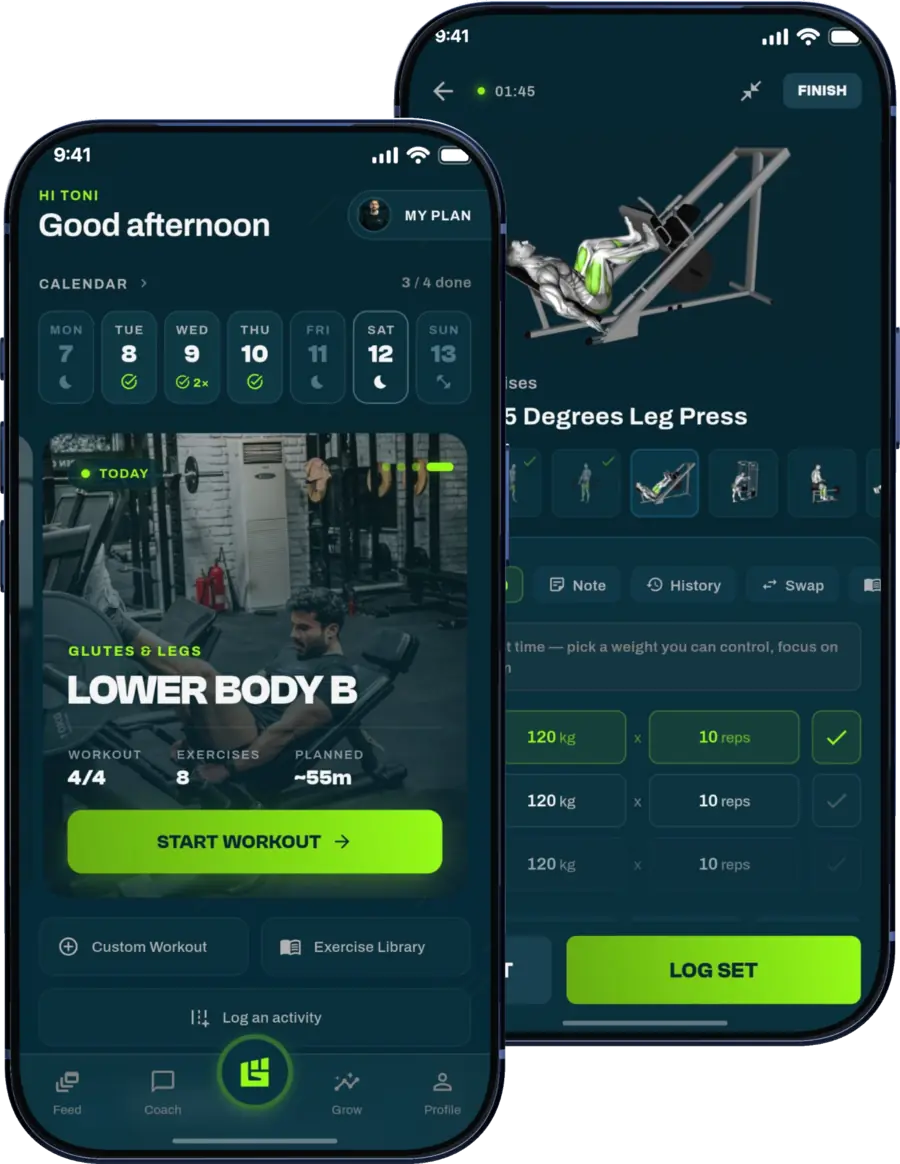
Get a personalized workout plan built around your goal, equipment and schedule. Train smarter, track every rep and keep moving forward, one workout at a time.






A plateau doesn't mean you've hit your genetic ceiling. It just means your body has adapted, and it's time to give it a new, smarter reason to get stronger.
This decision tree is the perfect place to start. It visualizes the very first questions you should ask yourself when the weights feel heavy and progress has ground to a halt.

As you can see, the first two checkpoints have nothing to do with what happens in the gym. More often than not, the solution to a strength stall is found in the kitchen or the bedroom.
Common Mistakes and Strategic Solutions
To give you an immediate action plan, we've laid out the most common reasons lifters get stuck. Use this quick-reference table to identify why you've hit a strength wall and discover the strategic fix for each common problem.
| Common Mistake | The Strategic Solution | Key Takeaway |
|---|---|---|
| Doing the same reps/sets for weeks | Implement a structured progressive overload plan (add weight, reps, or sets). | Progress requires a consistent, measurable increase in demand. |
| Not eating enough calories or protein | Track your intake for a week and ensure you’re in a slight calorie surplus with 1.6-2.2g of protein per kg of body weight. | You can't build new muscle tissue out of thin air. |
| Getting less than 7 hours of sleep | Prioritize 7-9 hours of quality sleep per night for optimal hormone function and muscle repair. | Gains are made during recovery, not just in the gym. |
| Program hopping or no consistency | Stick to a well-designed program for at least 8-12 weeks before making changes. | Your body needs time to adapt and respond to a consistent stimulus. |
| Poor exercise form | Record your main lifts and focus on mastering technique before adding more weight. | Bad form limits force output and increases injury risk. |
| Ignoring deloads or rest days | Schedule a deload week every 4-8 weeks to allow your body and nervous system to recover. | Sometimes, stepping back is the only way to move forward. |
Think of this table as your diagnostic tool. Find the mistake that sounds most like you, and you'll have a clear starting point. In the sections below, we’ll dive deep into the specific strategies that will get you back to hitting new personal records.
Is Your Workout Program Actually Built for Strength?
If you feel like you’re spinning your wheels in the gym—putting in the work but not getting stronger—it’s time to look under the hood of your training plan. Not all workout programs are created equal. A routine designed for general fitness or muscle size won't build raw strength the same way a dedicated strength program will.
Many lifters accidentally follow hypertrophy-style programs, which are fantastic for building bigger muscles, but then get frustrated when their big lifts stall. The two goals are related, but they need different strategies. If your progress has flatlined, there's a good chance your program’s architecture is the real problem.
Strength vs. Hypertrophy Training: The Key Differences
First, you need to be honest about what kind of training you’re actually doing. Strength training is all about teaching your central nervous system to fire on all cylinders, recruiting as many muscle fibers as possible to produce maximum force. Hypertrophy, on the other hand, is about creating metabolic fatigue and muscle damage to signal growth.
Here’s how that plays out in the gym:
- Rep Ranges: Pure strength lives in the 1-6 rep range. This is the sweet spot for teaching your body to handle maximal loads. Hypertrophy training usually hangs out in the 8-15 rep range to increase time under tension.
- Rest Periods: To lift heavy, you need to recover. Strength work demands long rest periods, often 3 to 5 minutes between sets. This gives your central nervous system (CNS) time to recharge for the next all-out effort. Hypertrophy routines use shorter rests, like 60-90 seconds, to keep metabolic stress high.
- Training Volume: Strength programs focus on high intensity (heavy weight) but often have lower overall volume on the main lifts. A classic 5x5 (5 sets of 5 reps) is a perfect example of a strength-focused setup.
If your workouts are packed with 10-12 rep sets and short breaks, you’re training for size, not maximal strength. There’s nothing wrong with that, but it explains why your one-rep max isn't moving.
A common mistake is chasing "the pump" when your goal is strength. The pump is a sign of metabolic stress, which is great for hypertrophy, but it has little to do with your ability to lift the heaviest weight possible for a single rep.
Building Your Workouts Around Compound Lifts
The absolute foundation of any real strength program is a relentless focus on heavy, multi-joint compound movements. These are the exercises that give you the most bang for your buck, hitting multiple muscle groups at once and letting you move the most weight.
Your primary strength-building lifts should be the big ones:
- Squats (and its variations)
- Deadlifts (conventional, sumo, Romanian)
- Bench Press (flat, incline)
- Overhead Press (barbell or dumbbell)
These lifts belong at the very beginning of your workout when you’re fresh and have the most energy. Isolation work like bicep curls or leg extensions comes later. They are accessories—they support the main show, but they don’t drive overall strength.
For instance, a strength-focused "push" day never starts with cable flyes. It starts with a heavy Bench Press or Overhead Press for multiple tough sets in the 3-5 rep range. Everything after that is just helping you get better at your main lift.
Evaluating Your Training Split and Frequency
Finally, take a hard look at your training split—how you organize your workouts across the week. To get strong, you need to practice the main lifts often. Hitting a movement pattern more than once a week is crucial for motor learning and adaptation. If you only bench press on "chest day," you're leaving a ton of progress on the table.
Consider a split that allows for higher frequency on your big lifts:
- Full Body: Training your entire body 3 times per week. This lets you squat, press, and pull in every session, maximizing your practice on the core movements.
- Upper/Lower: Splitting your workouts between upper and lower body days, usually hitting the gym 4 times a week. This structure lets you train major muscle groups twice weekly.
If you’re stuck on a classic "bro split" where each muscle gets blasted just once a week, it’s almost certainly holding back your strength. Switching to a smarter program can feel like a complete game-changer. You can find proven, evidence-based routines online or use a smart AI workout builder to design a program built specifically for your strength goals, making sure your training architecture is finally set up for success.
Mastering progressive overload beyond Just adding weight
Progressive overload is the golden rule of getting stronger. You have to consistently challenge your body with more than it’s used to, forcing it to adapt. But most lifters get stuck thinking this means only one thing: adding more weight to the bar.
While adding weight is the most straightforward approach, it has a surprisingly short shelf life. If it were that easy, we'd all be hitting world records. Hitting a wall in the gym often means you’ve exhausted this one-dimensional tactic and it's time to open up your toolbox.
Believing you can just keep piling on plates is a fast track to plateaus, frustration, and even injury. Real, sustainable progress comes from training smarter, not just heavier.
Smarter ways to increase training demand
When you can no longer slap another 5 pounds on the bar every week, it doesn’t mean your progress has to grind to a halt. It just means you need to get creative with other variables. These methods still force your muscles and nervous system to get stronger, even if the number on the plates stays the same.
Here are a few powerful ways to keep the gains coming:
- Add More Reps: If you benched 185 pounds for 5 reps last week, your goal this week is to hit 6 or 7 reps with that same weight. Once you can nail 8 reps with perfect form, you’ve earned the right to add weight and drop back to 5 reps.
- Do More Sets: Finished 3 sets of 5 on your squats? Next session, go for 4 sets of 5 with the same load. This bumps up your total training volume, a potent driver for both strength and muscle growth.
- Cut Down Rest Times: Normally rest 3 minutes between sets? Try shaving that down to 2 minutes and 30 seconds. This makes your workout denser and challenges your body’s ability to recover between efforts.
- Perfect Your Form and Range of Motion: Squatting an inch deeper or benching with a more controlled, deliberate path is a form of progression. Nailing your technique with a certain weight makes you functionally stronger and safer in that movement.
Progressive overload is a concept, not just a single action. The goal is to make the work harder over time. How you choose to make it harder is what separates a smart training plan from a frustrating one.
Using advanced overload techniques
Once you've got the basics down, you can introduce more advanced techniques to shock your body out of a stubborn plateau, especially on your main lifts.
One of the best is manipulating your lifting tempo. Instead of just moving the weight, you actively control the speed of each part of the lift. For a bench press, you could try a slow 3-second negative (lowering the bar), a 1-second pause on your chest, and then an explosive press up. This skyrockets your time under tension and builds rock-solid control.
Another great tool is adding paused reps. Pausing at the hardest part of a lift—like at the bottom of a squat or an inch off your chest on a bench press—kills all momentum and forces your muscles to do 100% of the work. This is how you build strength in those "sticking points" that are holding back your next PR.
Structuring progress with periodization
If you're trying everything and still not getting stronger, the final piece of the puzzle might be how you organize your training over weeks and months. This is where periodization comes in. It’s a planned, long-term approach to cycling variables like intensity and volume to sidestep burnout and peak at the right time.
Two common models that work incredibly well are:
- Linear Periodization: This is a simple, effective model where you gradually increase the weight (intensity) while decreasing the reps/sets (volume) over a training block. You might spend a month doing sets of 8, the next month doing sets of 5, and a final month building to heavy sets of 3.
- Undulating Periodization: This model mixes things up more frequently. Within the same week, you might have one heavy strength day (e.g., 4 sets of 3) and one lighter, higher-volume day (e.g., 3 sets of 10). The constant variation keeps your body guessing and is fantastic for breaking through intermediate-level plateaus.
By blending these different overload methods and structuring them with a smart periodization plan, you build a sustainable roadmap for getting stronger. You’ll finally stop the frustrating cycle of adding weight until you fail and start building consistent, intelligent strength for the long haul.
The underrated role of recovery, sleep, and stress
The time you spend grunting under a barbell is only half the battle. The real magic—the part where you actually get stronger—happens when you’re resting.
You don’t build strength in the gym; you stimulate it. The growth, repair, and adaptation all kick in during recovery. If you’re ignoring sleep and letting stress run wild, you're practically guaranteeing your progress will stall.
If your numbers aren't climbing, the problem might not be your workout plan. It's probably what you’re doing in the many hours you spend outside the gym. Your body sees intense training as a major stressor. Without the resources to recover, it simply can’t come back stronger.
How quality sleep builds strength
Let's be clear: sleep is the single most powerful performance-enhancing activity you can do. While you sleep, your body gets to work repairing damaged muscle fibers and, just as importantly, replenishing your central nervous system (CNS). A fried CNS can't generate the force needed for heavy lifts.
During deep sleep, your body also gets busy producing key hormones for muscle growth and repair.
- Human Growth Hormone (HGH): A huge portion of your daily HGH is released during the early stages of deep sleep. This hormone is vital for repairing tissues, building bone, and turning fat into fuel.
- Testosterone: Levels of testosterone, a primary driver of muscle mass and strength, also peak during sleep. If you're consistently sleeping poorly, you can tank your testosterone levels and directly sabotage your strength gains.
Getting less than 7-9 hours of quality sleep per night puts you in a recovery deficit. Your CNS never fully recharges, your hormones are suppressed, and your muscles can't properly rebuild. It's so critical that learning how to recover faster from workouts is a non-negotiable skill for sustainable progress.
The strength-sapping effects of chronic Stress
If sleep is your greatest ally, chronic stress is your worst enemy. When you’re constantly stressed from work, life, or anything else, your body pumps out a hormone called cortisol.
While a little cortisol is fine, chronically high levels are catabolic—meaning they actively break down muscle tissue. High cortisol messes with your body's ability to use glucose, shuts down protein synthesis, and can even lead to more fat storage, especially around your midsection.
Think of cortisol as the anti-strength hormone. It works directly against your goals by telling your body to break down muscle for energy instead of building it. No amount of perfect training can overcome a body that's marinating in stress hormones.
Finding ways to manage stress is non-negotiable. This doesn't mean you need to meditate for two hours a day. Practical stress reduction can be as simple as:
- Taking a 15-minute walk outside without your phone.
- Practicing mindfulness for 5 minutes before bed.
- Scheduling intentional downtime where you do nothing "productive."
The strategic power of a deload Week
Sometimes the best way to move forward is to take a planned step back. That’s the entire idea behind a deload week. It’s a scheduled period of reduced training intensity and volume designed to give your body and mind a complete break from the grind.
A deload is not a week of sitting on the couch. It's active recovery. You still go to the gym, but you might cut your training volume in half or reduce the weight on all your lifts by 40-50%.
The whole point is to let your joints, ligaments, and nervous system fully recover from weeks of accumulated fatigue. After a proper deload, you should come back feeling refreshed, motivated, and often significantly stronger. It’s a proactive strategy to prevent overtraining before it starts, making sure your journey to getting stronger is a marathon, not a sprint to burnout.
Are you fueling your body to actually get stronger?
Your program can be perfect, your recovery dialed in, but if you aren't eating for strength, you're just spinning your wheels. Think of it like trying to build a house without any bricks. No matter how good the blueprint is, nothing gets built.
When your lifts stall, the first and most honest place to look is your plate. You can't forge new, stronger muscle tissue from nothing. It demands calories and protein to rebuild what you break down in the gym. This isn't about some miserable diet; it’s about giving your body the raw materials it needs to adapt.
Calories: The energy for growth
The most basic part of the equation is your total energy intake—your calories. To build muscle and get stronger, your body needs to be in a slight caloric surplus. Put simply, you need to eat a little more than you burn.
This surplus gives you the fuel for tough workouts and, just as important, the energy for the demanding repair process that happens afterward. Trying to get stronger in a calorie deficit is a losing battle for most people. Your body is in breakdown mode, not building mode.
A small, controlled surplus of around 250-500 calories over your daily maintenance is the sweet spot. This is enough to fuel muscle growth without piling on a ton of unwanted body fat.
You can find your maintenance baseline with a quick online calculator, then just add a few hundred calories on top. The real key is consistency. Your body needs that extra fuel day in and day out to support your training.
Protein: The actual building blocks
If calories are the energy, protein provides the literal blocks to build muscle. Lifting weights creates microscopic tears in your muscle fibers. Protein delivers the amino acids needed to patch up those tears, making them bigger and stronger than they were before.
For anyone serious about strength, just "getting some protein" won't do. Research is clear: lifters need way more than the average person to maximize muscle protein synthesis.
A solid target to shoot for is 1.6 to 2.2 grams of protein per kilogram of body weight (or roughly 0.7 to 1.0 grams per pound). For a 180-pound (82kg) lifter, that’s about 126-180 grams of protein every day.
Here are a few practical ways to actually hit that number:
- Build meals around protein: Every single meal—breakfast, lunch, and dinner—should be anchored with a quality source like chicken, fish, eggs, tofu, or Greek yogurt.
- Use smart protein "hacks": A scoop of protein powder in your oatmeal, a few hard-boiled eggs as a snack, or a glass of milk can easily add 20-30 grams.
- Spread it out: Aim for 20-40 grams of protein every 3-4 hours. This keeps a steady stream of amino acids available for your muscles all day long.
Carbs and Fats: The performance fuel
While protein builds the muscle, carbs and fats play critical support roles. A lot of lifters mess this up, cutting carbs or fats too low and then wondering why they feel weak and sluggish in the gym.
Carbohydrates are your body's go-to fuel for high-intensity work. They’re stored in your muscles as glycogen, and when you lift heavy, you burn through it fast. If those stores are low, your performance will tank, and you won’t be able to lift with the intensity needed to trigger new gains.
Healthy fats are just as important, especially for keeping your hormones in a good place. Dietary fats are directly involved in producing hormones like testosterone, a major driver of muscle and strength. Make sure you’re getting them from sources like avocados, nuts, seeds, and olive oil.
To really get this right and bust through a plateau, you need to understand what should my macros be for your specific goals. When you get your protein, carbs, and fats dialed in, you give your body everything it needs to not just perform, but to adapt and come back stronger.
Using data to break through plateaus
If you're not tracking your workouts, you’re training blind. That feeling of being stuck in the gym can often be confirmed—or even disproven—the moment you look at the numbers. Making smart decisions based on what you’ve actually done is the quickest way out of a rut.
You can't fix what you don't measure. A messy notebook or a foggy memory just won't cut it when progress stalls. The goal is to move from "I think I lifted more" to "I know I lifted more," and that shift is fundamental to smarter training.
What you should be tracking
To get a real sense of your progress, you need to track a few key numbers. These metrics tell the real story of your performance and help you spot a plateau long before you feel stuck.
The two most useful metrics are your one-rep max (1RM) and reps in reserve (RIR). Your 1RM is a direct measure of your absolute strength, while RIR helps you manage intensity and effort day-to-day.
- One-Rep Max (1RM): This is the most weight you can lift for a single rep. You don’t need to test it directly all the time—in fact, it’s often safer not to. Instead, you can use a 1RM calculator to estimate it from a tough set of 3-5 reps. Watching your estimated 1RM trend up over time is proof you're getting stronger.
- Reps in Reserve (RIR): This is how you gauge how close you are to failure. After a set, you simply estimate how many more good-form reps you had left in the tank. An RIR of 2 means you stopped but felt you could have done two more clean reps. Tracking RIR ensures you’re pushing hard enough without redlining every single session.
Let tech handle the numbers
This is where a good app becomes your best friend. That old-school notebook can’t analyze your progress or warn you that a plateau is coming. An app like GrabGains turns your raw workout data into clear, visual feedback you can actually use.
Instead of just logging numbers, a smart tracking app does the thinking for you. It might notice your squat progress has slowed for three weeks straight and suggest a change in your volume before you even realize you're stuck.
This kind of technology acts like a coach in your pocket. It takes the performance data you enter—your reps, sets, and weight—and gives you adaptive suggestions to keep things moving. For example, if your bench press 1RM has stalled, it might recommend switching to a new rep scheme or adding a pause to break through your sticking point.
This data-driven approach removes all the guesswork. It makes sure every change you make is based on your own performance history, giving you a clear path forward when you feel like you're not getting stronger in the gym.
Frequently Asked Questions about strength plateaus
We get these questions all the time from lifters who feel like they're spinning their wheels. Let's clear up a few of the most common sticking points.
How Long Should I Stick to a Program Before Changing It?
Give any well-designed program at least 8-12 weeks before you even think about switching. One of the biggest mistakes that kills progress is "program hopping"—jumping from one routine to another without giving your body time to adapt.
Consistency is what drives results. If you've been stuck on your main lifts for 3-4 weeks straight and you know your nutrition and recovery are dialed in, then it might be time to make a change. But not before.
Can I Still Get Stronger While in a Calorie Deficit?
For most people, it's incredibly difficult. If you're brand new to lifting, you might get some "newbie gains" where you build strength and lose fat at the same time. But once you're an intermediate or advanced lifter, a calorie deficit works directly against you.
It's far more effective to pick one goal and stick to it. Dedicate separate training blocks to either cutting fat or building strength. Trying to do both at once usually means you fail at both.
Is It Better to Lift Heavy for Low Reps or Lighter for High Reps?
When your goal is building pure, maximal strength, lifting heavy for low reps wins every time. Training in the 1-6 rep range is what builds the neuromuscular connections you need to produce serious force.
Lifting lighter weights for higher reps, like in the 8-15+ range, is better for building muscle size (hypertrophy). A smart program will almost always include a mix of both, but your heavy, low-rep compound lifts are what will truly drive your strength numbers up.
Ready to stop guessing and start making intelligent progress? GrabGains uses AI to build adaptive workout plans that break through plateaus by adjusting your training based on your actual performance data. Pre-register today to get a plan that evolves with you.
Get inspired and motivated