Your ultimate RPE training guide for smarter gains
Unlock your potential with our RPE training guide. Learn to use Rate of Perceived Exertion for smarter, more consistent strength and muscle growth. This guide gives you a simple framework for using the rate of perceived exertion (RPE) to make every workout count. Instead of just going through the motions, you'll learn to rate the difficulty of each set on a 1-to-10 scale.
This simple tweak lets you instantly adapt your training based on how you actually feel. It’s the key to pushing hard on good days, pulling back when you're beat up, and making consistent progress without burning out.


What is RPE and why is it your secret weapon for training
 Imagine having a real-time effort meter for your body, like a tachometer in a car. That's exactly what RPE, or rate of perceived exertion, gives you. It’s a way to train smarter by listening to your body instead of blindly following rigid numbers that ignore your daily stress, sleep, and nutrition.
When you feel strong and rested, RPE lets you crank up the intensity. On days you feel tired or run down, you can dial it back to focus on recovery while still getting productive work in. This flexible approach is called autoregulation, and it’s what makes RPE training so powerful.
The power of listening to your body
Most old-school training programs are built on percentages of your one-rep max (%1RM). While that system is a decent starting point, it has one massive flaw: it assumes your strength is the same every single day. We all know that’s not true. RPE acknowledges that performance fluctuates.
Built for progress
Take the guesswork out of training
Get a personalized workout plan built around your goal, equipment and schedule. Train smarter, track every rep and keep moving forward, one workout at a time.






RPE is a subjective score you give a set based on how hard it felt. It’s measured on a 1-to-10 scale, where 1 is comically easy and 10 is the absolute hardest physical effort you could possibly give.
The modern RPE system we use in strength training was largely popularized by coaches like Mike Tuchscherer and Bryce Krawczyk. They took the concept and made it practical by connecting it directly to reps in reserve (RIR), which is just a simple way of asking: "How many more reps could I have done?"
This connection makes the subjective feeling of RPE much more objective and actionable.
- An RPE 10 means you had 0 reps left in the tank. You couldn't have done another rep.
- An RPE 9 means you had 1 rep left in the tank.
- An RPE 8 means you had 2 reps left in the tank.
This simple system took off in the 2010s because it gave lifters a way to self-regulate intensity based on how a set actually felt. For many, it made progressive overload far more precise than just sticking to fixed percentages.
Whether you're new to lifting or a seasoned HYROX athlete trying to dial in your performance, RPE is an incredibly effective tool. It creates a universal language for effort that helps you sidestep burnout, make smarter gains, and build a training habit that lasts.
The science behind RPE and how effort drives growth
To really get why an RPE training guide is so useful, you have to understand what actually makes muscles grow. The one principle that underpins all gym progress is progressive overload. This isn't some new fitness trend—the idea goes all the way back to legends like Milo of Croton from ancient Greece around 500 BCE, who supposedly built his strength by carrying a calf every day as it grew into a bull. RPE training just takes that simple concept and turns it into a reliable system for today's lifter.
And while Milo's story is a great way to picture it, modern science backs up the idea that effort-based training just works. A huge 2015 Cochrane review looked at 121 different trials with over 6,700 participants and found that people stuck to progressive resistance programs extremely well, completing over 75% of their workouts. This shows how RPE’s flexibility can keep you more engaged than rigid plans, leading to more consistent gains. You can read the full study on how these programs improve physical function on pmc.ncbi.nlm.nih.gov.
Effort is the primary driver of muscle growth
For years, the common gym wisdom was that the only path to growth was relentlessly adding more plates to the bar. While adding weight is definitely one way to apply progressive overload, it’s not the full picture. The real trigger for muscle growth is high effort—specifically, how close you push yourself to muscular failure.
Think about it: your muscles can’t read the numbers on the plates. They have no idea if you’re lifting 100 pounds or 300 pounds. All they know is the mechanical tension and metabolic stress they’re under. When you take a set close to failure (a high RPE), you force your body to recruit the maximum number of muscle fibers, including the high-threshold motor units that are responsible for the most growth.
The most important signal you can send your body to grow is that it was challenged to its near-limit. A set of 10 reps at RPE 9 is far more potent for hypertrophy than a set of 10 at RPE 6, even if the weight is lighter.
This isn’t just theory; recent research confirms it. A 2022 study that compared different ways of progressing found that as long as the effort was high, both adding reps and adding weight produced similar muscle growth. This drives home the point that how hard you train matters more than the specific load on the bar, which is exactly what RPE helps you manage.
Making every set count toward your goal
The general scientific consensus, often supported by large-scale umbrella reviews, points to 10 or more hard sets per muscle group per week as a solid target for maximizing growth. But there’s a big catch: those sets have to actually be hard enough to count.
This is where an RPE training guide becomes your best friend. If you do 15 sets for your chest but most of them are at an RPE 5 or 6, you’re mostly just spinning your wheels and accumulating "junk volume." You’re going through the motions without giving your muscles a real reason to adapt.
RPE makes sure every working set is a "hard set" by keeping you in that productive intensity zone. By aiming for an RPE of 7-9 on your main lifts, you guarantee that each set is actually contributing to that weekly volume goal. It makes your training far more efficient.
Here’s a simple way to think about how RPE makes your sets count:
- Low RPE (1-4): This is for your warm-ups and active recovery. These sets don't stimulate growth.
- Moderate RPE (5-6): Good for practicing technique or during a deload, but they provide very little stimulus for building muscle.
- High RPE (7-9): This is the sweet spot for hypertrophy. Sets in this range are challenging enough to force adaptation but not so taxing that they ruin your next workout.
- Maximal RPE (10): Reserved for true, all-out max attempts. Use it sparingly to avoid burnout and reduce your risk of injury.
By using RPE, you shift your focus from just moving weight to strategically applying effort. It turns your training from a simple numbers game into a smart, stimulus-focused process, ensuring the work you put in actually leads to the results you want.
RPE vs. RIR vs. percentage 1RM: choosing your method
To get the most out of your training, you need to know how to measure intensity. When you walk into the gym, you have a few ways to decide how heavy to lift: RPE, reps in reserve (RIR), and traditional percentage-based training (%1RM). Let's clear up the confusion so you can pick the right tool for the job.
First off, think of RPE and RIR as two sides of the same coin. They measure the exact same thing, just from opposite directions. RPE asks, “How hard did that feel?” while RIR asks, “How many more reps could you have done?”
They have a simple, inverse relationship that makes it easy to switch between them.
RPE + RIR = 10
This little formula is your key to making RPE feel less like guesswork. If you finish a set and know you could have done two more perfect reps, your RIR is 2. Plug that into the formula, and you know your set was an RPE 8 (because 8 RPE + 2 RIR = 10).
Autoregulation vs. rigid percentages
This is where RPE and RIR really shine. They are tools for autoregulation, which is just a fancy way of saying you adjust your training based on how you feel on that specific day. This flexible approach is a sharp contrast to old-school percentage-based training, where your loads are pre-planned based on your one-rep max (%1RM).
Percentage-based training is straightforward: you test your one-rep max, and your program tells you to lift a certain percentage of it. For example, a workout might call for 5 reps at 80% of your 1RM. It provides a clear, structured path, which is great on paper.
The biggest problem? Its rigidity. It assumes your strength is a fixed number, but we all know performance changes daily depending on sleep, stress, nutrition, and fatigue.
Real-world scenarios: the adaptive advantage of RPE
Let's walk through two common scenarios to see why RPE's flexibility is a game-changer.
Scenario 1: The "Good" Day You slept great, ate well, and feel like a beast walking into the gym. Your program calls for squats at 80% of your 1RM, but the set feels ridiculously light—you could have easily done 4 or 5 more reps. That's an RPE 6. If you stick to the plan, you're not training hard enough to trigger growth. You’re leaving gains on the table.
With RPE, you’d simply add more weight until that set of 5 feels like a true RPE 8, ensuring your effort matches your high energy for the day.
This simple decision-making process is what drives progress. The chart below shows how your effort leads to a fork in the road: growth or stagnation.

As you can see, matching your effort to your daily capacity is non-negotiable for making progress.
Scenario 2: The "Bad" Day Now, let's flip it. You’re running on four hours of sleep after a brutal day at work. Your program again calls for squats at 80%. This time, the weight feels like a ton of bricks, and you barely grind out the last rep. That set was a true RPE 10, an all-out effort.
Forcing yourself to finish the prescribed workout would be a fast track to injury and burnout. Instead, using RPE, you’d lower the weight until it feels like your target RPE 8, turning a potentially disastrous session into a productive one that still moves you forward.
To make the differences even clearer, this table breaks down how each intensity method stacks up.
RPE vs RIR vs percentage 1RM: a comparison
This table breaks down the key differences between RPE, RIR, and %1RM to help you choose the best method for your training goals and experience level.
| Attribute | RPE (Rate of Perceived Exertion) | RIR (Reps in Reserve) | %1RM (Percentage of 1-Rep Max) |
|---|---|---|---|
| Primary Focus | Subjective feeling of effort on a 1-10 scale. | Objective count of remaining reps. | Predetermined load based on a tested max. |
| Best For | Intermediate to advanced lifters who can accurately gauge effort. | Lifters who prefer a more concrete measure than RPE. | Beginners needing structure; peaking phases for powerlifting. |
| Flexibility | High. Adapts daily to your energy, stress, and recovery levels. | High. Also adapts daily, just framed differently. | Low. Rigid and doesn't account for daily performance changes. |
| Main Advantage | Promotes long-term progress by managing fatigue and effort. | Easy to understand and apply; less subjective than RPE. | Provides a clear, objective target for each set. |
| Main Disadvantage | Can be too subjective for beginners; requires experience to master. | Can be tough to estimate accurately on high-rep sets. | Can lead to undertraining on good days and overtraining on bad days. |
Ultimately, each tool has its place, and understanding their pros and cons is what separates smart lifters from those who just follow a spreadsheet.
Choosing your method: a hybrid approach
So, which method is best? For most people, the answer is a smart combination of both.
- Percentage-Based Training: Excellent for beginners who need structure and for specific peaking cycles where hitting certain numbers is the goal.
- RPE/RIR-Based Training: Ideal for the majority of your training. It accounts for daily ups and downs, helps manage fatigue, and ensures every set is productively difficult.
Many advanced programs use a hybrid model. For instance, they might prescribe a main lift using a percentage (e.g., work up to 85% for a single) and then use RPE for the follow-up sets to manage volume and fatigue.
While RPE is a cornerstone of strength training, it’s interesting to see how other disciplines manage intensity. For example, endurance athletes often use FTP training zones to structure their effort, which shares the same core principle of matching output to capacity.
By understanding the strengths and weaknesses of each method, you can start applying them intelligently to optimize your training and unlock consistent, long-term progress.
How to implement RPE in your training today
 Alright, let's move from theory to the gym floor. Swapping out strict percentages for perceived effort can feel a bit strange at first, but it quickly becomes one of the most powerful tools you have for making real, sustainable progress.
The first step is simply learning to be honest with yourself. RPE is a skill, and like any skill, it takes some practice to get it right. After every tough set, just ask yourself: "With perfect form, how many more reps could I have actually done?" That number is your reps in reserve (RIR), and it gives you your RPE.
Calibrating your internal RPE scale
Don't stress about hitting a perfect RPE target from day one. Instead, your first few workouts are all about gathering data. Just train like you normally would, but after each main set, log the weight and reps you hit alongside your best guess at the RPE.
Be brutally honest. If you finished a set of eight but knew you could have ground out two more ugly reps, that's an RPE 8. If you had to drop the bar and couldn't even think about another rep, that's a true RPE 10.
A great way to check your honesty is to film your top sets. The speed of your last rep is a dead giveaway. What feels like an RPE 7 often looks like an RPE 9 on camera, showing you that you've got more in the tank than you think.
This process—perform, rate, and review—is how you fine-tune your internal scale. Within just a few weeks, you'll find your perception of effort gets much sharper, giving you the confidence to start programming with RPE targets.
Progression models using RPE
Once you're comfortable rating your sets, you can use RPE to drive progressive overload in a structured way. Instead of just slapping more weight on the bar, RPE tells you when you're ready to advance. Here are two proven ways to do it.
1. Add Weight When RPE Drops This is a simple and brutally effective method for building both strength and size. You pick a target rep range and RPE, and you only add weight once the effort required to lift it goes down.
- Week 1: Squat 3x5 at RPE 8. You hit it with 225 lbs.
- Week 2: You aim for 3x5 at RPE 8 again. You feel stronger and manage 230 lbs.
- Week 3: A stressful week means 230 lbs feels heavy. You dial it back to 225 lbs to stay at a true RPE 8.
- Week 4: Feeling recovered and strong, that 230 lbs now feels like an RPE 7. That's your green light to jump up to 235 lbs to get back to your target RPE 8.
2. Add Reps at the Same RPE This model is fantastic for hypertrophy because it systematically increases your training volume. You keep the weight the same for a few weeks and just focus on squeezing out more good reps at the same RPE.
- Week 1: Dumbbell Press 3 sets with 70 lbs at RPE 8. You manage 8, 7, and 7 reps.
- Week 2: Still using 70 lbs at RPE 8, you hit 9, 8, and 8 reps this time.
- Week 3: You stick with 70 lbs and get 10, 9, and 9 reps at RPE 8.
- Week 4: Now that you've topped out your rep goal, you earn the right to move up. You grab the 75 lb dumbbells and start the cycle over.
This isn’t just bro-science; adding reps at a fixed load is just as effective for muscle growth as adding weight, as long as the effort is consistently high. Elite lifters have been using these principles for decades. As long as you're hitting 10+ hard sets per week per muscle group, these progression models ensure every single set is pushing you forward.
On top of that, RPE helps you manage fatigue within a workout. When doing your strength training exercises, you can use RPE to adjust the intensity based on how complex the movement is or how you're feeling that day.
Sample workout templates
Here’s what this looks like in practice for both hypertrophy and strength. Notice how the main compound lifts use a slightly lower RPE to manage fatigue, while accessories are pushed closer to failure to maximize the stimulus.
Hypertrophy (Muscle Growth) Workout Example
| Exercise | Sets & Reps | RPE Target |
|---|---|---|
| Barbell Squat | 3 x 6-8 | RPE 8 |
| Romanian Deadlift | 3 x 8-10 | RPE 8 |
| Leg Press | 3 x 10-12 | RPE 9 |
| Leg Extension | 3 x 12-15 | RPE 9-10 |
| Calf Raise | 4 x 15-20 | RPE 9-10 |
Strength Focus Workout Example
| Exercise | Sets & Reps | RPE Target |
|---|---|---|
| Deadlift | 1 x 3-5 (Top Set) | RPE 8 |
| Deadlift | 2 x 5 (Back-off Sets) | RPE 7 |
| Barbell Row | 4 x 6-8 | RPE 8 |
| Lat Pulldown | 3 x 8-12 | RPE 8-9 |
| Face Pull | 3 x 15-20 | RPE 9 |
By using these calibration methods, progression models, and templates, you have everything you need to start using RPE effectively and make smarter, more consistent gains.
Putting your progress on autopilot with smart tools
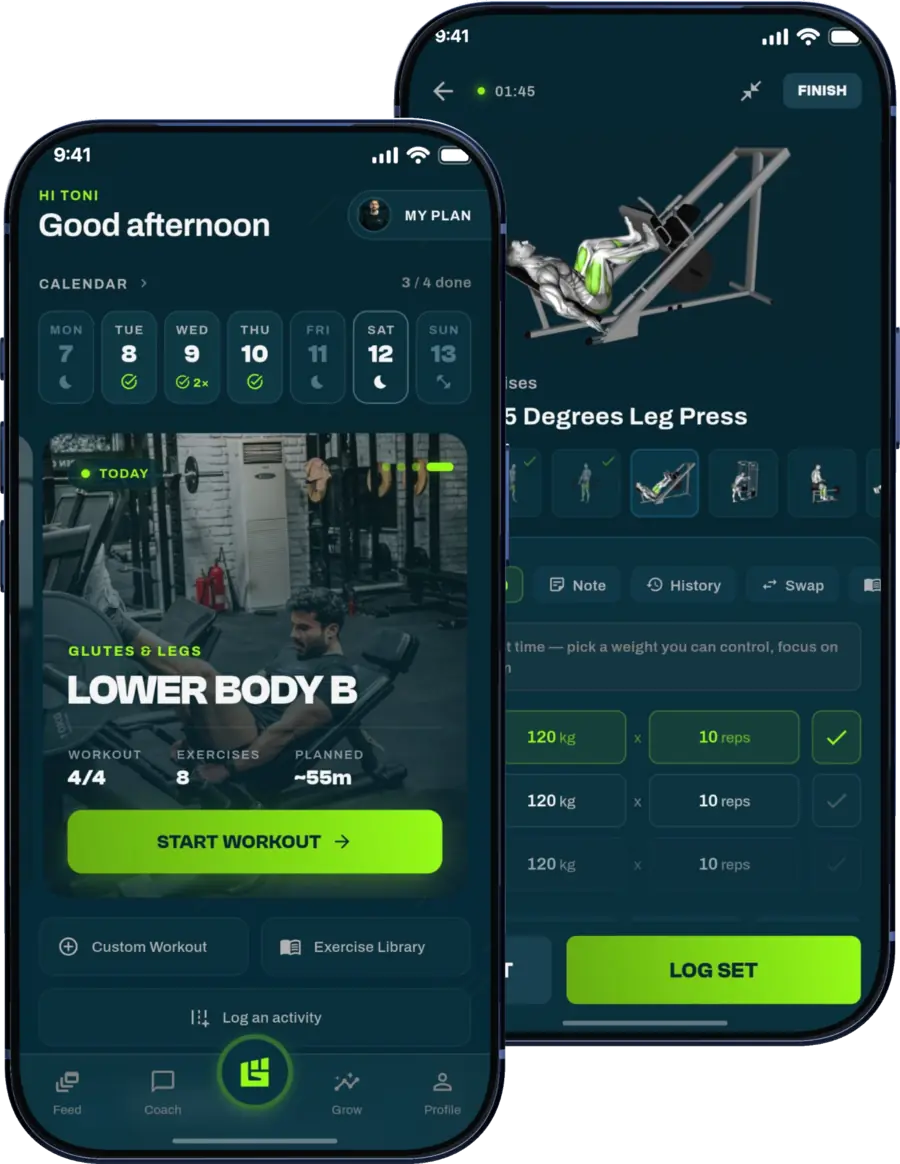
Tracking RPE in a notebook is a tried-and-true method, but let’s be honest—it involves a lot of mental math. What if you could take the guesswork out of your RPE training and let technology handle the number crunching?
Modern fitness apps do just that. They act like a smart training partner that lives in your pocket, taking your subjective RPE ratings and using them to make objective decisions about your next workout. This frees you up to focus on what really matters: giving your best effort on every single set.
How smart apps create adaptive workouts
A truly intelligent app doesn't just record your workouts; it adapts them for you. It uses your RPE feedback to automatically adjust the weights for future sessions. This is autoregulation at its best, handled seamlessly in the background.
Let's say your program has you doing three sets of five on the bench press at a target of RPE 8. You hit all your reps, but after each set, you log an RPE 7. The app’s algorithm sees this and understands you’re getting stronger. Instead of you having to guess how much to jump up next week, the system automatically increases the load for you.
The goal of this technology isn't to replace your judgment. It’s to empower it. The app combines your personal feedback with objective data to build a progression model that's perfectly synced to your body.
It works the other way, too. Feeling drained? If your warm-ups feel heavier than usual and you're logging higher RPEs, the system might suggest dropping the weight for your main sets. This ensures you still get a quality session in without digging yourself into a recovery hole. It’s a responsive approach built for long-term, sustainable progress.
Key features that make RPE training easier
The best training tools do more than just adjust weights. They’re packed with features designed to make RPE training more accurate, convenient, and motivating.
Here are a few of the most valuable features to look for:
- Massive Exercise Libraries: Good form is the bedrock of accurate RPE ratings. An app with video demonstrations for hundreds of exercises ensures your RPE reflects true muscular effort, not just sloppy technique.
- Visual Progress Charts: Nothing beats seeing your hard work pay off. Platforms that track your estimated 1RM, training volume, and RPE trends over time give you a clear visual of how far you've come.
- A Personal Trainer in Your Pocket: The convenience of having an AI workout builder means you get the benefits of expert programming without the high cost. The plan adapts to you, not the other way around.
By bringing these smart features together, today's technology makes a sophisticated method like RPE feel simple and accessible enough for anyone to use.
Common RPE mistakes and how to avoid them
Learning to use RPE is a skill, and like any skill, it takes some practice to get right. It’s an incredible tool for fine-tuning your training, but it’s also easy to fall into a few common traps that can slow your progress.
The good news? These mistakes are easy to spot and even easier to fix. Once you know what to look for, you can steer clear of them and make sure RPE is working for you, not against you.
Letting your ego take the wheel
This is, without a doubt, the biggest mistake lifters make with RPE: ego lifting. It happens when the weight on the bar matters more than your honest effort. You’ll grind out a shaky final rep that was a true RPE 9.5, but you log it as an RPE 8 so you can justify adding more weight next session.
This completely defeats the purpose of autoregulation. You’re essentially forcing your body to work harder than it's ready for, which is a fast track to burnout, mounting fatigue, and a much higher risk of injury.
The Fix: Record your main sets. Seriously. Video is your most honest training partner; it doesn’t care about your feelings. Watch the playback and look at your bar speed on the last couple of reps. If the bar slows to a crawl, you’re almost certainly at a higher RPE than you rated.
RPE is a skill built on honesty. Being truthful about your effort, even if it means lifting less weight on a given day, is what allows for smarter progression over the long haul.
Being too conservative and undershooting
The flip side of the coin is just as common: always playing it too safe. This is a classic trap for lifters who aren’t used to pushing themselves near their limits. They might finish a set with four solid reps left in the tank but call it an RPE 8 because it "felt hard."
Consistently undershooting your RPE means you aren’t training with enough intensity to signal real muscle growth. You’re just racking up "junk volume"—reps that add to your fatigue without contributing much to your progress. You're leaving gains on the table.
The Fix: If you think you might be too conservative, it's time for a reality check. On your last set of a simple accessory exercise—like a bicep curl or leg extension—take it to true technical failure. Go until you can't do another rep with good form. Experiencing what a true RPE 10 feels like will instantly calibrate your internal scale, making your RPE 8s and 9s far more accurate.
Misunderstanding effort across exercises
Another frequent mistake is assuming RPE should "feel" the same for every exercise. The experience of an RPE 9 on a heavy set of three squats is worlds apart from an RPE 9 on a set of 15 lateral raises.
- Compound Lifts: On heavy squats or deadlifts, an RPE 9 is a battle. It comes with massive systemic fatigue and requires serious mental grit.
- Isolation Lifts: For something like lateral raises, an RPE 9 is all about the intense, localized burn in the muscle itself.
If you confuse these two sensations, you’ll likely cut your isolation sets short, missing out on the muscle-building stimulus that comes from high-effort, high-rep training. Using RPE effectively means learning to judge effort based on the unique demands of each movement.
Frequently asked questions about RPE training
Let's wrap up by tackling some of the most common questions that pop up when lifters first start using RPE. Think of this as your quick-start guide for handling specific scenarios and building confidence in the system.
We’ve pulled these questions from real-world concerns that aren't always covered in the main guide, so you have everything you need to start training smarter right away.
How do I find my RPE for a new exercise?
When you’re trying a new movement, the first few sets are all about calibration. Start light, focusing on perfect form.
As you gradually add weight with each set, ask yourself a simple question right after you finish: "How many more reps could I have done with good form?" That number is your reps in reserve (RIR), which you can then translate to RPE (e.g., 2 RIR = RPE 8). Don't stress about getting it perfect on day one—gauging RPE is a skill you develop with practice.
The most important part of finding your RPE is being honest with yourself. It's better to slightly overestimate your RPE than to let your ego rate a set too low. Pushing too hard too soon is a fast track to overtraining.
Can I use RPE for cardio and endurance training?
Absolutely. In fact, the original RPE scale—the Borg Scale—was designed specifically for endurance training. While we've focused on the 1-10 scale for strength, the principle is identical for cardio.
You can rate the difficulty of a run or a HYROX workout on that 1-10 scale to manage your intensity. This helps ensure you’re in the right zone for your goal, whether it’s a long, steady run (RPE 5-6) or grueling high-intensity intervals (RPE 8-9).
What is a good starting RPE for hypertrophy vs. strength?
For hypertrophy (muscle growth), you want to live in the RPE 7-9 range. This means leaving 1-3 reps in the tank on most sets. It’s the sweet spot that provides enough stimulus for growth without generating so much fatigue that it wrecks your next session.
For pure strength, you’ll work across a wider range of intensities. A typical session might look like this:
- Top Sets: Your heaviest set of the day will be challenging, landing somewhere around RPE 8-9.5. This is where you build maximal strength.
- Volume Sets: Your follow-up sets (back-offs) are usually dialed back to RPE 7-8. This allows you to accumulate high-quality reps and build volume without burning out.
This approach lets you push hard on your main lift while managing your overall fatigue with slightly easier volume work.
Ready to take the guesswork out of your RPE training? The GrabGains AI workout builder creates truly adaptive workout plans that use your RPE feedback to automatically adjust your sessions. Stop crunching numbers and start making smarter gains by downloading the app.
Get inspired and motivated