Master Shoulder Press Machine form for strong shoulders
Master your shoulder press machine form with our guide. Learn setup, execution, & common error fixes for bigger, stronger shoulders.
You sit down at the shoulder press machine, grab the handles, and immediately start second-guessing everything. The seat feels a little off. Your elbows might be too far back. The path of the machine doesn’t match the one in your head. That hesitation is common, and it matters more than is often understood.
The shoulder press machine can build strong, rounded shoulders, but only when the setup fits your body and the rep stays honest. Generic cues help, but they only go so far. A machine from one gym chain can feel very different from the one at your office gym or home setup, so good shoulder press machine form starts with learning how to adjust the equipment to you.
Building bolder shoulders starts here
A lot of people treat the shoulder press machine like a plug-and-play exercise. Sit down, move the pin, push the handles, done. That’s usually where progress stalls. When the machine doesn’t fit your shoulder width, arm length, or starting position, your delts stop being the star of the lift. Your traps, wrists, or lower back start helping too much.
Built for progress
Take the guesswork out of training
Get a personalized workout plan built around your goal, equipment and schedule. Train smarter, track every rep and keep moving forward, one workout at a time.






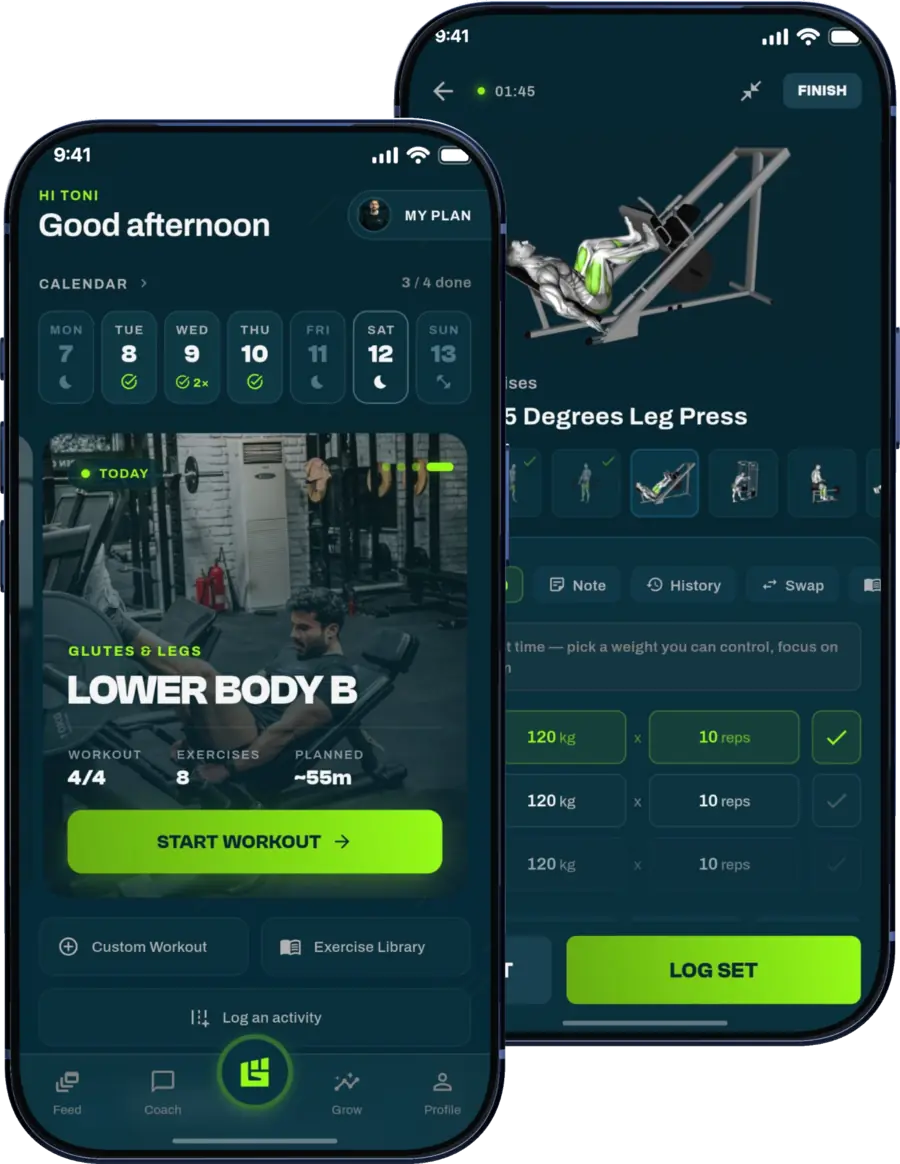

The fix isn’t complicated. You need a repeatable setup, a clear path for the handles, and enough control to keep tension where it belongs. Once that clicks, the machine stops feeling awkward and starts feeling precise.
What most lifters get wrong
Most form issues show up before the first rep. People rush the setup, choose a grip that doesn’t suit their joints, or force their body into a path that the machine wasn’t built for.
That’s why shoulder work improves faster when you understand both exercise selection and execution. If you want a broader view of shoulder training beyond this movement, this expert guide to shoulder muscle is a useful companion.
Good machine work doesn’t mean copying one perfect-looking rep from social media. It means creating a position you can repeat under fatigue without your body shifting to find shortcuts.
What a better approach looks like
Think of this guide as a practical fitting session. You’re not just learning where to put your hands. You’re learning how to judge seat height, how to choose a grip, how to match your body to different machine designs, and how to press in a way that builds muscle instead of irritation.
Use this standard every time you sit down:
- Start position first: If the bottom feels cramped or unstable, the whole set will drift.
- Follow the machine’s path: Don’t force a straight-up press if the machine moves in a slight arc.
- Own the lowering phase: The descent tells you whether you’re training your shoulders or just moving the stack.
Why the Machine Shoulder Press Belongs in Your Routine
You sit down at one shoulder press machine and it feels solid. You try another across the gym and the bottom position feels cramped, the handles sit too wide, and your shoulders do more surviving than pressing. That difference is exactly why this exercise deserves a place in your routine. A machine shoulder press gives you a stable way to train the delts hard, but its primary benefit is learning how to make the machine fit your body instead of forcing your body into one machine design.
The movement mainly trains the anterior and medial deltoids, with the triceps and upper chest assisting. For muscle gain, that matters. More stability usually means more attention can stay on the target muscles, and less effort gets spent controlling the load in space.

Why machines feel different from free weights
Free weights ask you to press and stabilize at the same time. Machines reduce part of that job. Research comparing the two has found that barbell overhead pressing excites stabilizer muscles more than machine pressing (machine shoulder press standards guide).
That is the trade-off.
If shoulder size is the priority, lower stabilization demand can help because fatigue is more likely to come from the pressing muscles you want to train. If you want to build overhead skill, coordination, and full-body control, free weights still have a clear place. Good programming uses both on purpose.
Where the machine shines
The machine shoulder press is especially useful for lifters who want repeatable reps and clearer feedback. The path is more consistent, your position is easier to reproduce, and progress is easier to judge from week to week.
It also gives you a better chance to work around equipment differences. Some machines use a neutral grip. Others fix you into a pronated grip or a slightly arcing path. That does not make one machine right and another wrong. It means you need to know how to match the setup to your structure so the press loads your shoulders without turning the bottom position into a joint complaint.
Here’s where I like it most:
| Use case | Why it works |
|---|---|
| Hypertrophy training | The guided path makes it easier to keep tension on the delts through the set. |
| Technique practice | You can pay attention to joint position, tempo, and control without balancing the load. |
| Training near fatigue | The fixed path lets you push hard with fewer coordination demands than dumbbells or a barbell. |
Practical rule: Use the machine when you want the shoulders to do the limiting. Use free weights when you also want to train stabilization and overhead control.
It earns a place beside free weights
The machine shoulder press is not a lesser version of overhead pressing. It is a different tool with a different job. For many lifters, it is one of the fastest ways to build confidence overhead because the setup is more predictable and the effort is easier to direct into the delts.
That only works if the machine fits you well enough to produce a strong press path. A great set on the right machine can feel smooth and locked in. A poor fit can shift stress into the front of the shoulder, even with perfect effort. The advantage is not just the machine itself. The advantage is knowing how to adjust any machine so your shoulders can train hard and recover well.
Nailing your setup for maximum gains and safety
A shoulder press machine can feel great on one setup and terrible on another, even with the same weight. The difference usually comes from fit. If the machine starts you too deep, too narrow, or too far behind your natural pressing path, your shoulders have to work around the equipment instead of through the exercise.
Set the seat before you touch the weight
Seat height decides your start position. Get that wrong, and every rep starts from a compromised angle.
For most lifters, the handles should sit around shoulder level or slightly below, with the elbows bent about 90 degrees at the bottom. Your forearms should point close to straight up and down. If the seat is too low, the elbows get pulled too far back and the bottom position often feels crowded in the front of the shoulder. If the seat is too high, the press becomes less efficient and the rep can turn into a short, awkward lockout.
Use this quick check before you unrack:
- Take the handles with a light grip: Let the machine settle into your start position.
- Check your elbow depth: Elbows should be under the handles or a little in front, not drifting far behind your torso.
- Look at your forearms: They should be close to vertical from the front and side view.
- Pay attention to the bottom position: If you feel a pinch right away, change the setup before adding effort.
A good setup should feel strong, not stretchy.
Build a stable base so the shoulders can press
Once the seat is set, anchor your body. Sit all the way back into the pad. Put both feet flat on the floor. Brace your trunk enough to keep your ribs from popping up as the set gets hard.
That support matters because the shoulder presses best from a quiet torso. If your low back lifts off the pad or your chest overextends, the body steals motion from the spine to finish a rep the shoulders should handle.
Use these cues:
- Keep your back in contact with the pad: Upper back and low back should stay connected without forcing a hard arch.
- Root your feet: Foot pressure helps keep you from sliding or shifting.
- Keep the chest tall: Good posture helps. Overdoing it usually turns into rib flare.
- Set the shoulder blades lightly: Stable against the pad, not squeezed down as hard as possible.
I usually tell lifters to look for "firm and quiet." If the setup feels tense everywhere, it is probably too forced.
Pick the grip that matches your joints and the machine
Machine design changes grip options. Some machines give you pronated handles, some neutral, and some offer both. The best choice is the one that lets you keep your wrists stacked, your elbows tracking naturally, and your shoulders comfortable through the full rep.
Neutral grip often feels better for lifters with limited shoulder rotation or irritated wrists. A pronated grip may feel stronger on machines that match your structure well and let the elbows press in a clean line. Neither is automatically better. The right answer depends on your build and the path of that specific machine.
Use comfort as feedback, but be specific about it. A grip that feels stable in the wrist and clean at the bottom is usually the better option. A grip that forces your elbows out of position or makes the front of the shoulder feel jammed is a poor fit, even if it looks standard.
Adjust for your body, not the demo model
Machine pressing achieves greater usefulness through adaptability. You do not need every machine to feel identical. You need to know how to make each one work for your frame.
A lifter with long arms often needs a slightly higher seat or a slightly shorter bottom range so the shoulder does not get pulled into a position they cannot control well. A broader lifter may do better with wider handles or a machine that allows a more open elbow path. Lifters with limited shoulder mobility usually benefit from the grip and seat setting that let them start strong without forcing depth they have not earned.
Use these decision points:
- Long arms: Raise the seat a touch if the bottom feels too deep or unstable.
- Broad shoulders: Choose the handle width that lets the elbows move naturally instead of crowding inward.
- Tight shoulders: Use the least restrictive grip and stop the rep where control is still clean.
- Unfamiliar machines: Take one or two warm-up sets to learn the path before loading it hard.
This is real coaching, not perfectionism. Small setup changes can shift stress away from the front of the shoulder and back onto the delts, where you want it.
Save the setup that works
If the machine has numbers, log them. If it does not, remember simple markers like where the seat lines up with your knee or hip.
That habit saves time, but it also improves consistency. When your setup stays the same, it gets easier to judge whether a set felt better because you got stronger or because you sat two clicks higher than last week.
The Perfect rep step-by-step execution
A strong setup gives you the chance to perform a clean rep. Execution decides whether that rep trains the shoulders.

Build tension before the press
Before the handles move, create enough stability to keep your torso from shifting. Feet flat. Core braced. Back on the pad. Head neutral. Shoulder blades set.
Then breathe in and hold enough pressure through your trunk to stay firm as you start the press. This should feel controlled, not frantic.
Press with the machine, not against it
Drive the handles upward along the machine’s natural path. Some machines move nearly straight up. Others travel slightly back. Let the design guide the rep.
As you press, exhale and keep your wrists stacked over your forearms. Bring the arms near full extension, but don’t slam into lockout. The goal is shoulder tension, not joint stress.
What a good top position feels like:
- Arms nearly straight
- Delts still loaded
- Neck relaxed
- No bouncing into the stop
Control the lowering phase
Improper form leads many lifters to waste the exercise. To maximize gains and reduce unnecessary joint stress, control the eccentric by lowering slowly and stopping just short of the stack touching down. Avoid locking out hard at the top as well, since that can shift stress into the joints, as described in this guide to shoulder press machine execution.
A clean lowering phase keeps the rep honest. It also keeps the set harder in the way that helps your shoulders.
Press hard. Lower honestly. If the stack crashes, the machine is doing part of the work for you.
Use a repeatable rhythm
Your breathing and tempo should look almost boring. Inhale before or during the controlled descent. Exhale through the press. Keep every rep close to the one before it.
That’s the standard I want clients to use:
| Phase | What to do | What to avoid |
|---|---|---|
| Start | Brace, set feet, stay tall | Loose torso, rushed unrack |
| Press | Drive smoothly through the machine’s arc | Jerking, chin jutting, shrugging |
| Top | Reach near full extension | Hard lockout |
| Lowering | Return under control and keep tension | Dropping the weight or resting the stack |
What the rep should feel like
A good set loads the front and side delts from start to finish. The triceps will help, but they shouldn’t dominate. Your neck shouldn’t feel like it’s taking over, and your lower back shouldn’t feel like it’s saving the rep.
If the first rep already feels awkward, stop and fix the setup. If the last few reps get ugly only because you’re close to fatigue, that’s normal. There’s a difference between hard work and a rep that changed into a different exercise.
Common Shoulder Press Machine mistakes and how to fix them
A set can look fine on a shoulder press machine and still miss the target. The handles move, the stack rises, and the rep gets counted. Meanwhile the delts lose tension, the neck takes over, or the low back starts doing work it should not be doing.
That is why machine pressing is not just about using good form. It is about fitting the machine to your body so the rep stays in your shoulders instead of drifting somewhere else.
Shrugging through the press
If your shoulders climb toward your ears as you press, the upper traps start taking over. You will usually feel that as neck tension or a pinched, crowded sensation near the top.
Fix the setup before you blame your shoulders. Lower the seat if the handles start too high. Reduce the load if you cannot keep the shoulder blades stable. Then press with a long neck and let the elbows drive the movement. A good rep should feel hard in the delts, not stressful in the neck.
Elbows drifting into a bad path
Elbows that flare too far out or slip too far behind the body are a common reason a machine feels awkward. On one machine, a wide grip may feel fine. On another, that same position can push the shoulder into a range your joints do not like.
Use the machine you have, not the one you wish you had. Set the seat so the handles line up around chin to nose height, then check your elbow path on the first few reps. The forearms should stay close to vertical, with the elbows under or slightly in front of the handles. If the machine still feels rough, shorten the range a little and stay in the portion you can load without pain.
Pressing errors usually start with a poor fit between your body and the machine.
Turning it into a low back exercise
Heavy sets often bring this out fast. The ribcage lifts, the lower back arches harder, and the torso turns the press into a full-body effort.
That changes where the stress goes. Instead of keeping the load on the shoulders, you start chasing the weight with spinal extension.
The fix is simple, but it takes honesty. Bring the weight down. Keep your feet planted. Brace your midsection before the rep starts, and keep your back in contact with the pad as long as the machine design allows. If you have to arch hard to finish the set, the load is too heavy for the pattern you are trying to train. Lifters using Fully customized workouts should still apply the same rule. The plan matters less than whether the reps stay in the right tissues.
Bouncing or unloading the stack
This mistake hides in a hurry. The lifter drops into the bottom, lets the stack settle, then starts the next rep from a dead reset.
That breaks tension and makes the set easier in the wrong way.
Clean this up with two cues:
- Lower the weight under control instead of letting it fall
- Reverse the rep before the stack fully unloads
You do not need to rush. You need to stay connected to the machine through the whole range. If every rep starts from a bounce, the shoulders get less work and technique falls apart first when fatigue shows up.
Programming the Shoulder Press Machine for Your Goals
Good form gives you a useful exercise. Smart programming turns it into progress.
Hypertrophy comes first for most lifters
For muscle growth, the machine shoulder press works well when you keep the reps controlled and take sets close to failure without letting technique collapse. For hypertrophy, a controlled 2 to 3 second eccentric matters, and 3 to 4 working sets in the 6 to 12 rep range is a practical target, as covered in this shoulder press machine form article.
That prescription works because it balances enough volume for growth with enough control to keep the exercise looking like a shoulder press.
A simple hypertrophy template:
| Goal | Sets | Reps | Notes |
|---|---|---|---|
| Muscle growth | 3 to 4 | 6 to 12 | Use a controlled lowering phase and stop when form starts to drift. |
How to use strength and endurance variations
If you’re training for strength, you can work in lower rep sets with heavier loads, but only if your body position stays disciplined. On machines, that means no chasing ugly reps just because the stack still moves.
If you want more muscular endurance, use lighter loads and longer sets while keeping the same technical standards. The biggest mistake in endurance-focused work is letting tempo disappear. The rep still needs shape.
Useful variations include:
- Unilateral pressing: Helpful when one side clearly does more work or when you want more focus on side-to-side control.
- Neutral-grip pressing: A solid choice when you want a more joint-friendly pressing pattern.
- Tempo work: Slowing the eccentric can clean up execution and make lighter loads more productive.
Match the movement to your training system
The shoulder press machine works best inside a plan that adjusts based on your recovery, performance, and available equipment. If you want that handled for you, Fully customized workouts can organize exercise selection, progression, and training goals in one place.
Keep the machine press early enough in the session that your shoulders can still produce quality reps. Then support it with lateral raises, rear-delt work, or upper-body pressing that fits your larger program.
A simple progression rule
Don’t rush to add weight every session. Add reps first if the machine uses large jumps. Increase the load when all planned sets reach the top of your rep range with the same setup and the same rep quality.
That’s slower than ego lifting. It’s also how shoulders improve without your form falling apart.
The Takeaway Your Blueprint for Shoulder Success
Strong shoulders come from repeatable reps, not random effort. The shoulder press machine works best when you fit the machine to your body, keep your torso stable, and control the entire rep instead of racing through it.
The biggest change most lifters need isn’t motivation. It’s precision. Set the seat properly. Choose the grip your joints tolerate best. Press along the machine’s path. Lower the weight under control. Fix mistakes as soon as they show up.
That approach builds more than better-looking delts. It gives you a dependable press you can use in almost any gym, on almost any machine, without guessing every time you sit down. Train that way and your shoulder press machine form becomes a tool for progress, not a source of doubt.
GrabGains helps you train with more structure and less guesswork. If you want a practical way to build workouts around your goals, track performance, and keep exercise form consistent from session to session, GrabGains is worth exploring.
Get inspired and motivated