Your ultimate strength and hypertrophy program blueprint
Build a strength and hypertrophy program that delivers serious results. This guide breaks down the science, exercises, and splits to build muscle and power.


If you want to build a physique that’s as strong as it looks, a strength and hypertrophy program is your most direct path. This approach blends heavy, low-rep work with higher-rep, muscle-building volume, hitting both major growth pathways—mechanical tension and metabolic stress—all in the same week.
Forget the old-school thinking that you have to pick one: be strong or look strong. You can, and should, do both.
Marrying strength and size in a single program

Walk into any gym, and you'll hear the same debate. One person swears by heavy sets of five for raw strength. Another preaches high-rep "pump" work for building size. Here’s the secret: they're both right. A well-designed hybrid program doesn't compromise; it intelligently combines these methods.
Built for progress
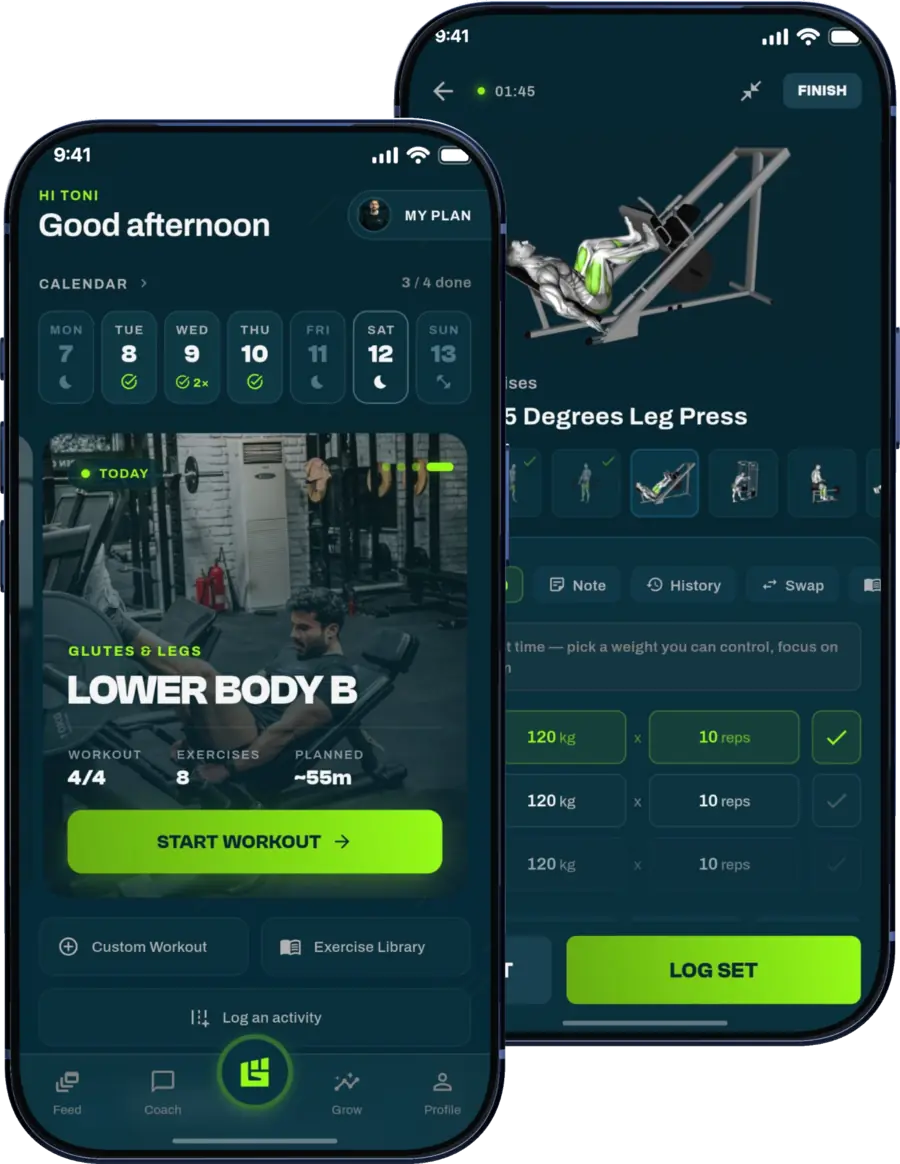
Take the guesswork out of training
Get a personalized workout plan built around your goal, equipment and schedule. Train smarter, track every rep and keep moving forward, one workout at a time.






This style of training, often called "powerbuilding," is built on a simple truth: getting stronger is a primary driver of long-term muscle growth. When you dedicate time to heavy lifting, you're improving your nervous system's ability to recruit muscle fibers. That enhanced neural drive pays off when you switch to your hypertrophy work, allowing you to lift heavier weight for more reps and creating a powerful cycle of progress.
The synergy between heavy lifting and volume training
Think of it like this: your strength work builds your engine’s horsepower, while your hypertrophy work expands the size of the engine itself. One makes you more efficient at producing force; the other gives you more muscle mass to produce that force with.
This is achieved through a strategy called concurrent periodization, which is just a formal term for training both strength and size within the same week. A leg day, for instance, might start with heavy squats for sets of 3-5 reps, then shift to leg presses, lunges, and extensions for sets of 8-15 reps.
- Strength focus (low reps, high intensity): This is where you build raw power. It primarily targets myofibrillar hypertrophy and neural adaptations, making you ruthlessly efficient at moving heavy loads.
- Hypertrophy focus (moderate reps, high volume): This is what builds visible size. It focuses on sarcoplasmic hypertrophy and metabolic stress, increasing the fluid volume in your muscle cells and creating that full, "pumped" look.
This dual-focus approach is no longer niche; it’s becoming the gold standard for serious lifters. The numbers back it up, with the global strength training equipment market valued at $12.88 billion in 2022. This boom reflects a massive shift toward structured programs that deliver real results. You can discover more insights on the expanding strength equipment market and its drivers.
The core idea is simple: getting stronger on your main compound lifts creates the potential to use heavier loads for more reps on your other exercises. That's what fuels muscle growth over the long term.
For a quick breakdown, here’s how the two styles compare.
Strength vs. hypertrophy at a glance
This table gives you a quick reference for the core training variables. Use it to understand the key differences in programming focus.
| Training Variable | Primary Focus: Strength | Primary Focus: Hypertrophy (Size) |
|---|---|---|
| Intensity (% of 1RM) | 85-95%+ | 65-85% |
| Rep Range | 1-5 reps | 6-15+ reps |
| Primary Growth Driver | Mechanical Tension (heavy load) | Metabolic Stress & Muscle Damage |
| Total Volume (Sets x Reps) | Lower to Moderate | Moderate to High |
| Rest Periods (between sets) | 2-5 minutes | 60-90 seconds |
| Main Goal | Increase maximal force production | Increase muscle cross-sectional area (size) |
| Key Adaptation | Neural (efficiency) & Myofibrillar | Sarcoplasmic (cell volume) & Myofibrillar |
Understanding these differences is the first step to combining them effectively in your own training week.
Setting the stage with the right variables
To build your own hybrid program, you need to know how to manage three main variables: intensity, volume, and frequency.
- Intensity: This is simply how heavy you're lifting, usually measured as a percentage of your one-rep max (1RM). For strength, you'll be working in the 85-95% 1RM range. For hypertrophy, you'll work mostly in the 65-85% 1RM range.
- Volume: This is your total workload, calculated as sets x reps x weight. Hypertrophy training is almost always higher in total volume than pure strength work.
- Frequency: This refers to how often you train a muscle or movement pattern each week. Most successful hybrid programs hit each muscle group twice a week—once with a strength focus and once with a hypertrophy focus.
By adjusting these variables, you create a program that systematically drives progress in both strength and size.
The unbreakable principles of smart programming

A good strength and hypertrophy program isn’t just a random list of exercises. It’s a blueprint built on a few core principles that separate aimless gym-goers from lifters who make real, predictable progress.
The most important of these is progressive overload. This is the foundation of every gain you’ll ever make. To get bigger and stronger, you have to consistently challenge your body to do more than it’s used to.
You can apply it in several ways:
- Lifting heavier (intensity): Gradually increasing the weight on your lifts.
- Doing more reps: Hitting more repetitions with the same weight.
- Adding another set: Increasing your total work volume.
- Improving your technique: Making each rep cleaner and more controlled.
- Decreasing rest time: Doing the same amount of work in less time.
The secret is to focus on small, consistent improvements. Trying to jump up too fast can lead to burnout or injury.
Matching your training to your goals
Next is specificity. Your body adapts specifically to what you ask it to do. If you want to get stronger at squats, you have to squat. If you want bigger biceps, you need to do curls.
For a hybrid program, this means your workouts must serve two purposes. You’ll need heavy, low-rep compound lifts to build strength. You’ll also need higher-rep isolation and accessory work to accumulate the volume required for muscle growth. This ensures you’re not leaving any gains on the table.
A huge mistake is chasing variety just for the sake of it. Find the exercises that give you the most bang for your buck and focus on getting brutally strong at them. Real progress comes from mastering the basics.
The art of volume, intensity, and frequency
Think of these three variables as the dials on your program. Getting the balance right is everything for managing fatigue and making steady progress.
- Volume is your total workload (sets x reps x weight). It’s the main driver for hypertrophy.
- Intensity is how heavy you’re lifting (% of 1RM). This is the key driver for strength.
- Frequency is how often you train a muscle group. Hitting each muscle twice per week is the sweet spot for most people in a combined strength and hypertrophy program.
This isn’t just anecdotal advice; the data backs it up. Research shows that well-designed hypertrophy plans with 3-4 weekly sessions and 10-20 sets per muscle can produce size increases of 0.5-1% weekly. At the same time, dedicated strength blocks can boost force output by 10-15% in just 12 weeks.
This focus on data-driven training is why the weight training market is projected to see significant growth. You can explore more about the trends driving this market expansion and see how personalization is playing a key role.
Managing fatigue and using auto-regulation
Finally, you have to learn how to recover. Your muscles don’t get bigger in the gym—they grow when you rest and eat. Pushing too hard for too long without enough recovery will bring your progress to a stop.
This is where auto-regulation comes in. It’s a term for listening to your body.
If you walk into the gym feeling beat up, it’s a good idea to dial back the weight or cut a set. On the flip side, on days you feel great, you have a green light to push a little harder. This flexible approach is what turns you from a rigid program-follower into a smart, resilient lifter.
Structuring your hybrid training week
Now for the fun part: mapping out your actual training week. A good hybrid program is a smart schedule designed for both intense lifting and solid recovery.
The most effective splits for building both strength and size usually have you hitting each muscle group twice a week. This gives you one day to go heavy and build raw strength, and a second day to rack up volume and chase muscle growth. The Push/Pull/Legs (PPL) and the Upper/Lower split are two of the most effective approaches.
The flexible push pull legs split
The Push/Pull/Legs split is a classic for good reason. It organizes your training by movement pattern.
- Push day: Chest, shoulders, and triceps.
- Pull day: Back and biceps.
- Leg day: Quads, hamstrings, glutes, and calves.
This grouping minimizes muscle overlap, which is great for recovery. To make it a hybrid program, you could run the split twice over six days. Your first push day might be built around a heavy bench press for strength, while the second would focus on higher-rep dumbbell presses and flyes for hypertrophy.
However, a six-day training week is a big commitment. A more manageable option is a four-day "rolling" PPL split, where you just do the next workout in the sequence on your scheduled gym days.
A quick tip: always put your main strength lift first. Tackle your heaviest compound movement right after warming up. This is when your energy and focus are at their peak, which is critical for moving big weights safely and making strength progress.
The efficient upper lower split
If you can consistently hit the gym four days a week, the Upper/Lower split is arguably the most efficient way to run a hybrid program. It’s a perfect blend of intensity and volume.
The logic is simple: two upper body days and two lower body days. You dedicate one of each to strength and the other to hypertrophy.
- Upper body strength: Start with a heavy press (like bench) and a heavy row.
- Lower body strength: Build the session around heavy squats or deadlifts.
- Upper body hypertrophy: Use moderate weight for higher reps on various presses, rows, and isolation work.
- Lower body hypertrophy: Focus on volume with moves like leg presses, lunges, and curls.
This separation makes it easy to go all-out on your strength days. For many lifters, this split hits the sweet spot between training frequency and recovery. If you want to take the guesswork out of planning, you can use a quality AI workout builder to map out a schedule that fits your life.
Sample 4-day upper/lower hybrid split
To show you what this looks like in practice, here’s a simple template for a 4-day hybrid split. Notice how the rep ranges change between the Strength and Hypertrophy days.
| Day | Focus | Key Lifts | Accessory Rep Range |
|---|---|---|---|
| Day 1 | Upper Strength | Bench Press: 3 sets of 5 reps Barbell Row: 3 sets of 5 reps | 6-10 reps |
| Day 2 | Lower Strength | Barbell Squat: 3 sets of 5 reps Romanian Deadlift: 3 sets of 8 reps | 8-12 reps |
| Day 3 | Rest | - | - |
| Day 4 | Upper Hypertrophy | Incline Dumbbell Press: 3 sets of 8-12 reps Lat Pulldown: 3 sets of 10-15 reps | 10-15 reps |
| Day 5 | Lower Hypertrophy | Leg Press: 4 sets of 10-15 reps Lying Hamstring Curl: 3 sets of 12-15 reps | 12-20 reps |
| Day 6 | Rest | - | - |
| Day 7 | Rest | - | - |
This is a solid starting point. Your "key lifts" are where you focus on progressive overload. The accessory work is where you’ll chase the pump and accumulate volume. Remember, this is a blueprint, not a prison. Listen to your body and make adjustments.
Choosing the right exercises for power and size
A program is only as good as the exercises you choose. The best split will fall flat if your exercise selection is poor. To build a powerful physique, you need the right movements.
We can simplify this by organizing exercises around fundamental human movement patterns. This approach ensures you build a balanced, functional body.
Building your foundation with compound lifts
Compound lifts are the "big money" movements of any serious strength and hypertrophy program. These multi-joint exercises recruit massive amounts of muscle, trigger a powerful hormonal response, and are the primary drivers of true strength.
Your strength-focused days should be built around these core lifts. They provide the mechanical tension necessary to force your muscles to get stronger.
Here are the essential movement patterns and their flagship compound exercises:
- Squat: The king of lower body strength. The barbell back squat is the standard.
- Hinge: Builds your entire posterior chain. The conventional deadlift is the ultimate test of strength.
- Horizontal push: For chest, shoulder, and tricep power. The barbell bench press is a classic.
- Vertical push: For building powerful shoulders. The overhead press (OHP) is your primary tool.
- Horizontal pull: This builds a thick, dense back. Barbell rows and dumbbell rows are go-to options.
- Vertical pull: This builds back width. Pull-ups are the gold standard, with lat pulldowns as a great alternative.
These six movements should form the backbone of your training. Your goal is to get progressively stronger at them over time.
Sculpting muscle with isolation exercises
After your heavy compound lifts, it's time to shift focus. Isolation and accessory exercises are where you add targeted volume and bring up lagging body parts.
The logic is simple: Start workouts with heavy, low-rep compound lifts to maximize mechanical tension. Finish with higher-rep isolation work to induce metabolic stress. This one-two punch is the secret to an effective powerbuilding routine.
For example, after a heavy bench press for sets of 5, you might do incline dumbbell presses for sets of 10-12, followed by cable flyes for 15-20 reps.
Here are some top-tier isolation moves to complement your compounds:
- For shoulders: Lateral raises are essential for building that wide, 3D look.
- For biceps: Any curl variation will work.
- For triceps: Skull crushers and cable pushdowns are perfect for targeting all three heads of the triceps.
- For quads: Leg extensions are unmatched for isolating the quadriceps.
- For hamstrings: Leg curls are crucial for balanced leg development.
Maintaining form under fatigue
One final tip: form on your accessory work matters. It’s easy to get sloppy when you’re tired, but that’s when focused, quality reps count most. Don't sacrifice technique for more weight. Choose a load you can control, focusing on the mind-muscle connection.
Fueling your body for growth and recovery
The time you spend under the bar is just the signal. The real gains are built outside the gym. Your effort in the weight room is only half of the equation; the other half is won in the kitchen and while you sleep.
Getting your nutrition and recovery dialed in is what turns hard work into actual results.
The foundation: calories and protein
To build new muscle, your body needs a caloric surplus. For lean growth, a small surplus of 250-500 calories above your daily maintenance is the sweet spot. It provides just enough raw material to build muscle without significant fat gain.
Beyond calories, protein is your most important macronutrient. Understanding how much protein you need is fundamental. Aim for 0.7-1.0 grams of protein per pound of body weight each day. This gives your body the building blocks it needs for repair and growth.
The role of carbs and fats
Carbohydrates and fats are essential fuel. Carbs are your body's go-to energy source for high-intensity lifting. Fats play a huge role in hormone production, including testosterone.
- Carbohydrates: Fuel your workouts. Get them from complex sources like oats, brown rice, and potatoes.
- Fats: Support hormones. Focus on healthy sources like avocados, nuts, and olive oil.
A balanced intake ensures you have the energy for your strength sessions and the hormonal support for recovery.
Recovery beyond just sleep
Getting 7-9 hours of quality sleep every night is non-negotiable. There's no supplement that can replace it. But your strategy shouldn't stop there.
Recovery isn't passive. It's an active process. You can't train hard, eat poorly, sleep four hours, and expect to build muscle. Respect the recovery process as much as the training itself.
Consider these smart recovery tactics:
- Active recovery: On off days, a light walk or stretching can boost blood flow to sore muscles.
- Deloads: A planned deload every 4-8 weeks is essential for avoiding burnout.
- Stress management: High cortisol (the stress hormone) can interfere with muscle growth. Make time for activities like meditation or reading to keep stress in check.
This holistic view is becoming more data-driven. The weight training market is projected to reach $23.76 billion by 2030, fueled by smart technology. Today, around 30% of trainees use fitness wearables to track metrics that influence recovery and performance. You can find more details on the weight training market's growth and see how tech is shaping modern fitness.
Tracking your lifts and busting through plateaus
You can have the best strength and hypertrophy program, but if you aren't tracking what you do, you're just exercising—not training. Tracking your performance separates people who make steady, long-term gains from those who get frustrated.
It’s how you turn gym sessions into usable feedback. The key is to monitor the metrics that tell the story of your progress.
Key metrics to keep an eye on
Start with a few simple data points. A training logbook or an app is all you need. Consistency is more important than complexity.
- Logbook data: This is your ground truth. For every workout, write down the exercises, weight, sets, and reps. Over time, this log becomes proof of progressive overload.
- Estimated 1-rep max (e1RM): Use a reliable e1RM calculator with your top working sets to see your strength trending upward without the risk of a true max-out day.
- Total weekly volume: This is a great indicator for hypertrophy. Multiply sets x reps x weight for your main lifts. Seeing this number climb is a strong sign you're doing enough work.
- Body measurements and photos: The scale doesn't know the difference between fat and muscle. Every 4-6 weeks, take circumference measurements. Progress photos will show you changes numbers can't.
Progress is never a straight line. You'll have great days and bad days. The point of tracking isn't to see every number go up every session—it's to see a clear upward trend over months.
How to break through training plateaus
Everyone hits a plateau. Your lifts stall, and motivation drops. This is normal. It’s a signal that your body has adapted and needs a new challenge. When your numbers flatline for two or three weeks, it’s time to make a change.
Here are a few strategies for reigniting progress:
- Introduce a novel stimulus: If your barbell bench press has stalled, swap it for an incline press for a 3-4 week block. Changing the angle or grip is often enough to spark growth.
- Change up your rep scheme: Been grinding in the 3-5 rep range forever? Try a phase of training focused on sets of 6-8. If you've only done high-rep work, a strength block can build a new foundation of power.
- Take a strategic deload: Often, you're stuck because of accumulated fatigue. A deload week—training at around 50-60% of your usual intensity—gives your body a break, allowing you to come back stronger.
Common questions on hybrid training
When you're combining strength and hypertrophy training, a few common questions always pop up. Here are straight answers to help you stay on track.
How often should I deload?
A good rule of thumb is every 4-8 weeks. But the best guide is your body. You'll know it's time when your joints feel cranky, motivation drops, and warm-ups feel heavy. When that happens, take the deload.
A deload isn’t a vacation. You can still follow your routine, just drop the intensity and volume to around 50-60%. This keeps the habit going while giving your body the break it needs.
Can I do cardio with this program?
Yes, but be smart about it. Your lifting sessions come first. Two or three low-to-moderate cardio sessions a week is the sweet spot. A 20-30 minute incline walk or steady-state bike ride works perfectly. Just avoid high-intensity interval training (HIIT) on heavy leg days.
What if I miss a workout?
Don’t sweat it. If you miss one workout, pick up where you left off on your next training day. Consistency over the long haul beats short-term perfection. If you miss a few sessions, be smart on your first day back. Drop the weight or volume a bit to ease your body back into it.
Ready to stop guessing and start building a truly personalized strength and hypertrophy program? The GrabGains AI workout builder creates adaptive routines that evolve with you, ensuring you're always on the fastest path to your goals. Pre-register today and be the first to train smarter.
Get inspired and motivated